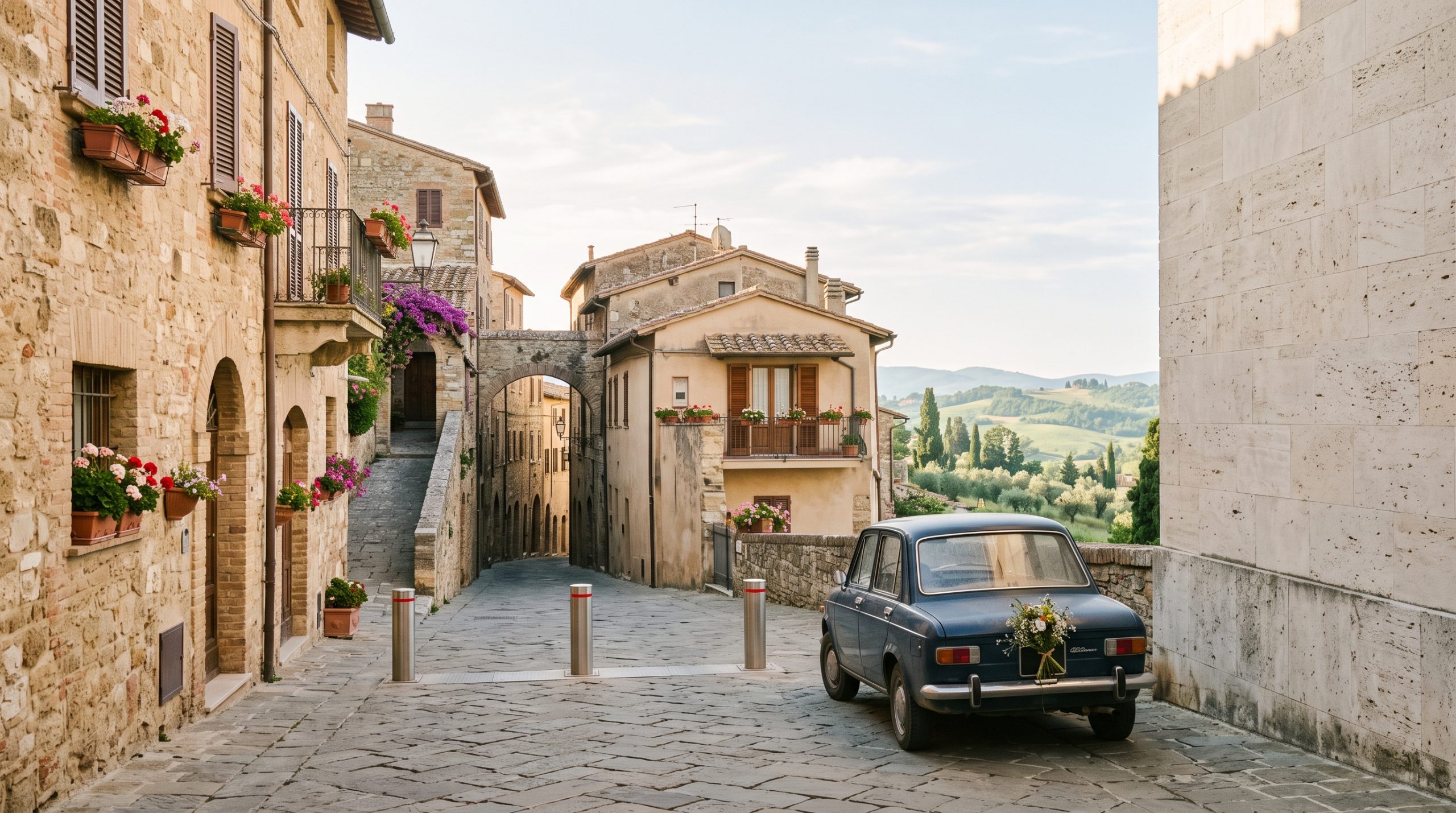
The first thing that happens on an Italian elopement morning is a drive. Not the ceremony, not the vows, a drive, usually in the dark, usually in a rental car whose plate nobody has registered anywhere. In Rome that drive into the historic center is completely legal until 6:30am. In Florence it is legal until 7:30. Those two numbers shape an Italian elopement day more than any location list will.
ZTL stands for zona a traffico limitato, a limited traffic zone. Towns and cities use them to keep non-resident cars out of historic centers during the hours the center belongs to people on foot. Nobody waves you down. Cameras sit at every gate, reading every plate, matching it against a permit database, whether or not anyone is watching.
The useful part, and the part couples rarely hear, is that the hours we want are almost always the hours the zone is asleep. A ZTL is not a wall around your ceremony. It is a timetable, and it is published.
Why your start time matters more than your route
A ZTL is a camera-controlled zone in an Italian historic center. Rome’s Centro Storico gates go live at 6:30am on weekdays and Florence’s at 7:30am, and Florence lifts its zone entirely on Sundays and public holidays. Start inside those quiet windows, or have a hotel or a licensed driver register your plate, and the driving stops being a problem.
Rome at 6:30, Florence at 7:30, and Sunday off
Rome runs several zones with different clocks, and they do not agree with each other. The Centro Storico zone is closed to unauthorized vehicles from 6:30am to 6pm Monday to Friday, and from 2pm to 6pm on Saturday. The Tridente, the wedge of streets around via Condotti, runs longer: 6:30am to 7pm on weekdays and from 10am on Saturday. Public holidays are open. There are separate night zones too, with the central one live from 11pm to 3am on Friday and Saturday nights, and Trastevere holding its own early-morning restriction and its own late hours.
Florence is simpler and, for a sunrise start, more generous. Sectors A, B and O cover the historic center and are active Monday to Friday from 7:30am to 8pm, and Saturday from 7:30am with a mid-afternoon finish. Sunday is open all day. Across the warm half of the year the city adds a summer night zone from 11pm to 3am on Thursday, Friday and Saturday nights, pulling in two further sectors that are quiet the rest of the year.
| Zone | Cameras live | Open to any plate |
|---|---|---|
| Rome, Centro Storico | Mon to Fri 6:30am to 6pm, Sat 2pm to 6pm | Before 6:30am daily, Saturday morning, public holidays |
| Rome, Tridente | Mon to Fri 6:30am to 7pm, Sat 10am to 7pm | Before 6:30am daily, public holidays |
| Rome, central night zone | Fri and Sat 11pm to 3am | Sunday to Thursday nights |
| Florence, sectors A, B, O | Mon to Fri 7:30am to 8pm, Sat 7:30am to mid-afternoon | Before 7:30am daily, all day Sunday, public holidays |
| Florence, summer nights | Thu, Fri, Sat 11pm to 3am in the warm months | Sunday to Wednesday nights, winter |
Two things follow from that table. A June sunrise ceremony in Rome sits comfortably inside the free window, because the gates are still cold when the light arrives. And a Florence day that begins at 7:15am and a Florence day that begins at 7:45am are not twenty minutes apart, they are on opposite sides of a rule.
One caution that the timetable does not cover. Some streets inside these centers are permanent pedestrian areas rather than timed zones, and those never open to traffic at any hour. If the ceremony spot is on foot-only ground, the drive ends at the nearest legal curb and the last stretch is walked. That is usually a gift rather than a problem, and we build the walking minutes into the timeline the same way we build in the driving ones.
The plate is the permit, and someone has to register it
Access in Italy is attached to a license plate, not to a person, a booking or a good reason. The camera photographs the plate, checks it against the list of authorized vehicles for that zone, and that is the whole transaction. A rental agreement never includes ZTL access, and the notice for an unregistered pass arrives by post long after the trip, usually routed through the rental company, commonly starting around 80 euros and rising in the bigger cities.
There are two clean ways in. The first is your accommodation. A hotel inside the zone can register your plate with the comune in advance, and that permission covers arrival, unloading and parking in an authorized garage. It is not a license to circle the center for an afternoon. You only learn the plate at the rental desk, so the practical move is to photograph it there and send it to the hotel the same day, before you set off toward the city.
The second is to not drive at all. Taxis and licensed service vehicles are authorized categories inside these zones, which is why a local driver books out the problem in one message. For a ceremony morning in a center with tight parking, a car with a driver that can legally stop where you are getting out is worth more than the convenience of your own trunk.
One more thing to sort at home: Italy expects a non-EU license to travel with an International Driving Permit, and rental desks ask to see it. Order it before you fly. It is a translation document rather than a substitute for your own license, it is issued in the country that issued that license, and it cannot be sorted out after you land. We fold this into the checklist we send alongside the planning fundamentals for eloping abroad.
Where the route planner is confidently wrong
A route planner optimizes for distance and traffic. It has no opinion about permissions. Type in a hotel address in the middle of Florence at 9am and it will hand you a clean line straight through sector A, because that genuinely is the shortest way there. The road is open. Open and permitted are different words.
So there are always two numbers on an Italian elopement day: the minutes the map gives you, and the clock the gate keeps. Plan on the second. The gates themselves are signed, a red-bordered circle with the words zona traffico limitato, usually with an electronic panel reading varco attivo or non attivo, and by the time you are close enough to read the panel you are generally committed to the turn. Reading it in advance, at the kitchen table, months out, is far easier than reading it through a windscreen in traffic.
The other place the map misleads is Venice, and it does it silently. It will route you to a hotel address as though a car could get there. It cannot. Every drive into Venice ends at Piazzale Roma or on the Tronchetto parking island, and the final leg happens on water or on foot, with the People Mover linking Tronchetto to Piazzale Roma. Build that transfer into the day as its own leg with its own luggage plan, especially if either of you is changing into something long.
The coast road, the lake villages and the city with no roads
The Amalfi Coast adds a second clock on top of the ZTL one, and it catches couples who did all their reading about Florence. The SS163 Amalfitana runs roughly 40 km from Vietri sul Mare to Positano through Cetara, Maiori, Minori, Atrani, Amalfi, Conca dei Marini, Furore and Praiano. It is not one of several coast roads. It is the coast road.
Under an Anas ordinance renewed each year, that road runs on alternate plates during the busy season, from 10am to 6pm. On odd-numbered dates, plates ending in an odd digit stay off it. On even dates, even digits stay off. The pattern has held for several seasons.
| Period | Days the alternate plate rule applies | Hours |
|---|---|---|
| June, July, October | Saturdays, Sundays and public holidays | 10am to 6pm |
| August, September | Every day | 10am to 6pm |
| November to May | Not in force | Road open to all plates |
Two details make this workable rather than restrictive. Only the SS163 is covered, so the inland routes over the Valico di Chiunzi and the SR366 across Agerola stay available to any plate all day, which is how a mid-afternoon transfer between Ravello and Positano still happens in August. And the window closes at 6pm, which lines up neatly with the hour the coast starts to look like the reason you came. A September elopement on the Amalfi Coast that shoots the evening rather than the middle of the day is not a compromise, it is the better day.
Positano is stricter than the road that leads to it. The center is limited to authorized vehicles around the clock rather than on a timetable, so plan to leave the car in a paid garage on the road above and walk down, and remember that Positano is a staircase town, which is a real consideration for shoes and for how long the descent to the beach actually takes.
Lake Como works the same way in miniature. Varenna and Bellagio both keep their historic centers closed to non-resident vehicles, with paid garages on the edge of each village, one of them a short walk from Villa Monastero. The honest advice is to stop trying to solve this with a car. Park once, walk in, and use the boats between villages, which is the more beautiful way to arrive anyway. Our destination guides go deeper on each region, and if you are weighing the coast against the lake against Tuscany, the access rules are a genuinely good tiebreaker.
How the gates get built into a timeline
We build Italian days backwards from the gate clock rather than forwards from breakfast. If a Florence ceremony is set for 7am, the cars are parked and empty before 7:30 and nobody is watching a dashboard clock during the vows. If the ceremony is on the Amalfi Coast in August, it sits after 6pm or well before 10am, and the transfer runs inland if it has to run at all. A ceremony hour is never placed adjacent to a gate switching on. That single habit removes most of the stress that couples associate with driving in Italy.
The practical work behind it is unglamorous. We check the parity of our own plates against your date before anyone books a car. We confirm which garages take a reservation and which are first come. We hold a second location outside the zone for every location inside it, so weather or a closed street changes the frame and not the day. Permit research and logistics guidance are part of every experience we run, worldwide; the permit fees themselves, along with accommodation and any unusual transport, sit on your side of the ledger.
Having eight people on the team changes what is possible on a day with a long drive in it. On most Italian days the photographer and the filmmaker travel in separate vehicles, which means one can go ahead to the second location, park in the legal spot and confirm the light while the other stays with you for the last twenty minutes at the first. Two cars also means two sets of gear on the ground, and on a coast road where a single closure can add half an hour, that redundancy is the difference between adapting and improvising. Our published elopement films and galleries are the clearest way to see what those early, empty hours actually look like when a city is still asleep, and highlights reach you within 5 days of the day itself.
Photography, film and planning come from one team here, and coverage runs from a single dedicated photographer or filmmaker for a full day up to a photographer and filmmaker working the same day together, all set out on our experiences and pricing page. Tell us the town and the month and we will tell you which hour actually works there.
Common questions
Can we drive into central Florence on a Sunday for our ceremony?
Yes. Florence suspends its ZTL on Sundays and public holidays, so the sectors covering the historic center are open to any plate all day. Permanent pedestrian streets stay closed to cars regardless, so the last few hundred meters may still be walked.
What time do Rome’s ZTL cameras switch on in the morning?
The Centro Storico zone goes live at 6:30am Monday to Friday and stays live until 6pm, with a Saturday window from 2pm to 6pm. Public holidays are open. A pre-dawn arrival for sunrise portraits sits comfortably inside the free hours in every month of the year.
How do we get our rental car registered for a hotel inside a ZTL?
The hotel does it. You send them the plate, and they register it with the comune before or on the day you arrive. You will not know the plate until you collect the car, so photograph it at the rental desk and message it straight over. The permission covers arriving, unloading and parking in an authorized garage.
Does the Amalfi Coast alternate plate rule apply to rental cars?
It reads the plate, not the driver or the contract, so a rental is treated exactly like a local car. It applies only to the SS163 between Vietri sul Mare and Positano, between 10am and 6pm on the days it is in force, and the inland roads over Chiunzi and Agerola are unaffected.
Can we drive to a ceremony spot in Positano, or do we have to walk?
Plan on walking the last stretch. Positano’s center is limited to authorized vehicles around the clock, so cars go into a paid garage on the road above and the descent is on foot or by authorized local driver. The staircases are steep and worth factoring into footwear and timings.
Does a ZTL restrict where we can actually hold the ceremony?
No. A ZTL governs vehicles, not people. Anywhere you can reach on foot stays open to you, and any venue or municipal permit is a separate matter handled with the comune. What the zone changes is where the car stops and how many minutes of walking sit between the car and the vows.
The date, the town and the hour you want
Send us the destination you are circling and the month you are holding, even if nothing is booked yet, and we will come back with the honest version: which hour the light and the gates both agree on, whether a Sunday changes the shape of the day, and whether the region you have chosen fits the pace you want or whether a neighboring one fits it better. Everything runs in writing, so you can read it twice and reply from a different time zone. We answer with an initial brochure within 24 hours, and we are booking 2027, 2028 and 2029.