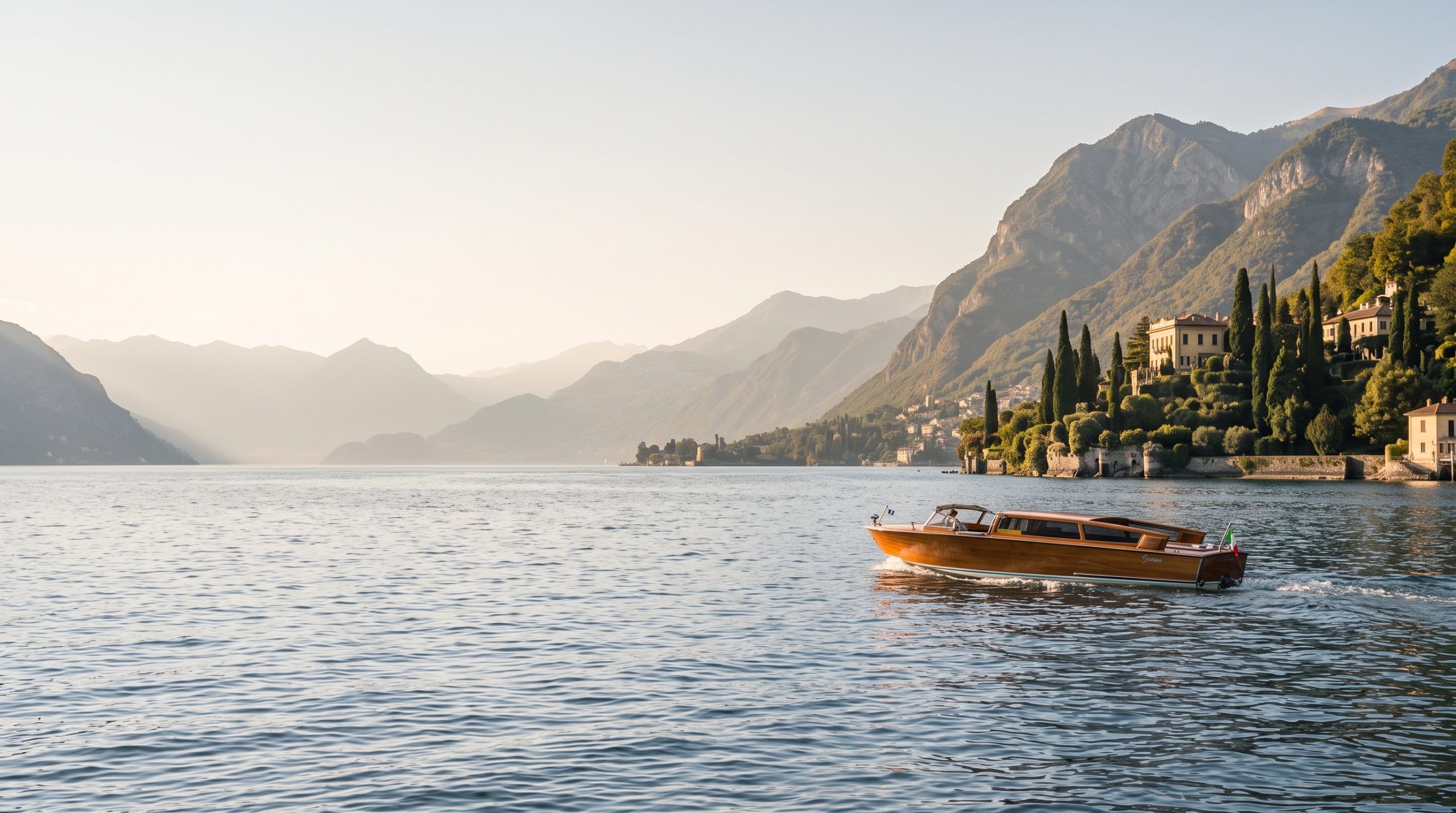
Stand on the last few metres of the Bellagio promontory and you are standing somewhere the lake named after a scheduling problem. Punta Spartivento means the point that divides the wind, and that is exactly what happens there. The Tivano arrives from the north, the Breva comes up from the south, and the two part company at the tip.
That matters more than it sounds, because a wooden boat is an open boat. There is no cabin, and nowhere to turn your back on the weather. A ceremony afloat on Lake Como is not scheduled around the prettiest hour. It is scheduled around which of those two winds owns the water at the moment you want to be standing up in a varnished cockpit saying something you wrote down.
The good news is that both winds are predictable enough to plan against, and the lake is narrow enough that a change of mind costs fifteen minutes of water rather than half a day of driving.
The vows happen afloat, the signature happens ashore
Italian law puts the legal marriage in the hands of a civil status officer inside a municipal room or a venue the comune has approved, so no boat on Lake Como can hold the paperwork. It holds everything else. You sign ashore with two witnesses present, then step down onto the water and say the words that are actually yours.
Sala Fermi, the Loggiato, and the room that seats six
On the Varenna side, the approved venue most couples end up using is Villa Monastero, the old lakeside house on via Polvani with a botanical garden running almost two kilometres along the shore. The Province of Lecco owns it, and an agreement with the Comune of Varenna opened it to civil marriages and civil unions.
What is unusual, and genuinely useful, is that the agreement names each room and what it will hold. Sala Fermi takes up to 80 people. Sala Polvani 30, Sala Musica 15, Sala Biliardo 12, the Loggiato 8, and the Salottino Orientale 6. There is also the stretch of garden directly in front of the villa. Celebrations run inside the villa’s ordinary opening period, March to October, with dates outside that window handled by request.
The rest of the legal shape is national rather than local. A non-Italian couple needs a nulla osta, the sworn statement that nothing stands in the way of the marriage, obtained through your own consular network in Italy. Once publications are complete, the ceremony has to take place within 180 days. And a civil ceremony in a town hall’s own chamber is free of charge: in Como, marriages are celebrated in the Sala Consiliare or the Sala Giunta of Palazzo Cernezzi at no cost, which is worth knowing if you would rather put the money into the boat. Approved villas and gardens carry their own tariffs.
We research all of it against your specific date and comune, and hand you the sequence in order. The fees themselves are yours. If the machinery of an Italian wedding is new to you, our guide to planning an elopement covers the parts that are the same everywhere.
The wind clock: Tivano early, Breva from midday
The Tivano is the north wind and it is an early riser, running down the lake at first light and often blowing harder than its southern counterpart. It keeps most of its strength in the southern basin toward Lecco. Up in the northern half of the lake, the water is usually calm until around eleven in the morning.
Then the Breva takes over. It is a thermal, drawn up from the south as the land heats, and it is at its most dependable when the weather is settled. It commonly builds to about force four, peaks through the afternoon, and flattens off toward evening. In high summer, if the night has not cooled enough, the Breva sometimes never arrives at all.
Turn that into a timeline and the central lake gives you two good windows and one demanding one. Between roughly eight and eleven you get glass: Menaggio and the western ridge lying flat on the surface, no spray, nobody’s hair across their face, and an engine that can be switched off so the boat simply drifts. From midday through late afternoon the Breva is up, the channel has a chop in it, and standing in an open cockpit becomes a physical act. Later, as the wind lies down, a second calm stretch opens before dark.
None of which makes the Breva hour a bad hour. Wind in an open boat is good film. It moves fabric and puts texture on the water, and it makes people hold on to each other. But it decides things for you. A cathedral veil in a force four is a choice rather than a surprise, and the vows themselves want the quiet window.
Two ridges, and why the water loses the sun early
Almost everyone plans a boat ceremony for sunset. On this lake that is usually a mistake, and it is the most useful thing we can tell you about the light here.
The central basin runs roughly north to south with mountains standing close on both sides. Varenna sits on the eastern shore looking west across about three kilometres of water. Bellagio’s point looks north, up the lake toward the Alps. In the morning the sun has to climb over the Grigne behind Varenna before it reaches the water, so the Varenna waterfront can still be sitting in shade while the Tremezzina shore opposite is already lit and warm. In the evening the reverse happens earlier than people expect. The sun drops behind the western ridge above Tremezzina, and the water goes from direct light to a bright, flat, blue shade while the printed sunset time is still some way off.
So we do not time the vows to a published sunset. We time them to the last direct light on the water, which on that stretch comes sooner, and then we keep working through the afterglow, which lasts a long time in a basin this deep and turns the whole channel a cool soft colour as the windows come on along the shore. If you want to see both halves of that hour side by side, they run all through our elopement stories and films.
How thick the water gets between eleven and five
The public crossing between Varenna and Bellagio covers about three kilometres in roughly fifteen minutes, run by Gestione Governativa Navigazione Laghi, with the first Varenna departure before seven in the morning. It is also the busiest water on the lake. By late morning that channel carries ferries, licensed taxi boats and a steady traffic of small hire boats, and the difficulty is not the crowd, it is the wake. A photograph survives a ferry passing behind you. A hull rolling in that ferry’s wash while you are trying to stand still does not. Before nine, almost nobody has hired a boat yet.
Mahogany, hoops, and a boatyard working since 1771
Wooden boat means two quite different things here, and choosing the wrong one is how couples end up with a beautiful hull that does not suit the day they had in mind.
The first is the Lucia, the traditional Lariana working boat: low, open, broad, with slender arched hoops rising over the beam where a canvas cover once went. It sits you close to the surface, it moves slowly or under oars, and it looks like it belongs to the lake because it does. The second is the varnished mahogany runabout, the classic taxi-boat shape, with a raked windshield, a long foredeck and a deep open cockpit behind it. That one covers distance, holds a group, and gives you a foredeck to stand on.
These boats are still being built, not only restored. At Laglio on the western shore, the Cantiere Ernesto Riva has been making wooden boats since 1771, more than 250 years in the same family, now led by Daniele Riva, and it put the first fully electric boat on the lake. Silence, for a ceremony afloat, turns out to be a specification worth caring about.
Licensed taxi boats keep private piers on both sides of the channel, in Bellagio just off Piazza Mazzini and again over in Varenna, which is what makes a two-shore day work at all. Board on one side, say the vows in the middle, land on the other.
Getting aboard without a hand on your dress
This is the part nobody writes about. The pier is reached by steps, there is a gap of open water between the pier edge and the gunwale, and the varnish underfoot is lovely and slick when wet. You board by taking a boatman’s forearm, not a handrail. A long skirt needs someone else gathering it, because both of your hands are occupied for those three seconds.
Practically: flat leather soles or bare feet until you are sitting down, heels in a bag, and if there is any water in the bilge a full train will find it. A wooden thwart is hard, cool and about the height of a low bench, so a fitted dress needs a moment of arrangement once you are down. Getting off is the harder half, because by then the boat is alive in the wake and the pier is not. We plan the boarding and the landing as two separate moments with a pair of hands on each of them, and we film the landing rather than assisting with it, which is one more reason there are two of us aboard.
What a boat gives the film, and what it takes back
Room is the constraint. An open cockpit is roughly two arm-spans across, so two of us cannot both stand amidships without landing in each other’s frames. We work the diagonals instead: one on the bow quarter, one back by the stern, swapping on the turns. For the wide pass, one of us rides in a second boat so the frame holds the whole lake behind you rather than a gunwale. Because the photography and the film come from the same eight-person team rather than two suppliers introducing themselves at the pier, that choreography is agreed the night before, not negotiated on board.
Sound is the other half of it. An open boat under way is the most difficult audio on this lake: engine behind you, Breva across the microphone, water working along the hull. On an Expedition day the audio goes on before you leave the pier, and the vows are said with the engine off and the boat drifting, which is also the quietest the water gets. Aerials run on the same discipline. Our pilots fly registered, inside the 120 metre ceiling, in visual line of sight, clear of crowds, with the airspace over the basin checked before we build a sequence around a drone shot rather than after.
One full day with a dedicated photographer or filmmaker starts at $4,900, one full day with both working together starts at $7,900, and the multi-day option along with everything included sits on our pricing page. Team travel to Lake Como is inside that, and so are the timeline, the location design, the permit research and the weather alternative. Highlights reach you in 5 days, the full gallery or film in 3 weeks.
If you already know which shore you want to leave from, or you have no idea at all and would rather we worked it out, Tell Us Your Story and we will lay the hours out against the wind.
Common questions
Can we sign the legal paperwork on the boat?
No. The signing happens in front of a civil status officer in a municipal room or an approved venue, which on the Varenna side includes Villa Monastero’s named rooms and the garden in front of the villa. The boat carries the private exchange, and that can be the only place you say vows you wrote yourselves.
Will the boat stop so we can actually hear each other?
Yes, and we ask for it directly. The boatman cuts the engine and lets the hull drift for the vows. Before eleven in the morning the water is usually flat enough that drifting is genuinely quiet, which is why we put the exchange in that window rather than in the Breva.
Is there somewhere to change out of walking shoes before we board?
Not on the pier itself. Villa Monastero’s rooms cover the legal half of the day, and beyond that we build in a private room on whichever shore you are leaving from, then carry a bag aboard. Shoes come off for the boarding anyway.
What happens if the Breva is up on our date?
We move the water hour, not the day. The lee behind the Bellagio promontory stays workable when the open channel is not, the western bays sit out of the worst of a southerly, and the pier and garden hours are unaffected. With a fifteen minute crossing between the shores, we have a second aspect and a second light inside the same afternoon.
Do we need a permit to say vows on a private boat?
A private exchange on a boat you have hired needs no municipal permission. Permits attach to the legal ceremony venue, and to certain villas and gardens if you want to use their grounds. We do the research and tell you exactly what to apply for and when; the fees are paid by you.
Can we do this in April, or in late October?
Yes for the paperwork, since Villa Monastero celebrates inside its ordinary March to October opening. On the water, the Breva only behaves predictably in settled weather, so a shoulder-season afternoon might be glass and might be a light chop. We plan for both and tell you which one we are watching as the date comes closer.
Picking your hour on the lake
A day here takes on a natural shape once you accept the wind clock. Sign in the morning in a room with your two witnesses, walk out into the garden, take the boat while the water is still glass, drift for the vows off Punta Spartivento with the northern branch opening ahead of you, then cross and spend the middle of the day on the other shore, coming back onto the water for the calm stretch after the Breva lies down. Two shores inside one day, and no car involved. If you are weighing the lake against a coastline or a mountain, our destination guides set them next to each other.
We currently have Lake Como elopement dates open across 2027–2029. Everything between your first message and the boat happens in writing, at whatever hour suits you: a reply and our brochure within 24 hours, a tailored proposal, then a signed contract and a 30% retainer, and the planning begins. Tell us the month you are considering and we will tell you what the water is likely to be doing. Check Your Date.