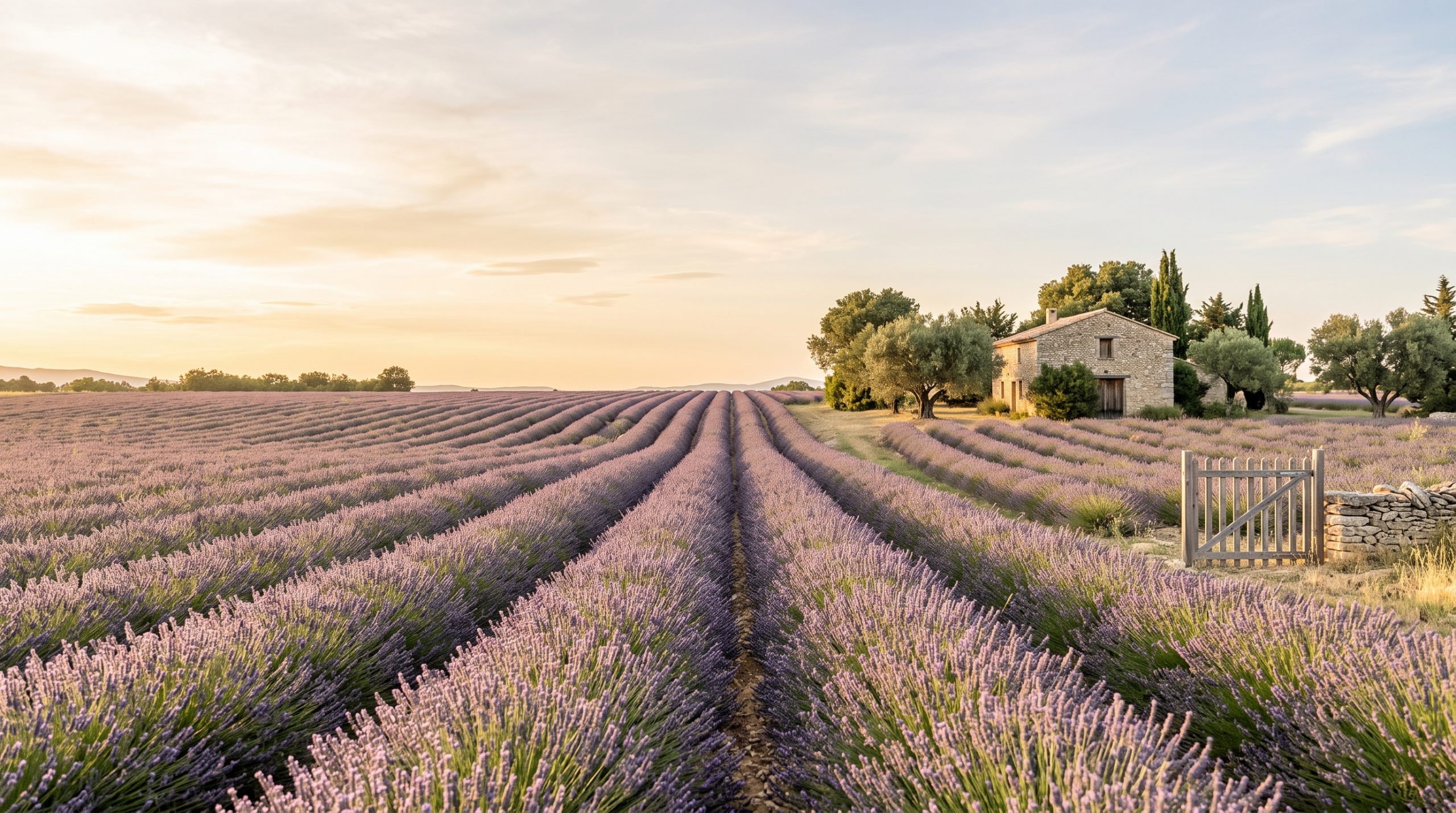
At 5:40 in the morning on the Valensole plateau the rows are still grey and the air smells of almost nothing. Twenty minutes later the sun clears the ridge, the whole slope turns violet, and a tractor coughs into life at the far end of the parcel. That tractor is the point. The lavender in front of you is not scenery. It is a standing crop with an owner, a yield, and a cutting date that was set long before you looked at flights.
Couples send us a saved photograph of one particular field and ask whether they can stand in it and say their vows. The answer is usually yes. It is also usually simpler than they fear, because it runs through a person rather than a permit counter. Someone farms that parcel. The work is finding them, asking properly, and asking while the answer can still be yes.
Below is what that ask actually looks like on the plateaus of Provence, where most lavender elopements happen, and at four other named fields whose owners publish their terms in plain writing.
Yes, if the grower says yes first
Nearly every lavender field in Provence is privately farmed, so a ceremony in the rows rests on the owner’s permission rather than a government permit. Commercial lavender farms publish photography passes and fees. Private growers are approached one at a time, usually through the village mairie or the local tourism office, and most say yes when asked early.
A lavender field is a crop, not a venue
On the difficulty scale this sits at fiddly rather than hard. There is no application form, no fee schedule, no ministry involved. There is a farming family, a season that lasts a few weeks, and a kitchen table that gets a lot of visitors in July. Ask in February and you are a curiosity. Ask on the second Saturday in July and you are the ninth person that morning.
What makes the ask land is understanding what you are asking for. The rows in front of you are the year’s income, cut once, distilled, and sold by weight of oil. Walking a row is not a neutral act, which is why the official Alpes de Haute-Provence guidance for the Valensole plateau asks visitors not to pick sprigs and to treat the fields as the working farmland they are. Growers who say yes almost always say yes to the headland, the track, and the tractor lines, and they are right to.
One famous exception is worth knowing before you build a day around it. The Abbaye de Sénanque near Gordes states on its own site that access to the lavender in front of the abbey is not permitted, in order to protect the monks’ harvest, that drone flights over the valley and the abbey are not allowed, and that commercial use of the abbey’s image or name is not permitted either. That last line matters more than couples expect. The most photographed lavender in France is the one field to plan around rather than into, and we would rather tell you that now than at the gate.
Finding the person who farms that parcel
Start with the ground itself. France’s public cadastre will give you the outline of a parcel and its reference number. It will not give you a name. That gap is where most couples stall, and the way through it is entirely analogue.
The village mairie is the first stop, because the secretary knows who farms what and will often say so. The tourism office is the second, and in lavender country they field this question every season. The third route is the most reliable of all: the distillery, the farm shop, or the roadside stall selling honey and bunches at the edge of the plateau in season. The person behind that table either farms the field you are looking at or knows the family who does.
Write the ask so it can be answered in one line. Give the date and a two-hour window rather than a whole day. Say how many people, and be honest, because two is a very different request from twelve. Say where you plan to park and confirm that you will keep to the headland and the tractor lines. Ask directly about a drone rather than assuming. Say whether the photographs and film will be published, since that is a separate question from standing in the field, and a grower who is relaxed about one may want a word about the other.
Offer something in return. Buying the year’s oil at the farm door, or arranging your bunches from the grower rather than a florist in town, changes the shape of the conversation. It is not a bribe. It is the ordinary courtesy of a customer, and it is how the yes becomes a warm yes. Our destination elopement guides go into how those first approaches read in other regions.
From parcel to grower: the permission sequence
- Fix the week, not the day. On the Valensole plateau the official guidance puts flowering between mid-June and mid-July, with the peak usually in early July and harvest beginning around mid-July. Everything downstream hangs off that window.
- Fix the parcel. Cadastre reference and a screenshot, plus the nearest hamlet or crossroads. You need to be able to say which field you mean without waving at a valley.
- Identify the farmer through the mairie, the tourism office, or the farm shop. Allow a few weeks for this in winter, a few days in spring.
- Get the yes in writing. Email is fine. What you want in the reply is the date, the time window, the headcount, parking, and a clear line on the drone and on publication. A written yes also survives a change of mind about which field looks best on the morning.
- Handle what the grower cannot give you. Roads, verges and public parking belong to the commune, not the farm, and anything on monastic or abbey land follows that community’s own published rules.
- Sort the legal marriage at home, where your county or state issues the licence, sets its own waiting period, and gives the certificate an expiry date of its own. That document is the one with a validity window you cannot negotiate, so read it the day it is issued rather than the week you fly.
The real minimum is short. Cotswold Lavender asks commercial photographers to register at least 24 hours ahead, and a private grower can say yes on a Tuesday for a Thursday. The comfortable minimum is a different number. We work to the week being chosen six to nine months out, the grower approached in late winter when there is time to talk, a check-in when the fields colour up in June, and a final confirmation the evening before, because a hot fortnight moves a cutting date faster than any calendar does. If you are still deciding the shape of the whole trip, our notes on how to plan an elopement cover the order those decisions are best made in.
The small print at five named fields
Published rules tell you a great deal about how a place is run. These five are among the most photographed lavender sites in the world, and their owners set out what they expect.
| Field | Who says yes | What the owner publishes |
|---|---|---|
| Valensole plateau, Alpes de Haute-Provence | The individual grower; the mairie for roads and verges | Working private farmland. Official guidance asks visitors not to pick and to respect the fields. Entry is the grower’s decision, field by field. |
| Abbaye de Sénanque, Gordes | The monastic community | Access to the lavender is not permitted, to protect the harvest. No drone flights in the valley or over the abbey. No commercial use of the abbey’s image or name. |
| Mayfield Lavender, Banstead, Surrey | The farm | Casual family photographs are free. Wedding and portrait photography needs registration: a two-hour daytime pass at 60 pounds or a full day at 110 pounds between 9am and 6pm, and an evening pass at 150 pounds between 6pm and 9pm. Everyone being photographed pays the standard entry price. Sign in 30 minutes before. No drones on the field at any time. |
| Cotswold Lavender, Snowshill | The farm | Register at least 24 hours ahead and buy a pass for each day. Wedding and family photography is 55 pounds a day for the photographer, with standard entry for everyone else. Arriving without prior agreement costs 125 pounds on the day. The pass covers the main public field from 10am to 5pm. |
| Purple Haze Lavender Farm, Sequim, Washington | The farm | Professional photography rates start at 50 dollars per half hour and are arranged in advance. Visitors photographing casually during business hours are not charged. |
The the lavender fields costs and processing windows below are a point-in-time reference, not a promise of future tariffs.
Read those terms again with a ceremony in mind and the same handful of details jump out every time. The best light and the standard access window rarely overlap. A Cotswold pass covers 10am to 5pm, which is the flat middle of a July day. Mayfield sells the 6pm to 9pm evening slot separately and prices it highest, which tells you exactly when that field is at its best. On the Valensole plateau the equivalent problem solves itself in the other direction, because a grower who is wary of an afternoon crowd is often perfectly happy with two people at six in the morning, gone before the first coach.
Everyone in the frame counts as a visitor. Mayfield applies its entry price to every person being photographed, and a Cotswold pass covers the photographer while the rest of the party pays at the gate. Our own fee does not move with your guest count. The farm gate is a separate arithmetic, and it is worth doing before you invite anyone.
Then there is the cut. Harvest on Valensole begins around mid-July, and a hot June pulls the whole thing forward. Altitude buys time, which is why the higher ground around Sault holds colour after the lower plateau has been mown. Growers also rotate and replant, so a parcel that was solid violet in a picture from two summers ago may be wheat, or young plants, or stubble on your date. We hold a second and third parcel for every lavender day, usually within fifteen minutes of the first.
Aerials are their own conversation. Sénanque rules out drone flights in the valley and over the abbey, and Mayfield does not allow them on the field at any time. Elsewhere the answer comes from the landowner and the local rules together, so we settle both before any aerial shot goes into a film plan rather than after. When you are ready to talk about a specific week and a specific plateau, Send Us a Message and we will start on the parcel list.
Why the legal part happens at home
In France a civil marriage is registered by the mairie, at the mairie, in a public ceremony. A field is not an option, however beautiful. The commune also has to be yours in a legal sense: one of you needs a domicile or a continuous residence of at least a month there before the banns go up, or a parent who lives there. The banns are then published for at least 10 days before the ceremony can take place, and the marriage has to follow within a year of that period ending. The dossier itself is strict about age of paper, with a birth certificate under three months old if it was issued in France and under six months if it was issued abroad, and you name your witnesses in advance, two at minimum and four at most, all of them adults.
American couples meet one extra wrinkle. The US Embassy in France explains that neither the embassy nor any federal authority can issue a certificat de coutume or a certificat de célibat, because marriage records are held by individual states. US citizens instead sign an attestation that stands in for both documents, available from the embassy’s own site, and where a mairie insists on a certified signature the embassy in Paris and the consulate general in Marseille provide notarial services.
Which is why almost every couple we work with in lavender country signs the legal paperwork at home and holds the real ceremony in the rows. This is not a downgrade. It is the better version. You bring a celebrant or a friend, you write your own words, you take as long as you like, and nobody is watching a clock in a municipal room. Rings, readings, the walk up the tractor line, the first minute afterwards when neither of you can speak: all of it happens exactly as you imagined, with the certificate already signed and filed in your own country. France has recognised same-sex marriage since 2013, and the ceremony in the field is open to any couple who can find a grower to say yes.
This guide helps you plan the the lavender fields process; it is not legal advice. Rules can depend on nationality and circumstance, so confirm your own case with the responsible office.
What we can arrange with the field, and what only the grower can approve
We hold the shape of it. The week against the flowering window, the hour against the light and against the grower’s own preference, the wording of the ask, the backup parcels, the timeline that gets you from a rented house to a field track without a rush. We are not lawyers and we do not file anyone’s paperwork, but the research and the logistics around access are ours, and they are included in every experience we run.
The window a grower gives you is usually short, and a short window is where a second camera earns its place. One of us stays on the vow at close range while the other holds the wide shot down the rows, so the ceremony hour is covered twice without anyone being asked to repeat anything. You can see how the rows and the light actually read in our recent elopement stories and films. Highlights reach you within 5 days, and the full gallery or film within 3 weeks.
What stays with you is the marriage licence at home, any access or permit fees payable to a farm or a landowner, your celebrant and accommodation, and unusual transport such as a private boat or a mountain guide. Coverage and what each experience includes are set out on our pricing page.
Common questions
Can we get married in the lavender fields at Valensole?
You can hold your ceremony there with the grower’s permission, since the plateau is privately farmed rather than public land. The legal marriage itself is registered at a mairie and not in a field, so couples visiting from abroad sign at home and keep the ceremony for the rows.
Do we need permission to photograph in a lavender field in Provence?
To stand in the field, yes, from whoever farms it. Photographing from a public road or a track is a different matter, but a ceremony means people, time and usually a tripod, and that is a request you make in advance rather than an assumption you arrive with.
How much does it cost to use a lavender farm for a ceremony?
Commercial farms publish it. Cotswold Lavender charges 55 pounds a day for the photographer with standard entry for everyone else, Mayfield Lavender sells passes from 60 pounds for two hours up to 150 pounds for the evening slot, and Purple Haze in Sequim starts at 50 dollars per half hour. Private growers in Provence more often ask for care than money.
When is lavender actually in bloom in Provence?
Official guidance for the Valensole plateau puts the flowering between mid-June and mid-July, with the peak usually in early July and cutting from around mid-July. Higher ground such as the country around Sault runs later, which is why a late-July week moves north and up.
Can we fly a drone over a lavender field?
Only where the landowner and the local rules both allow it. Sénanque prohibits drone flights in its valley and over the abbey, and Mayfield does not permit them on the field at any time. We confirm the position for your exact parcel before any aerial goes into the plan.
Is a ceremony in a French lavender field legally binding?
No. French civil marriage is celebrated publicly at the mairie by the registrar, so a field ceremony is a symbolic one. Couples sign at home first, which means the words you say in the rows are the ones you chose rather than the ones the law requires.
Can Americans get married in France without living there?
Not easily. One of you needs a domicile or at least a month of continuous residence in the commune before the banns are published for 10 days, and the US Embassy cannot issue the certificat de coutume many mairies request. Signing at home first removes the whole chain.
What happens if the field is cut before our date?
We move. Every lavender day we plan carries a second and third parcel, usually within fifteen minutes of the first, and we watch how the season is running from June onward so the change happens on paper rather than on the morning.
Pick the week, then pick the field
Tell us the year and roughly the week you have in mind and we will work backwards from there: the flowering window first, then the growers worth approaching on that plateau, then the hour that gives you empty rows and low sun. We are planning lavender weeks for 2027, 2028 and 2029. Everything between us happens in writing, which suits the time zones and leaves you with a record you can re-read, and you will have a reply and our first brochure within 24 hours. Start Your Story.