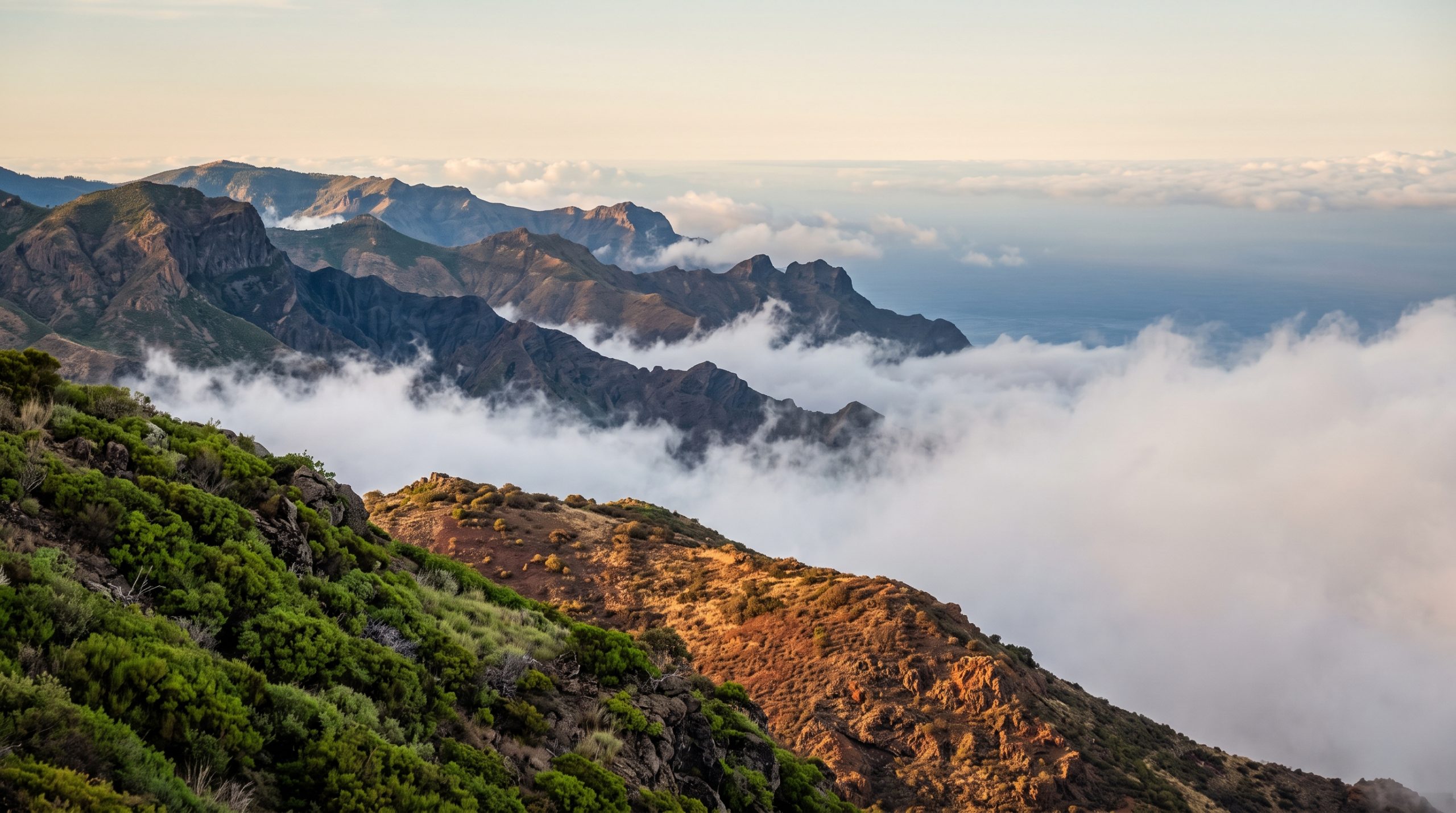
The Canary Islands get sold as the place where weather stopped happening. Average temperatures on Tenerife move between roughly 19°C in February and 24°C in September, and the island collects about 296 mm of rain across an entire year. On paper, every month works equally well.
Temperature is not what changes the day. Daylight is. Mid-December gives you 10 hours and 21 minutes between sunrise and sunset in Santa Cruz de Tenerife, with the noon sun only 38 degrees above the horizon. Mid-June gives you 13 hours and 56 minutes and a midday sun within five degrees of straight overhead. Same island, same shirt, two completely different films.
Then there is the Saharan dust, the altitude season, and the fact that a permit quota can decide where you stand at first light. This is the year as we actually plan it, with the numbers we plan from.
The Canary window we would choose first
Late May into the first week of June. Sunset sits near 20:45, rainfall is close to its annual floor, the red tajinaste is in flower above 1,600 metres in Teide National Park, and the summer arrivals have not landed. If those dates are taken, we would choose the first half of October before anything else.
Month by month: conditions, light, crowds, verdict
Light times below are for Santa Cruz de Tenerife, mid-month. The islands keep UK time rather than mainland Spanish time, an hour behind Madrid, which is why June sunsets land after nine in the evening and December sunsets are finished by quarter past six.
| Month | Conditions | Light, mid-month | Crowds | Our verdict |
|---|---|---|---|---|
| January | Coolest stretch, showers on northern slopes, dust most likely | 07:58 to 18:29, noon sun 38 degrees | Heavy winter arrivals on the coasts | Beautiful coast, unreliable summit |
| February | Island average near 19°C, almond blossom in the highlands | 07:44 to 18:55 | Busy, and blossom weekends fill the hill villages | Strong for colour at altitude |
| March | Driest air of the year, humidity at its annual low | 07:16 to 19:13, clocks move late in the month | Steady rather than crushed | Underrated, book it |
| April | Warming, long dry spells, cloud still building in the north | 07:41 to 20:30 | Manageable outside Easter week | Reliable all-rounder |
| May | Tajinaste in flower above 1,600 m, very little rain | 07:15 to 20:47 | Light, before the summer wave | Our first choice |
| June | Longest days, trade winds strengthening | 07:07 to 21:03, noon sun near vertical | Climbing fast | Superb evenings, dead middays |
| July | Sunniest month at about 11.1 hours of sun a day | 07:17 to 21:05 | Peak | Late ceremonies only |
| August | Driest month, roughly 12 mm across a single rainy day | 07:34 to 20:46 | Highest of the year | Warm sea, hard light, full island |
| September | Warmest sea of the year, around 24°C | 07:49 to 20:11 | Falls away after the first fortnight | Best of the late season |
| October | Still dry, Atlantic swell returning to the north coast | 08:05 to 19:36 | Quiet midweek | Second choice, and close |
| November | Rain returns, the north turns green | 07:27 to 18:13 | The calmest weeks on the islands | Excellent for laurel forest |
| December | Wettest month, about 40 mm over 8 rainy days, 5.7 hours of sun a day | 07:50 to 18:11, shortest day of the year | Over 1.4 million foreign arrivals in the month | Soft light, tight timeline |
One thing worth being blunt about. Destination guides that promise you an empty low season are describing somewhere else. Canary arrivals have not dropped below a million foreign visitors in a single month since June 2023, and December 2027 alone brought 1,447,097. Quiet here is an hour and an altitude, not a month.
The two blooms, and how far their dates move
The red tajinaste, Echium wildpretii, is the one worth building a date around. It grows in the higher zone of Teide National Park, roughly 1,600 to 2,000 metres, throws up a flower spike two to three metres tall, blooms once, and then dies. Flowering runs through May and into June. The peak shifts by a week or two depending on how cold the winter was, so we watch it and adjust the shape of the day rather than the date.
The almond blossom is the winter version. It comes to the highland villages from late January into February, and Tejeda in Gran Canaria builds a festival around it in the first week of February. Be realistic about the scale: this is orchards on terraces, not a hillside painted pink. It photographs best framed tight, with the volcanic rock and the terrace walls doing the work behind the couple.
August and December, and what we would book instead
August is the driest month of the Tenerife year, about 12 mm of rain spread over roughly one rainy day. It is also the hottest, the busiest, and the month when a Saharan dust episode can push inland temperatures up sharply and flatten every distant ridge into grey paper. The light between eleven and five is brutally overhead. If you want warm water and long evenings, mid-September to mid-October gives you the sea at its annual warmest, near 24°C, sunset still at 20:11 in mid-September, and an island that empties after the first fortnight of September.
December is the other one we would move. It is the wettest month, near 40 mm across about 8 rainy days, with 5.7 hours of sunshine a day and the shortest daylight of the year. It also carries the largest single month of foreign arrivals. March does the same job better: humidity bottoms out, sunset holds at 19:13 mid-month, and you get close to 12 hours of daylight to work with.
If your date is already in December, that is a plan, not a problem. Sunrise at 07:50 means nobody sets an alarm for three in the morning. The noon sun never climbs past 38 degrees, so the light stays usable straight through the middle of the day instead of dying at ten. The north is green in a way it never is in August, and winter cloud usually sits below the caldera rim, which means climbing above roughly 2,000 metres often buys clear sky over a grey coast. Tell us the week you have and we will tell you which side of which island it belongs on.
What the sun actually does here across the year
At 28 degrees north the sun climbs fast, and this catches out photographers used to Scotland or Patagonia. From the horizon to 6 degrees of elevation takes about 31 minutes in March and September and about 35 minutes in December. The golden hour is half an hour. Civil twilight then gives roughly 25 more minutes of blue before the sky goes flat. Everything we build for first and last light is a sequence of short, exact moves, not a leisurely wander.
The direction changes just as much as the duration. In mid-December the sun rises around 116 degrees and sets around 244, well round to the southwest, which lights the south and west coasts and puts the sun over open water from almost anywhere on that side of Tenerife. By mid-June it rises at 63 degrees and sets at 297, far into the northwest, which is what brings the Los Gigantes cliffs and the north coast into play for a sunset ceremony.
Height matters most for the ceremony hour. Mid-June noon sun sits about 85 degrees up, effectively straight down, so a June ceremony belongs at 20:00 and not a minute before. December noon at 38 degrees is genuinely kind, and a December ceremony can sit at 17:00 with warm side light all the way through. The last Sunday in October takes an hour off the end of the day overnight, moving sunset from 19:36 in mid-October to 18:13 by mid-November, which is the single biggest jump in the calendar. You can see what these hours do to a finished edit in our stories and films, where the difference between a 21:00 summer sunset and a 38 degree winter noon is obvious in the first few frames.
Permits, quotas and the hours the mountain keeps
The summit crater of Teide is not a walk-up. Access along the Telesforo Bravo trail is restricted and needs a free licence from Teide National Park, which has to be applied for well in advance because demand runs ahead of the daily quota all year. The two lookout trails from the upper cable car station, La Fortaleza and the Pico Viejo viewpoint above an 800 metre wide crater, need no licence at all and are where most of our high-altitude work happens.
The cable car opens at 09:00 and closes in the late afternoon through the cooler half of the year, running on into the early evening in high summer, with the last ascent about an hour before the doors shut. Read that against the sunrise and sunset times above and the conclusion is unavoidable: neither first light nor last light at 3,555 metres falls inside normal operating hours. The operator sells separate sunset and stargazing outings outside those hours, and that booking is part of what we handle when the film needs the summit rather than the caldera floor.
Elsewhere, the pattern repeats. The Barranco de Masca descent runs on a pre-booked ticket and a fixed entry slot, with cars left in Santiago del Teide rather than in the village. On La Palma, the LP-4 climbs past the observatory at kilometre 37 to Roque de los Muchachos, where coach parking is reserved in 30 minute slots through the national park system and only two coaches fit at a time, which tells you exactly how small the summit is and why we go at an hour nobody else wants. Permit research, applications and timing are ours; the government, venue and landowner fees themselves sit with you. Our guide to planning an elopement sets out how that division works in practice.
If a specific month is already fixed by work, family or a flight you have paid for, write to us with it and we will build around it. Send Us a Message and we will tell you what that week can realistically give you.
The weather plan is a 40 minute drive
Tenerife is not one climate. The south is warm and dry, the north takes far more rain and grows the laurel forest because of it, and conditions can change markedly across very short distances thanks to the mountain in the middle. That is the whole basis of our bad-weather planning. We do not sit and wait for a front to pass. We move, because the trade winds pile cloud onto north-facing slopes and leave the Teno massif, the south coast or the caldera floor clear on the same afternoon.
So the plan we write before anyone flies has a primary location, a wind-direction alternative on the opposite coast, and an altitude alternative above the cloud, with the ceremony hour able to slide by 90 minutes without breaking the rest of the timeline. If a whole week looks unusually wet, moving island is also on the table. Lanzarote averages around 121 mm of rain a year against Tenerife’s 296 mm, and its August total is about 2 mm, which is close to a guarantee written in a climate table.
This is where working as one team stops being a slogan. In December you have a 35 minute golden window, and one person cannot shoot the wide landscape frame and the close portrait inside it at the same time. A dedicated photographer and a dedicated filmmaker working together means those 35 minutes produce both, without anyone asking you to repeat a moment for the second camera. Photography, film and planning come from the same eight of us, team travel is included worldwide, and the way that is packaged is set out on our experiences and pricing page.
Common questions
Will a calima ruin our photographs?
Saharan dust now reaches the islands on at least 146 days a year, around 40% of days, with the heaviest concentrations in winter and early spring. Most of those days are mild: a warm haze that softens distance and turns the sun orange, which suits close work and silhouettes. When it thickens, we drop altitude, keep frames tight, and use the coast where the horizon is close.
Is the summit of Teide realistic on our date?
Only with the free national park licence for the Telesforo Bravo trail, applied for months ahead, and only inside cable car hours, which never cover sunrise or sunset. For high-altitude light we plan the caldera floor at around 2,000 metres and the free lookout trails, then add a separate evening summit outing if that is where the film has to end.
How early do we need to start in June?
Later than you think. Mid-June sunrise is 07:07 and sunset is 21:03, so a full day of coverage stretches across nearly 14 hours of daylight and the ceremony belongs at 20:00. The trade-off is that the middle of the day is unusable for portraits, so we build a long lunch and a siesta into the timeline on purpose.
Can a December elopement here still work?
Yes, and it is more comfortable than most couples expect. Sunrise at 07:50 and sunset at 18:11 give you 10 hours and 21 minutes, and because the noon sun peaks at 38 degrees, all of it is usable light rather than two ends of a harsh day. December averages 5.7 hours of sunshine a day, so we plan two locations properly instead of five in a rush.
When exactly is the red tajinaste in flower?
Through May and into early June, in the zone between about 1,600 and 2,000 metres in Teide National Park. The peak moves by roughly a week or two from year to year with the winter, so if the bloom is the reason for your date we would aim at the second half of May and keep the location list flexible by elevation.
Which island gives us the best odds of dry weather?
Lanzarote, on the numbers. It averages about 121 mm of rain a year against Tenerife’s 296 mm, and August there brings roughly 2 mm. Tenerife wins on variety of landscape within one day of driving, so the honest answer depends on whether you want volcanic minimalism or six climates before dinner.
Are the islands ever actually quiet?
Not by month. No month has fallen below a million foreign arrivals since June 2023. Quiet is a time of day and an elevation: the Roques de García at 07:30 in November, a north coast bay two hours before sunset, a caldera track in the hour after the last coach leaves for the resorts.
Choosing your month, then your hour
Pick the month for the thing you cannot move: the bloom, the long evening, the school holiday, the flight. We will pick the hour and the coast, then write the alternatives around it. We are booking 2027, 2028 and 2029, all of the planning between us happens in writing and in your own time, and the first reply with our brochure comes back within 24 hours. Check Your Date and tell us the week you are holding.