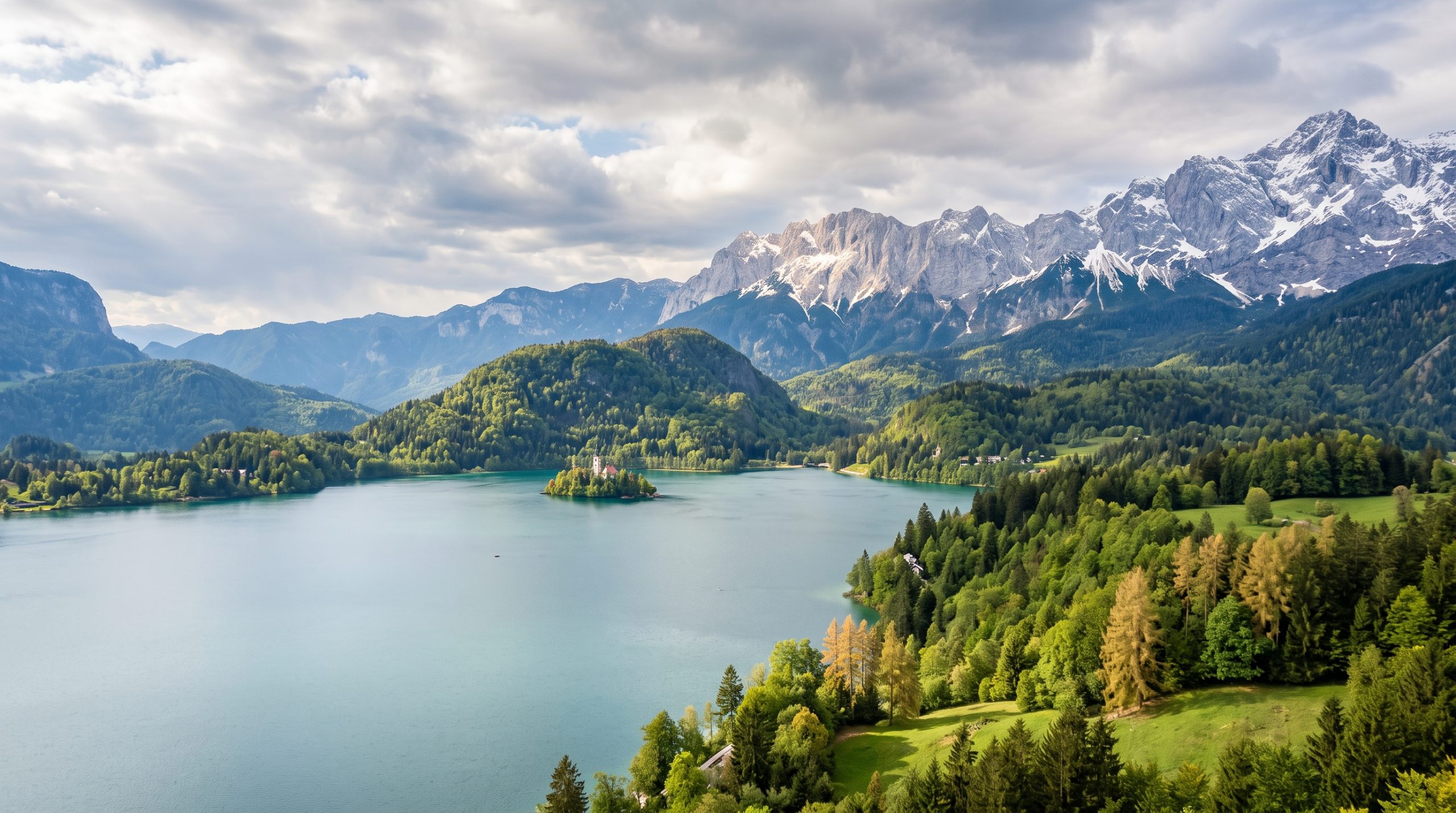
At 6:40 on a mid-September morning the sun comes up over Bled, and for a while after that it is still behind the hills. That gap is most of the reason we push couples toward September. You get a genuine sunrise hour without a 4am alarm, the lake sits quiet, and the first coaches are still well over an hour from the castle car park.
Slovenia is small enough that one day can hold a lake, a gorge and a high alpine pass, and mountainous enough that the calendar decides which of those three you actually get. The Vršič Pass tops out at 1,611 m and is a warm-season road. Vintgar Gorge runs an April to October season. The larches turn gold for about a fortnight and nobody can tell you which fortnight until roughly ten days beforehand.
What follows is the month-by-month version: what the light does, what is open, when the crowds arrive and leave, and which weeks we would move a date onto if we could.
The Slovenian fortnight we would choose first
The last two weeks of September. You still get close to twelve hours of daylight, sunrise around 6:50 and sunset near 19:00, the high roads and the gondolas are running, gorge access is open, and August traffic has gone. Early October is the near miss, trading an hour of daylight for the larches.
Slovenia month by month, rated for an elopement
Temperature and rainfall figures below are Bled averages, and the light column gives sunrise and sunset for the middle of each month at the lake. Slovenia runs on Central European Time and puts clocks forward on the last Sunday in March, back on the last Sunday in October.
| Month | Conditions | Light, mid-month | Crowds | Our verdict |
|---|---|---|---|---|
| January | Around 3 °C (37 °F) by day, near -5 °C at night, cold and often bright between fronts | 07:43 to 16:41 | Low at the lake, busy at the ski centres | Best odds of a white day |
| February | Cold nights hold, snow cover more reliable up high than in the valleys | 07:09 to 17:27 | Low outside school holidays | Winter, with more daylight than January |
| March | Valley thaw, brown meadows, alpine roads still shut | 06:19 to 18:08 | Lowest of the spring | The month we like least |
| April | Green returns below 1,000 m, gorge season opens, Vršič usually clears late | 06:18 to 19:49 | Quiet, then an Easter spike | Good if the day stays low |
| May | About 133 mm of rain, meadows at their fullest, Soča running high on snowmelt | 05:31 to 20:28 | Building, still manageable | Our spring pick |
| June | Longest days of the year, 15h46 of daylight, afternoon build-ups common | 05:10 to 20:57 | Rising fast through the month | Choose it for the light, not the quiet |
| July | Warmest month, about 24 °C (75 °F) by day, 14 °C overnight, everything open | 05:25 to 20:54 | Peak | Workable with a 5am start |
| August | Warm and humid, one of the wettest stretches of the year | 06:01 to 20:16 | Peak, and heaviest at Bled | The month we plan hardest around |
| September | Around 157 mm on average, usually in bands rather than all day | 06:40 to 19:18 | Falls away sharply after the first week | Book it |
| October | Around 9 °C by day and 2 °C at night, larches turning, morning inversions | 07:19 to 18:19 | Light, and thinning weekly | Close second, watch the clock change |
| November | Grey and damp in the basins, colour gone, high roads closing | 07:04 to 16:33 | Lowest of the year | The hardest month to shape |
| December | 8h37 of daylight, sun never higher than about 20 degrees | 07:40 to 16:17 | Concentrated in town, not on the trails | The whole day behaves like golden hour |
Four windows that move every year
None of these arrive on a fixed calendar. We give odds rather than promises, and the location detail behind each one sits in our destination elopement guides.
Larch gold, October. Autumn colour in the Julian Alps peaks in October, when the larches turn vivid yellow against the beech reds and browns. It is altitude-driven: the high larch goes first and the valley floors follow, so the good fortnight at any one elevation sits mid-month and shifts a week either way depending on the year. If colour is the point, we book the middle two weeks of October and keep a high option and a valley option live until a few days out.
Snowmelt on the Soča, May and June. Late spring is when the Soča is fullest, fed by melt off the high Julian Alps. The river reads greener and louder then than it does in a dry September, which matters if the water is meant to be in your film rather than behind it.
Early-summer flowers around Bohinj. The meadows above Lake Bohinj come into flower in early summer, and the valley builds a festival around it. That window climbs the mountain as the weeks pass, so a pasture at 1,200 m peaks well after one at 600 m.
October and November inversions. Cold, still autumn mornings fill the basins with fog and leave the tops clear. You cannot order one, and roughly one morning in three or four is worth the early start in that stretch. When it happens, the answer is to go up rather than wait it out, which is why our October timelines always carry a high alternative and an early departure.
The Slovenia months we would move away from
March is the one we argue with couples about. The valley snow has gone, the meadows have not come back, and the alpine passes are still closed, so the palette is brown and grey at exactly the altitude you can actually reach. Mid-month you have 11h49 of daylight, which is plenty, but there is less to point it at. If you want spring, mid-May is a different country: full meadows, nearly 15 hours of daylight, and the Soča at its best.
November is the other one. The larch needles are down by the first week in most years, the high roads shut, and mid-month daylight is down to 9h28 with the sun peaking around 25 degrees. If you want a quiet Slovenia with weight to it, we would rather put you in late January or February, when the same emptiness comes with snow, brighter air and a sky that does something at both ends of the day.
If your date in either month is already fixed, we do not spend the planning trying to talk you out of it. Those months push the day into the gorges, the forests and the lakeshore, where the light is soft and the weather matters less, and they reward a ceremony hour set late in the afternoon rather than at dawn. Tell us the date you are locked into and we will tell you what that week tends to do, then design around it.
What the sun is doing above the valleys
This is the part that changes your photographs and your film more than the temperature does. At the June solstice the sun climbs to about 67 degrees above Bled at midday, close to straight down. Between roughly 10:00 and 17:00 in June and July, open ground goes flat and faces lose their shape, so the usable hours sit at the ends of a 15h46 day. A long, generous evening, and a very early morning.
By late December the sun never gets above about 20 degrees. Nothing on the valley floor is ever lit from overhead, ridges throw long shadows across the water all day, and the entire 8h37 window behaves like one extended golden hour. Winter days here are short but they are not compromised, and you can see what that low angle does to snow and water in our published galleries and films. Highlights land with you five days after the day itself, the full gallery or film three weeks later.
A short winter window is also the clearest argument for having a photographer and a filmmaker on the ground at the same time. In late September you have room to work slowly, shoot the vows, then walk twenty minutes and shoot them again for the camera that missed them. In late December you do not. Everything happens once, in the same ninety minutes, and two people working side by side means the film and the stills come out of the same moment rather than a repeat of it. That is the difference between our two full-day options, and both are set out on the pricing page.
What is open when: roads, gondolas and gorges
Access catches couples out more than weather does. A location can be shut for the season on a bright, still day.
- Vršič Pass, 1,611 m. The highest road pass in Slovenia, 50 cobbled hairpins, and a warm-season route only. It typically clears in late April and stays open into late October, depending on the snow that year, so we treat early spring dates as valley dates and keep the pass as an upgrade rather than a plan.
- The Mangart road, 2,055 m. Slovenia’s highest road, 17 curves climbing to the saddle on the Italian border inside Triglav National Park, open for the summer season. High-alpine ground you can reach by car, for a few months of the year.
- Vintgar Gorge. Open to visitors between April and October, with opening hours that change through the season. Access is organised: official parking plus a shuttle from Bled bus station and the Vintgar LIP car park, on a green access fee of 4 euros per adult, free for children.
- Savica waterfall. Reachable year-round, up 553 steps that take 20 to 25 minutes from the car park. The entry point opens around 10:00 outside summer and from 8:00 in the high season, which decides whether the falls are a morning location or an afternoon one.
- Vogel gondola, above Lake Bohinj. Runs every half hour from 8:00 to 18:00 from Ukanc. In July, sunrise is at 5:25, so a sunrise ceremony on that ridge is a walking proposition, not a cable car one. The ski centre works on natural snow and has been running into the first week of April.
- The high huts. Triglav’s mountain huts keep a short summer season and most close well before the autumn colour arrives, so multi-day high routes belong to July, August and September.
One more piece of timing that has nothing to do with weather. Slovenian civil ceremonies are held in official premises set by each administrative unit, on the limited days those offices run, and anything outside that needs a formal decision from the unit, which then charges for it. Ljubljana’s administrative unit charges 170 euros for a ceremony outside its official venues or days, and other units set their own. It is straightforward, it is not fast, and it is a reason to fix your month early. Send Us a Message with the window you are considering and we will map the paperwork against it.
How we build Slovenia’s weather backup before you fly
Bled collects roughly 1,640 mm of rain a year, and the wettest months sit near 150 mm each. That total reads worse than it lives. Rain in the Julian Alps usually arrives in bands with clear gaps between them, and the useful skill is not optimism but knowing where to be during the band.
So every plan we build carries named alternatives rather than a shrug. A ceremony hour that can move two hours in either direction without breaking anything downstream. A gorge or a forest for the hour it is actually raining, because both look better wet. A high option for the mornings when the valley is under fog and the ridge is not, and a lakeshore option for the days when the tops are in cloud and staying there. Aerials run on a permit and a legal window, so we confirm both in advance and plan the film so the drone is a bonus rather than a dependency.
The one thing we will not do is sell you weather. We can tell you what a fortnight has historically done, how long the light lasts, and what happens when the forecast turns. The planning fundamentals behind that, including a timeline built around light and real travel time, hold in every month. Only the alternatives change.
Common questions
Will there be snow at Lake Bled if we elope in December?
Sometimes. Bled sits low in a valley, so December can give you frozen reeds and bare grass in the same week. January and February hold the colder nights, near minus 5 °C, and the dependable snow is higher up: Vogel skis on natural snow inside Triglav National Park and has been running into the first days of April. If snow is the reason for the trip, we plan around altitude rather than around the lake.
How likely is rain on our date, honestly?
Over a year Bled takes about 1,640 mm, and no month is dry. In practice most days have rain somewhere in them and very few are a write-off. We plan for the gaps, not for sunshine, and choose locations that hold up when it is falling.
When exactly do the larches turn gold?
October, and the peak climbs down the mountain through the month. High larch turns first, valley beech last, and the good stretch at any single elevation runs about a fortnight and moves up to a week year to year. Booking the middle two weeks of October gives you the best chance of catching it somewhere.
Can we drive the Vršič Pass for a May elopement?
Often yes. The pass generally clears in late April, but the top sits at 1,611 m and can hold snow and cold well into May. We plan a May day that works without it and treat the pass as the section we add once the road status is clear.
Can we have a sunrise ceremony on a mountain in July?
Not by gondola. Mid-July sunrise at Bled is 5:25 and the Vogel cabins start at 8:00, so a summer sunrise on high ground means walking up in the dark. Sunset is the easier trade in July: the sun goes down at 20:54, the last cabins are still running, and the warm hour runs long.
How far ahead should we lock a late-September date?
Earlier than for the quieter months, simply because that fortnight is the one most people ask about. Our calendar is currently open across 2027, 2028 and 2029. Send the inquiry form and you get a reply and our initial brochure within 24 hours, then a tailored proposal, and planning begins once the contract is signed and the 30 percent retainer is paid.
Choosing your fortnight
Pick the fortnight before you pick the location. Slovenia will give you a lake, a gorge, a pasture and a 2,000 m saddle in the same small country, but the month decides which combination is reachable, how long the light lasts, and how many other people are standing where you want to stand. Once the fortnight is set, the rest can be designed around it.
Tell us the dates you are weighing up and what you want the day to feel like, and we will come back with an honest read on that window and a shape for the day. All of it happens in writing, at whatever hour suits you. Check Your Date.