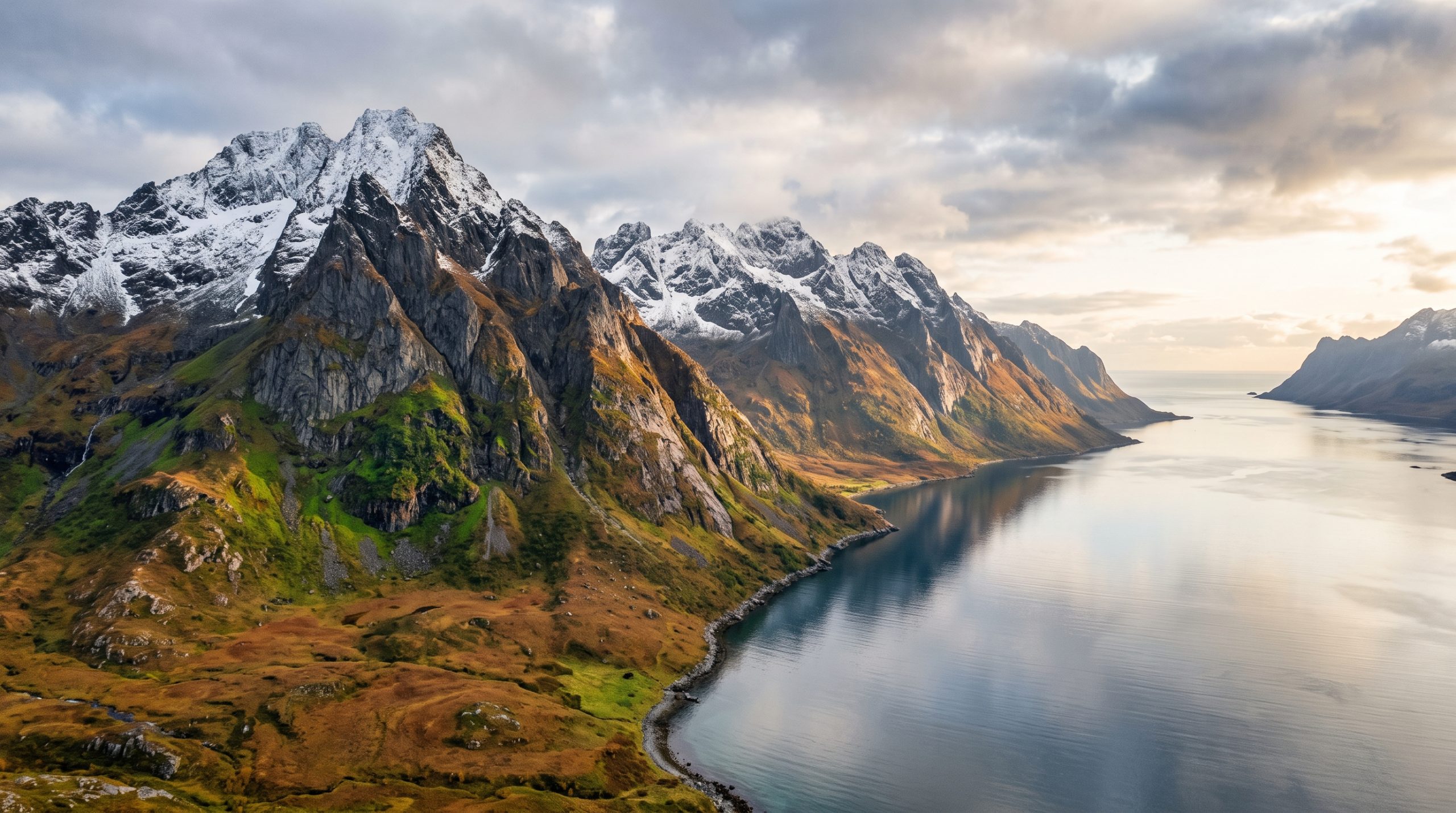
On 1 February the sun is above the horizon in Tromsø for a little over five hours. By 28 February it is up for nine and a half. Same city, same fjord, four weeks apart, and a completely different day to plan.
That is what makes Northern Norway unlike most places couples write to us about. Temperature matters less than light here, and the light does not change gradually. It arrives and leaves in blocks, and it takes the roads, the high trails and the aurora with it.
What follows is the year as we actually plan it: daylight hours by month, how high the sun gets, the fixed dates for polar night and midnight sun, the two months we would move a flexible couple away from, and how we build a strong day in the harder ones.
Why March is the Arctic month we would take first
March. By mid-month Tromsø has about eleven and a half hours of daylight, the sun still tops out near 17 degrees so the whole day stays low and warm-toned, snow cover is at its most reliable, and aurora season runs until early April. No other month hands you both halves of the Arctic year on one trip.
Month by month at 69 degrees north
Daylight figures below are for Tromsø, at 69.6 degrees north. Lofoten sits a degree and a half further south and runs gentler in winter: Svolvær keeps about three hours of sun on 15 January, the day Tromsø comes out of polar night.
| Month | Daylight in Tromsø | Ground and weather | People | Our verdict |
|---|---|---|---|---|
| January | Polar night to 15 Jan, then 2h35 by 20 Jan | Cold and dark, snow arriving on the coast | Peak aurora demand in town | Blue twilight only, so commit to it |
| February | 5h05 on the 1st, 9h23 by the 28th | Deep snow, sun under 10 degrees all day | Busy in Tromsø, calm on Senja | Strong, and gaining an hour a week |
| March | 11h30 mid-month, 12h15 at the equinox | Snow still holding, light climbing fast | Busy, easing late in the month | Our first choice |
| April | 14h on the 1st, 16h by mid-month | Tromsø’s driest month, around 97 mm | The quietest good month of the year | Underrated for mixed snow and bare rock |
| May | 22h mid-month, midnight sun from about 20 May | Sunniest month, near 219 hours | Quiet until the final week | Bright nights without the traffic |
| June | 24 hours | Lofoten’s driest month, 71 mm over 17 days | Filling through the month | Best for a ceremony near midnight |
| July | 24 hours until 22 July | Warmest, Tromsø highs near 17°C | Norwegian holiday month, busiest | Work the small hours instead |
| August | 18h mid-month, 16h30 by the 25th | Warm sea, first colour, first aurora | Drops off sharply after mid-month | Best all-round compromise |
| September | 15h30 on the 1st, 11h20 by the 30th | Colour peaks, Tromsø’s wettest at 141 mm | Much quieter than winter | Autumn colour and aurora together |
| October | 11h10 on the 1st, 6h45 by the 31st | Lofoten’s wettest, 160 mm across 27 days | Quiet everywhere | Aurora yes, ground usually bare |
| November | 6h35 on the 1st, polar night from 27 Nov | Dark early, snow not yet dependable | Quiet before the holidays | Hardest month to plan light around |
| December | No sun above the horizon at all | Twilight at midday, almost no recorded sunshine | Busy around the holidays | Choose it for darkness, not daylight |
Two rows in that table do something no other region we work in can. In June the sun never sets; in December it never rises. Everything else about planning a day here follows from that.
The dates that barely move, and the two that move every year
Polar night in Tromsø runs from 27 November to 15 January. The sun crosses back over the horizon on 15 January, but the city centre does not see it clear the mountain ridge until Sun Day on 21 January, celebrated locally with buns and hot chocolate. Those six days are terrain rather than astronomy, and the skyline you stand under matters as much as the calendar.
Midnight sun in Tromsø lasts from around 20 May to 22 July. In Lofoten the official window is 28 May to 14 July, with Uttakleiv holding it from 25 May to 18 July and Røst, out at the southwestern tip of the archipelago, from 29 May to 13 July. Latitude and skyline set those dates, so they repeat within a day or two every year and a 2028 date can be built around them.
Aurora is the third window and the loosest. The lights may be visible in the Tromsø region from late August to early April, whenever the sky is dark and clear enough. That is a seven-month season, not a guarantee on any one night, and we will not write it into a timeline as though it were scheduled.
Autumn colour and the first lasting snow are the two that wander. Colour can peak in the first week of September one year and hang on into October the next, and the first snow that stays on the coast arrives anywhere from October to December. We put no date on either in a proposal. We put a plan on both sides of them, which is much of what our planning process is for.
The Arctic months we would avoid, and the windows we prefer instead
Late October into November
This is the softest window in the Northern Norwegian year, and we would rather say so than sell it. Lofoten’s wettest month is October, roughly 160 mm across 27 wet days, and by early November Tromsø is down to six and a half hours of sun before polar night closes it on 27 November. Colour has usually gone. Snow has usually not arrived.
If your calendar is open, move it. September gives you colour, twelve hours of daylight at the equinox and strong aurora nights. February gives you deep snow and daylight climbing about an hour a week.
If your date is fixed in November, we build the day inside the hours either side of solar noon, work at sea level where the light reaches, use villages and interiors through the afternoon, and treat aurora as a scene we go out for afterwards rather than one the day leans on. That makes a quieter, more inward day, and it photographs well. It just has to be designed that way from the start.
July
July is the warmest month, with Tromsø highs near 17°C, and the light is extraordinary. It is also the Norwegian holiday month, and Lofoten feels it. Visit Lofoten’s own page on Reinebringen, one of the most walked trails in the country, tells you to expect crowds on the stairs, particularly in July. Roads narrow to passing places, and the car park at every famous beach is full by ten.
Early June solves most of it: Lofoten’s driest month at 71 mm over 17 days, with the midnight sun already up from 28 May. The last week of August solves the rest, with 16 hours 30 minutes of daylight on the 25th and the season’s first aurora. If July is the month you have, we invert the day and work from 22:00 to 02:00, when the coaches have gone and the light is better anyway.
What the sun does at this latitude
At 69 degrees north the sun never gets high. At the summer solstice it peaks near 44 degrees. At the equinoxes it manages 20. In late February it tops out around 9, so the entire seven-hour day is the raking, long-shadowed light a photographer in California gets for forty minutes after sunrise.
That reshapes the timeline. In winter we are not chasing a golden hour, because the whole day is one. On 15 February the sun in Tromsø is up from 08:17 to 15:42 and never climbs above 7 degrees, so vows usually sit between 11:00 and 13:00 and we keep working as the colour deepens.
Midsummer runs the opposite way. Around 21 June the sun in Tromsø reaches its lowest point near 00:40 and is still about 3 degrees above the horizon, so a sunset flattens, holds, and becomes a sunrise without going dark. That is the hour we build around: ceremony at 22:30, portraits until one in the morning, and the flattest light of the 24 falling in mid-afternoon. It is worth seeing what that hour looks like in our galleries and films before you decide which half of the year you want.
Snow lines, ferries and the four-month paperwork window
Access is the part couples underestimate. A ridge that is a straightforward two-hour walk in August is a different proposition in March, and high trails hold snow well into June. Visit Lofoten is explicit that Reinebringen is not recommended in the winter season, so from November through April we plan elsewhere and keep Reine for the harbour, the boat and the red cabins at water level. Winter ground here is lower, closer to the sea and better sheltered, which helps on every count.
The coastal ships keep sailing through the dark months, and the Tromsø to Kirkenes stretch is one of the better ways to get clear of town light for the aurora. Crowding is the more useful thing to plan around. Visit Norway itself recommends autumn over the busy winter months, or heading out to Alta, Lyngen or Senja rather than basing everything in Tromsø. We agree, and most of our days here happen outside the city for that reason.
The legal timing has its own window. The Norwegian Tax Administration issues the marriage licence, the prøvingsattest, and it is valid for four months, so there is such a thing as applying too early. For a March date the useful window opens around November. Non-citizens also need an original certificate of no impediment from the authorities at home, and processing takes time, so the paperwork runs backwards from your date. Municipal civil ceremonies are free for residents of the municipality; if you are not resident, or you want an officiant at an hour or a place that takes extra time, expect a fee. Those fees are yours. The research and the sequencing are ours, and you can see what each experience covers on our pricing page.
Month choice is the first thing we work through with a couple. If you already have one, Check Your Date with us and we will tell you honestly what it gives you and what it takes away.
How we build the Arctic weather fallback before you fly
Every day we plan here carries a wind-direction plan, because wind is what actually decides where you stand. A westerly pushes swell onto the exposed beaches of outer Lofoten and the seaward side of Kvaløya, so we move to the inner arms of the Lyngen fjords or the sheltered southern shore of the Lofoten chain, usually inside thirty minutes of driving. The ceremony hour moves too: within about two hours in winter, when the light window is short, and up to four either way in June.
Aerials work the same way. Drone footage happens where it is legal, safe and appropriate, and winter adds a wind window to the permission, so we design the film to stand without it and take the aerial when the air is still.
Season is also the clearest argument for sending two people. In February the workable light is a few hours long, with no room to shoot the vows for stills and then repeat them for the camera. A dedicated photographer and filmmaker working the same moment from two positions covers it once, live, with the audio recorded as it happens. In late June there is room for one person to work slowly. The month should decide that, and our destination guides take the same approach to other regions.
Common questions
Can we get northern lights and daylight photographs on the same trip?
Yes, and February and March are the two months that make it straightforward. Mid-March gives you around eleven and a half hours of daylight for the day itself, and full darkness by late evening, with aurora season open until early April. December offers the darkness but no real daylight, and June offers no darkness at all.
When exactly is the midnight sun in Lofoten and Tromsø?
Tromsø holds the midnight sun from roughly 20 May to 22 July. Lofoten’s official window is 28 May to 14 July, with Uttakleiv running from 25 May to 18 July. These dates shift by no more than a day or two between years, so they are safe to build a 2027 or 2028 date around.
Is December too dark for a Tromsø elopement?
Not too dark, just differently lit. Between 27 November and 15 January the sun does not rise above the horizon in Tromsø, but the middle of the day is a long blue and rose twilight with real usable light. We compress the day into roughly 10:00 to 14:00, then use lanterns, windows and firelight for the rest.
Which month has the fewest other people in it?
April, and it is the one we wish more couples looked at. Winter tourism has finished, the summer season has not started, Tromsø’s driest month is April at around 97 mm, and you get 14 to 16 hours of daylight over a landscape that still has snow on the high ground. Late September is the runner-up.
How far in advance do we need the Norwegian paperwork?
The marriage licence from the Norwegian Tax Administration is valid for four months, so it cannot be secured a year ahead. Processing takes time and a foreign certificate of no impediment has to come from your own authorities first. We build the sequence backwards from your date and tell you the month to start.
What actually happens if the weather turns on our date?
We move, and we already know where. Each day is planned with named alternatives chosen by wind direction and cloud base, a ceremony hour with tolerance built in, and a running order that can reverse. Nothing about that is improvised on the morning, and nothing about it costs you more.
Do we need snow for a winter elopement to look like winter?
If snow matters to you, book February or March rather than late autumn. October and November are dark but frequently bare, especially at sea level, and we would rather tell you that now than have you arrive expecting white ground. Inland and higher terrain holds snow far longer than the coast, which gives us options in the shoulder weeks.
Picking the month, then the date
Start with what you want the light to do, because up here that one decision makes most of the others for you. Snow, blue twilight and a chance of aurora means February or March. A ceremony at midnight in 24-hour gold means June, and if you would rather have colour, mild air and quiet roads, September.
Tell us the month you are drawn to, or the date you already hold, and we will come back within 24 hours with the daylight figures for it, what it means for access, and where in the region it works best. From the first reply onward, the process stays in writing, at whatever pace suits you, from the first message through to the proposal, the contract and the 30% retainer that starts the planning. There are eight of us, and photography and film are one team, not two bookings.
When you are ready, Tell Us Your Story and we will start with your month.