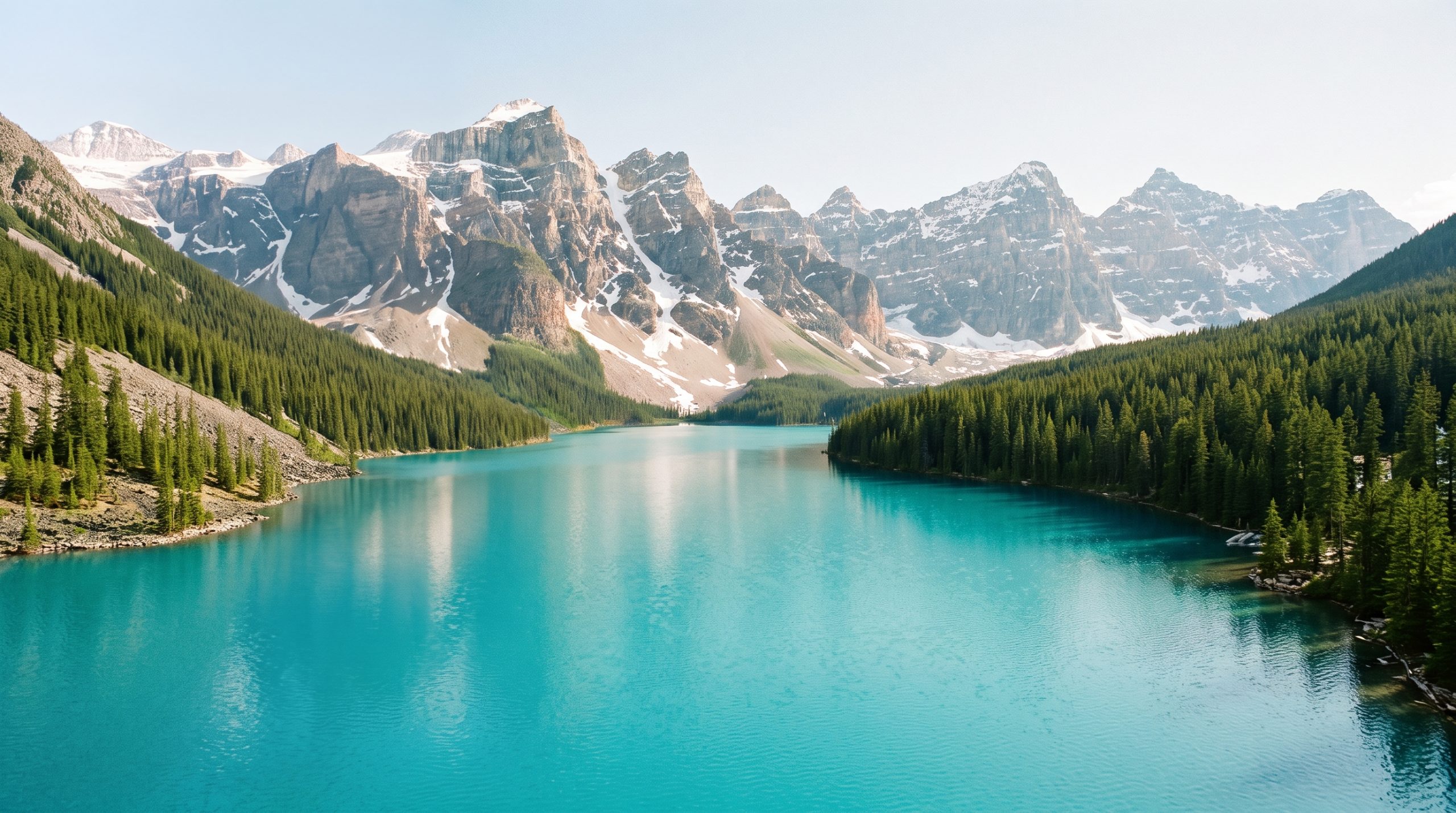
Stand on the shore at Moraine Lake in the third week of May and you are looking at a lake that has not arrived yet. Slabs of ice sit against the far side, the water is low against a wide gravel beach that will be underwater by July, and the color is a flat gray-green. Most years the road is not even open to get you there.
Six weeks later that same shoreline is unrecognizable. Fay Glacier and the ice above the Valley of the Ten Peaks start running properly, and the meltwater carries rock flour, glacial silt ground fine enough to stay suspended and throw light back as that one specific turquoise. The lake fills, the beach vanishes, and the color switches on.
That switch matters more to your date than the temperature does, and it does not follow the calendar most couples expect. It also runs late at some lakes and early at others. Below is how the Banff year actually behaves, with the road dates, the frost dates and the light times we build real elopement days around.
The date we would circle first
For turquoise water with room to work, book the second week of September. The lakes have held full color since late June, Moraine Lake Road is still open, visitor numbers drop after Labour Day, and sunrise lands near 7:20am with sunset near 8:00pm. That is a complete day that does not have to begin at three in the morning.
Ice off, then rock flour: how the color actually arrives
Two separate things have to happen, and people conflate them. First the ice leaves. At Lake Louise that usually falls somewhere between the last week of May and the first ten days of June, and the date moves by roughly two weeks from one year to the next, so a fixed early-June date is a coin toss rather than a guarantee. Moraine Lake sits higher and runs later, and in late May it is often only part thawed with the water level well down.
Then the melt has to load the water. An ice-free lake is not automatically a turquoise one. The saturated color arrives when glacial melt ramps up and puts enough rock flour into suspension, which in a normal year means the third week of June onward at Moraine and Lake Louise, and can be later again at the lakes along the Icefields Parkway. From there it holds, deepens through July and August, and stays until the season closes.
The practical difference between the two headline lakes is access, not color. Lake Louise is reachable every day of the year, which is why we can plan a January elopement there. Moraine Lake exists on your calendar only while the road is open, and in 2028 that window is June 1 to October 12, weather permitting.
Month by month, with the numbers
Sunrise and sunset below are mid-month at Lake Louise, rounded to five minutes. Treat them as the outer edge of your working day rather than the moment light hits the water, for reasons covered further down.
| Month | Water and ground | Light, mid-month | Crowds | Our verdict |
|---|---|---|---|---|
| January to February | Lakes frozen and snow covered | 8:45am to 5:05pm, about 8h20m | Ski traffic, empty lakeshores | Winter day, no turquoise |
| March | Still fully iced, deep snow high up | 8:00am to 7:50pm | Low | Snow country, not water |
| April | Snowiest month of the Banff year, lakes iced | 6:50am to 8:40pm | Lowest of the year | Quietest, coldest palette |
| May | Ice off begins at Lake Louise late in the month | 5:55am to 9:30pm | Building | Too early for color |
| June | Color builds fast after mid-month; wettest month | 5:30am to 10:05pm, about 16h35m | Ramping hard | Strong from about the 20th |
| July | Full turquoise, highest water, warmest air | 5:45am to 9:55pm | Peak of the year | Yes, with dawn starts |
| August | Full color, driest ground, haze possible | 6:30am to 9:05pm | Peak into mid-month | Yes, evenings are excellent |
| September | Full color, larches turning, first frosts | 7:20am to 8:00pm | Falls after Labour Day | Our pick |
| October | Color holds, snow on the peaks, fewest wet days | 8:10am to 6:50pm | Thin after the road shuts | First ten days, excellent |
| November | Lakes closing over, snow not yet deep | 8:00am to 4:55pm, about 8h50m | Very low | The thinnest month |
| December | Frozen lake, skating and lanterns at Lake Louise | 8:45am to 4:35pm, about 7h55m | Rises over the holidays | Real winter, no turquoise |
Larch gold and first snow: two narrow windows
Parks Canada puts peak autumn color in the Lake Louise larches at mid to late September, and the strongest of it is a matter of days rather than weeks. The exact week shifts with the summer that preceded it. Plan a date, not a week, and accept that you may land on gold going green or gold going bare.
Larch Valley above Moraine Lake takes the entire influx, which is why Parks Canada publishes eight other larch hikes around Lake Louise. We use those. The second window is shorter still and worth knowing about: the few days when fresh snow sits on the Ten Peaks while the water below is still fully colored. That combination tends to appear from the last days of September into the first week and a bit of October, before the road closes on October 12.
When turquoise-lake timing is not worth forcing, and what we choose instead
April and May are the two we argue about most. April is the snowiest month of the year in Banff, the lakes are still ice covered, and Moraine Lake Road has not opened. May reads like spring in a booking calendar and behaves like late winter on the ground: ice off may or may not have happened at Lake Louise, water levels are down, and the color has not started. If turquoise is the reason you chose Banff, we will push you to late June or to September, and we will say so plainly rather than let you find out on the day.
If your date is already fixed in April or May, that is not a problem to solve, it is a different day to design. Those months hand you things September cannot: Lake Louise under ice with Victoria Glacier behind it, the lower Bow Valley opening up while the high country stays white, viewpoints with nobody in them, and no shuttle window governing your morning. Average last spring frost in Banff is June 7, so a May morning is genuinely cold and genuinely still, which is its own kind of picture.
November is the one month we rarely recommend at all. The lakes are closing over without yet being the deep-winter scene, snow cover is patchy at valley level, and mid-month daylight is down to about 8 hours 50 minutes. Couples set on that time of year usually end up happier in December, when the frozen lake and the lantern-lit shoreline at Lake Louise become the point instead of a compromise. Tell us the date you are holding and we will tell you honestly what that month does best.
Light, shadow and the ceremony hour
Printed sunrise times assume a flat horizon, and Banff has nothing of the kind. At Moraine Lake and Lake Louise the summits catch light long before the shoreline does, so the first frame of the morning is alpenglow on rock with the water still sitting in shade. That is not a compromise, it is the better photograph, and it is the reason our timelines list two separate hours for dawn: when the peaks light, and when the shore does.
Through late June and July the sun is high and hard by mid-morning and stays that way, which compresses the good light into the two ends of a very long day. Sunset near 10:05pm in mid-June means an evening ceremony finishes in warm light at an hour when most guests would expect dinner. By mid-September the sun tracks lower all day, the warm window stretches out, and vows sit comfortably between 4:00pm and 6:30pm without anyone setting a 3am alarm. You can see how both ends of the year read in our published elopement galleries and films.
Season is also the honest argument for having a photographer and a filmmaker on the ground at the same moment. In June you have 16 and a half hours of daylight and can afford to do things twice. In early October the whole usable window is roughly two hours at each end of the day, and a filmmaker working after the photographer has finished simply runs out of light. Coverage options and what each one includes are set out on our pricing page.
Tell Us Your Story with the month you have in mind, and we will come back with the light times for your actual date and the version of the day that suits it.
How shuttles, road dates and weather shape the route before anything else
Moraine Lake Road is closed to private vehicles for the whole season. Access is by Parks Canada shuttle from the Lake Louise Park and Ride, by licensed bus and tour operators, or on Roam transit, and the seats are reserved rather than turned up for. Dedicated sunrise departures exist, run by Parks Canada and by private operators including Moraine Lake Bus Company, and they are the piece we book first when a couple wants dawn at the Ten Peaks. The 2028 season runs June 1 to October 12. Outside it, Moraine is off the table and Lake Louise carries the day.
Ceremonies in the national park outside the Banff townsite need permission from Parks Canada, and locations inside the townsite are booked through the Town of Banff, which takes facility bookings up to 18 months ahead. Permit research and the applications are our work; the government and venue fees themselves are yours. Drones are prohibited in Canada’s national parks, so a Banff film is built on the ground, from movement, sound and the way light drops down the valley walls. Our guide to planning an elopement covers the paperwork sequence in more detail.
Then the weather. June averages about 14 days with precipitation, the most of any month, and October about 8, the fewest, so a plan built on hoping for a mirror surface is not a plan. Ours is written before anyone flies. Every timeline names a primary location and a wind-direction alternative, because a west wind that breaks the reflection at Lake Louise does nothing to the moraine boulders or the forest edge, and both photograph better in flat light anyway. The ceremony hour is written to move, usually by 90 minutes either way. When cloud sits low on the peaks we drop elevation instead of cancelling, and the Bow Valley viewpoints keep working when the high country has disappeared. More seasonal detail on individual locations sits in our destination elopement guides.
Common questions
What month does Moraine Lake turn blue?
The ice leaves in late May, but the water level stays low and the color stays dull until glacial melt increases. Reliable saturated turquoise starts around the third week of June, deepens through July and August, and holds until the road closes in October.
Is Lake Louise still frozen in late May?
Sometimes. Ice off usually falls between the last week of May and the first ten days of June, and the date swings about two weeks year to year. We plan both versions for any date in that range, and a frozen Lake Louise with Victoria Glacier above it is a strong day in its own right.
Can we have our ceremony at Moraine Lake if cars are not allowed up the road?
Yes. While the road is open, June 1 to October 12 in 2028, access is by shuttle, licensed operator or guided tour, and we book that transport into your timeline including the sunrise departures. The return schedule shapes the ceremony hour, which is exactly why it is planned rather than improvised.
Can we get golden larches and turquoise lakes on the same date?
Yes, and mid to late September is the overlap Parks Canada names for peak larch color. The lakes are still fully turquoise then. The strongest week of gold moves with the weather, so we build alternatives at different elevations rather than betting everything on one slope.
What are the odds of a still morning for reflections?
Dawn is the calmest hour of the day, which is why we work it, but nobody can sell you a mirror. In June roughly one day in two carries precipitation; October averages about eight wet days across the month. Every timeline we write has a version that works with a broken surface and low cloud.
Can you fly a drone for our film in Banff?
Not inside the national park, because drones are prohibited in Canada’s national parks. It changes how the film is shot rather than how good it is, and Banff gives you scale from the ground that most places cannot. In destinations where aerials are permitted, they are part of what we deliver.
We already hold an April date. Is Banff still worth it?
Yes, with a different shape to the day. April is the snowiest month in Banff, so the day runs on snow, ice and rock rather than turquoise, with Lake Louise frozen and viewpoints all but empty. Send us the date and we will design it around what April does well.
Choosing the date by ice-off and water colour
Our calendar is currently open across 2027, 2028 and 2029, and Banff dates in September go early. Send the inquiry form and you will have a reply and our brochure back within 24 hours, then a tailored proposal for your date. We keep the planning in one written thread, at your pace, across whatever time zone you are in. Planning starts once the contract is signed and the 30 percent retainer is paid.
Send us the week you are considering and the shape of day you want, and we will tell you what the lakes and the light are actually doing then. Check Your Date.