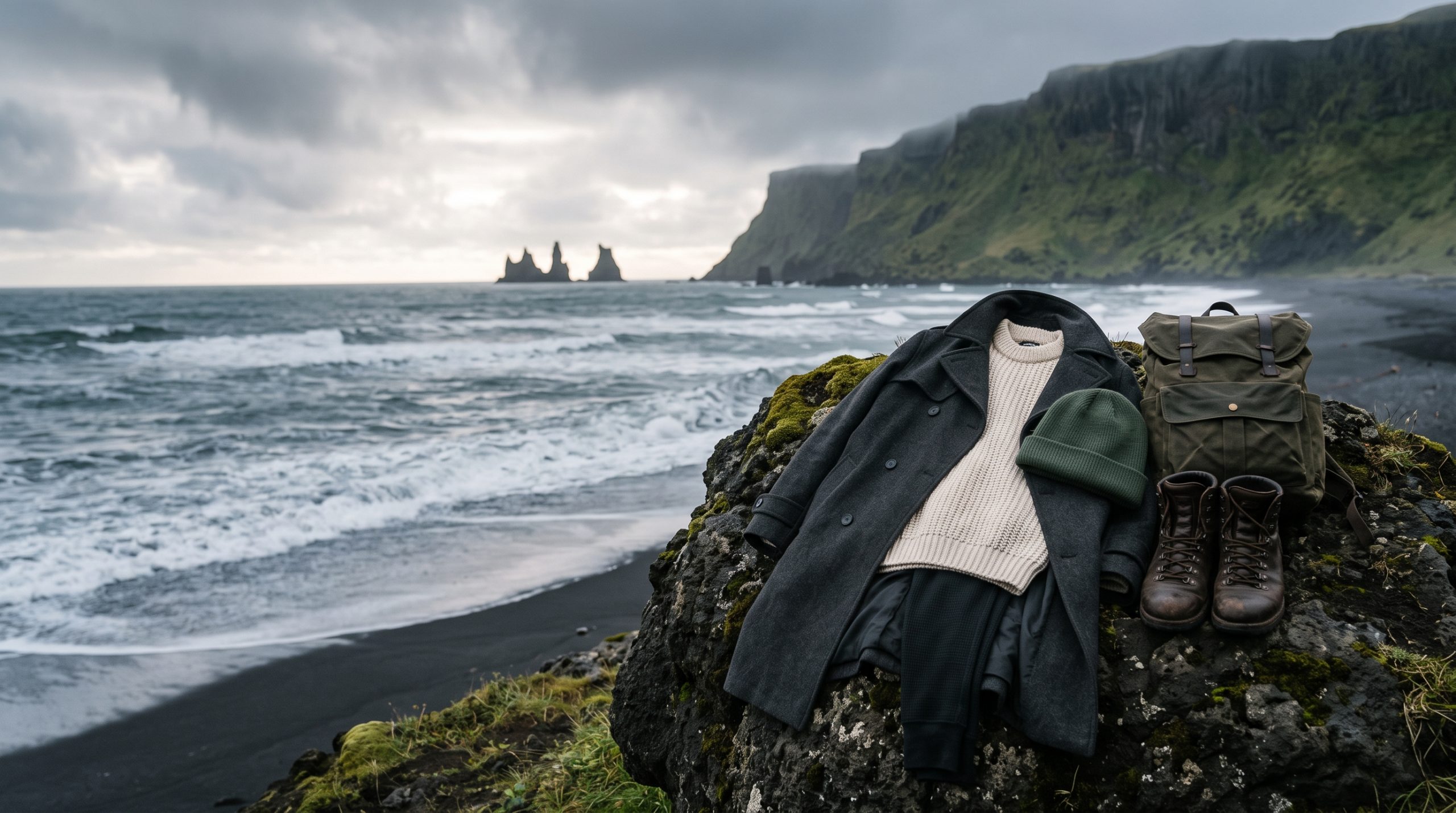
Icelandic forecasts are written in metres per second rather than miles per hour, and that single detail should change how you pack. An ordinary day on the Met Office page reads 3 to 10 m/s. Ten metres per second is roughly 22 mph. Nobody local would comment on it, and it is still enough to lift a cathedral veil to horizontal and hold it there for the length of your vows.
The temperature is the part that misleads people. July is the warmest month in Reykjavik, with an average high near 13 C, about 56 F, and lows around 9 C. Those are mild numbers on paper. The Icelandic Met Office publishes a wind chill table precisely because the gap between the reading and the body is so wide, and its own worked example puts minus 12 C with a 12 m/s wind at the equivalent of minus 24 C in still air.
So the packing list is not really about warmth in the abstract. It is about what a particular fabric does on a particular hem, at a particular hour, in moving air. This is what we tell couples before they buy anything.
Dress for 10 m/s, not for 10 degrees
Wear merino next to the skin, a dress or suit in a fabric with weight to it, and waterproof boots you can walk lava in. Add a windproof shell that comes off for the frame and goes straight back on. Iceland’s air temperature is mild almost all summer. The wind is the thing you actually dress for.
The layer nobody sees
Merino wool against the skin does most of the work, and none of it shows. A 150 gsm base layer in a skin tone vanishes under everything except the thinnest silk. A 200 gsm layer is the winter version and is still thin enough to sit under a fitted bodice. Leggings that stop at the ankle bone keep the line clean above a boot. Look for flat seams, because a raised seam under a close-cut dress prints through in a way that no amount of light fixes.
Cotton is the one thing to leave at home. It holds water against you and stays cold once it is wet, and Icelandic rain tends to arrive sideways rather than from above, so it finds the gap at the neck and the cuff first. Silk long johns are the alternative if merino irritates your skin.
For the person in the suit, a thin merino crew under the shirt does more than a heavier jacket. Wool socks, not cotton. A jacket cut with enough room that the base layer underneath does not pull across the shoulders when your arms go around someone. Hand warmers belong in the coat pocket rather than the trouser pocket, where they warm your hands between frames instead of printing a rectangle through the fabric.
Fabric behaves differently at 12 m/s
Every dress looks calm on a hanger in a shop with the door closed. The useful question is what the fabric does when air is moving through it at the speed Iceland moves air on an average afternoon. Weight and structure win. Movement is welcome, and it needs to be movement you chose.
| Fabric | In a 12 m/s wind | In Icelandic rain |
|---|---|---|
| Heavy crepe, mikado, duchess satin | Holds its line, moves at the hem only | Darkens where it is struck, keeps its shape, dries slowly |
| Chiffon or tulle overlay | The best movement you will get on camera, and the hardest to keep off your legs | Goes limp and clings within a minute |
| Silk charmeuse slip | Reads beautifully below about 8 m/s, wraps tight above it | Turns translucent quickly |
| Lace over a structured lining | Stable, though a loose bell sleeve fills like a sail | Fine in drizzle, heavy once it is soaked through |
| Wool cape or a tailored coat | The most useful thing in your bag | Sheds light rain for a long time |
Wind is also what gives an Icelandic film its motion. A skirt that lifts, a coat that snaps, grass laid flat across a whole hillside behind you. It is the difference between footage that looks like a studio and footage that looks like the North Atlantic, and you can see how it reads in the films and galleries we publish.
Veils, hair and everything else the air can grab
A cathedral veil is a sail. We love them and we plan for them, which means one held frame with two people on the fabric, then it comes off and goes in the bag. A fingertip veil with the comb set low behind an updo survives far more. Loose hair below the shoulders will be across your face in most frames above 8 m/s, so a braid, a low knot or a half-up style with pins set against the prevailing direction is worth the fifteen minutes it costs. Bring more pins than you think and a small can of firm hold. Skip anything you have to hold with a hand: a hat that needs steadying, a bouquet wrapped in long trailing ribbon, a hem you have to keep gathering.
Boots first, and the twenty seconds you change out of them
Almost nowhere in Iceland is a smooth surface. Lava is sharp and rubbly, river gravel rolls underfoot, and wet moss is slick. Waterproof leather or synthetic boots with a lugged sole and real ankle support are the footwear for the day, worn under the dress for every approach and every walk between locations. We keep to gravel, marked paths and bare rock, because the moss is slow-growing and we would rather it stayed where it is.
Ceremony shoes come out of the pack when we arrive, get worn for as long as they are comfortable, and go away again. Heels sink into black sand and skate on wet basalt, so if you want a heel in the frame, plan on it being a still frame rather than a walking one. Many couples end up preferring the boots in the pictures anyway.
One detail about black sand that catches people out. Dry sand brushes off a hem with a hand. Wet sand does not, it grinds in and sets, and it is still there three hours later at the next location. So we work the sand before the water line, not after, and we build the coastal hour around the tide table and the wind direction, with a sheltered alternative held within a short drive.
The ceremony hour is its own climate
Everything above assumes you are moving. For twenty to forty minutes you will be standing still with the coat off, and that is the part of the day the clothing has to be genuinely built for. Standing still in 10 m/s at 9 C is a completely different experience from walking in it.
Light decides when that window falls. Around the June solstice the sun rises in Reykjavik before three in the morning and sets just after midnight, so we can place vows at ten in the evening, in low soft light, and you only have to be coat-free once. At the winter solstice the city gets a little over four hours of daylight, with sunrise near 11:20 and sunset around 15:30, so the ceremony sits in the middle of the day and the light stays low the entire time. Both are good. They ask different things of what you are wearing, which is why the timeline and the outfit get planned together rather than separately, and why the way a day gets built matters more than any single garment.
Season by season, what goes in the bag
Iceland’s clothing problem changes shape roughly four times a year. The table below is the version we send couples once we know the month, alongside the location notes in our destination guides.
| Window | Reykjavik air temperature | Light | What we add to the outfit |
|---|---|---|---|
| June to early August | Highs near 13 C (56 F), lows near 9 C | Sun up before 3am, down just after midnight at the solstice | One merino layer, a packable shell, and a late evening ceremony instead of an early morning one |
| Late August to October | Falling steadily from summer highs | Real darkness returns, which is what makes northern lights frames possible | A proper waterproof over-layer. Rain falls on roughly 18 days in an average September in Reykjavik |
| November to February | Highs around 1 to 2 C | Just over four hours of daylight at the solstice, sunrise near 11:20, sunset near 15:30 | Two base layers, insulated waterproof boots, gloves you can pull off in one movement |
| March to May | Climbing from near freezing into single figures | Daylight gains quickly, several minutes a day | Winter kit through March, traction spikes for icy paths, and lowland locations while higher ground is still under snow |
The sea does not warm up the way the air does. It peaks around 11 C off Reykjavik in high summer, so spray on a south coast beach in July is cold spray, and a soaked hem stays cold for the rest of the morning. That is a reason to carry a second pair of dry socks, not a reason to skip the coast.
Tell us the month you are considering and what you already own, and we will tell you what it will actually be like to stand in it. Check Your Date.
What rides in our car
We work as a team of eight, and on an Iceland day that usually means two vehicles rather than one. While one of us stays with you, someone else is already at the next stop reading the wind direction and finding the sheltered side of it, which is how a location change costs you fifteen minutes instead of an hour. A second full set of gear travels with the second car, so a long drive across the south coast never rests on one bag.
Practically, that also means we carry the things people forget. Towels, spare gloves, hand warmers, a dry bag big enough for a gathered dress, and a windproof layer in a size that fits most people. Team travel is included worldwide, so what comes with each experience is set out plainly on our pricing page rather than assembled from add-ons at the end.
Common questions
Can I wear a strapless dress in Iceland?
Yes, and it works best paired with a wool cape or a tailored coat that comes off for the frame. A strapless bodice with a structured lining holds its position in wind better than a soft one. Plan on the coat being on between locations and off for perhaps twenty minutes at a time.
Will my veil survive Icelandic wind?
A fingertip veil with a low comb handles most days. A cathedral veil is a one-frame proposition above about 8 m/s, and we plan for that deliberately, with two of us on the fabric for a held shot before it goes back in the bag.
What do I actually wear on my feet under the dress?
Waterproof boots with a lugged sole and ankle support, for every approach, every lava field and every gravel path. Ceremony shoes live in the pack and come out when we arrive. Heels sink in black sand, so keep them for still frames.
How cold does July really feel?
Reykjavik highs sit near 13 C, about 56 F, and lows near 9 C. Standing still in moving air is the part that surprises people, which is why one merino base layer and a windproof shell make a July day comfortable rather than endured.
Should I bring an umbrella?
No. Icelandic rain generally arrives horizontally and an umbrella becomes something you have to hold with both hands. A hardshell with a wired hood, or a wide hood on a wool coat, does the job and looks better in the frame.
Do we need more than one outfit for the day?
Usually not, but a second warm layer and dry socks are worth the space. Couples adding a glacier tongue, a hot spring or a long hike often want a change for that section, and we build a place and a window for it into the timeline.
Tell us what you are planning to wear
Send us the month, the dress or suit you have in mind, and the kind of ground you want under your feet, and we will come back with a timeline built around real light, a location plan with a sheltered alternative for each stop, and a straight answer about what that fabric will do outside. We are booking 2027, 2028 and 2029. Everything happens in writing, at whatever hour suits your time zone: the inquiry form comes straight to us, and a reply with our brochure follows within 24 hours. Start Your Story.