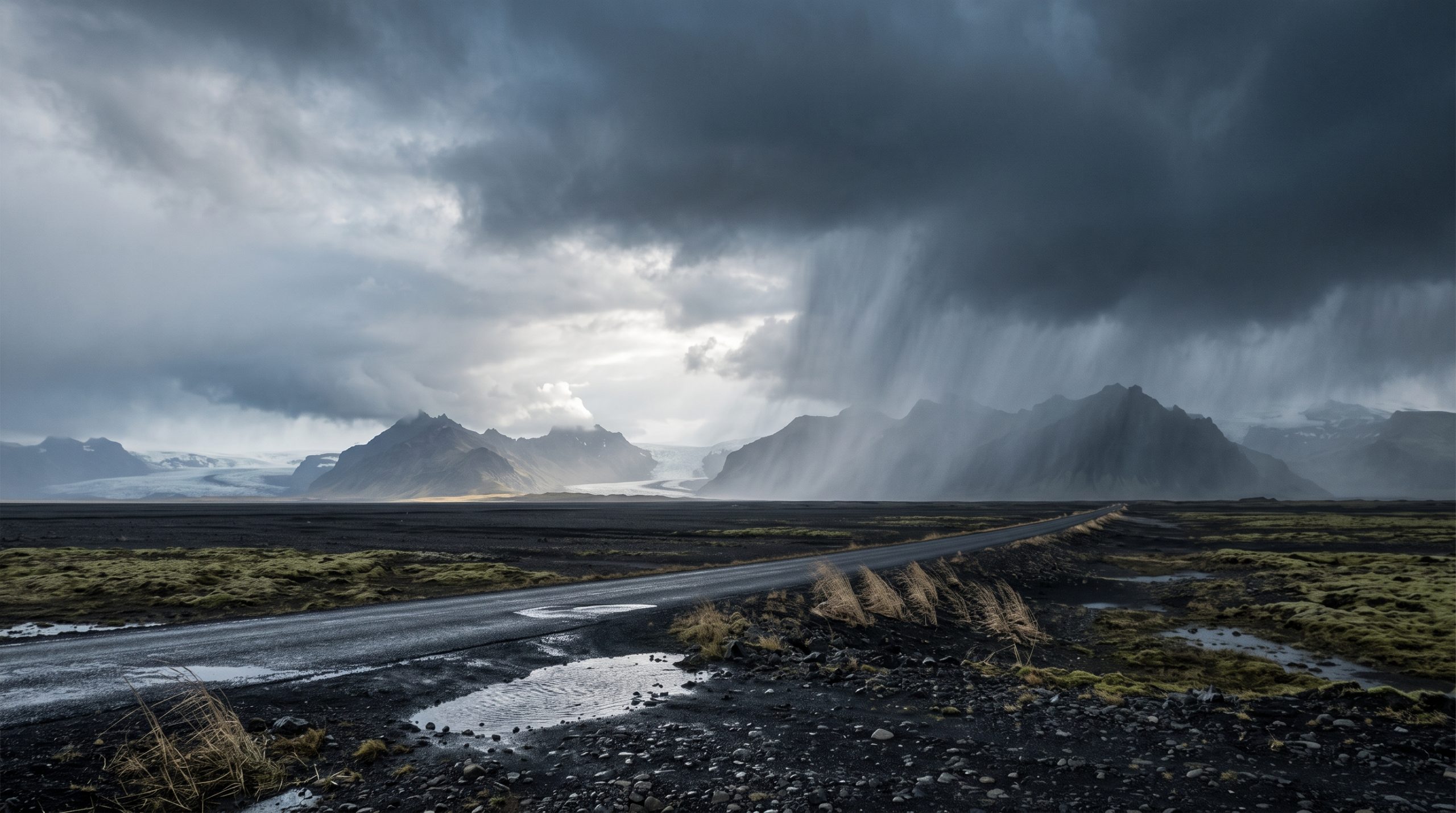
The forecast couples worry about is usually the one that changes least. Rain in Iceland is a wardrobe decision. Wind is the thing that rewrites a day, and it arrives in metres per second, because that is the unit every Icelandic forecast uses and the unit our plans are built around.
On a mid-December morning in Reykjavík the sun comes up at 11:22 and is gone by 15:29. In mid-June it sets at 23:58 and the sky never fully closes. Those two numbers shape an Icelandic wedding day far more than any storm will, and they are the ones almost nobody checks before choosing a date.
So this is what moves, month by month, what stays exactly where we put it, and what we do on the morning the map turns orange.
Wind moves the day. Rain almost never does.
Rain, drizzle and low cloud do not cancel an Icelandic elopement day, and we photograph and film through all three. Wind and road access are what change the plan. Above roughly 15 metres per second we move the ceremony to sheltered ground rather than lose the hour, and in winter the four-hour daylight window governs everything else.
Why we would put your date in the first half of September
If you handed us a blank calendar, we would take the first two weeks of September. Mid-September in Reykjavík gives sunrise at 06:48 and sunset at 19:59, so there are just over thirteen hours to work with and no need to be standing on a ridge at 3am to catch first light.
The sun peaks around 29 degrees above the horizon at that point in the year, which means the light stays raking and low for most of the afternoon instead of climbing overhead and flattening everything for six hours. The highland roads are still open. The summer coach traffic has thinned. And genuine darkness has returned, so the aurora becomes a real possibility on the same trip without the day itself being built around it.
Our second choice is the second half of August, when the sea off the south coast reaches its warmest point of the year at about 10.5°C, or 51°F, and the light still runs to nearly ten at night. If a September date is gone, that is where we go looking next, and our destination guides break down which regions hold up best in each stretch.
Twelve months of light, wind and access
Daylight figures are for Reykjavík at mid-month. Rainfall notes use the 1991 to 2020 averages, where the year runs from roughly 40 millimetres in June to about 100 millimetres in December, and the annual total sits near 870 millimetres.
| Month | Conditions | Light at mid-month | People | Our verdict |
|---|---|---|---|---|
| January | Mean around 0.6°C, or 33°F, and the windiest stretch of the year | 5h19m, sun peaks at 4.6 degrees | Emptiest month on the south coast | Tiny window, extraordinary light |
| February | Snow cover most likely, frequent gales | 8h31m, three hours more than January | Still quiet midweek | Underrated |
| March | Sea at its coldest, about 5°C, mixed snow and rain | 11h35m, sun to 23 degrees | Building steadily | Snow with usable hours |
| April | Drying out, highlands still under snow | 14h58m, dark nights end near 10 April | Golden Circle busy by 10am | Long days, low ground only |
| May | Green arrives, first mountain roads inspected | 18h17m, no true night after mid-month | Noticeably calmer than June | Quiet and green |
| June | Driest month in Reykjavík, near 40mm | 21h01m, sunset at 23:58 | Peak coaches, empty at 2am | Book it for the light |
| July | Calmest air of the year, mean wind near 4 m/s | 19h51m | Busiest month everywhere | Gentlest weather, most company |
| August | Warmest sea, about 10.5°C, first dark skies late in the month | 16h33m | Easing after the middle | Our second choice |
| September | Autumn colour inland, wind picking up | 13h11m, full darkness back | Falls away fast after the 15th | Our first choice |
| October | Highland roads closing, first snow on passes | 9h57m | Quiet outside Reykjavík | Colour, wind, short days |
| November | Storm track active, snow at sea level possible | 6h37m, sun peaks at 7.6 degrees | Very quiet | All-day low sun |
| December | Wettest month, near 100mm, mildest of the three winter months | 4h08m at the solstice, latest sunrise on 25 December | Reykjavík busy, coast empty | One long golden hour |
The windows that open and close inside a fortnight
Some of Iceland is available all year. Some of it exists for about ten weeks, and the dates move.
The highland F-roads are closed through winter and open in stages between late May and mid-July. F35 across Kjölur is usually among the first, in late May or early June. F208 into Landmannalaugar and F249 towards Þórsmörk typically open from the middle to the end of June. The remote interior, including Sprengisandur and the routes towards Askja, often waits until early July. Vegagerðin, the road administration, sets each opening after physically inspecting the route and publishes it on umferdin.is, so the dates shift by two or three weeks from one year to the next depending on snowmelt and river levels.
Darkness has its own calendar. In Reykjavík the sun stops dropping far enough below the horizon for a properly dark sky in the second week of April, and it does not return until the first days of September. Between mid-May and late July it sits within about eight degrees of the horizon even at midnight, which is why a June ceremony at eleven at night still has light on faces.
The midnight sun peak is narrow too. The solstice gives Reykjavík 21 hours and 9 minutes between sunrise and sunset, and by 15 August that has already dropped to 16 hours and 33 minutes. Four weeks either side of the solstice is the whole of it.
If your date has to sit outside one of these windows, tell us which window matters to you. There is almost always a region that delivers the same feeling three weeks earlier or later, and we would rather redesign the location than hand you a compromise on the day.
The stretch we would steer you out of, and what we do when the date is fixed
Mid-November to mid-January is the hardest stretch to build a full day around. On 15 December Reykjavík gets 4 hours and 15 minutes between sunrise and sunset, the latest sunrise of the year falls on 25 December at 11:23, and December is also the wettest month in the capital. The sun tops out at 2.4 degrees above the horizon at the solstice. That is not a flaw, but it is a very small container.
If the date can move, late February is the sensible swap. By 15 February the day has stretched to 8 hours and 31 minutes, roughly three hours more than mid-January, and snow cover is at its most reliable. You keep the winter look and gain a working afternoon.
If the date cannot move, and often it cannot, we build the whole thing inside the window rather than fighting it. Ceremony around 12:30. Everything within about forty minutes of one base, so no hour is spent driving in the dark. Dinner at four in the afternoon because the light has already gone. Then, if the sky clears, we go back out for the aurora as a bonus rather than a promise, because nobody can forecast it further than a couple of days ahead and we will not sell you a sky.
What the light actually does at 64 degrees north
This is the part that changes photographs and films more than temperature ever will. At the June solstice the sun rises at an azimuth of about 20 degrees and sets at about 340, so it swings around the northern sky and lights north-facing coastlines that get nothing at lower latitudes. At the December solstice it crawls from 152 degrees to 208, a shallow arc across the southern sky, and never rises above the height of a low hill.
Practically, that gives three completely different working days. In mid-June the sun spends about 115 minutes between six degrees of altitude and setting, then does the same again on the way up, so the warm band runs for hours and you can work slowly across three locations. In mid-September the same band lasts about 63 minutes, which is enough for one main location and one detail stop. In mid-December there is no band, because the sun never gets above 2.4 degrees. The entire four-hour day is that light. Every frame is side-lit and long-shadowed, and the only question is where you point it.
Season is also why the two-person question matters. A June evening is generous, and a single photographer or a single filmmaker has room to work a location properly and then move. A December day gives four hours total, and in those conditions a dedicated photographer and filmmaker on the ground at the same time means nobody is choosing between the still frame and the shot, and the vows do not have to be repeated for a second angle. What that looks like across different seasons and coastlines is visible in our galleries and films, which is the fastest way to see what a low winter sun or a north-lit June midnight actually does.
What the bad-weather version of the day looks like before you arrive
Weather planning is not optimism. It is a document, written weeks ahead, that lists the places we will go if the wind is on the wrong side of the mountain.
For every day we cover, there is a primary location, a sheltered alternative usually within thirty minutes, and a third option facing the opposite direction, because a southerly at 18 metres per second turns one headland unworkable and leaves a valley fifteen minutes inland completely calm. Ceremony time is written as a movable block, not a fixed hour, so an afternoon of horizontal rain can swap places with a clear morning without touching anything else in the timeline.
On the day itself we work from Icelandic sources rather than one global app. The Met Office at vedur.is runs a four-colour warning system, and its own forecasts flag gusts near mountains separately from the general wind figure, which is exactly the detail an international forecast smooths away. Vegagerðin’s condition map at umferdin.is shows every route as passable, difficult or closed, and it updates through the night. Yellow on the Met Office map usually means we dress differently. Orange means we move to the plan we already wrote. Red means the country pauses, and the ceremony hour moves to the following morning, which is one of several reasons we suggest keeping the day after your date free.
None of this depends on your guest count, and the coverage itself does not change with the season. What each experience includes is set out on our coverage and pricing page, and the sequence of planning decisions is walked through in how to elope.
Send us the date or the rough week you are considering and we will tell you what that stretch usually does, what is open, and how much daylight you actually have. Check Your Date.
Common questions
Will rain cancel our Iceland elopement day?
No. Rain and low cloud change which lens we reach for and how long we stay in one spot, not whether the day happens. Reykjavík averages around 870 millimetres of precipitation a year spread across most months, so a completely dry day is the exception rather than the plan.
How much wind is too much for an outdoor ceremony in Iceland?
Icelandic forecasts give wind in metres per second, and the practical shift comes around 15. Below that, an exposed clifftop is fine and dresses behave. Above it we move to a sheltered valley, a lava field with structure, or the leeward side of the same headland, which is why every plan carries alternatives chosen by wind direction rather than by scenery alone.
Is December too dark to get married in Iceland?
No, but it is small. The solstice gives Reykjavík 4 hours and 8 minutes between sunrise and sunset, with the sun never climbing above 2.4 degrees, so the whole day is low golden light. We build the ceremony around 12:30 and keep every location within about forty minutes of one base.
Can you promise northern lights on our elopement night?
Nobody can. Genuine darkness returns to Reykjavík in the first days of September and lasts until around 10 April, so anything inside that window is possible, and aurora forecasts are only useful two or three days out. We treat it as something we chase after the day is complete, with the timeline never depending on it.
When do Iceland’s highland roads open for a summer elopement?
In stages between late May and mid-July. F35 over Kjölur often opens first, F208 into Landmannalaugar and F249 towards Þórsmörk usually from mid to late June, and the deep interior frequently not until early July. Vegagerðin inspects each route before opening it, so plan a highland location for July or August rather than mid-June.
Do we need to hold a backup date?
Not a second wedding date, but keeping the day after free is genuinely useful, especially between November and March. It gives us a second sunrise and sunset to work with if the wind arrives on the wrong side of the mountain, and it costs nothing but one extra night of accommodation.
Give us the week; we will tell you what Iceland can do with it
Our current availability runs across 2027, 2028 and 2029, and the earlier a date lands with us, the more of the good light we can design around rather than react to. The whole planning process stays written and easy to revisit, so you can read, think and answer at your own pace across time zones. Tell us the week, the region you are drawn to, and whether you would rather be up at 3am in June or eating dinner in the dark in December, and we will tell you honestly which of those Iceland does best for you. Tell Us Your Story.