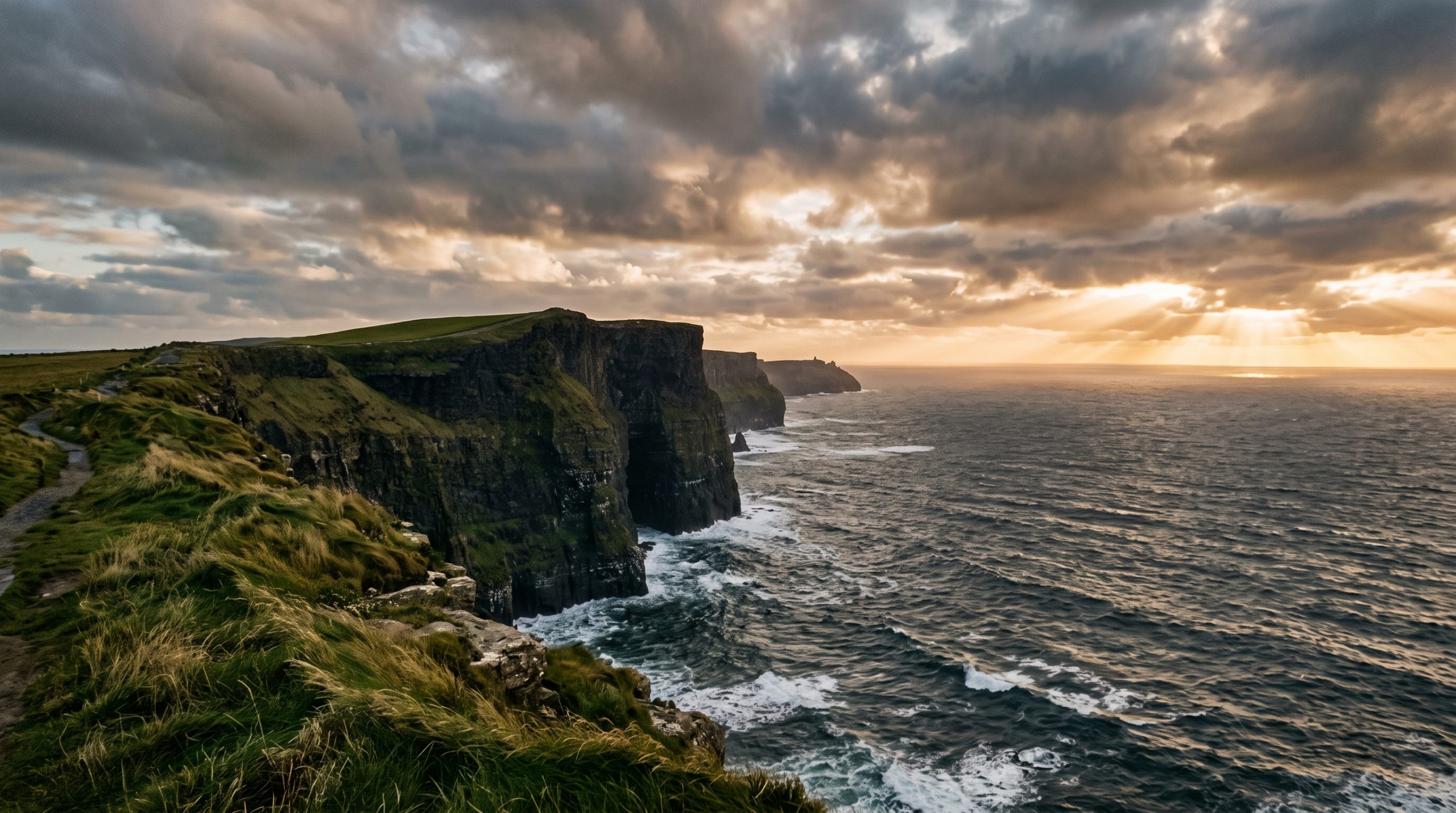
In the third week of June the sun sets over the Clare coast at 22:07, and the Cliffs of Moher Experience closes its gate at 21:00. The best hour of light on the most photographed cliff in Ireland happens after the car park has emptied. That one mismatch decides where we park, which direction we walk in from, and what time we ask you to eat dinner.
Mid-December is the reverse. Sunrise at Doolin lands at 08:49 and the site opens at 09:00, so the low slanted light of a winter morning is still lying across the 800 metres of paved path when the gate lifts. Same cliff, same ticket, completely different plan. Clare County Council runs the visitor experience and publishes its hours month by month, which is why we read them before we read anything else.
This page is about what a film of your Irish elopement costs, and about the things on this coast that actually move the number: the hour the light works, the permission a national park or a heritage site needs, and how far you are willing to drive between two headlands that both deserve an hour.
Where a film day in Ireland starts
We film elopements across Ireland, from the Burren to Slea Head to Connemara, with photography, film and planning from one team of eight. A full day covered by one dedicated filmmaker starts at $4,900. A day with a photographer and a filmmaker working together costs more and delivers both. Team travel to Ireland is included in either.
Eighteen hours of light in June, seven in December
Ireland sits far enough north that the length of your day is the single biggest planning variable, bigger than weather and much bigger than location. On the Clare coast in the third week of June, usable light starts at 04:20 and has not fully gone at 22:59. Six months later the sun is up for seven and a half hours and everything has to happen inside them.
| On the Clare coast | First usable light | Sunrise | Sunset | Last usable light |
|---|---|---|---|---|
| Third week of June | 04:20 | 05:11 | 22:07 | 22:59 |
| Start of May | 05:25 | 06:05 | 21:05 | 21:45 |
| Late March | 06:04 | 06:39 | 18:52 | 19:27 |
| Mid-October | 07:28 | 08:03 | 18:43 | 19:18 |
| Mid-December | 08:06 | 08:49 | 16:22 | 17:05 |
Those times shift as you move up the coast. The same June evening that ends at 22:07 in Clare runs until 22:17 on Achill, and 22:13 at Clifden. Ten minutes sounds like nothing until you are trying to hold two headlands in one evening and the second one is an hour’s drive north.
A June day, then. We start at 03:40, because first light is 04:20 and the ground you want has to be underfoot before it. The getting ready happens in a cottage kitchen at an hour that feels ridiculous, the walk in happens with head torches, and by the time the sky begins working nobody is thinking about the time. Sunrise at 05:11 comes over your shoulder from the Burren behind you, so the rock lights up and the Atlantic stays dark and heavy. That reads beautifully on film and it is the reason we shoot the morning facing out and save the silhouettes for the far end of the day.
Then there is the middle. We will be honest about it, because pretending otherwise wastes your money: from late morning until the middle of the afternoon the main viewing platforms at Moher carry coach traffic and the light overhead is flat and grey-bright. It is the worst hour of the day at the most famous place on the coast. So we are not there. We spend it twenty minutes inland on the limestone pavement of the Burren, or on a green road with nothing in it, or asleep, because you are getting up at 03:40 again if the second morning is better than the first.
Ceremony hour is the one fixed point. Your solemniser is named on your notification paperwork three months out, so unlike everything else in the day, that time is set early and stays set. From 19:30 the coast comes back to life. The gate at Moher closes at 21:00 and the sun does not set until 22:07, so the final ninety minutes are worked from a village-side car park, walking in on the public right of way that runs along the cliffs. It is the quietest the place gets all year and almost nobody plans for it.
The shape of a December day
Winter is the underrated version. Sunrise at 08:49, sunset at 16:22, and between them very little bad light, because the sun never climbs high enough to go harsh. The whole day fits between a late breakfast and an early dinner, the paths are empty, and in December the visitor centre opens at 09:00 with the morning light already on the cliffs. Shorter is not smaller.
The rain question, and what we do about it
It rains. In one recent January, Met Éireann logged 30 rain days at Valentia Observatory in Kerry, and in the same month Shannon Airport recorded a single very wet day. Both of those things are true at once, and the gap between them is the whole story: this coast gets frequent rain and comparatively few full washouts. Rain here is mostly mobile, in bands, with clearings between them.
So we plan for movement rather than for sunshine. Every day is built as two location clusters no more than 30 minutes apart, chosen so that one of them faces away from the forecast wind. Lee-side ground is scouted before you arrive rather than found on the morning. The order of events is a shape, not a schedule, and we rewrite it the evening before and again at first light if the charts have changed. Low cloud sitting on a headland is not a problem for a film; it is the best texture the west coast gives you, and it lasts about eleven minutes.
Squalls, wind, and the eight minutes when it clears
Atlantic weather arrives in bands you can watch coming. A squall crosses the bay for twenty minutes, sits on you for ten, and then hands you a clearing so clean that the rest of the day rearranges itself around it. Those eight minutes are the entire argument for photography and film coming from the same team.
Two people hired separately, meeting for the first time at 04:00, spend the front of that clearing negotiating. The photographer needs you still, at the edge of the light. The filmmaker needs you moving, because two people standing still is a photograph, not a film. Both are right. The only thing that resolves it is deciding in advance who gets the first ninety seconds of the clearing and who gets the next, location by location, before anyone leaves the house. Ours is decided at the planning stage because the photographer and the filmmaker on your day came out of the same team and built the timeline together.
Wind decides where the vows happen. On the cliff top at Moher or out at Slea Head, a steady onshore wind takes everything you say to each other and delivers it to the microphone as noise. Professional audio for vows is part of the two-person day, and it is only worth having if we put you somewhere it can survive: ninety seconds’ walk into the lee of a stone wall, down onto the beach beneath the headland, or into a boreen with a hedge on the weather side. The frame in the lee was chosen at the same time as the frame on the headland, so nothing is improvised when the wind makes the decision for us.
Aerials work on the same logic. Drone footage is included wherever it is legal, safe and appropriate, and on this coast that means a registered operator, a ceiling of 120 metres, the aircraft in sight throughout, and flight lines planned over open inland ground rather than across nesting cliff faces. Someone has to have eyes on the drone the whole time it is up. With two of us on the ground, the aerial and the close frame happen inside the same clearing instead of one after the other.
The finished work is easier to judge than to describe, and our films and galleries show both cameras on the same day: the slow wide shot of two people crossing wet limestone, and the still frame of a hand holding a hood down. If you already have a month in mind, Check Your Date and tell us which county you keep coming back to.
Everything the day includes, from location design to delivery
One fee, and the parts of it that people usually pay for separately are already in it.
- Destination and location design for your specific dates, built on the light table above rather than on a list of famous viewpoints.
- Planning throughout, and a custom timeline shaped around light and real travel time on Irish roads, which are slower than any map app believes.
- Permit research and logistics guidance for every location on your day.
- Weather alternatives and backup planning, with lee-side ground identified in advance.
- Drone footage where it is legal, safe and appropriate.
- Professional audio for vows and other meaningful moments on the two-person day, where conditions allow.
- Team travel worldwide, including flights, accommodation and ordinary travel for the team assigned to you.
- Highlights delivered within 5 days, and the full gallery or film within 3 weeks.
There is no half-day version. A full day is the unit, because the two ends of an Irish day are where the light lives and a shorter booking would mean choosing one of them.
Team travel, permit fees, and the euro costs Ireland adds
The two-person day, one dedicated photographer and one dedicated filmmaker working together, starts at $7,900. Two to seven days across more than one region, with a film built from all of them, is a custom proposal. Coverage details for every option sit on the pricing page.
Travel is genuinely included and there is no long-haul surcharge, no mileage, and no difference between a day in Wicklow and a day on Achill Island. Guest numbers do not change the fee either. Ten people at your ceremony affect access, permits, transport and the timeline, and none of those are billed back to you as extras.
What Ireland adds are third-party costs, all in euro and all paid directly by you.
| Cost | Who covers it | Detail |
|---|---|---|
| State marriage notification | You | A non-refundable notification fee of 200 euro, paid when you both attend the Civil Registration Service appointment |
| Solemniser or celebrant | You | Set by them, and their name goes on your paperwork three months ahead |
| Permit research and applications | Us | Included, for every location and every authority involved |
| Permit and licence fees | You | Whatever the authority charges. Killarney National Park requires an NPWS permit for commercial photography and filming |
| Site admission | You | The Cliffs of Moher Experience gate rate is 15 euro per adult, lower when booked online in advance |
| Team flights and accommodation | Us | Included worldwide, in every county |
| Your accommodation, food and car hire | You | A hire car is essential, and the drives between headlands run longer than the map suggests |
| Unusual transport | You | A private boat, a 4×4 up a bog road, or a mountain guide, only where the location needs it |
Lead time on permissions is not a formality here. The Office of Public Works looks after 780 heritage sites and publishes required lead-in times for filming and photography applications, and a late application, if it is accepted at all, is charged at double the fee. In Killarney National Park, which covers over 26,000 acres, commercial photography and filming run on a permit applied for in advance with insurance details attached. This is exactly the work that sits inside the fee, and it starts the week your locations are settled. If the legal sequence itself is what you are untangling, our guide to how to plan an elopement lays out the order of it.
How an Irish film enquiry moves from message to hold
- You send the inquiry form with your dates, or your rough window, and any region you are drawn to.
- We reply within 24 hours with our initial brochure.
- We put together a tailored proposal: the coverage that fits, the team assigned, and the shape the day would take in that month.
- You sign the contract and pay a 30% retainer. The date is yours, and the remaining payment schedule is set out in the proposal.
- Planning starts. Locations, timeline, permit applications, and the alternatives we hold in reserve for wind and cloud.
- We travel to you, film the day, and deliver highlights within 5 days and everything else within 3 weeks.
Who the west coast actually suits
This coast rewards couples who will be awake at 03:40 in June and out on wet grass by 04:20. It suits people who are comfortable on uneven ground, because limestone pavement has cracks that swallow a heel and bog takes a boot with no warning. It suits couples who can hear at 05:00 that the order of the day has changed and find that interesting rather than upsetting.
If a pre-dawn start is honestly not you, October answers it almost perfectly. Sunrise at 08:03, sunset at 18:43, the visitor centre open from 08:00 to 19:00 either side of both, and a coastline with the summer traffic gone out of it. If long walks are the sticking point, Connemara and Achill hand you enormous open ground within a few minutes of a parked car, and we simply plan the harder ascents out of the day. Our destination guides go region by region if you want to narrow it down before you write. Tell us the day you actually want and we will build that one, or tell you plainly which month on this coast fits it better.
Common questions
Is a film-only day cheaper than photography and film together?
Yes. Our one-day experience covers a full day with one dedicated photographer or one dedicated filmmaker, so a film-only day is the lower of the two starting points. The two-person day puts a photographer and a filmmaker on the same hours, working from one plan, and adds professional audio for the vows. There is no half-day option in either direction.
Do we need a permit to film our elopement in Ireland?
It depends entirely on the ground you are standing on, which is why the research is part of what you are paying for. Killarney National Park requires an NPWS permit for commercial photography and filming. Office of Public Works heritage sites are applied for in advance against published lead times. We identify every permission your locations need, apply for them, and tell you what each authority charges.
How far in advance do we have to sort the Irish paperwork?
At least three months. You give notification of your intention to marry in person at a Civil Registration Service office, both of you together, and pay a non-refundable notification fee of 200 euro. The marriage registration form you are given afterwards is valid for six months from your intended date, and your solemniser is named during that process.
What happens if it rains for the whole day?
We move rather than wait. Days are built as two clusters within 30 minutes of each other with one facing away from the forecast wind, so the plan has somewhere to go. We rebuild the running order the night before and again at first light. Rain on this coast usually travels in bands, and the light in the clearing behind a band is the best light of the day.
Can you fly a drone on the Wild Atlantic Way?
Where it is legal, safe and appropriate, yes. That means a registered operator, a maximum height of 120 metres, the aircraft kept in visual line of sight, and flight lines planned over open ground rather than across seabird cliffs. We confirm what is possible at each of your locations during planning, so the film is never built around an aerial we cannot fly.
How soon do we see the film?
Highlights reach you within 5 days. The full film, or the full gallery, arrives within 3 weeks. Nothing about that changes because the day happened in Ireland rather than somewhere closer to us.
Does the price change if we bring guests?
No. The fee is the same whether it is the two of you on a headland or a dozen people. Guest numbers do change access, permit requirements, transport and how much time the timeline has to absorb, and all of that is planned rather than charged.
Is June or October better for filming on the west coast?
June gives you more than eighteen hours of usable light and a 04:20 start, which is extraordinary and demanding in equal measure. October gives you an 08:03 sunrise, an 18:43 sunset, quieter paths and site hours that wrap neatly around the whole day. They produce different films, and we will tell you which one your plans point at.
What happens after your first Ireland message
We handle the planning in writing so nothing depends on matching time zones, at whatever hour suits you. You send a message, we answer it with the brochure inside a day, and the proposal follows. Nothing on our side needs you to be available at a particular time, which matters when you are five or eight hours behind us and planning around a working week.
Our current Ireland availability runs across 2027–2029. Tell us the month, the county if you have one, and whether the film is the centre of this or is sitting beside the photographs, and we will come back with the shape of the day and what the light will be doing while you live it. Tell Us Your Story.