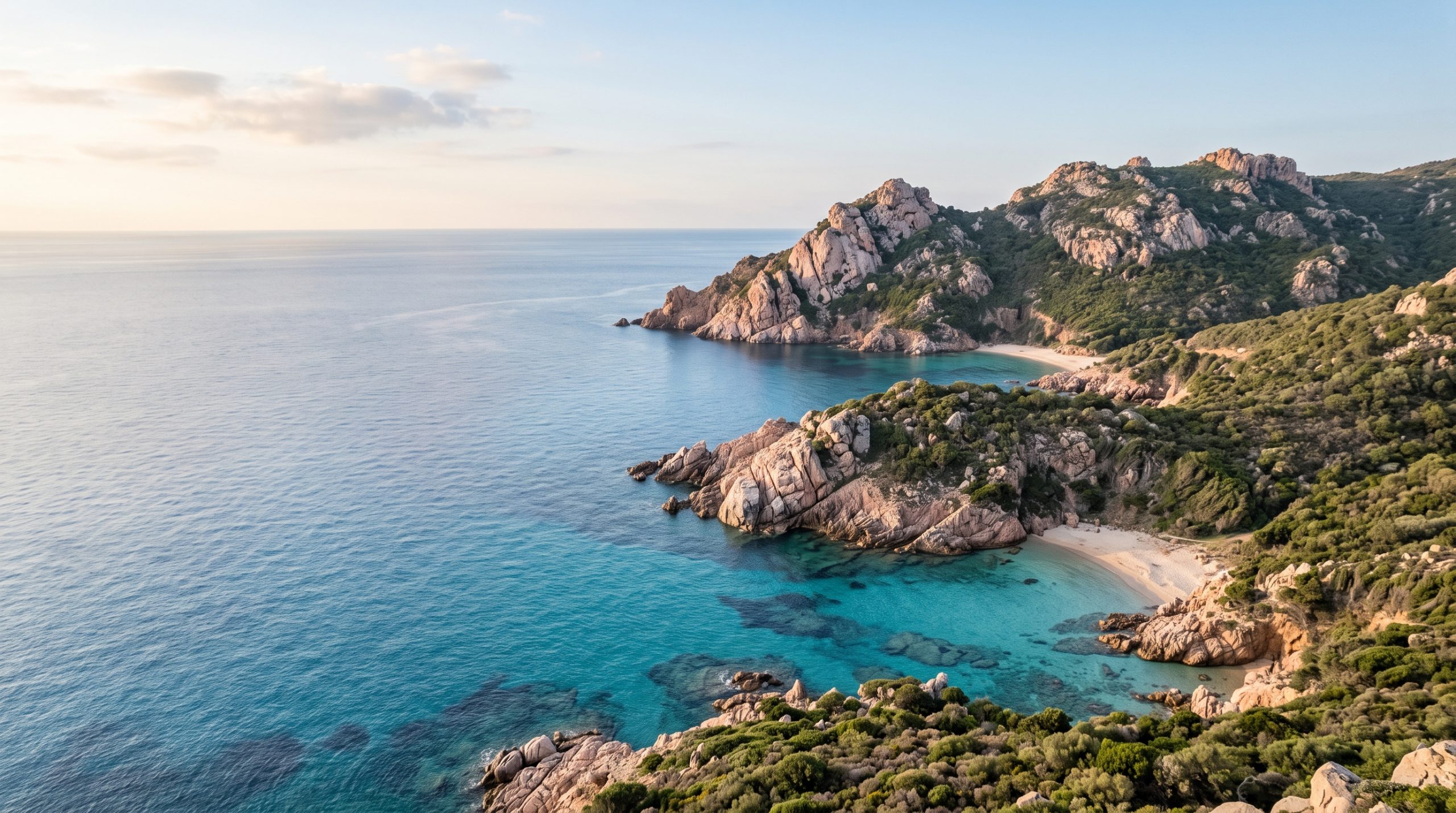
The footpath down to Cala Goloritzé opens at 7:30 in the morning. In the third week of June the sun is up just before six, so the most photographed cove on the island has been sitting in flat daylight for an hour and a half before the first walker is allowed through the checkpoint at Su Porteddu. The path itself runs about 3.6 kilometres and drops roughly 500 metres of limestone, an hour and a half down at an unhurried pace.
Do that arithmetic and you have the central fact about eloping in Sardinia: the light you came for and the places you have seen in photographs are often on different timetables. Some coves have gates. One beach sells 1,500 places a day and stops counting at six in the evening. When the maestrale gets up out of the northwest, half the island’s coastline is the wrong half to be standing on.
None of that makes Sardinia difficult. It makes it a planning problem with a right answer, and the answer moves with the month. This page sets out what a day here costs, what we charge and what the island charges, and where the two of you will actually be between five in the morning and nine at night.
The number, before the scenery
We photograph, film and plan elopements across Sardinia, from the Baunei calas to the granite of Gallura. One full day with a dedicated photographer or filmmaker starts at $4,900. One full day with both, working the same hours together, starts at $7,900. Team travel to the island is included. Permit fees and vendors are yours.
From a 5:20 sky to a 9pm sea: where the hours go
Sardinia’s two coasts divide the day between them. The Golfo di Orosei and the Ogliastra cliffs face east and take sunrise straight off the water. Alghero, Capo Caccia and the Stintino peninsula face west and hold the long evening. In late June the sky starts to lift around 5:20, the sun clears the sea just before six, and the west coast is still holding colour past nine. Fifteen hours of daylight. We do not try to use all of it, and you would not enjoy the version of the day that did.
An east-coast June morning begins in the dark. We are usually moving by 4:45, because the first twenty minutes after sunrise are the twenty minutes worth the alarm, and the limestone above Santa Maria Navarrese takes that side light exactly once. Ceremonies on this coast work best between six and eight, while the cliffs are lit from the side rather than from overhead and before the day’s boat traffic reaches the coves.
Then the island stops being photogenic for a while. From roughly eleven until four in high summer the light is vertical and white, the beaches are at their fullest, and there is nothing out there worth having. We hand that block back to you: a long lunch in shade, a swim, a drive, dry clothes. Selling you a midday hour would be easy, and you would not look at the results twice.
Evening pulls you west or north. Late June sunset at Alghero falls a minute or two after nine, with usable sky until about half past, which makes a seven o’clock ceremony and a ten o’clock dinner an ordinary Sardinian sequence rather than an eccentric one. That one fact reshapes most timelines couples arrive with. You are not choosing between sunrise and sunset on this island. You are choosing which coast you stand on when each of them happens.
Late September buys you a 7:10 sunrise
Move the same day to the third week of September and sunrise shifts to around 7:10, sunset to around 7:25 in the evening. You give up close to three hours of daylight and get back a start time that feels civilised, a sea near its warmest of the year, and coves that have emptied out. September is also when the maestrale reasserts itself, usually in bursts of two to four days. For us that reads as a direction rather than a problem: when the northwest is rough, the southeast sits in the lee, and Villasimius, Porto Giunco and Costa Rei are all inside an hour of Cagliari.
The gates, the caps and the hours we book around
The worry we hear most often about Sardinia is that the best places are now ticketed, capped and crowded, and that a couple flying in from Denver will end up saying vows in a line of day-trippers. The rules are real. They are also timetables, and a timetable is something you can plan against.
Cala Goloritzé takes bookings from April through October, holds 250 people at a time, and charges a per-person access ticket, currently seven euros. Places are released 72 hours ahead through the Comune di Baunei’s booking system, the trail opens at 7:30, the descent closes in the early afternoon, and no boat may land, so everyone leaves on foot the way they came. La Pelosa at Stintino sells 1,500 places a day at three euros fifty a head between eight in the morning and six in the evening, and asks for rigid mats rather than towels on the sand. After six the counting stops for the day, which is precisely when the light out towards the tower becomes worth photographing.
So having somewhere to yourselves usually comes down to an hour rather than a place. Send us the coves you have saved and we will tell you what time each one is yours, and which of them are better traded for a stretch of coast three headlands along that nobody has ticketed because nobody has heard of it.
Two cameras, one maestrale morning
Photography, film and planning here come from one team of eight. The photographer and the filmmaker on your day work from the same timeline, travel on the same flights, and hold access tickets booked inside the same 250 as you. They are not a photographer plus a videographer hired separately, working together for the first time on your morning and hoping their instincts line up.
In Sardinia the difference shows up first in the wind. A stills camera does not care that the maestrale is pushing twenty-five knots across a granite headland. A film cares enormously, because a film can hear. So on a windy morning our filmmaker’s first job is geometry: which side of the rock is quiet, where two people can say something to each other and be understood. The Expedition includes professional audio for vows where conditions allow, and that clause gets settled by scouting the evening before rather than by hoping on the day. The vows go in the lee. The photographer works the exposed side, where the wind is doing something worth keeping and a wave is breaking behind you.
It shows up again in load. Everything that goes down the Goloritzé path is on somebody’s back for 3.6 kilometres of descent, with no returning to the car for another lens. Two people carry stills, audio and aerials between them and still move at your pace. One person carries a compromise.
And it shows up in that first golden twenty minutes, which is the entire reason for a 4:45 start. One person cannot hold a forty-second moving shot and catch the frame where you turn around at the same time. Two can, from two angles, without either stepping into the other’s shot, because they have worked this coast together before. Aerials run inside Italy’s ENAC and EASA framework: registered operator, published zone map, 120 metres of altitude, aircraft kept in sight. We confirm the zone and the window first, then decide whether the film leans on a drone at all. If you want to see how that resolves on this kind of coast, our galleries and films are the honest answer.
Send us the week you are looking at and the two or three places you cannot leave out, and we will tell you what that day looks like from the inside. Check Your Date.
What travels with us to Sardinia
Single day or several, every experience includes:
- Destination and location design across the island, from the Baunei calas to the granite of Gallura
- Planning, and a timeline built around real light and real drive times instead of a template
- Permit research and logistics guidance, including which comune governs which stretch of coast
- Weather alternatives named before you land, so a maestrale morning has an address rather than a shrug
- Drone footage where it is legal, safe and appropriate
- Professional audio for vows on the Expedition, where conditions allow
- Team travel worldwide: flights, accommodation and ordinary travel for the assigned team, with no long-haul distinction and no island supplement
- Highlights within 5 days, and the full gallery or film within 3 weeks
- A price that does not move with guest count. Guests change access, permits, transport and the shape of the timeline, never the fee
Where coverage starts, and what the island bills separately
Two shapes cover a single day: one dedicated photographer or one dedicated filmmaker, or both of them working the same hours together. Longer trips run as the Odyssey, two to seven days across one or several destinations, quoted as a proposal built around your route. All three sit on the pricing page, and what you read there is what Sardinia costs. Getting us to the island is our expense, not a line on your invoice.
What Sardinia itself charges is separate, and we quote it in euros because euros are what you hand over. The comune sets the fee for a legal civil ceremony and each one sets it differently: Cagliari currently asks non-resident couples 200 euros for a ceremony outside office hours on a weekday and 250 euros on a Saturday afternoon, while smaller coastal comuni publish their own scales for their own outdoor civil venues. Beach and trail access tickets are small and charged per person. Accommodation, your celebrant, flowers, hair and dinner are yours. So is unusual transport, which on this island usually means a private gommone out of Santa Maria Navarrese or Cala Gonone to reach a cala with no road, a 4×4 for the tracks across the Golgo plateau, or a mountain guide for a morning on the Supramonte.
If you are marrying legally rather than symbolically, the paperwork is a sequence, not an obstacle. The atto notorio is sworn at an Italian consulate in the United States in front of four adult witnesses unrelated to either of you, and it stays valid for 90 days. The nulla osta is sworn before a US consular officer in Italy and then legalized at the Prefettura. You make the declaration of intention at the town hall with two witnesses, with an interpreter present if you need one, and banns are waived or shortened for non-residents, anywhere from a single day to a week depending on the comune. We build your travel days around that order of operations, and our planning fundamentals cover the groundwork.
How a Sardinia cost enquiry becomes a held date
- You send the inquiry form with your dates, or with the two or three weeks you are choosing between.
- We reply within 24 hours, with an initial brochure.
- You tell us the shape of day you want: dawn start or a late one, a real hike or fifteen minutes from the car, legal ceremony or symbolic.
- We build a tailored proposal around it, with coverage, locations, a timeline and the permits your specific day needs.
- Contract signed, 30% retainer paid, date held.
- Planning begins properly: timeline, permit research, ticket windows, sheltered alternates, and the paperwork order if you are marrying on the island. The rest of the payments are set out in your proposal.
Who Sardinia fits, and the month that fits them
The island rewards couples who will be awake at 4:30 in June, who are steady on uneven limestone, and who can hear “we are going to the other coast today” over breakfast without it spoiling the morning. If that sounds like you, the Baunei coast in early summer is close to the best version of a Mediterranean elopement we know how to build.
If a pre-dawn alarm is not your idea of a good start, tell us plainly and we will build the day the other way round: late September or the first half of October, sunrise near half past seven, a long slow evening on the west coast, nothing more than a fifteen-minute walk from where the car is parked. If a 500-metre descent is out for any reason, the granite at Capo Testa, the Valle della Luna and the headlands north of Alghero all give you a coast that looks ancient and asks almost nothing of your knees. If you want water more than cliffs, the southeast around Villasimius holds calm sea on the days the northwest is running swell.
What we would rather not do is guess. Tell us what a good morning genuinely looks like for the two of you and we will either shape the day around it or say which month and which region fits it better. Our destination guides are a reasonable place to start narrowing the coast down.
Common questions
Can we get legally married in Sardinia as Americans, or does it have to be symbolic?
Legally is entirely possible. You need an atto notorio sworn at an Italian consulate in the US with four unrelated witnesses, a nulla osta sworn before a US consular officer in Italy and legalized at the Prefettura, and a declaration of intention at the town hall with two witnesses. Banns are waived or shortened for non-residents. Plenty of couples still choose a symbolic ceremony on the coast and handle the legal side at home, and both work well.
How much does the comune charge to marry us?
Every comune sets its own fee, and it varies by day and by hour. Cagliari currently asks non-resident couples 200 euros for a weekday ceremony outside office hours and 250 euros on a Saturday afternoon. Smaller coastal towns publish separate rates for their outdoor civil venues. We confirm the current figure for your comune and your date during planning.
Do you need Cala Goloritzé tickets for the team as well as for us?
Yes. Everyone walking that trail counts toward the 250 places, ourselves included, and tickets are released 72 hours ahead through the Comune di Baunei’s system. We book ours in the same minute as yours and go through the checkpoint with you when the trail opens at 7:30.
Is August a bad month to elope in Sardinia?
It is the hardest month, and we would rather say so. The coast is at its busiest, ticketed beaches sell their places early, and the middle of the day is unusable for photography. An August day can still be a good one if it is built entirely around 5:30am and 8:30pm. June and the second half of September are simply easier to work with.
What happens if the maestrale blows on our date?
We move. The maestrale comes out of the northwest in bursts of two to four days, which means the southeast coast is sheltered on exactly those days. Your proposal names the alternate coast before you fly, so the morning decision is one line in an existing plan rather than an improvisation.
Does the price go up if our parents come?
No. Coverage costs the same for two people as for twelve. Guest numbers change access, permits, transport and how the timeline is built, and we plan around all of that, but they do not change the fee.
How quickly do we get the photos and the film?
Highlights arrive within 5 days, usually while you are still on the island or barely home. The full gallery or the finished film follows within 3 weeks.
Can you fly a drone over the calas?
Sometimes, and we confirm before we promise. Italy runs on ENAC and EASA rules: registered operator, published zone map, 120 metres of altitude, aircraft kept in sight. Some stretches of protected coast are closed to flight altogether. We check the zone and the window for your exact locations, then design the film around aerials only where they are legal, safe and appropriate.
What happens after you write to us
Every planning step stays in one written thread, at whatever hour suits you. You send the form, we reply within 24 hours with a brochure and some real questions about your dates, and nothing is held until a contract is signed. We are currently taking Sardinia elopement bookings for 2027 through 2029, so there is room to think this through properly.
Tell us the week, the coast you keep coming back to, and what you want the morning to feel like. We will send back a plan with hours in it. Start Your Story.