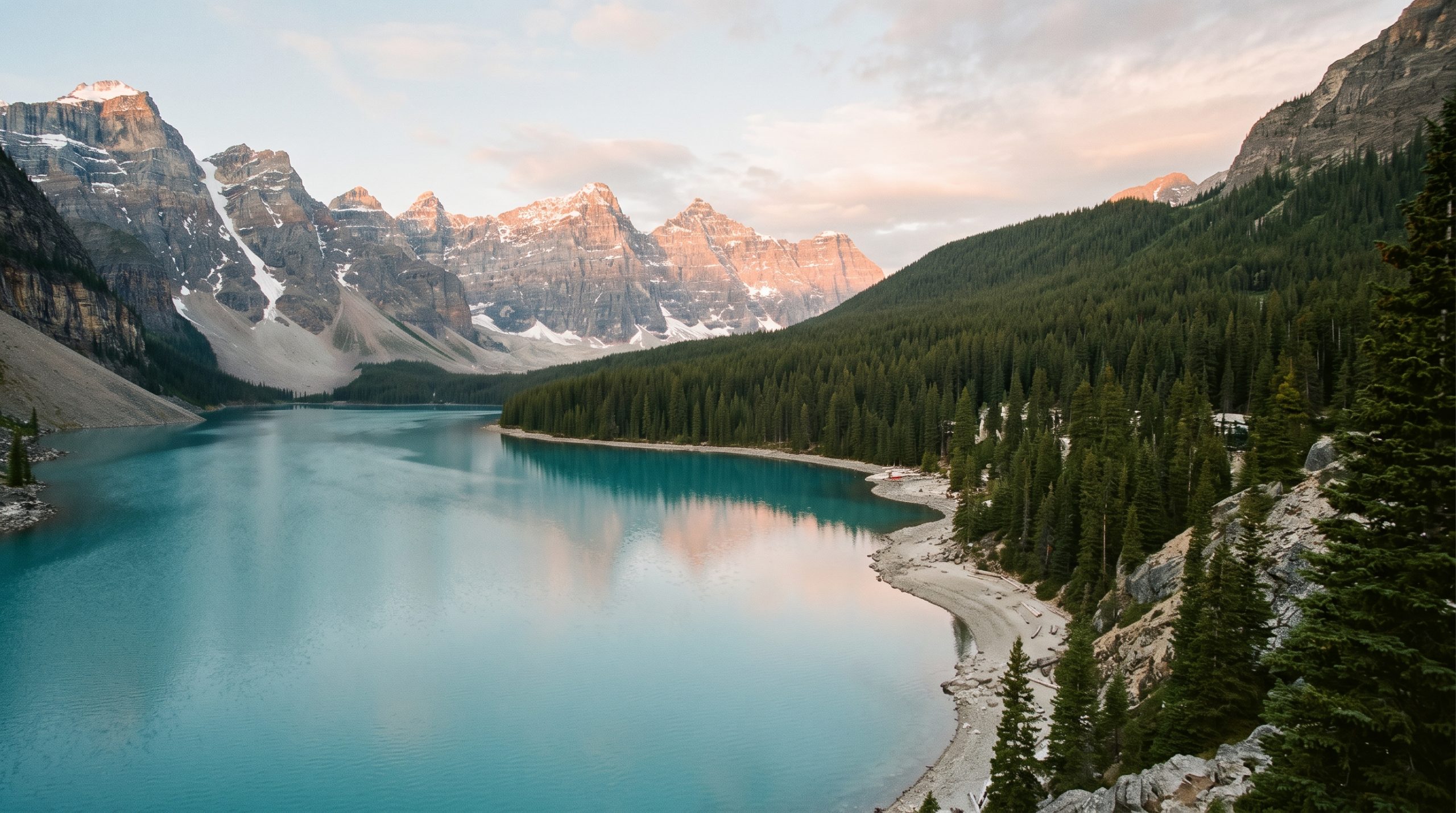
In late June the sun comes up over Banff at 5:27am, and for the first half hour it is not on you at all. It lands high on the east face of Mount Rundle while the valley floor is still sitting in blue shade. Anyone who has stood on the Vermilion Lakes boardwalk at five in the morning knows how that works: you photograph the mountain first, watch the line of light walk down the slope, and it reaches the water and the two of you somewhere after six.
That is the kind of detail a Banff budget really turns on. The lakeshore lot at Lake Louise is paid parking through the shuttle season. Moraine Lake Road has been shut to private cars for years, so the only way up it is a bus seat somebody has reserved. A valid national park pass is required for every person standing at your ceremony, celebrant and witnesses included. None of that is expensive on its own, and all of it decides what a single day can physically hold.
We are Unmapped Stories, eight photographers and filmmakers who treat planning, stills and film as one job rather than three separate hires. Below is the honest arithmetic for a Banff elopement in 2027: what we charge, what Canada charges you directly, and what the money buys at 4:40 in the morning when the sky first goes pale behind Cascade Mountain.
What you are actually paying for in Banff
We photograph, film and plan elopements throughout Banff National Park, and one full day with us starts at $4,900 in US dollars. Canada then bills you separately for a few small things: a park pass at roughly twelve Canadian dollars a head, a forty dollar government licence fee, your celebrant, and either parking or a reserved shuttle seat.
A June day, from 4:40am to 10:49pm
Banff sits at 51 degrees north, which is the single most useful number on this page. In the last week of June, civil dawn is at 4:40am, sunrise at 5:27am, sunset at 10:01pm and usable light hangs on until about 10:49pm. That is sixteen and a half hours of daylight with two long golden windows bolted onto either end and a bright, flat, unhelpful middle.
So we build the day in two halves and give you the afternoon back.
We are usually knocking on your door at 3:45am. Not because we enjoy it, but because the first pull-out on Vermilion Lakes Road is four minutes from the townsite and the water there is glass before the wind picks up, and the wind almost always picks up by eight. From 4:40 you are standing in soft blue light with pink starting on the ranges. By six the sun has cleared the ridgeline enough to reach the valley floor, and you get the warm frames people actually picture when they imagine the Rockies.
Ceremonies mostly sit between seven and ten in the morning. The light is still kind, the ranges are lit, and the busiest places have not filled yet. Your celebrant meets us at the site with your two witnesses, both of whom need to be at least eighteen and physically present, and the whole legal part takes about fifteen minutes.
Then the middle of the day, which we are honest about. Between eleven and four in high summer the sun is nearly overhead, the lakes go pale and the contrast is brutal. We do not fight it. That block is for a hike into Consolation Lakes, a canoe, lunch somewhere with a door, a drive north up the Icefields Parkway to Bow Lake and Peyto Lake, or a couple of hours of sleep. If you want a summit or a long trail, that is where it goes.
The second half is the one couples underestimate. From about half past eight the valley softens again, the last light rakes across the Sawback Range, sunset is at 10:01pm, and there is still colour in the sky at half past ten. Most vendors have gone home hours earlier. We have not, because a full day means the whole arc of the light, not eight hours of it.
One straight piece of astronomy: in late June the sun never drops more than about fifteen degrees below the horizon here, so the sky never goes properly dark. If you want stars over the peaks, that is a September or January request, and it changes everything about how we shape the hours.
| When you come | First workable light | Sunrise | Sunset | Truly dark |
|---|---|---|---|---|
| Late June | 4:40am | 5:27am | 10:01pm | Never |
| Late September | 6:52am | 7:25am | 7:45pm | About 9:40pm |
| Mid January | 7:58am | 8:35am | 5:12pm | About 7:10pm |
Late September is the humane version of a Banff day, and it is also when the larches turn gold above Moraine Lake, in the second half of the month. Mid January hands you a short day where practically every hour is good light, frozen lakes you can walk out onto with a guide, and a valley almost to yourselves. A June elopement and a January one are not the same event with different coats on.
The lakeshore you cannot close, and how we plan around it
Here is the thing couples ask us about Banff more than anything else, and the answer is in Parks Canada’s own wedding paperwork: the park is a public place, and exclusive rights to an area are not granted. You cannot rope off the Lake Louise shoreline. Neither can anyone else, at any price. What you can do is arrive at an hour and a place where it barely matters.
Time does most of that work. Lake Louise is 58 kilometres up the Trans-Canada from the townsite, about forty-five minutes, and in July we want to be parked there before five in the morning, because that lot is the tightest resource in the park and it has no interest in your timeline. Distance does the rest: the Lakeshore Trail thins out noticeably about twenty minutes past the boathouse, and the Moraine Lake rockpile empties as soon as the first shuttles roll back down. Then there is the simplest move of all, which is choosing places that were never the famous ones. Two Jack Lake, the Bow Valley Parkway pull-outs, Lake Minnewanka’s far shore and the meadows under Mount Norquay photograph beautifully and hold a fraction of the people.
Moraine Lake needs its own paragraph, because the access rules changed and a lot of older advice online has not caught up. The road is closed to personal vehicles. You reach it on a Parks Canada shuttle, on Roam transit, or with a licensed bus operator, and seats are reserved well ahead. The road itself is generally open from around the first of June until the second week of October. If you want a private charter up there rather than a public seat, know that Parks Canada now charges licensed operators a per-trip fee of a little over three hundred dollars for each run, which is why that option is priced the way it is. We will tell you honestly whether it is worth it for your morning.
Why the second camera matters where drones cannot fly
Drones are prohibited in Canada’s national parks. Not restricted, not permit-by-permit for a wedding morning: prohibited. That single rule reshapes how a Banff film has to be made, and it is the clearest example of why we send a photographer and a filmmaker who already work together rather than two people who met in a parking lot at 4am.
Without aerials, every bit of movement in your film has to come from the ground. That means a filmmaker walking a gimbal along the rockpile while the couple stays still, long-lens compression that stacks the Ten Peaks up behind you, a slow push through lodgepole pine as the light lands. It is slower work than flying a drone over a lake, and it is better work, but it only happens if the person holding the video camera is not also the person responsible for your portraits.
The shared-window problem is the other half of it. When you have twenty minutes of good light on a shoreline you cannot close, one camera has to choose. Wide, with the two of you tiny against the rock and nobody else in frame, or close, where the light on your faces is the whole point. Two people take both. One holds the wide while the other works tight, and when a bus arrives and forty people walk into the background, we already have the frame that does not include them.
Sound is the third thing, and Banff is loud in ways photographs never show. Wind coming off glacial water, the Bow River behind Surprise Corner, a shuttle idling. On The Expedition we mic vows properly where conditions allow, so what you say at Bow Lake survives a gust instead of disappearing into it. You can see how a whole Banff day resolves into stills and a finished film in our published stories and films, which is a more useful answer than anything we could write here.
There are eight of us. That means there is always a second camera on the ground and a colleague in reserve, and it means the person who built your timeline around a 5:27 sunrise is the person standing beside you when it happens.
Everything that travels with us, and what Canada charges on top
Team travel is included, worldwide and without exception. Flights to Calgary, accommodation in the valley, the drive out to Lake Louise at four in the morning, all of it is inside our fee. There is no long-haul surcharge and no per-mile mileage line, because a photographer worrying about a fuel receipt makes worse decisions about where to be at sunrise.
Inside every Banff experience
- Destination and location design across the park and its edges, matched to your month.
- Planning throughout, and a custom timeline built on real light and real drive times.
- Permit research and logistics guidance, including which authority governs the site you want.
- Weather alternatives and backup planning, which in the Rockies is not optional.
- Drone footage where it is legal, safe and appropriate. Inside Banff National Park it is not, so we plan the film without it.
- Professional audio for vows and meaningful moments on The Expedition, where conditions allow.
- Highlights delivered in five days. The full gallery or film in three weeks.
Where coverage starts
The Adventure is one full day with a dedicated photographer or a dedicated filmmaker. The Expedition is one full day with a dedicated photographer and filmmaker working side by side, from $7,900. The Odyssey runs two to seven days across one or several destinations, with photography and film throughout and a proposal written for your route. Full detail sits on our coverage and pricing page. Your guest count never changes the fee; it changes access, permits, transport and the timeline.
What Canada bills you directly
All figures in this table are Canadian dollars. Our own coverage, above, is quoted in US dollars.
| Cost | Who charges it | Where it stands |
|---|---|---|
| National park entry | Parks Canada | $12.25 per adult per day at the current rate; a Discovery Pass is $83.50 for one adult or $167.50 for up to seven people arriving in one vehicle, valid a full year |
| Marriage licence | An Alberta registry agent | $40 government fee, plus the agent’s own service charge, which varies between offices |
| Celebrant | The marriage commissioner or officiant you book | Set by them |
| Ceremony site | Parks Canada outside the townsite, the Town of Banff inside it | Depends on the site and the size of your group; town facilities can be reserved up to 18 months ahead |
| Lake Louise lakeshore parking | Parks Canada | $36.75 a day through the 2027 season, raised by just under eleven percent at the start of 2028, charged May through October |
| Moraine Lake access | Parks Canada, Roam transit, or a licensed operator | A few dollars for a reserved public seat; a private charter also carries a per-trip fee of a little over $300 |
| Beds, meals, canoes, gondolas, guides | Local businesses | Yours to choose |
Two notes on the volatile end of that list. Parks Canada adjusts its fixed fees every couple of years against the consumer price index, and the last adjustment landed on 1 January 2028, so 2029 numbers should sit in the same neighbourhood rather than jumping. Unusual transport is always a separate booking too: helicopter flying in this part of the Rockies works from bases outside the park boundary, and 4×4 charters, boats and mountain guides are billed by whichever operator you choose.
Send us the month you have in mind and we will tell you what the light is doing that week, and what your day could hold around it. Check Your Date.
How a Banff 2027 date moves from enquiry to hold
- You send the inquiry form with your dates and whatever shape of day you are imagining.
- We reply within 24 hours with an initial brochure.
- We write a tailored proposal around the day you described, not a template.
- You sign the contract and pay a 30% retainer.
- Planning begins: locations, timeline, permit research, weather alternatives, the lot at Lake Louise, the shuttle reservation.
- We travel to Alberta ahead of your date and photograph and film the day. The remaining payment schedule is set out in your proposal.
Our Banff calendar is currently open across 2027, 2028 and 2029 now. If you are still working out the fundamentals of an elopement rather than the specifics of this one, how to elope covers the groundwork first.
Who gets the most from a Banff elopement day
Banff pays back three particular kinds of people. Those who will genuinely get up at 3:45am in July and be cheerful about it, because the difference between 5am and 9am at Lake Louise is not subtle. Those who are steady on uneven ground, since the rockpile at Moraine and the switchbacks toward Larch Valley are rock and root rather than boardwalk. And those who can hear on the morning that the range is buried in cloud, and go with the alternative we already built.
If a 3:45am start sounds like a bad start to a marriage, say so in your first message. September gives you a 7:25 sunrise and gold larches. January gives you a short day of low light and quiet lakes. A multi-day shape lets us split the work so nothing gets crammed into one dawn. There is a version of this that fits how you actually like to spend a morning, and finding it is our job, not yours. Our destination guides are a good way to see how differently the same mountains behave across the year.
One more piece of Banff candour. Late summer air in the Rockies can go hazy for days at a time, which flattens the far ranges. It also does lovely things to backlight and to the near-forest frames, so a hazy day is a different day rather than a lost one, and we come with a plan for it.
Common questions
Do we need a permit to get married in Banff National Park?
Yes, ceremonies are registered in advance. Parks Canada governs sites in the park outside the townsite and the Town of Banff governs those inside it, so which form you file depends on where you stand. The park remains a public place throughout and exclusive use of an area is not granted. We handle the research and the paperwork; the fees themselves are yours.
How do we get an Alberta marriage licence as Americans?
Both of you go in person to an Alberta registry agent with acceptable ID. The government fee is $40 and the registry office adds its own service charge. The licence is issued while you wait, it is only valid for a marriage performed in Alberta, and the wedding must happen within three months. You also need two witnesses aged eighteen or over, physically present.
Can we still get married at Moraine Lake now that the road is closed?
You can. Moraine Lake Road is closed to personal vehicles, so access is by Parks Canada shuttle, Roam transit, or a licensed bus operator, all of which need reserving ahead. The road is generally open from about 1 June to the second week of October, which is the real constraint on a Moraine morning.
Can you fly a drone for our Banff elopement film?
Not inside the park. Drone use is prohibited in Canada’s national parks, so we build the film from the ground instead, with gimbal movement, long-lens work on the Ten Peaks and hard-won position rather than altitude. If aerials matter a lot to you, tell us early and we will look at where a legal segment could sit on a multi-day route.
What month should we choose for a Banff elopement?
The second half of September is our first suggestion for most couples: gold larches, a 7:25 sunrise, cold clear air and full dark by about 9:40pm for night frames. Late June gives the longest day and the greenest valley, but the earliest starts. Mid January is short, bright and almost empty.
Does having our parents or a few friends there cost more?
Our fee does not change with guest count. What guests change is access: more park passes, more vehicles into a lot that fills before dawn, longer to move between locations, and sometimes a different ceremony site. Tell us the number early and the timeline gets built around it.
When do we get our photos and film?
Highlights reach you five days after the day itself. The full gallery, or the finished film, arrives within three weeks. That holds whether you elope at Vermilion Lakes or spend a week working north along the Icefields Parkway.
Writing to us, and what comes back
We keep every planning decision in writing, which suits a plan built across time zones. You send the form, an initial brochure comes back within a day, and the proposal follows once we know what kind of morning you want. Then the planning notes start, and they keep going until the timeline says 3:45am and you know exactly where the first pull-out is.
Tell us your month, your two names and whether 4:40am sounds like a good idea. Tell Us Your Story.