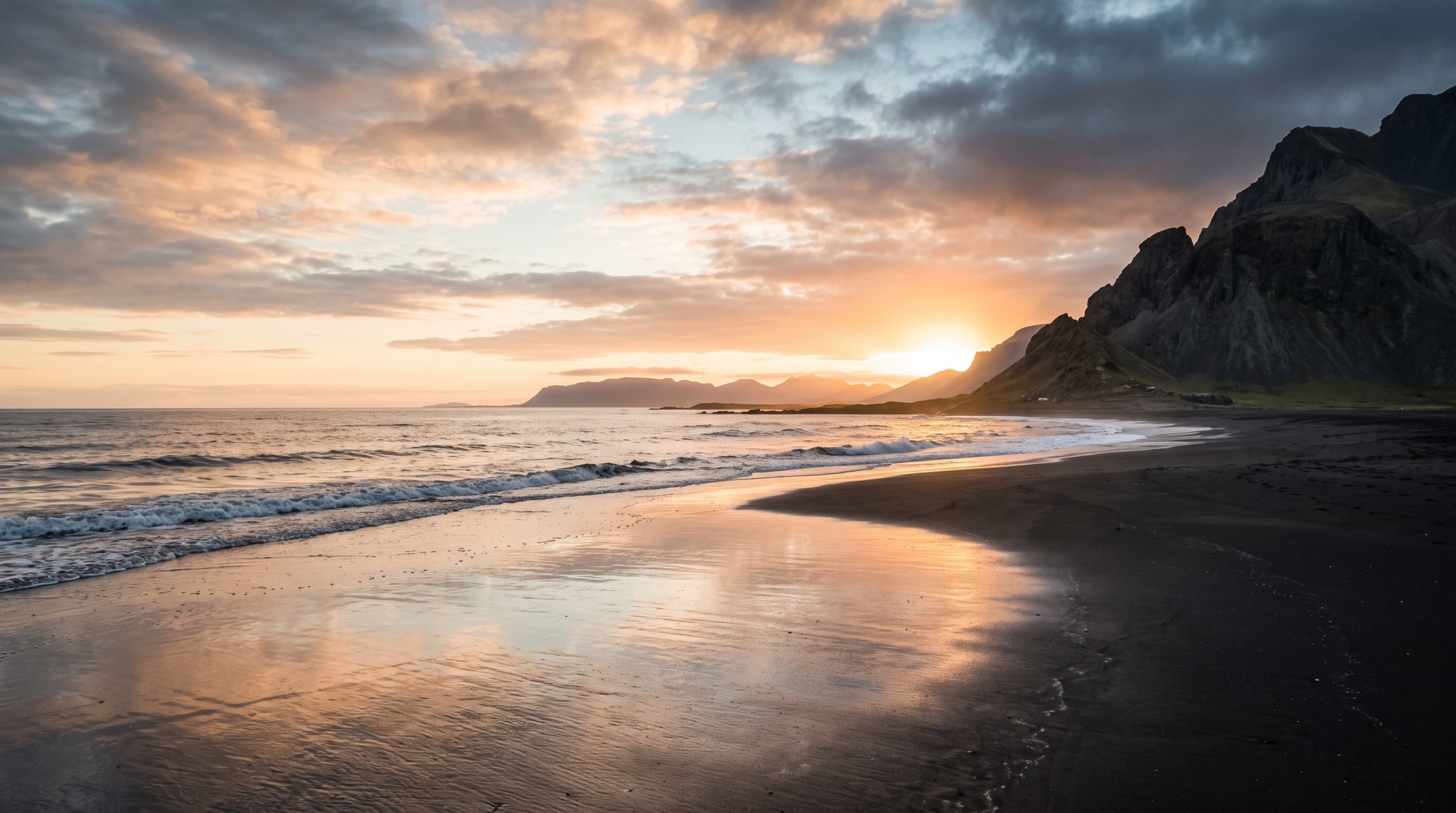
On June 21 in Reykjavík the sun goes down at 12:03am and comes back up at 2:55am. Those three hours are not night. The sun slides along a few degrees beneath the horizon, the northern sky holds a low copper band that never closes, and at 1am you can read the fine print on a marriage license without a headlamp.
That is the real reason couples ask us about vows at 1am. It is not novelty. It is the one hour of the Icelandic year when the light of an ordinary sunset lasts long enough to hold a whole ceremony inside it, and when the car parks along the south coast are all but empty.
The window is narrower than most planning guides admit. It moves with latitude as much as with the calendar, and it starts closing at roughly two minutes a day once July begins. Here is what each month actually gives you, where 1am still has a sun in it, and how we build a night that holds up whether or not the sky cooperates.
The window when 1am still has sun in it
Late May to mid-July, with the peak in the two weeks either side of June 21. In Reykjavík that day runs 2:55am to 12:03am, so 1am falls into a twilight that never darkens. For the sun still up at 1am, head to the Westfjords or Grímsey, Iceland’s only ground inside the Arctic Circle.
April to September: what 1am gives you each month
Every row below assumes Reykjavík or the south coast unless it says otherwise. The north runs brighter and, in an average June, drier.
| Month | Conditions | Light at 1am | Crowds | Our verdict |
|---|---|---|---|---|
| April | Cold ground, snow still lying inland, weather turning over quickly | Dark. Daylight climbs several minutes a day, but midnight is still midnight | Quiet on the coast | A fine month to elope, the wrong month for this |
| May | Drying out, greening late, first lupine spikes in the last week | Almost there by May 25, with no true darkness left in the sky | Building | Late May works, and the north is still quiet |
| June | Reykjavík takes a little over 40 mm of rain across the entire month, mostly as showers | Strongest of the year. Sunset 12:03am, sunrise 2:55am on the solstice | Peak season opens | Book it |
| July | Warmest month. In the cool summer of 2024, Reykjavík’s highest reading all year was 17.4°C (63°F) | Still gold through the first half. Sunset pulls back about two minutes a day | Busiest | Aim before July 15 |
| August | Often the most settled stretch, green highlands, berries on the heath | A long evening rather than a midnight sun. August 5 sunset in Reykjavík is 10:22pm | Still busy, easing late | Lovely, and a different film |
| September | Autumn color inland, first snow on the tops | Real darkness returns as the country loses 4 to 6 minutes of daylight a day | Thinning fast | A great month for something else entirely |
How far north you have to go for a sun that never sets
Reykjavík sits at about 64.1°N and the Arctic Circle starts near 66.5°N, so the capital’s sun sets every night of the year, solstice included. It sets by a hair. That hair is what people mean when they say midnight sun, and it is genuinely beautiful, but it is not the same thing as a sun still above the horizon at 1am.
Akureyri gets around 23.5 hours of light on June 21. Ísafjörður, up in the Westfjords, holds brightness through the full 24. Grímsey, the small island off the north coast and the only Icelandic ground inside the Arctic Circle, keeps the sun up outright. Grímsey adds a boat or a light aircraft to the day, transport you book and we plan the timeline around.
The north pays a second dividend in June: Akureyri’s average June rainfall is well under half of Reykjavík’s. Most Icelandic summer weather arrives from the southwest, which is why the same afternoon can be gray at Vík and clear over Mývatn. If your list of must-have locations is entirely on the south coast, say so early, because that decides whether we are chasing a true midnight sun or the very good twilight version of it.
The narrow windows: purple hillsides, puffin cliffs, highland gates
Three things people plan whole trips around all sit inside or beside the midnight sun window, and each one moves.
The Nootka lupine, those violet hillsides you have seen along Route 1, peaks from mid-June to mid-July, with the south coast usually a week or two ahead of higher inland ground. A warm May pulls it early. A cold, late spring holds it back, and no one can promise you a specific field on a specific night. What we can do is build two or three lupine options into the route and pick on the day.
Puffins hold the cliffs from roughly early May to mid-August, in the Westman Islands, home to the world’s largest colony, and at Dyrhólaey on the south coast. Dyrhólaey is the interesting one for a 1am plan. Its upper ground sits under nesting-season access limits through May and June, with the gate open across the evening and overnight rather than in the middle of the day, which is exactly when we want to be there. Those dates are set season by season, so we confirm the current window with the Environment Agency before we build a night on it.
The highland gates are the constraint most couples underestimate. The Icelandic Road Administration opens each F-road only after inspecting it, once snowmelt and river levels allow, so the interior comes online in stages across a six-week spread. F35 over Kjölur is usually first, late May into early June. F208 to Landmannalaugar and F249 toward Þórsmörk typically follow in mid to late June. The deep interior, Askja and Sprengisandur, often waits until early July. A June 12 date and a Landmannalaugar ceremony are therefore two different plans, and we hold a lowland pairing for exactly that reason.
If your date is already fixed in August or April
Neither month is a problem. They are simply different films, and we would rather tell you what changes than let you land expecting something the sky cannot do.
In August you still get an enormous evening. Reykjavík’s sunset on August 5 is 10:22pm, which gives us a warm block from around eight until close to midnight, and the highlands are fully open by then in a way they are not in early June. What you lose is the 1am hour itself. We would move the ceremony to a late evening slot and use the second half of the night for sleep rather than for driving. If the midnight hour is the point of the whole thing, and your dates have any flex at all, we would move you to the third week of June and nowhere else.
April is the opposite trade. Midnight is properly dark, the highlands are shut, and the south coast is quiet in a way it never is in July. Daylight is gaining several minutes a day, so a sunrise ceremony sits at a civilized hour and the evening light is long and low. It is a strong month for a two-person day on the coast. It is not a month for vows at 1am, and we will say so before you book flights.
Tell us the date you are holding and what you actually want from it. If that date and that hour do not fit together, we will tell you which week does, and what we would build instead if the date cannot move. Our planning fundamentals for eloping cover the sequence we work through with every couple.
What a 49-degree sun does to the pictures
On the solstice in Reykjavík the sun never climbs higher than about 49 degrees above the horizon, even at its highest. There is no overhead midday here in the way there is in California. The light rakes across the landscape all day, and then for four hours around midnight it comes in almost horizontally.
Run the numbers on the solstice and the midpoint between 2:55am and 12:03am lands near 1:30pm, because Iceland keeps a single time zone that sits ahead of its own solar time. Everything happens later than your body expects. Between roughly 10pm and 2am the sun is within a few degrees of the horizon, which means four continuous hours of the light most of the world gets for twenty minutes. Faces are lit from the side. Lava fields hold shadow. Hair takes a rim of copper without anyone standing in the sun’s way. On an overcast night the whole sky becomes one soft source and portraits still work, they simply go cooler and quieter. You can see how both of those nights render across our galleries and films from finished elopements.
The long window is also why the photo and film sides stop competing. A forty-minute sunset forces a photographer and a filmmaker to take turns, and one of them always loses. Four hours does not. On a midnight-sun night our photographer can work a slow, quiet portrait sequence on one side of a headland while the filmmaker builds the wide, moving frames that need time and a tripod, and neither of them is rushing the other. Two people, one plan, written together weeks before.
Aerials run on a permit and a specific time window, so we confirm both before we design any part of the film around a 1am flight. Sound is the other quiet advantage of the hour. With the day traffic gone, vows recorded at 1am carry the water and the wind and very little else, and on the Expedition we bring proper audio to catch that.
How we design the midnight route before you fly
Iceland’s weather is regional, not national, and June 2027 made the point in three numbers. Reykjavík recorded 37.8 mm of rain that month, about 87 percent of its long-term average. Akureyri in the north took 65.3 mm, more than three times its June normal. Stykkishólmur, in the west, got 12.6 mm. Three regions, one month, wildly different skies. The split does not always run the way the guidebooks say it will, which is precisely why we do not commit a single location list until the forecast firms up.
So the plan you get before you fly is a paired plan. Each location has a partner chosen by wind direction rather than by convenience, usually a sheltered headland, a canyon, or a moss field that sits in the lee of whatever is blowing. Ceremony hours are written to move. The midnight sun is unusually generous here, because with no darkness pressing in on either side we can slide the ceremony two hours earlier or later on the morning of, and lose nothing at all.
We also write the paperwork dates into the same timeline, alongside travel time that assumes real Icelandic roads rather than map estimates. Our destination guides go deeper on individual regions if you are still choosing between the south coast and the north.
If June 2027 or 2028 is the shape of this for you, send us a message with your date and the kind of night you are picturing.
Common questions
Can we legally be married at 1am in Iceland?
The hour is agreed with your celebrant, not with the landscape. The license itself runs through the District Commissioner, and the paperwork includes a certificate of marital status, or a certified confirmation from the relevant authority if your country does not issue one. Those documents run on calendar deadlines, and we build them into your timeline.
Will it be bright enough at 1am to see each other’s faces?
Yes. Around the solstice the sun stays within a few degrees of the horizon, which is bright enough to walk unfamiliar ground, read your vows off paper, and shoot without adding light. It reads as a long sunset rather than as night.
Do we have to stay awake all night for this?
Most couples sleep from late afternoon into the evening and start the day at around 9pm. Blackout curtains are standard in Icelandic summer accommodation. We write that sleep block into the timeline the same way we write in dinner, and we plan the following morning as a rest morning.
Is the sun actually above the horizon at midnight in Reykjavík?
Not quite. Reykjavík is at roughly 64.1°N, south of the Arctic Circle at 66.5°N, so on June 21 the sun sets at 12:03am and rises at 2:55am without the sky ever going dark. For a sun still visibly up at 1am, you need the Westfjords or Grímsey.
How busy are the famous locations at 1am in high summer?
Iceland saw about 2.27 million foreign departures in 2027, and most of those people are on a daytime rhythm. Coach tours and rental cars work between mid-morning and early evening. At 1am on the same day, the same waterfall is usually yours.
What happens if it is overcast on the night we chose?
You lose the copper light and gain an even, shadowless one that flatters faces and holds detail in black sand and green moss. Because there is no darkness deadline in June, we can also wait an hour or two for a break in the cloud, which is the single biggest advantage this season has.
Can we reach Landmannalaugar for a mid-June date?
Sometimes. F208 usually opens in mid to late June, but the Road Administration sets the date only after inspecting the route, so no one can guarantee it a year out. We plan a highland day with a fully built lowland alternative, and confirm which one we are running a few days ahead.
Picking the night, then building the hours around it
Our planning calendar currently covers 2027, 2028 and 2029, and June dates tend to be the ones couples ask about first. What each shape of coverage includes, from a single day to a multi-day route across the north, is set out on our pricing page. Our team’s travel to Iceland is included, wherever in the country the light takes us.
Send the inquiry form and you will have a reply and our first brochure back within 24 hours, then a tailored proposal. We keep every planning decision in writing, on your schedule and in your time zone, so nothing needs to be arranged live. When you are ready, a signed contract and a 30 percent retainer start the planning, and we begin picking the night. Check Your Date.