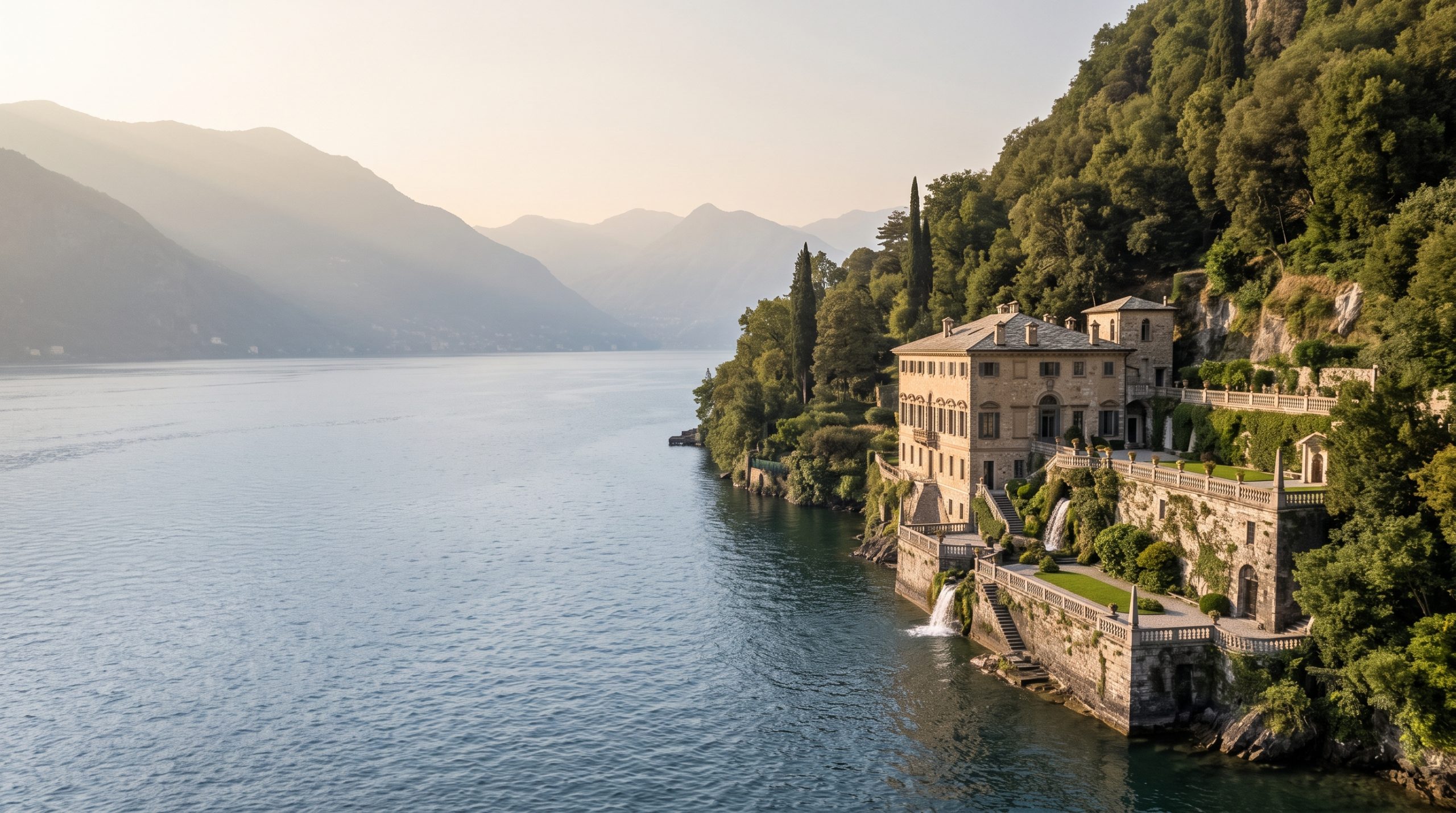
The old mule road out of Torno crosses the Pliniana valley on an ancient stone bridge, and from up there you are looking down at the roof of a villa with no road to its own front door. Everyone arrives at the dock. That one fact shapes most of what a ceremony day looks like on this stretch of the eastern shore.
Torno sits about six kilometers up the lake from Como, past Blevio, on the bank most day visitors never stop on. The scheduled boat from Como takes roughly half an hour. Behind the village the slope climbs through chestnut woods to the hamlets of Montepiatto and Piazzaga, and the Strada Regia, the waymarked footpath linking Como to Bellagio along this shore, runs through the old borgo on its way north.
The thing to settle before you plan anything else: this shore faces west. Torno wakes in shade while the opposite bank is already lit, and it holds direct sun deep into the afternoon until the ridge across the water cuts it off. Get that the wrong way round and you have built a sunrise ceremony in a village that will not see the sun for another two hours.
Torno, Villa Pliniana and a shore that faces west
Yes, you can marry here. Villa Pliniana is a private Sereno Hotels estate in Torno reached by its own dock, and Torno’s register office sits in the village on Via Plinio. A symbolic ceremony needs only the landowner’s agreement. The light here is an afternoon and evening proposition rather than a sunrise one.
The front door is the water
Villa Pliniana is a sixteenth-century palazzo on roughly eighteen waterfront acres, in its own cove between Torno and Faggeto Lario, with a private dock and a helipad. Sereno Hotels runs it as a single private estate: eighteen suites sleeping around forty people, and interiors that seat up to two hundred for dinner. When couples talk about eloping at Pliniana, what they are usually picturing is the loggia, the water steps and the park, all reached most naturally by boat.
The village itself is a different arrival. The public Navigazione Laghi boat from Como lands at Torno’s pier and, outside the quietest winter weeks, runs at close to an hourly rhythm. By car you come up the narrow SP583 from Como and stop at the lakefront, because the borgo above is stone steps and lanes no car is going to enter. On foot, the Brunate to Torno stage of the Strada Regia is about six kilometers and drops you in above the rooftops.
| Arrival | What it involves | Where it puts you |
|---|---|---|
| Scheduled boat from Como | About 30 minutes on the water, roughly hourly in season | Torno’s public pier, in the middle of the village |
| Small private launch | Chartered for the day, door to door, timed to you | The estate’s own dock, or the pier |
| Car on the SP583 | Six kilometers of narrow provincial road from Como | The lakefront, then steps on foot |
| Strada Regia on foot | The 6 km Brunate stage of a 30 km waymarked route | Above the village, arriving downhill into the borgo |
Navigazione Laghi will also charter vessels from its own fleet, but that tariff is built for large groups and starts in the region of 1,800 euros plus VAT for an eight-hour slot. For two people, a small private launch is the sane answer, and it is what we build most Torno days around.
Crowds are worth being blunt about. The coach circuit on this lake goes to Bellagio and Varenna, not here, so Torno is never busy in the way those two are. What it has is a small lakefront and one pier, and for a few minutes either side of a boat landing the quay belongs to everyone. Arriving early is not the lever. Knowing the timetable is, and we put the waterside hour in the quiet gap between departures.
What the light actually does here, hour by hour
This is the part almost every page about the eastern shore gets wrong, and it decides your timeline.
At sunrise, Torno is not lit. The sun comes up behind the ridge above the village, so the first light of the day lands on the opposite bank, on Cernobbio and Moltrasio and the mountains behind them. Stand on the Torno lakefront at that hour and you are in cool blue shade looking at a brilliantly lit far shore. Some couples love exactly that, and the water at that hour is glass, unbroken by a single wake. It is a soft, low-contrast picture rather than a golden one, and one of the best hours here for film. It is just not the hour anyone expects.
Direct sun reaches the village through the middle of the morning and stays through the afternoon. Midday is the weak part of the day: the lake goes white, the stone flattens out, and the village lanes turn into hard stripes of light and dark. We use those hours for the interiors, the paperwork, lunch, and the walk up the hill.
Then the good stretch arrives, and it ends earlier than the forecast says. Because the mountains on the far side stand well above the waterline, the sun disappears behind them a fair while before the published sunset time. On the shore at Torno you can lose direct light while the sky is still bright, which catches out anyone planning by an app rather than by the ridge. We time the ceremony hour off the ridge, not the clock, and we scout it on the day before.
There is a way to buy that time back, which is why we build the second half of a Torno day uphill. Climb two hundred meters above the water and the far ridge sits lower relative to you, so the light lasts longer. The shoreline can be in shade while the terraces and the woods above Montepiatto are still warm. Then, once the sun has gone, this shore does something the western side cannot: the afterglow sits on the water for a long, still while, the village lamps come on below, and the lake turns the color of pewter. If you want to see how that reads in finished work, our galleries and films are the honest version of it, shade, afterglow and all.
Steps, not slopes: the borgo and San Giovanni Battista
From Piazza Caronti on the lakefront, the way up into the old village begins in Via Pozzo, where the Strada Regia waymarks start and the route heads out towards Molina and the bridge over the Stravalle stream. Follow the lanes up instead and you reach the oldest part of Torno and the church of San Giovanni Battista, standing high in the village on a small piazzale with one monumental horse chestnut in it.
The church is worth the climb for the doorway alone. The gabled front is exposed stone with a rose window above, and the marble portal is fifteenth-century work from the Rodari circle, the same school of carvers behind the sculpture on Como’s cathedral. Saints stand in the jambs, Paul, Catherine and Rocco on one side, Peter, Lucy and Sebastian on the other, with the Baptism of Christ in the lunette. Inside, a single nave runs through six bays of pointed arches. The interior belongs to the parish, so anything happening in there is the parish’s decision and we raise it with them at the planning stage rather than on the day.
Now the sentence nobody else writes. The climb is steps, not a slope, and that changes everything about doing it in wedding clothes. The risers are old stone, uneven, and in the shaded sections they stay damp long after rain. Heels are not usable on them. A long train picks up grit and the odd wet leaf. None of that is a problem, it just needs planning: shoes go in a bag and come out at the top, we allow ten or twelve minutes for a climb that takes four in trainers, and we walk the flights that morning to see which ones are dry. With a serious train we work the borgo lanes on the way down instead of the way up.
Above the roofs: Montepiatto and the oak from 1730
The loop above Torno climbs to the hamlets of Piazzaga and Montepiatto and takes in the erratic boulders, the carved Massi Avelli, and the Pietra Pendula, a stone slab balanced on a stalk of rock. There is also the Rugulon, a great oak dated to 1730. It is a real walk, not a stroll, and we treat it as its own hour with a change of clothes, not as an add-on to a ceremony. For couples who want ground rather than one view, this is where the day opens up. More of that thinking sits in our destination guides.
Who signs, and who says yes
Two separate permissions, and it helps to keep them apart.
The legal one belongs to the comune. Torno’s Ufficio Anagrafe e Stato Civile is in the village on Via Plinio, and the municipality’s own marriage pages list Villa Pliniana among the locations attached to that service. In Italy a legally binding civil ceremony is performed by a registrar in a place the comune recognizes, so the route here runs through that small village office and needs a lead time for documents, translations and consular paperwork. Plenty of couples marry at home first and hold a symbolic ceremony on the lake instead, which removes the municipal step entirely. Both are real choices, and the practical difference is set out in our guide to planning an elopement.
The second permission belongs to whoever owns the ground. Villa Pliniana is private, so everything inside the estate walls, including where we set up and whether a drone leaves the ground, is the villa’s call and we confirm it in writing before we build a timeline around it. On public ground in the village, nobody sells a permit for two people exchanging vows on a quay, and a small private ceremony on the lakefront needs no municipal paperwork. Courtesy is the real constraint there: not standing in the way of the boat, and not filling a working pier.
Aerials run under Italy’s civil aviation rules, with the airspace checked on the official D-Flight map rather than assumed, and over a private estate the owner’s consent sits on top. We handle the research and the logistics; permit fees themselves sit with you, along with the boat, the celebrant and the rooms.
The afternoon wind, and the plan that survives it
By early afternoon the lake usually has a breeze running up it from the south. It builds, it puts chop on this shore, and it makes a small launch crossing lively. The valley behind Pliniana adds a draft of its own, coming down out of the cleft that the old bridge spans. None of it stops a day. It just decides the order of one.
Sound is where it shows. On the estate’s water steps and in the park there is room for two of us to work at real distance, one wide on the film and one close on the photographs, without either appearing in the other’s frame. Up in the borgo the lanes are barely wider than outstretched arms, with a wall on one side, so we take turns by arrangement instead of crowding a couple who are trying to say something private. Wind off open water will find a lapel microphone, so on an Expedition day, where the couple has both a photographer and a filmmaker, we put vows in the lee of a wall or in the sheltered corner of the cove and keep the exposed shoreline for the wide, wordless frames. A full day here runs from $4,900 with one dedicated photographer or filmmaker, or from $7,900 with both working together, and travel for the team to Italy is included, with the rest of the detail on our pricing page.
Rain on this lake tends to arrive as a band moving up the water rather than a whole lost day. So we invert: interiors and the covered borgo first, ceremony held back an hour or two, boat hour taken when the band has passed. Where a day is based at the villa, the estate’s own rooms are a genuine alternative rather than a consolation, which is rare on this lake. If the wind is up hard, the sheltered corner is minutes away rather than a drive, because the cove sits behind its own shoulder of land.
Common questions
Do we have to arrive at Villa Pliniana by boat?
The estate sits in its own cove with a private dock and a helipad on the property, and the water is how it is designed to be reached. We plan a small private launch for the couple and any guests, timed to the ceremony hour rather than a public timetable.
Can we make the marriage legal in Torno, or does it have to be symbolic?
A legally binding civil ceremony is possible, and it runs through Torno’s register office on Via Plinio, whose marriage pages list Villa Pliniana among its locations. It needs a real lead time for documents and consular paperwork. Many couples marry at home first and keep the ceremony on the lake symbolic, which is simpler and no less meaningful.
What is the climb up to San Giovanni Battista like in a long dress?
It is stone steps rather than a path, uneven, and damp in the shaded flights after rain. Heels do not work. Allow twelve minutes rather than four, carry your shoes up and change at the top, and expect a long train to collect grit. We walk it beforehand and pick the driest flights.
Does the last boat back to Como decide when we have to stop?
Only if you rely on the public service. The best light here comes after the sun has left the shoreline, so we would rather hold a private launch for the evening than let a timetable end the day at its best point.
Can we use a drone over the cove at Villa Pliniana?
Sometimes, and it is two approvals rather than one: the airspace, checked on the official D-Flight map under Italy’s civil aviation rules, and the estate itself, since the ground is private. We confirm both in writing before any part of the film depends on an aerial, and we always plan a version that works without one.
A Torno day, end to end
A morning that starts unhurried, because the sun is not on this shore yet. Documents or a slow breakfast, then the borgo and the church portal while the light is high. Lunch. A launch across the middle of the afternoon, and a ceremony set two hours before the ridge takes the sun, not two hours before the printed sunset. Then the water steps, then height for the last of the light, then the afterglow with the village lamps coming on below. Highlights reach you five days later, the full gallery or film inside three weeks. Our Lake Como planning calendar currently covers 2027, 2028 and 2029, and we handle the planning in writing so nothing depends on matching time zones, in your own time, starting with the form and a reply inside a day. Tell us the shape of morning you actually want, and we will tell you honestly which hour and which month on this shore will give it to you. Start Your Story.