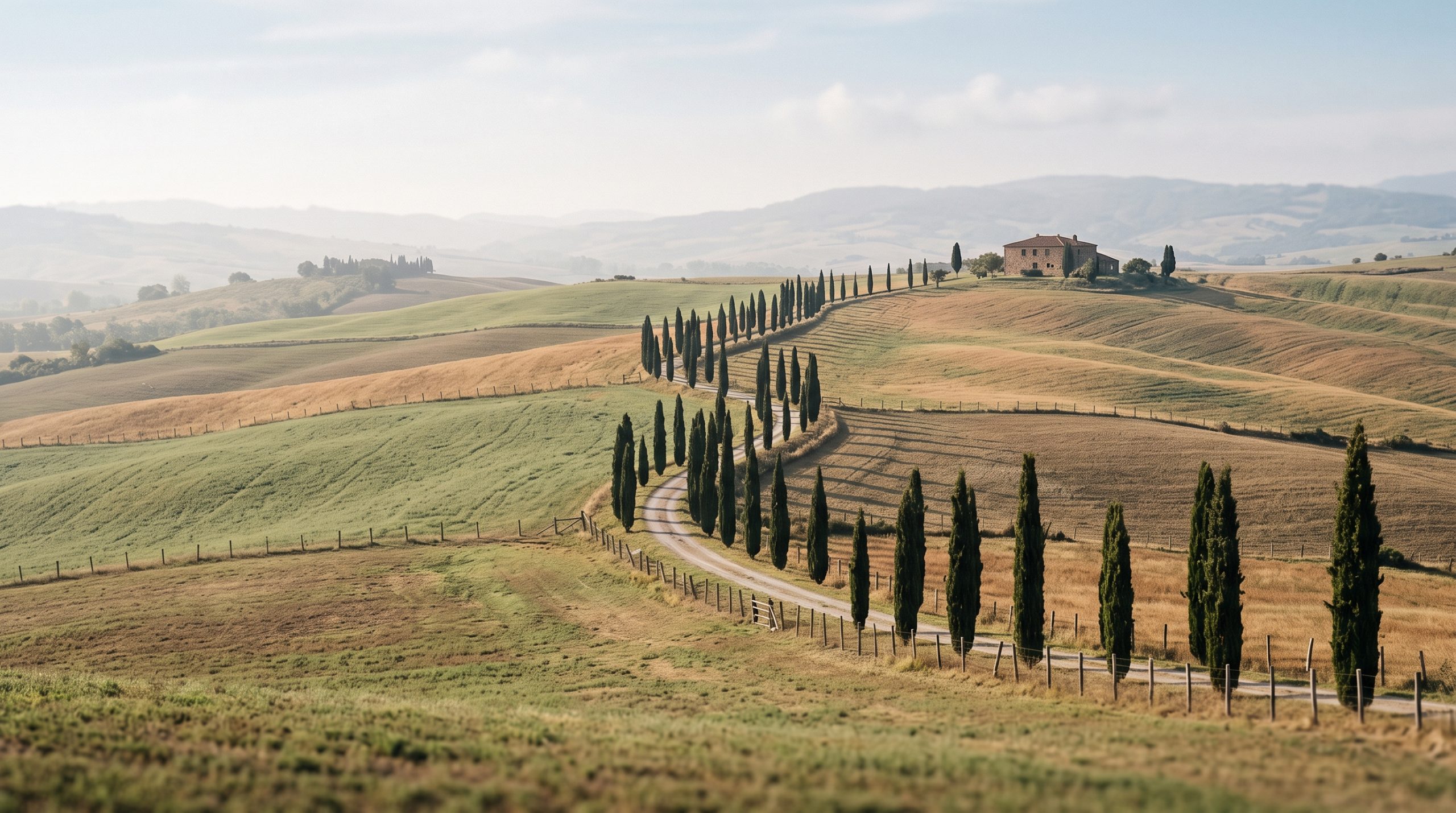
The turn for the Cappella della Madonna di Vitaleta comes off the SP146 between San Quirico d’Orcia and Pienza, and at first light it is easy to drive straight past. A sign, then a stretch of white gravel, then a walk. The chapel stands alone in the fields, its facade faced in Rapolano stone with one small rose window, given the clean shape we photograph today when Giuseppe Partini reworked it in the 1800s. It looks like it belongs to nobody. Everything around it belongs to somebody.
That is the part couples do not expect about Val d’Orcia. The whole valley reads as open country, and almost none of it is. The land is worked, the poderi are addresses with families behind them, and the authority to actually marry you sits somewhere else again: in a municipal office with set opening hours, in one of the five comuni whose territory UNESCO inscribed in 2004.
So there are two separate questions here, and running them together is where plans go sideways. Whose gate is this, and may we stand behind it. And is this spot somewhere an Italian civil registrar is legally able to marry anyone at all. The answers almost never land on the same person.
Who has to say yes before you marry in Val d’Orcia
Two parties, usually. The comune, which holds the legal power to celebrate a civil marriage and only at addresses it has formally designated for it, and the landowner, who controls physical access. Church buildings add a third. Photographing on open farmland is a courtesy question rather than a legal one, and it is answered by whoever farms it.
Where Val d’Orcia permissions take patience
On a scale that runs from straightforward to genuinely out of reach, marrying legally in Val d’Orcia sits comfortably in the middle. Nothing here is closed to visiting couples and there is no residency period to serve. What there is instead is a chain of documents collected in a particular order from three offices in two different cities, and a ceremony location that has to be legally eligible before anybody can stand in it.
Couples who start eight or nine months out find the whole thing administrative. Couples who start eight weeks out find it tense. We are photographers and filmmakers, not lawyers. Rules change and circumstances differ, so confirm the detail with the relevant registry office or your own consulate before you book flights. If you are still deciding what shape the day should take at all, our notes on how to plan an elopement are a better starting point than any document list.
Four kinds of ground in one valley
Val d’Orcia is not one legal surface. The inscribed area covers towns, villages, farmhouses, the old Via Francigena and the abbeys, inns and bridges strung along it, spread across Castiglione d’Orcia, Montalcino, Pienza, Radicofani and San Quirico d’Orcia. Each of those five comuni runs its own registry office and sets its own tariffs. Underneath that, ownership changes every few hundred metres.
Ground a comune can legally marry you on
Italian civil marriage happens at the casa comunale unless the comune has done something specific first. Article 3 of DPR 396/2000 lets a comune establish one or more separate civil registry offices, created or removed by resolution of the giunta comunale, with the act sent to the prefetto. That resolution is what turns a garden, a hall or a terrace into a place where a registrar can legally act. It is a standing arrangement between the comune and a location, not something assembled around one couple’s date.
San Quirico d’Orcia celebrates in Palazzo Chigi Zondadari on Piazza Chigi, and has also opened the Horti Leonini, its sixteenth-century park, to civil ceremonies under its Love Me in Valdorcia initiative, including the Giardino delle Rose and the avenue of holm oaks. The same comune publishes a municipal regulation governing the concession of areas used for wedding ceremonies and receptions, updated in 2021, which tells you how seriously the paperwork side of location is taken here.
Pienza celebrates in the Sala Consiliare of the Palazzo Comunale and publishes two tariffs by giunta resolution: currently 750 euro for a civil marriage or civil union in the council hall, and 1,000 euro for one held in an open-air location. Pienza also states plainly that non-residents can marry there on production of the authorization issued by their own civil registrar. Which mechanism applies to you is settled at the counter when you file, and it is settled quickly.
Ground a family farms
The poderi, the agriturismi, the vineyards below Montalcino and the long private drives lined with cypress are all somebody’s business address. Access is a private arrangement, negotiated with the owner, and it has nothing to do with your marriage file. A farm can say yes to a ceremony on its lawn and still not be a place where a registrar may officiate, because those are two different permissions from two different sources. Plenty of Val d’Orcia venues hold both. Plenty of the most beautiful ones hold only the first.
Ground the church holds
Chapels and pievi belong to a parish or to a family, and permission comes from that owner rather than from the town hall. One thing worth knowing if a Catholic ceremony is on your mind: a religious ceremony performed by Roman Catholic clergy does not require a separate civil ceremony, and the clergy registers the marriage with the local vital records office afterwards. That single fact removes several steps from the chain below, and adds a different set of parish requirements in their place.
The road, the verge and the view
Most of the frames you have saved were made from public ground. The classic Podere Belvedere composition is a roadside composition, shot from the pull-offs along the SP146 with a long lens. Vitaleta is reached on foot from the white road. Standing on a verge needs nobody’s permission. Walking out into the wheat needs the farmer’s, and the wheat is the whole point of the picture.
Here is the honest part. At sunrise in mid-May, the Belvedere verge is not a private moment. There will be tripods, and there will be a rental car arriving every four minutes. We shoot it anyway, because the light off those hills at 6am is worth the company, but we do not build a ceremony there. We build the ceremony where the ground is yours for the hour and take the famous frames on either side of it. You can see how that split plays out across a finished day in our published stories and films.
The document chain for American couples, in order
Val d’Orcia sits in the province of Siena, which puts it in the consular district of the U.S. Consulate General in Florence. That single fact fixes most of the geography below. This is the sequence in which the documents are actually gathered.
- Atto Notorio. A sworn declaration that nothing prevents the marriage, made under articles 95, 86, 89 and 97 of the Italian Civil Code, signed by you together with four witnesses who are not family members. Italian consulates in the United States take it, and it can also be taken in Italy before a tribunal.
- Dichiarazione Giurata. The marriage affidavit sworn before a U.S. consular officer. For Val d’Orcia that is the Consulate General at Lungarno Vespucci 38 in Florence.
- Legalization of the Dichiarazione Giurata. Carried out by the Ufficio Legalizzazione of the Prefettura of Florence, Via Antonio Giacomini 8, second floor, room 27, which opens at 9:00 am on weekdays.
- Declaration of Intention to Marry. Made in person before the civil registrar of the comune where you will marry, with everything above in hand. This is the moment a date stops being provisional.
- The ceremony. Celebrated by the mayor or a delegate, with two witnesses present, and an interpreter if you do not speak Italian.
- Apostille on the Italian marriage certificate. Issued by the Prefettura with jurisdiction over the place you married. For all five Val d’Orcia comuni, that is Siena.
The U.S. Consulate lists the affidavit before the Atto Notorio, because most American couples arrive in Italy with the Atto Notorio already done at home. It is the same chain either way. Worth noting too that U.S. consular officers state openly that they are not trained in Italian law and cannot interpret Italian marriage requirements, which is a useful piece of candour: on any question of what your particular file needs, the comune’s registrar is the office whose answer governs.
Work back from the ceremony to the landowner permissions
The published minimums are shorter than people assume, and the comfortable minimum is longer. San Quirico d’Orcia asks for marriage publications to be requested at its Ufficio di Stato Civile on Piazza Chigi at least two months before the ceremony. Those publications are valid for six months, cannot be filed more than six months before the presumed date, and open a window in which you may marry from the fourth day afterwards and up to the 180th. San Quirico also publishes exactly which couples the publication requirement binds, which is the sort of clarity you want from an office you are relying on.
| Step | What the office publishes | What we build the timeline around |
|---|---|---|
| Holding the date | Set by each comune’s own diary | Nine to twelve months out |
| Requesting publications | At least two months before the ceremony, per San Quirico d’Orcia | Four to five months out |
| Publication window | Valid six months; marry from the fourth day to the 180th | Ceremony date placed mid-window, never at the edge |
| Atto Notorio | Italian consulate in the United States, or a tribunal in Italy | Done at home, well before the flight |
| Florence affidavit and legalization | Consulate then Prefettura, weekday mornings from 9:00 am | Two clear working days in Florence, not one |
| Declaration of Intention | In person at the comune before the ceremony | A full working day clear of the ceremony morning |
The reason we push so hard on the exact hour is that the registrar’s availability and the light are two independent constraints, and only one of them can be negotiated. A civil ceremony in the Horti Leonini at eleven in the morning is a different film from the same words at seven in the evening. Because we send a photographer and a filmmaker who already work together, one can hold the wide frame of the park while the other stays close on faces and vows, and nobody has to ask the registrar to pause. We are currently booking 2027, 2028 and 2029, which is usually enough runway to get the hour you want rather than the hour that is left.
What catches couples out in Siena province
None of these are disasters. They are the things that cost a morning if you hit them on the day instead of on paper, and they are the reason we ask about paperwork early in planning rather than late.
- Two prefectures, not one. Florence legalizes your affidavit before the wedding. Siena issues the apostille on your marriage certificate after it. The two cities are about 70 kilometres apart, and the second errand is easy to forget once the day is over.
- Florence is not next door. Lungarno Vespucci 38 and Via Antonio Giacomini 8 are both in Florence, roughly a two-hour drive north of Pienza. That is a day out of your trip, and it wants to be a day you planned.
- Revenue stamps, bought elsewhere. An urgent Atto Notorio issued on the spot in Italy needs marche da bollo: two of 16 euro and one of 31.86 euro. You buy them at a tabaccheria before you reach the counter, not at the counter itself.
- A pretty terrace is not a registry office. Unless the comune’s giunta has already designated a location as a separate civil registry office, no registrar can marry you there, however willing the owner is. Ask any venue for the resolution, not for reassurance.
- Outdoors is a different tariff. Pienza’s open-air rate sits above its council hall rate, and the same pattern shows up across the valley. Budget the venue and the comune as two separate lines.
- The interpreter is a requirement, not a nicety. If you do not speak Italian, an interpreter must be present. Build that person into the day rather than discovering them at nine in the morning.
- Publications are public. Where they apply, the comune posts them at the town hall for two consecutive weeks including two Sundays, and only after the Declaration of Intention has been filed. The posting runs, then a short wait, then your window opens.
Fees and deadlines quoted here were correct at the time of writing and are worth re-checking with the office that issues them. If you already know your month and have a shortlist of comuni, send it over and we will tell you what the calendar actually allows: Tell Us Your Story.
Legal at home, ceremony above the Orcia
A large share of the couples we film in Tuscany sign their legal paperwork in their home county and hold the ceremony here. This is not a lesser version of the day. It is the version that gets the hour right.
What changes is entirely administrative. No publications, no Florence errand, no prefecture, no interpreter requirement, no registrar’s diary sitting between you and the best light of the evening. What also changes is where you can stand. Because nothing legal is happening at the ceremony, the designation rules fall away completely, and the only permission that matters is the landowner’s. A farm track between cypress rows, a terrace above Bagno Vignoni, a stone threshing floor behind a podere: if the owner says yes, that is the whole approval chain.
What does not change is anything you will remember. Your words, your witnesses, the walk up, the person who reads for you, the light going long across the Orcia. On film and in photographs the two routes are indistinguishable. We plan both the same way, and our destination elopement guides treat them as equal options rather than a first choice and a fallback.
Common questions
Can we legally get married outdoors in Val d’Orcia?
Yes, at locations the comune has formally designated as separate civil registry offices under article 3 of DPR 396/2000. San Quirico d’Orcia has opened the Horti Leonini park for civil ceremonies, and Pienza publishes a specific tariff for ceremonies in open-air locations. A field or a private terrace with no designation cannot host a legally valid civil ceremony, whatever the owner agrees to.
Do we need permission to photograph at the Vitaleta chapel or Podere Belvedere?
Both are reached from public ground. Vitaleta is signposted off the SP146 and approached on foot along a white road, and the Belvedere frame is made from the roadside. Stepping off those routes onto planted farmland is a private landowner’s decision, so we ask in advance where we intend to walk, and we plan the ceremony somewhere the ground is genuinely yours for the hour.
How much does a civil ceremony in Pienza cost?
Pienza’s giunta sets the tariff by resolution and publishes it: currently 750 euro for a civil marriage or civil union in the Sala Consiliare, and 1,000 euro for one held in an open-air location. Tariffs are periodically re-confirmed, so treat those as the current published figures and verify with the comune when you file.
How far ahead do we have to deal with the comune?
San Quirico d’Orcia asks for marriage publications to be requested at least two months before the ceremony, and they cannot be filed earlier than six months before the presumed date. That is the legal floor. We work four to five months ahead on the paperwork and nine to twelve months ahead on holding the date itself.
What happens if neither of us speaks Italian?
An interpreter must be present for the civil ceremony, and typically for the Declaration of Intention to Marry as well. It is a legal condition rather than a convenience, so the interpreter goes into the timeline as a named person with an arrival time, alongside your two witnesses.
Can same-sex couples have a ceremony in Val d’Orcia?
Yes. Italian civil status law provides for civil unions, and the Val d’Orcia comuni publish their tariffs for civil marriages and civil unions together. Pienza’s 750 euro council-hall rate and 1,000 euro open-air rate apply to both. Venue designation, witnesses and the interpreter requirement work identically.
Will our Italian marriage certificate be valid in the United States?
A marriage that is valid where it was performed is automatically valid in the U.S., and the Italian certificate is sufficient proof once it carries the apostille. For a wedding anywhere in Val d’Orcia, that apostille comes from the Prefettura of Siena, not from Florence, so build one more errand into the end of the trip.
Is it simpler to marry at home and hold the ceremony in Tuscany?
Administratively, yes, by a wide margin. It removes the publications, the Florence affidavit, the legalization and the registrar’s diary from your week. It also opens up locations that will never be designated registry offices, including working farmland and private terraces where the owner’s yes is the only approval required.
Where we can coordinate the ground while you hold the legal file
We design the destination and the locations, build a timeline around real travel time between Pienza and the ridge you want at sunset, research the permits and the access, hold your date against the comune’s availability, and carry weather alternatives for every hour of it. We do not file your documents and we are not your lawyers. That division is clean and it works. Travel for the assigned team is inside the fee, wherever in the world you point us, and coverage sits on our pricing page.
Everything with us happens in writing, at whatever pace suits your time zone. Send the inquiry form and you will have a reply and our brochure within 24 hours; highlights land five days after the wedding and the full gallery or film three weeks after that. If you have a month in mind and a comune you like the look of, that is enough to start: Check Your Date.