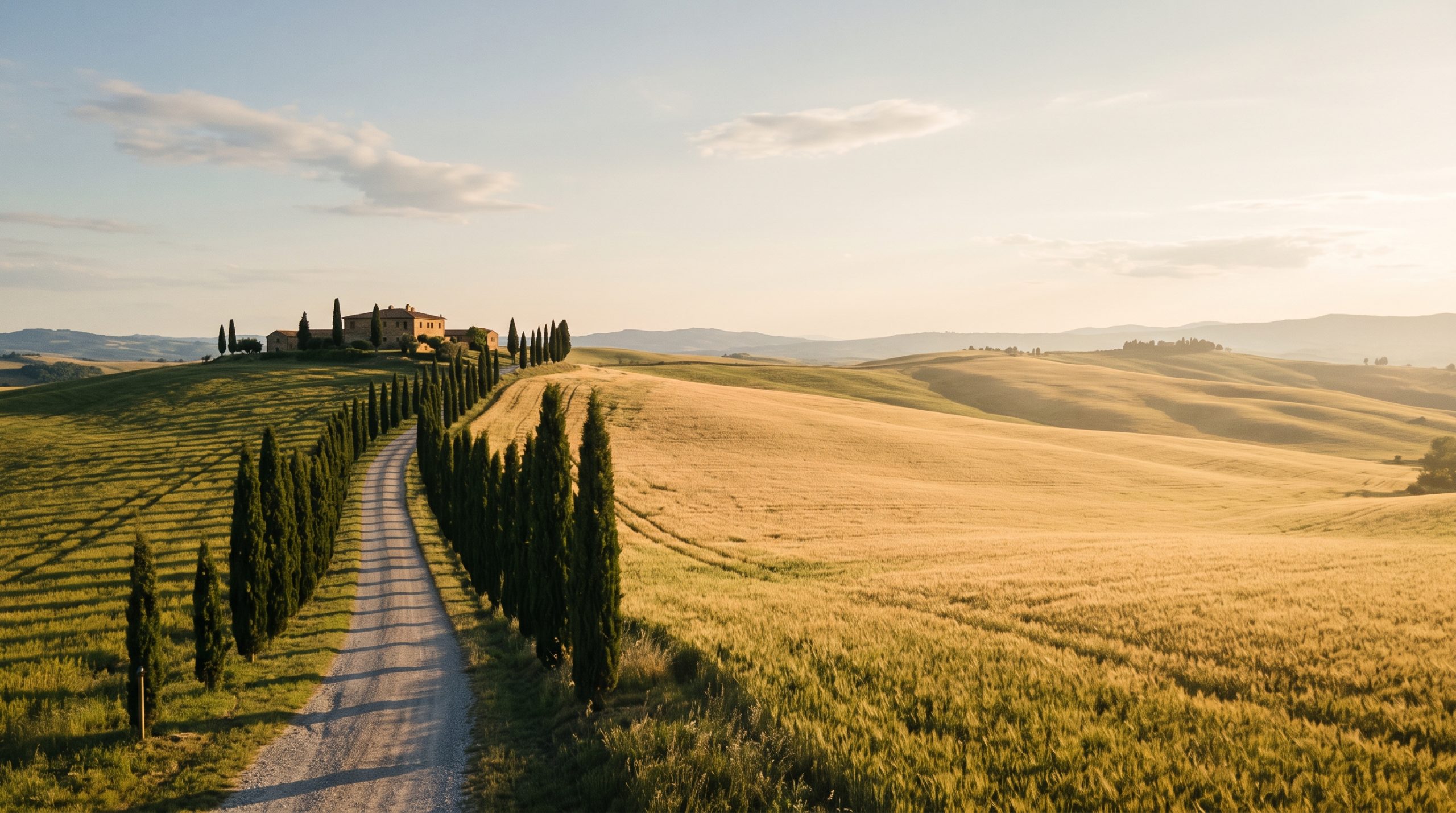
The chapel everyone means when they say Tuscany sits in a field off the SP146 between San Quirico d’Orcia and Pienza. From the road you see it at a distance. From the place where cars stop on the gravel side track it is roughly a ten-minute walk, and when you arrive, the Cappella della Madonna di Vitaleta turns out to be small, privately owned, and closed. That is the honest version, and it is still one of the finest ten minutes of light in Europe.
The rest of the honest version is a clock. In mid-June the sky above Pienza is already working at 4:57am, the sun clears the horizon at 5:33am out of the northeast, and by 1:20pm it stands 70 degrees overhead and the hills go flat and white. No camera fixes 70 degrees. The valley hands the light back at about 7:30pm and holds it until roughly 9:30pm.
So a Tuscany wedding film is not really priced by the hour, and it should not be planned by the hour either. It is built around two short windows, the drive between them on gravel roads that are slower than any map believes, and the paperwork the comune needs somewhere in the middle. This is what ours costs, and how we spend the day.
Cost and coverage in Val d’Orcia, in one paragraph
We photograph, film and plan Val d’Orcia elopements as one team. A full day with one dedicated photographer or one dedicated filmmaker starts at $4,900. A full day with both working side by side starts at $7,900. Team travel to Italy is included in that. Italian permit fees, vendors and accommodation are not.
Two gold windows, and the white hour between them
In June we are awake before four. Not for drama, but because the useful part of a Tuscan summer morning is finished by eight, and the drive to a ridge on the strade bianche runs at gravel speed in the dark. We want to be standing in position while the sky is still gray, which in mid-June means around 4:57am, half an hour before the sun itself.
That gray half hour is where the mist lives. It sits in the low fields on nights when the air cools faster than the ground, which is why late September and October are the months that most reliably give you a valley floor full of it while the ridgelines stay clear.
The mid-June sun comes up at 57 degrees on the compass, well north of east, so the light arrives across the valley rather than down it, and one flank of every cypress row is lit while the other stays in shadow. Which side you stand on decides the frame. By 6:30am the color has gone out of the light and turned into plain warm sun, which is excellent for walking, laughing, holding hands badly, and every unposed thing that fills the middle of a gallery. By 7:30am Pienza is opening and the first vans are arriving at the viewpoints, and we are usually driving away from them.
Mid-morning belongs to the paperwork, if you are marrying legally in Italy. A civil marriage is performed in front of a registrar, with two witnesses and, where neither of you speaks Italian, an interpreter. The registrar’s office keeps office hours, and office hours in June are exactly the part of the day you least want to spend on an exposed ridge. The two fit together neatly.
Then we stop. Properly. Lunch runs long, the light is at its worst, and the heat shimmer over cut stubble ruins anything shot on a long lens. It is tempting to fill those hours with something. It is a mistake, and the second window asks for energy you will want to have kept. From about 5pm the shadows lengthen again, and the hour before sunset is where vows in a farmhouse courtyard or on an olive terrace tend to sit. Sunset in mid-June lands at 8:53pm and goes down at 303 degrees, well north of west, and the sky stays workable until about 9:30pm, with the hill towns turning on their lights below you.
Late September runs the same day on kinder terms: sunrise near 7:03am, sunset near 7:06pm, and a midday sun of 46 degrees rather than 70, so the middle hours stop being a write-off. You lose three hours of daylight and gain ninety minutes in bed.
| Window | First workable light | Sunrise | Sunset | Midday sun | What the fields are doing |
|---|---|---|---|---|---|
| Late April | 5:45am | 6:16am | 8:06pm | 60 degrees | Green wheat, wildflowers on the verges |
| Mid-June | 4:57am | 5:33am | 8:53pm | 70 degrees | Gold, and cut from around the end of the month |
| Late September | 6:34am | 7:03am | 7:06pm | 46 degrees | Plowed brown, vine color, mist in the low ground |
| Late October | 7:03am | 7:32am | 6:23pm | 36 degrees | Olive harvest, low light all day, bare hills |
Late October times are given before the clocks change at the end of the month, after which everything shifts an hour earlier by the clock and the whole day becomes a long soft afternoon.
What the second camera changes on a Val d’Orcia ridge
Here is the specific problem this landscape sets. The good light is short, directional, and it moves. In the eight or ten minutes after 5:33am, a photographer wants a couple walking toward the lens through a gap in the cypresses, stopping when something real happens. A filmmaker wants a slow continuous move, a held frame, and a second angle of the same walk so the cut works. Both are right. One person switching between a stills body and a cinema body gets half of each, and the half that suffers is usually the film, because film needs the shot before and the shot after.
Aerials sharpen the same point. A drone is worth flying in Val d’Orcia for about an hour, while the sun is low enough to draw shadow lines down the plowed contours. After ten in the morning the sky whitens and the hills lose their edges from above. Italy runs drones under the European Open category, with operator registration through ENAC’s D-Flight portal and flight kept within visual line of sight below 120 meters, and the geographic zone map decides the rest. We confirm both the zone and the window before the film is planned around them. When the filmmaker is the one flying, that hour is not stolen from your portraits, because the photographer never stops.
Sound is the other thing this valley quietly offers, and only in the morning. At 5am the air here is often completely still, so bells from Pienza, gravel underfoot and wind through a cypress row record cleanly. By late afternoon there is usually a breeze across the open ground, and a lapel mic in a sheltered courtyard is a different job from a lapel mic on an open ridge. The Expedition includes professional audio for vows and the moments that matter, and knowing which hour will carry it is a planning decision, made weeks before, not a hopeful one made on the day.
None of this works if the photographer and the filmmaker meet each other for the first time in the hotel car park. We are eight people, four photographers and four filmmakers, working from one plan we wrote for your day, which also means there is always a second camera on the ground and a colleague in reserve. If you want to see what the two windows actually produce before you commit to anything, our published galleries and films are the fastest way to judge us.
If your dates are close to fixed, send them to us and we will tell you what the sun is doing that week and where we would start. Check Your Date.
The famous viewpoints are busy by nine
This is the thing couples ask about most before they book Tuscany, and the answer is not reassurance, it is timing. Val d’Orcia went onto the UNESCO World Heritage List in 2004 as a cultural landscape, described by UNESCO as “an exceptional reflection of the way the landscape was re-written in Renaissance times”. A place with that reputation collects tripods, workshop groups and coach stops, all of which arrive after breakfast.
So the roadside icons are ten minutes of the day, not its spine. The chapel from a distance, and the curve of cypresses everyone already knows. The rest happens on farm tracks and private ground where a landowner’s permission buys you an entire hillside with nobody in it, and finding that ground and asking for it is part of the planning we do rather than something you chase in your last month. The same field at 5:10am and at 10:00am are not the same photograph, and only one of them is yours.
Everything in the price, and what Italy adds on top
Every experience we run, in every country, includes the following.
- Destination and location design, and a custom timeline built around the light and the real driving time between places
- Permit research and logistics guidance, including which comune governs the ground you want to stand on
- Weather alternatives and backup planning, held ready for the morning
- Drone footage where it is legal, safe and appropriate
- Professional audio for vows and meaningful moments on the Expedition, where conditions allow
- Team travel worldwide: flights, accommodation and ordinary travel for the assigned team, with no long-haul surcharge and no European exception
- Highlights delivered in 5 days, and the full gallery or film in 3 weeks
- A fee that does not move with your guest count, whether that is nobody or thirty
What Italy charges separately is worth knowing in advance. Each comune publishes its own tariff for a civil ceremony held in a room or an outdoor space it has authorized, and the amount differs from village to village, so we pull the current figure for the one you choose. San Quirico d’Orcia runs its marriages out of Palazzo Chigi Zondadari on Piazza Chigi and keeps a written regulation for the areas it grants for ceremonies, along with the revenue stamps at 16 euros each that Italian civil paperwork still runs on. Beyond the comune, expect the official interpreter, the apostille on your marriage certificate afterward, a celebrant if your vows are symbolic, the agriturismo or villa fee for private ground, and a rental car for the white roads. Helicopters, vintage cars and anything unusual on wheels sit outside our fee too.
Coverage figures for one day of photography, one day of film, and both together are set out on our pricing page. If you want more than one day, or Val d’Orcia plus the coast, or a village in Umbria on the way through, that is the Odyssey and it runs from two to seven days on a custom proposal.
From first message to a held date, in six steps
- You send the inquiry form with your dates, or the month you are circling.
- We reply within 24 hours with our initial brochure.
- We write you a tailored proposal: the shape of the day, the team assigned, the coverage.
- You sign the contract.
- You pay a 30% retainer, and the payment dates that follow are set out in that proposal.
- Planning begins, and location design, timelines and permit research start moving.
We currently have Tuscany elopement dates available through 2027–2029, and the planning that follows runs on shared documents you can read at any hour.
The couples who do best in these hills
Val d’Orcia rewards people who will get up at four in June and be pleasant about it. It also rewards people who are comfortable walking ten minutes on a rutted track in shoes that will get dusty, and relaxed about a plan that moves at 5am because the mist came in thicker than forecast, or did not come at all. If that sounds like a good morning to you, this is one of the great mornings anywhere.
If it does not, say so early, because the fix is easy and it is ours to make. A late September or October day starts after seven, keeps a usable middle at 46 degrees, and gives you harvest color and mist instead of gold wheat. A day built only on the second window and blue hour is a real option and a beautiful one. If flat farm tracks and long walks are not what you want at all, tell us that too and we will point you at a shape of day, a month or a region that fits better, and our destination guides are a good place to start comparing. What we will not do is sell you a 4am start and hope you enjoy it.
Common questions
Can we legally get married out in the Val d’Orcia hills?
The legal act is a civil marriage in front of a registrar, held in a room or an outdoor space the comune has authorized for it, so the fields themselves are not where the signing happens. Most couples do the civil ceremony in the comune and their vows in the landscape, and we build the day around both.
Do we need witnesses and an interpreter if we are eloping just the two of us?
Two witnesses are required at the ceremony, and an interpreter is needed where neither of you speaks Italian. Some couples bring two people, others arrange them locally, and we build the timeline so that part of the morning is unhurried rather than a scramble between the registrar and the ridge.
How much does it cost to have both a photographer and a filmmaker in Tuscany?
That is our Expedition, a full day with a dedicated photographer and a dedicated filmmaker working from the same plan, and the starting figure sits on our pricing page. It includes the team’s flights, accommodation and travel to Italy, so what you add on top is Italian, not ours.
Are drones allowed over Val d’Orcia?
Aerials run under the European Open category with ENAC operator registration, within visual line of sight and below 120 meters, and the geographic zone map decides where. We confirm the zone and the time window in planning, then design the film around the hour the low sun makes the contours worth flying.
How soon do we see the film and the photographs?
Highlights reach you 5 days after the day itself, which for most couples is while they are still in Italy. The full gallery or the finished film follows within 3 weeks.
Which month gives us green hills instead of gold stubble?
Late April and May, when the wheat is still growing and the verges are full of wildflowers. The gold arrives in June, the harvest cuts it around the end of that month, and by August the hills are plowed brown. September and October trade all of that for vine color and morning mist.
Do we pay for your flights and hotels in Italy?
No. Team travel is included worldwide, Tuscany included, with no separate travel line and no distinction between a European trip and a long-haul one. You cover permit and venue fees, your own accommodation, celebrant and vendors, and anything unusual on transport.
What happens after your first Tuscany message
Everything runs in writing, at whatever hour suits you, which matters when Tuscany is six hours ahead of the East Coast and nine ahead of California. Send us the month you are circling and the rough shape you want, and we will come back with what the light is doing that week, where we would put the two windows, and which comune the ground belongs to. Tell Us Your Story