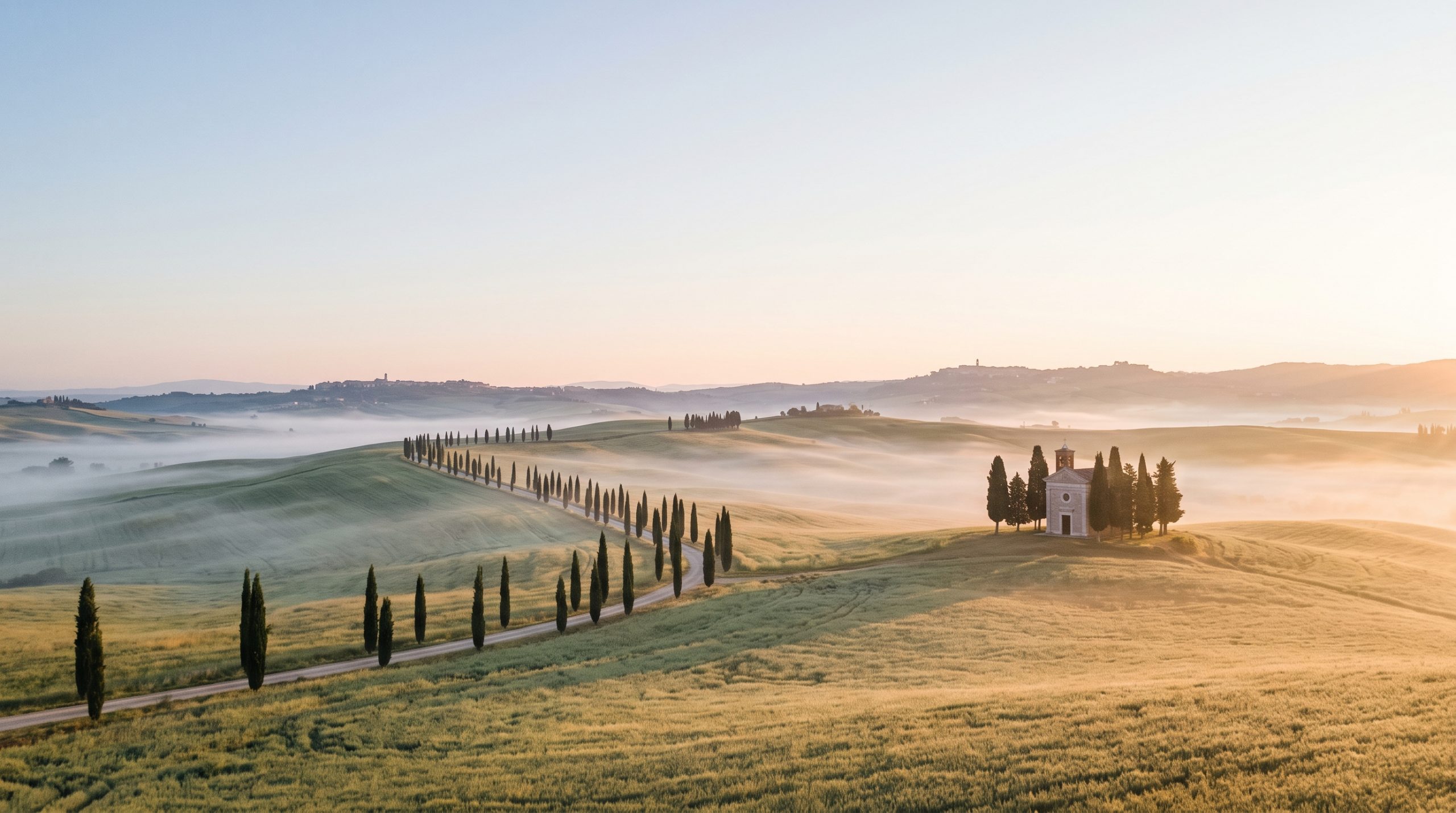
In the third week of June the sun clears the ridge east of San Quirico d’Orcia at 05:34, and the fields below Pienza are usually still holding a floor of mist. To be standing in that mist you leave the house at 04:45. That is the whole timeline in one sentence, and everything after it is arithmetic.
A Val d’Orcia day is not built around a venue. It is built around a handful of pull-ins on the SP146, one chapel you cannot drive to, a council room with a published tariff, and about five hours in the middle of the day when the light goes flat and white and the valley gives you nothing. Get the clock right and the day feels slow in the best way. Get it wrong and you spend it in the car.
Below is the day we actually build, in June and again in late September, with the drives measured rather than guessed.
One June day, start to finish
Wake at 04:15 and leave at 04:45. Walk the last kilometre to the Vitaleta chapel and be in place for a 05:34 sunrise. Breakfast at 07:45, then a long pause through the white midday. Ceremony in the late afternoon at San Quirico d’Orcia, cypress rows at 19:45, sunset at 20:56, last frame near 21:30.
04:45 to 08:00: the dark drive and the walk to Vitaleta
Civil twilight in the valley starts around 04:58 in mid-June, so there is workable light more than half an hour before the sun itself appears. That half hour is the reason for the alarm. The valley at 05:00 is grey and blue and completely empty, and the difference between arriving then and arriving at 06:30 is the difference between a landscape and a car park.
The Chapel of the Madonna di Vitaleta sits in the hills on the road between San Quirico d’Orcia and Pienza. The regional tourism board is blunt about the approach: you take the SP146 to a small road through olive groves, park, and walk about a kilometre. There is no drop-off. The land around it is private, so the walk stays on the marked path, and the last stretch opens onto the chapel with its two cypresses all at once.
Ten minutes is the honest walking time in trainers. In heeled shoes, carrying a dress over one arm, it is closer to twenty, and the grass beside the track is wet enough at 05:00 to soak a hem in the first fifty metres. So we do the obvious thing. Shoes go in a bag, the dress travels folded, and one of us carries water and a microfibre towel for the hem. Nobody photographs the walk in. It is not part of the film. It is the price of having the chapel to yourselves.
From 05:34 the sun comes up over the eastern ridge and moves fast. The mist that pools under Pienza usually burns off between 07:00 and 07:30 depending on the previous night, which gives roughly ninety minutes of the light people come here for. We spend it in two places, not five. Then we walk back, drive ten minutes, and eat breakfast at a table while the day is still cool.
The same day in June and in late September
Both months are good. They are not the same day. September gives you a civilised alarm and a dinner at a normal hour, but the usable arc from first light to last frame is about two and a half hours shorter, which means one location comes out of the plan.
| Moment | Mid-June | Late September |
|---|---|---|
| Leave the house | 04:45 | 06:15 |
| On the path to the chapel | 05:05 | 06:35 |
| Sunrise | 05:34 | 07:04 |
| Breakfast | 07:45 | 09:15 |
| Long pause | 11:00 to 16:00 | 12:00 to 15:00 |
| Ceremony hour | 16:30 | 15:30 |
| Cypress rows on the SP146 | 19:45 | 18:00 |
| Sunset | 20:56 | 19:06 |
| Last frame, end of civil twilight | 21:30 | 19:35 |
| Sitting down to dinner | 21:45 | 20:00 |
One more date matters more than couples expect. Clocks in Italy go back on the last Sunday in October, and from that evening the sun is down before 17:30. An October day is a beautiful day, and it is a compact one. We plan it as a single arc with no midday break rather than as two halves.
Where the map lies on the SP146
The distances here are tiny and the times are not. San Quirico d’Orcia to Pienza is about ten kilometres of the SP146 and a route planner will tell you twelve minutes. In the second half of June we plan twenty-five. Harvest is staggered because farms share machinery, so you sit behind a combine or a trailer for two kilometres at a time, and every pull-in with a view has cars reversing out of it.
The white roads are the bigger gap. The strade bianche are compacted limestone gravel, and they are the reason the valley looks the way it does in photographs, but they run at roughly half the speed of the asphalt and they throw a dust plume that hangs in still air for a minute after you pass. Two things follow. We plan gravel legs at half the map time, and we never put a second vehicle directly behind the first on a dry white road. When you book the rental, ask for something with real ground clearance rather than the cheapest small car on the list. A crossover makes these roads a non-event.
Arrival is worth the same honesty. Florence Airport is the nearest sensible gateway, and the road distance to the valley is around seventy miles, which route planners put at roughly one hour and fifty minutes. Plan on two and a half hours door to door once you have queued at the rental desk and stopped for fuel. Collect the car at the airport rather than in the city. Most of central Florence is a limited traffic zone, camera controlled from 07:30 to 20:00 Monday to Friday and 07:30 to 16:00 on Saturday, and the simplest way to have nothing to do with it is to never drive into it.
Two routes we would not recommend. Basing yourselves in Florence and driving down for the sunrise means leaving at 02:30, and the day never recovers from it. Adding Montepulciano to a June morning that already includes Vitaleta looks fine on a map and turns into eleven kilometres of switchbacks, a walled hilltop where cars stay outside the gate, and a steep climb in the wrong shoes. Pick one hill town and be in it properly.
Why the middle of the day is not a gap in the schedule
Between roughly 11:00 and 16:00 in June the valley goes white. The contrast is brutal, the cypresses lose their shape, and the stone in Pienza holds heat like a radiator. There is no version of the schedule where shooting through that window produces work anyone wants.
So the pause is written into the timeline as a real thing. Lunch is booked, usually in Pienza where the cheese shops open onto the main street, and afterwards there are two or three hours with the shutters closed. Couples who have been awake since 04:15 sleep for an hour of it. This is also where the second change of clothes happens, unhurried, and where we scout the exact ceremony position and the evening pull-in while you are not standing in the sun waiting for us.
Bagno Vignoni is the exception worth knowing. The old thermal square in the middle of the village is a stone basin of steaming water rather than a piazza, it sits about five kilometres south of San Quirico, and it reads well in flat overhead light because the steam does the work the sun will not. If your day needs something at 13:00, that is where it goes.
Two months and two signatures: fitting the comune into the clock
Most American couples we work with in Tuscany do one of two things. They sign the legal paperwork at home and hold the ceremony in the valley with a celebrant, which leaves the clock completely free. Or they marry legally in an Italian comune, which is straightforward and does put fixed points in the day.
If you take the legal route, the timing is set by the comune, not by you. San Quirico d’Orcia asks for the marriage publications to be requested at the civil status office in Piazza Chigi at least two months before the ceremony; the publications are then valid for six months, and you can marry from the fourth day to the one hundred and eightieth day afterwards. American couples also need an atto notorio, sworn before an Italian consulate in the United States in front of four witnesses, and a nulla osta sworn in Italy before a United States consular officer. Florence is the nearest consulate to the valley. Both are booked well in advance, so they belong at the front of the planning, not the end.
| Ceremony room | Where | Published tariff |
|---|---|---|
| Palazzo Chigi Zondadari | Piazza Chigi, San Quirico d’Orcia | Free for residents on a weekday morning, up to 500 euro for couples from outside the province of Siena |
| Horti Leonini | Renaissance garden, San Quirico d’Orcia | From 200 euro |
| Sala Consiliare | Palazzo Comunale, Pienza | 750 euro |
Pienza takes non-resident couples in the council chamber on presentation of a delegation from their own registrar. Both comuni set these figures by council resolution and revise them, so we confirm the current tariff and the exact slot at the point of booking rather than working from a number in a blog. One timing note that saves an afternoon: at San Quirico the weekday afternoon slot is the most expensive one, and it is also the one that sits comfortably before golden hour. We think that trade is usually worth making, and we say so in the proposal.
How we split two cameras across one valley
The valley punishes single-vehicle plans. Somebody has to be at the next pull-in early enough to take the last space, and somebody has to stay with you so you are never standing at the roadside in a dress waiting for a scout to come back. On an Expedition day the photographer and the filmmaker come from the same team, travel in two cars, and split exactly that way. On a full day with one of us, we build the route so the scouting happens during the midday pause instead.
Aerials work the same way. Italian drone flying sits under the European rules that ENAC administers, which means a registered operator, a 120-metre ceiling and visual line of sight, and airspace that has to be checked for the specific field rather than for Tuscany in general. We confirm all of that before we plan a single sequence around it, and we hold a ground version of the same sequence either way. Drone footage is included wherever it is legal, safe and appropriate, and the Expedition adds proper audio so the vows are not a wind recording.
A full day with one dedicated photographer or one dedicated filmmaker starts at $4,900, a day with both working together starts at $7,900, and everything else lives on the pricing page. Flights and accommodation for the assigned team are inside that, in Tuscany as everywhere. If the valley is one leg of something longer, two to seven days across one or several regions, that becomes a custom proposal instead. You can see how a full day of Val d’Orcia light actually resolves in our published galleries and films, which is also the fastest way to understand what lands in your inbox: highlights five days after the day itself, and the full gallery or film within three weeks.
If you already have a month in mind, or a chapel, or nothing but a rough week in September, send it over. We will come back with the light times for those dates and a first shape for the day. Send Us a Message.
Common questions
How early do we really have to get up for a June sunrise in Val d’Orcia?
The alarm goes at 04:15 and you leave at 04:45. Sunrise in mid-June is 05:34, workable twilight starts around 04:58, and the walk in from the parking area takes ten to twenty minutes depending on shoes. A 06:00 start means arriving after the light has already gone hard.
Can we drive right up to the Vitaleta chapel?
No. You reach a parking area off a small road from the SP146 and walk the last kilometre on the path. The surrounding land is private, so the approach stays on the track. Bring trainers for the walk and change at the chapel, which is what almost everyone does.
Is a September elopement day shorter than a June one?
By about two and a half hours of usable arc. Late September gives sunrise near 07:04 and sunset near 19:06, against 05:34 and 20:56 in mid-June. The morning is far kinder and dinner happens at 20:00, but one location usually comes out of the plan.
Do we need to be in Italy before the wedding day for paperwork?
If you are marrying legally in Italy, yes. The nulla osta is sworn in front of a United States consular officer in Italy, and San Quirico d’Orcia wants the publications requested at least two months ahead. Couples who want an entirely free clock sign at home first and hold the ceremony here.
Where should we base ourselves for a Val d’Orcia day?
Inside the San Quirico d’Orcia and Pienza triangle. Everything in this timeline sits within about ten kilometres, which is what makes a 04:45 departure survivable. Basing in Florence and driving seventy miles down for sunrise costs you the morning and most of the goodwill.
What happens to the timeline if the weather turns?
It shifts rather than collapses. Mist and low cloud are often better than a clear sky here, and a wet morning usually means we move the chapel hour to the evening and bring the ceremony forward. Every plan we write carries a named alternative for each location, chosen when we scout, not on the day.
Your version of this clock
Nothing above is fixed. Some couples want the ceremony at 05:40 with nobody else in the valley and a long lunch afterwards, and some want to sleep until seven and give the whole day to the evening. Both are good days. Tell us which one sounds like you and we will build the hours around it, or tell you honestly that the month you are looking at fits the other shape better.
We are booking 2027, 2028 and 2029. Send the form, and you will have a reply and our brochure within 24 hours, then a tailored proposal; planning begins once the contract is signed and the 30% retainer is paid. It all happens in writing, at whatever hour suits you, so nothing has to be squeezed into a lunch break. If it helps to read the groundwork first, start with how to plan an elopement and our destination guides. Start Your Story.