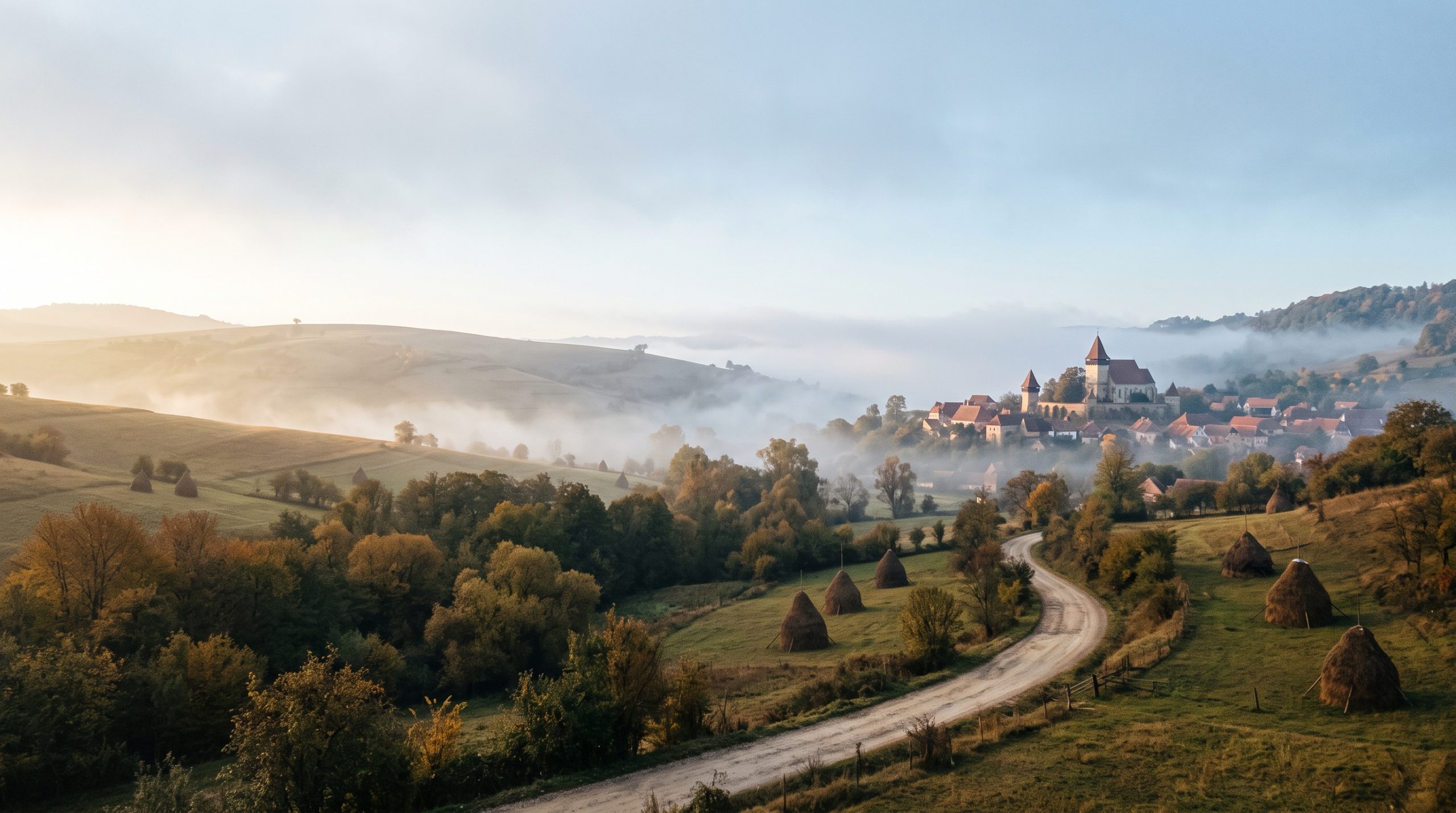
The barrier on the Transfagarasan does not lift until 7am. That single fact rearranges more Transylvania plans than anything else we deal with here, because by 7am in July the sun has been up for well over an hour and the highest stretch of the road is still locked. Route planners have no idea. They will cheerfully route you up there for first light.
Transylvania is not a difficult place to elope. It is a place where three operational facts decide the shape of the trip: a mountain road with a season and a curfew, a civil registry that answers to residence rather than romance, and an airport map with no nonstop from the United States. Get those right and the rest of the region is unusually generous. Saxon citadels, a glacial lake that holds snow into June, dawns where the loudest sound is a cowbell in the next field.
What follows is the operational half of the planning: which airport, what is gated and when, who has to say yes to a drone, and how the legal side actually works for two Americans. We are booking 2027, 2028 and 2029 across the region.
The bottom line before you book flights
Fly into Cluj or Sibiu with one European connection and allow four full days on the ground. Plan the high mountains for the June to October window, when the Transfagarasan is open daily between 7am and 9pm. Marry legally at home, then hold the ceremony here with a celebrant. Aerials need clearance weeks ahead.
The legal side: married at home, ceremony in the Carpathians
Romania recognizes only the civil ceremony performed at a city hall. A religious or celebrant-led ceremony carries no legal weight on its own, and the registrar issues the marriage certificate as soon as the civil formalities are complete. The declaration that starts the process is filed at the city hall of the town where one of you holds domicile or residence, and a different town is possible only with the approval of that town’s mayor.
Then the documents. A passport, a birth certificate carrying an apostille and a sworn Romanian translation, proof that you are free to marry, and a prenuptial health certificate obtained from a clinic in the Romanian town where the ceremony will take place. A ten-day publication period sits between filing the declaration and the ceremony itself. Two witnesses have to be present. If neither of you speaks Romanian, an interpreter is required. The United States issues no national single-status certificate, so that piece comes from your state or your county.
For two Americans with no address in Romania, that route is long and it puts the ceremony hour inside an office on a weekday morning. Almost every couple we plan for here does it the other way round. The legal marriage happens at home, quietly and on your own terms, and the ceremony that actually matters happens on a ridge at six in the morning, with a celebrant we help you find and you pay directly. Our guide to how eloping works walks through both orders of operations.
Cluj, Sibiu or Brasov: which way in
No airport in Transylvania has a nonstop from the United States, so every itinerary here runs through one European hub. You can still be in the mountains the same day you land in Europe, but only if you fly into the airport that matches the half of the region you came for.
| Airport | Code | Best for | Schedule reality |
|---|---|---|---|
| Cluj-Napoca Avram Iancu | CLJ | Northern Transylvania, the Apuseni, ending the trip in a real city | The widest network of the three, with around a dozen airlines, a Lufthansa hub route and broad Wizz Air coverage of western Europe |
| Sibiu | SBZ | The Fagaras Mountains, the Transfagarasan, fortified-church country | The main airport for southern Transylvania, with daily Lufthansa Group and Austrian connections through Munich and Vienna |
| Brasov-Ghimbav | GHV | Bran, Brasov and the ridges west of the city | Opened in June 2023 and still small, with a handful of airlines to mostly European cities including Budapest and Rome |
There is a fourth way in, and we mention it mainly to talk you out of using it on arrival day: fly to Bucharest and drive north. It works, but it puts a Carpathian crossing on the day you land, straight off a transatlantic flight. If Bucharest is the routing that suits you, say so early and we will build the first night on the south side and cross in daylight the next morning.
Bases, briefly. Sibiu, or a village in its county, puts you within reach of Cartisoara at the northern foot of the pass. Brasov works for Bran and the meadows west of the city. Cluj suits the north and the Apuseni, and it is a genuinely good place to end on, with Piata Unirii, St. Michael’s church and the Banffy Palace all a short walk apart. Our destination guides go deeper on the regions themselves.
The June to October window on the Transfagarasan
The DN7C was cut through the Fagaras Mountains between 1970 and 1974 as a military road, and it still behaves like one. It climbs from the south past the Vidraru reservoir, tops out a little above 2,000 metres at Balea Lake beside the summit tunnel, and drops north through the hairpins that everyone has seen from the air.
The section that closes for winter runs from Piscu Negru in Arges County to Balea Cascada in Sibiu County: kilometre 104 to kilometre 130, about 27 kilometres of road. CNAIR, the national road administration, gates it in November and reopens it once the high ground is clear. In 2027 that was 7am on June 6. In 2028 it was midday on June 12. Older seasons have run later still, into the first days of July.
When it is open, that high section is open daily from 7am to 9pm, and CNAIR can restrict it at short notice when the weather at the summit turns. Those two numbers shape a Transylvania elopement day more than any venue decision. First light in summer arrives before the gate lifts, which makes the pass an evening location rather than a sunrise one. So we build the sunrise hour lower down, in the foothills or on a meadow above Cartisoara, and take the road up as the coaches drain away and the light goes long.
Outside the open season there is still a way to the lake. The cable car from Balea Cascada runs up to the shore independently of the gated road, which is how Balea gets photographed in late spring while snow still covers half of it. It tends to load when it is full rather than on a strict clock, so we plan a wait into the day instead of pretending there is not one. Our published stories show what that light does to the ridgeline and how the hairpins cut together in a film.
One more practical thing. There is no fuel on the pass. The last useful stations are at Cartisoara on the north side and Curtea de Arges on the south, and the climb sits on sustained grades of eight to ten percent, which a small rental car will feel in second gear. A full tank before the gate is part of the plan, not an afterthought.
Where a route planner will let you down
A planner will send you over the Transfagarasan in the second week of May without a word of warning. The gap between the map and the road there is not measured in minutes. It is measured in whether the road exists that week. The gate is the same story: no planner models a 7am opening, so any itinerary containing a summit sunrise was written by software that does not know the road is shut at that hour.
Bran Castle is the other place plans quietly fail. It is privately owned and operated, with its own opening hours and its own ticket portal, and the courtyard fills from mid-morning onward. Driving there for a midday portrait hour is technically possible and, in our experience, not worth the day it costs you. It makes a good early visit and a poor centrepiece. What does work is the countryside around it, in the hour before the coaches arrive.
Two smaller ones. Romanian national roads are single carriageway and run through the middle of villages, so the average speed that looks reasonable on a screen is not the one you get behind a tractor on a market morning. And any drive using the pass has to clear the gate at both ends, which means finishing on the side you started unless the whole day belongs to it.
Aerials, and who has to say yes first
Romania runs on EU Regulation 2019/947, with the Romanian Civil Aeronautical Authority, the AACR, as the national authority. Anything over 250 grams or carrying a camera has to be registered, the operator ID goes on the airframe, and the open-category ceiling is 120 metres. An operator registration issued in another EU state is recognized here, which matters when a team flies in for a single day.
Airspace clearance is only half of it. Castles, monasteries and fortified churches are landowners as well as monuments, so aerial work above them needs the site’s yes on top of the aviation one. We start those requests weeks rather than days ahead, and we design the film so it stands up whether or not the aerial over one specific roof comes through. Permit fees are yours to pay. The asking, the wording and the timing are ours.
How the gate and the grades shape the day we build
A Transylvania day gets built backwards from two fixed points: the hour the light is worth having, and the hour the road allows. Everything else moves around those. If the ceremony is on the pass, it sits in the evening block with a clear hour of margin before the 9pm closing, and we hold a lower alternative in the same valley for the evening the summit is inside a cloud. If it is in a village, the drive there goes before the day warms up and the tour vans start rolling.
The second camera is not a luxury on ground like this, it is how long drives get absorbed. With a photographer and a filmmaker both on the day we often run two vehicles, so one of us can go ahead to read the parking at the lake or the light in a churchyard while the other stays with you. Nobody spends golden hour learning a location for the first time. There are eight of us, which also means a colleague in reserve and a second set of bodies and lenses already in the country, several hours from the nearest camera shop.
Coverage runs as The Adventure, one full day with a dedicated photographer or a dedicated filmmaker, or The Expedition, where a photographer and a filmmaker work the day together, while The Odyssey stretches across two to seven days and more than one place if you want it, and the coverage and pricing page sets out what each includes. Team travel is included worldwide, so flights and accommodation for the assigned team never arrive as a line item later. Highlights reach you in five days and the full gallery or film in three weeks.
If this sounds like your kind of week, send us the dates you are circling and the half of the region you keep returning to. Tell Us Your Story.
Common questions
Can two Americans legally get married in Transylvania?
Romania recognizes only the civil ceremony at a city hall, and the declaration has to be filed where one of you holds domicile or residence, with another town possible only by that mayor’s approval. With no Romanian address, that is a heavy route. Nearly every couple completes the legal marriage at home and holds the ceremony here with a celebrant.
How long before the ceremony do the Romanian papers have to be filed?
A ten-day publication period sits between filing the marriage declaration at the city hall and the civil ceremony, and both of you file in person. Documents from abroad need an apostille and a sworn Romanian translation, and the prenuptial health certificate has to come from a clinic in the town where the ceremony takes place.
Which airport is closest to the Transfagarasan and Balea Lake?
Sibiu, SBZ. It is the main airport for southern Transylvania, with daily connections through Munich and Vienna, and it puts you on the northern side of the pass. Cluj, CLJ, carries the bigger schedule and works better for the north. Brasov-Ghimbav, GHV, is the small one, useful when Bran and Brasov are the centre of the trip.
Is the Transfagarasan open in May?
No. The high section between Piscu Negru and Balea Cascada stays gated through winter and spring. It reopened on June 6 in 2027 and on June 12 in 2028, and some seasons have run later, into early July. We do not commit the pass to a June date until CNAIR confirms the season is open.
Can we be at Balea Lake for sunrise?
Not by road in summer, because the high section only opens at 7am and the sun beats it by more than an hour. We keep sunrise in the Fagaras foothills, where the valley mist does something the summit never does, and use the pass in the evening block instead, which also puts you up there after the day traffic has gone.
Do we need a permit to fly a drone in Romania?
Drones over 250 grams or carrying a camera must be registered, operations follow EU Regulation 2019/947 under the Romanian Civil Aeronautical Authority, and the open-category ceiling is 120 metres. A registration issued in another EU state is recognized. Above castles and fortified churches the site owner also has to agree, which is why we ask weeks ahead.
How far ahead should we book a Transylvania elopement?
We are working on 2027, 2028 and 2029. A date is held once the contract is signed and a 30 percent retainer is paid, and planning begins from there. Inquiries get a reply and an initial brochure within 24 hours. For June dates on the pass, earlier is better, because the alternatives have to be designed around a road that may open late.
Is Bran Castle worth building the day around?
Honestly, no. It is privately run with fixed opening hours and its own ticket portal, and the courtyard is busy from mid-morning. Visit it early if the story matters to you, then spend the good light in the countryside around Bran, where there is no queue and no barrier rope.
Choosing your week in the Carpathians
If the high mountains are the point, look at the back half of June through October and let the pass decide the exact date. If the Saxon villages and the citadels are what you keep picturing, the season is longer and gentler, and September mornings there are quiet in a way July never is. Tell us which of those two you are seeing and we will either shape the day around the week you already have, or say plainly which month fits it better. We keep the process in writing, at whatever hour works in your time zone, starting with the form. Check Your Date.