The gate on the high stretch of the Transfagarasan, above Balea Cascada, opens at 07:00. On 21 June the sun is already up there at 05:32, and by the time the first car is let through it has climbed past thirteen degrees and gone hard. Every couple who has ever planned to drive up to Balea Lake for sunrise has planned to arrive ninety minutes late.
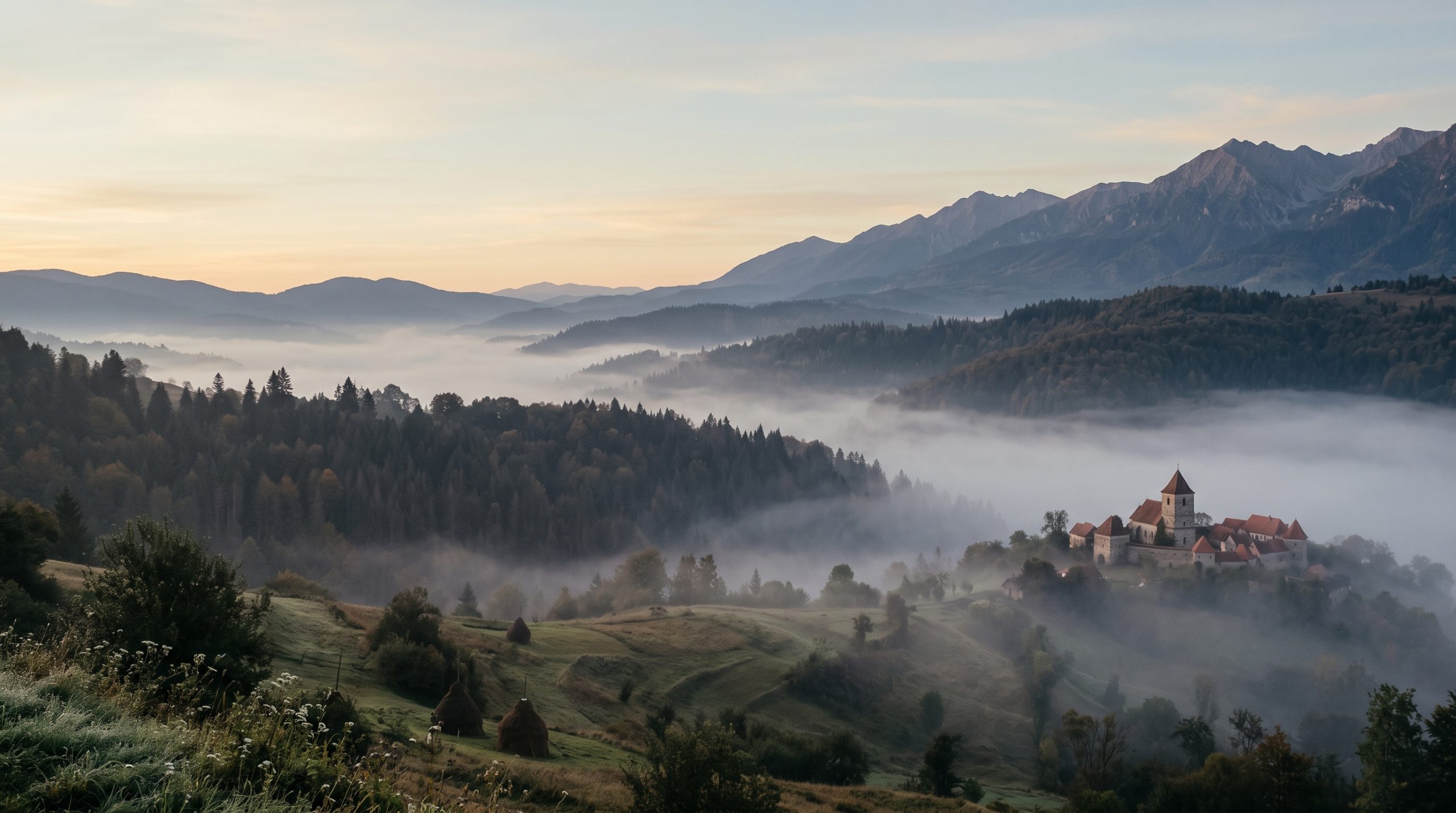
So we do not put first light there. We put it on the Brasov side of the mountains, in the hay meadows above Pestera and Magura, where the east face of Piatra Craiului takes the sun before anything on the valley floor does and no barrier has to open for you. The same dawn on the same range, without the queue.
That is most of the work here. Transylvania is long east-west valleys, a limestone ridge running about twenty-five kilometers south from Zarnesti, Saxon villages built around fortified churches, and a clock that sits a long way east inside its own time zone, so midsummer solar noon lands at 13:19 and the evening light worth waiting for does not start until 20:00. Get the hours right and the region gives you more than you asked for. Get them wrong and you have flown a long way to photograph a coach park.
Photography, film and planning for one Transylvanian day
We are eight people, four photographers and four filmmakers, working across Transylvania from the Bran valley and Piatra Craiului to the Saxon villages and the high Fagaras. Photography, film and planning come from the same team, not three suppliers. Coverage starts at one full day, and team travel is included. It is all on our coverage and pricing page.
One June day, from a 04:49 sky to a 21:10 sunset
Late June near Brasov gives you civil dawn at 04:49, sunrise at 05:28 and sunset at 21:10, with usable light hanging on until about 21:48. That is close to seventeen hours. Nobody should be photographed for seventeen hours, so a midsummer day here works as two long blocks with a real gap in the middle, and the gap is part of the plan rather than a failure of it.
We are usually moving by 04:00. The drive from a Bran valley guesthouse up the gravel to the meadows above Pestera takes longer than the map says, and the point of leaving early is to be standing in the right field while the sky is still grey, not arriving as the color goes. At 05:28 the sun comes up in the northeast, at an azimuth of about 55 degrees, and the limestone opposite turns a long time before the grass at your feet does. Vows land best between about 05:40 and 06:30, when the sun is between four and ten degrees and the whole valley is still cool.
By 07:00 the light has hardened. That is when we drive down for breakfast, and it is also the honest reason we do not build a morning around Bran Castle: between roughly ten and four the road through the village is a queue and the ground below the walls belongs to tour groups. The castle is worth seeing. It is not worth your best hour, and we will say so before you book rather than after.
The middle of a June day is for travel and for sitting down. Solar noon is 13:19, the sun stands at 68 degrees, and open limestone at that angle goes flat and white. So the middle hours go to a drive out to the Saxon plateau, lunch somewhere with a courtyard, or an interior: the cool inside of a fortified church at Viscri or Prejmer, where the only light is what comes through the windows and the walls are a meter thick. It photographs like a different country from the ridge you were on at dawn.
Late afternoon we move again, usually into the Zarnesti gorge or up onto the terraces where the hay is stacked. Here is a piece of local geometry worth knowing: in the Bran valley the Piatra Craiului ridge stands to your west, about a thousand meters above the valley floor, so the floor loses the sun close to an hour before the almanac sunset. Around 20:15 the shade arrives at Bran while the almanac still says 21:10. If you want that last hour you have to be high on the meadows, or across the valley where the western wall of the Bucegi is still lit.
Between 20:00 and 21:10 the sun drops from ten degrees to nothing, swinging round to about 304 degrees in the northwest. That is the hour that carries the film. We hold the walking and the long lens work for it, and we keep shooting into civil dusk at 21:48, because the blue that sits over the Fagaras after the sun has gone is worth another twenty minutes on your feet.
September changes the shape completely, and for many couples it is the better one. On 20 September sunrise is 07:01 and sunset 19:22, a twelve-hour day you can run as one continuous piece with a 05:45 alarm rather than a 03:45 one. Fog sits in the Saxon valleys at dawn in late September and October, burning off from the ridge downward, which is the single most photogenic weather this region produces.
| Month | Sunrise, Brasov | Sunset | High Fagaras road | What we build the day around |
|---|---|---|---|---|
| Late June | 05:28 | 21:10 | Open, high section 07:00 to 21:00 | Two blocks and a long rest, vows before 06:30 |
| Late July | 05:47 | 21:01 | Open | Cut hay, cloud building over the ridge by afternoon, high ground taken early |
| Late September | 07:01 | 19:22 | Open | Valley fog at dawn, one continuous twelve-hour day |
| Mid October | 07:32 | 18:34 | Open, closing for winter in early November | Beech and larch color, a sun that never climbs high |
| Late December | 07:55 | 16:36 | Closed above Balea Cascada | Eight hours forty minutes of light, everything planned low |
Your date will have its own numbers, and the timeline we send you is built on those rather than on a template. If you already have a month in mind, or two you are choosing between, Check Your Date and we will tell you what the light does that week.
The ten minutes the ridge clears, and who is standing where
Summer afternoons in the Carpathians build cloud over the high ground, and the Fagaras crest spends a lot of July hidden. Then it lifts. When it does, you have somewhere between ten minutes and half an hour before it closes again, and one person cannot photograph and film that window. Swapping between stills and video means both are compromised, and the frame nobody gets is the one where the couple is small and the whole ridge is clear behind them.
This is where one team matters more than any promise about style. On an Expedition day a dedicated photographer and a dedicated filmmaker work the same window from two positions that were agreed in advance, because they work together every month and they know who holds the wide and who takes the ridge. Nobody is walking through anybody’s shot. Nobody is asking you to repeat a moment for the second camera.
Inside a fortified church the same logic applies in reverse. These are small, dim rooms with one useful window and a custodian who has given you a set amount of time. A photographer can work at a slow shutter close in. A filmmaker needs a different distance, a different lens and light that holds still for longer than a heartbeat. Two people who have never met will spend that window negotiating. Two people from the same team will have decided on the drive over.
Sound is the other thing this landscape decides for you. On an exposed crest the wind is louder than either of you, so where the film includes vows we place them below the crest, in the lee of rock or at the treeline, and take the crest for pictures ten minutes later. Expedition days carry professional audio for vows and the moments that matter, where conditions allow. Aerials run on permission and a time window in Romania, and national park ground and castle grounds each have their own rules, so we confirm what is possible for your exact locations before any part of the film depends on a drone.
What that produces is a gallery and a film of the same day made by people who planned it together. Our published stories and films are the honest version of what this looks like: cold blue meadows at 05:20, limestone going pink above a sleeping village, fog lying in the valleys below a church tower. Highlights reach you within 5 days, the full gallery or film within 3 weeks.
What Romania asks for on paper
This is the question that stalls more Transylvanian plans than weather does, so here is the plain version. Romania recognizes the civil ceremony held at a city hall as the marriage itself, and the marriage can only be held after a ten-day publication period that starts when you file the declaration at the civil status office. Everything you bring from the United States has to carry an apostille and a Romanian translation, and there is a health certificate to obtain locally with a short validity window.
There is a further wrinkle worth knowing before you fall in love with the idea. The United States has no national register of marital status, so the embassy cannot certify that you are free to marry, and the certificate a Romanian registrar would like to see does not exist in the form they are used to. Couples do work through it. It takes two trips, or one long stay, and a local person handling documents.
Which is why most of the American couples we work with in Transylvania sign the legal paperwork at home, before or after, and hold the ceremony that actually matters to them on a mountain meadow with two witnesses and no registrar in sight. It changes nothing about the day, the vows or the film. If you want the civil ceremony in Romania as well, tell us early, because a ten-day window and a city hall appointment reshape the travel plan and we would rather build the timeline around it than beside it. Our planning fundamentals cover how the legal and the ceremonial parts fit together wherever you marry.
What we cover, and what stays in lei
In every experience
- Destination and location design for your date, not a list of places we already have pictures of
- A custom timeline built around real light and real travel time on Transylvanian gravel
- Permit research and logistics guidance for castles, citadels, church custodians and private land
- Weather alternatives and backup planning, which in the Carpathians means a sheltered low-level option held for every high one
- Drone footage where it is legal, safe and appropriate
- Professional audio for vows and meaningful moments on the Expedition, where conditions allow
- Team travel worldwide: flights, accommodation and ordinary travel for the assigned team, with no long-haul surcharge
- Highlights within 5 days, the full gallery or film within 3 weeks
- A price that does not move with guest count, because guests affect access, permits and transport rather than our fee
Where coverage starts
The Adventure is one full day with one dedicated photographer or one dedicated filmmaker, from $4,900. The Expedition is one full day with a dedicated photographer and filmmaker working together, from $7,900. The Odyssey runs from two to seven days across one or several destinations with photography and film throughout, quoted as a custom proposal. There is no half-day option in Transylvania or anywhere else.
What stays local
Romania is inexpensive to be in and specific about what it charges for. Permit and access fees at castles, citadels and fortified churches are set by whoever administers each site and paid in lei, as are guesthouse rooms, dinner, flowers and a celebrant. If you take the civil route, apostilles, notarized translations and an interpreter at the registrar sit on your side of the line. So does unusual transport: a mountain guide for high ground, a 4×4 on forest tracks above Zarnesti, a horse cart through a village lane. We research and arrange all of it. You pay it directly, at local prices.
How a Transylvania enquiry becomes a held date
- You send the inquiry form with your date, or the month you are circling. We currently have Transylvania elopement dates available through 2027–2029.
- We reply within 24 hours with an initial brochure and our first questions about the day.
- You tell us what you want it to feel like. We send a tailored proposal with the shape of the day and the team assigned to it.
- Contract signed, 30% retainer paid. The remaining payments are set out in the proposal.
- Planning begins: location design, a timeline against your exact sunrise and sunset, permit research, weather alternatives.
- You marry. Highlights land within 5 days, the full gallery or film within 3 weeks.
Who this country suits, and what to tell us
Transylvania rewards couples who are genuinely willing to be up at 03:45 in June, who do not mind an hour on gravel before breakfast, and who are steady on uneven karst and wet grass in proper boots. It also rewards a couple who can hear on the morning that the crest is in cloud and the day now starts in a beech forest instead, without the whole thing feeling ruined.
If a 03:45 alarm is not your idea of a good start, say so and we will move you to late September, where sunrise is 07:01 and the day runs twelve unhurried hours. Couples who would rather not walk uphill at all get the Bran and Moieciu valleys, where meadows, barns and a full view of the ridge sit on ground a car can reach. If you want the Saxon villages and the high Fagaras in the same trip, that is two or three days rather than one, and it is what the Odyssey exists for. Our destination guides are a good place to see how those pieces fit before you write to us.
What does not work is choosing a month for the weather it has in photographs. April in the high Fagaras is still winter, and the road above Balea Cascada does not reopen until the snow is cleared, usually some time in June. Tell us the week you have and what you want the day to feel like, and we will tell you honestly which valley and which hours give you that.
Common questions
Do we have to be legally married in Romania for the day to count?
No. Romania treats the civil ceremony at a city hall as the legal marriage, and it can only take place after a ten-day publication period following your declaration, with apostilled and translated documents. Most American couples we work with sign at home and hold their ceremony and vows in the mountains.
Can we actually get to Balea Lake for sunrise?
Not by car in summer, because the high section of the Transfagarasan is open only between 07:00 and 21:00 and June sunrise up there is 05:32. We plan Balea as a late afternoon or evening piece and take first light in the Bran valley or above Zarnesti, where access is not gated.
When does the Transfagarasan open?
The high section between Balea Cascada and Piscu Negru closes for winter and spring and reopens once it has been cleared, usually in June, with daytime access only. If your date is in May we build the day on lower ground and it loses nothing.
Is Bran Castle worth including?
Only deliberately. Through the middle of the day the village road and the castle grounds are busy with tour groups, so if the castle matters to you we plan it as a short, early piece and keep the meadows and the ridge for the hours that make the film.
What happens if the ridge is in cloud on our morning?
We move to the alternative we already chose. Every high location in your timeline has a sheltered lower one attached to it, usually within twenty minutes of driving, and cloud sitting on the crest often means fog in the valleys, which is better light than a clear sky.
Is one day enough, or do we need more?
One full day is enough if you stay in one valley, and it is what most couples book. If you want the Saxon plateau and the high Fagaras, or a village morning and a mountain evening on separate days, that is a two to seven day Odyssey.
Do we pay for your flights to Romania?
No. Team travel is included worldwide, so flights, accommodation and ordinary travel for the photographer and filmmaker assigned to you are already inside the figure you are quoted, with no European or long-haul distinction.
How soon do we see the photos and film?
Highlights reach you within 5 days of the day itself. The full gallery, or the finished film, comes within 3 weeks.
The month we would pick for your date
Everything between your first message and the morning itself happens in writing, at whatever hour suits you, on either side of the Atlantic. You write, we reply within 24 hours with a brochure and real questions, and the planning builds up in one thread you can read back.
Tell us the date you are holding, or the two months you are choosing between, and we will tell you what the sun does that week, which valley we would use and where we would put your vows. Tell Us Your Story.