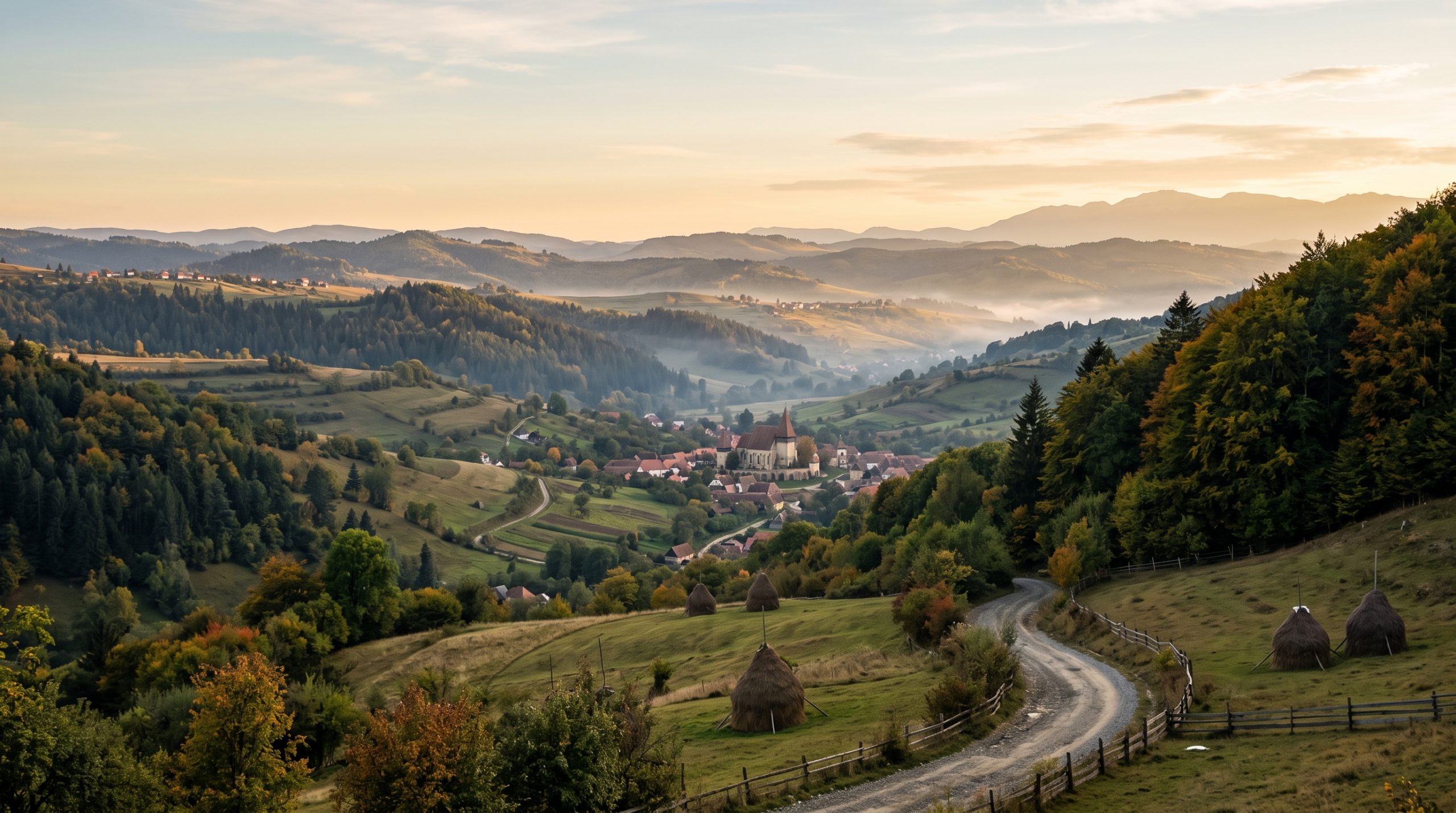
In late June the sun clears the hills east of Brașov at 5:28, and there is workable gray light on the hay meadows by 4:50. The barrier at the foot of the Transfăgărășan does not lift until seven. Those two numbers shape a Transylvanian elopement day far more than any list of castles does, and almost nobody planning this from Denver or Charleston has been told them.
So in summer the high ground is an evening place, or a place you sleep. There is a cabana at Bâlea Lake, 2,034 meters up, and staying the night is the only honest way to have that water at first light in July, because the road below is closed to traffic until seven. Late September flips the arithmetic. Sunrise lands at 7:01, the barrier goes up at seven, and the pass over the top stays open until the first of November.
We are eight people, four photographers and four filmmakers, and we work as one team. The person planning your morning at Bâlea is the person standing in the wind with a camera when it happens. Below is what we do in Transylvania, what a day looks like when it is built around real light and real gates, where coverage starts, and what Romania asks you to pay for separately.
Photo, film and planning between Brașov and Sibiu
We photograph and film elopements across Transylvania: the Saxon villages of the south, the fortified churches, the Bran valley under Piatra Craiului, and the Făgăraș ridge above 2,000 meters. One team handles planning, stills and film. Coverage runs from one full day to seven, and our travel to Romania is included in the fee.
A day timed to a 5:28 sunrise and a 7am mountain gate
Transylvania runs on two clocks. One is the sun, which hands you nearly sixteen hours in late June and about eight and a half in late December. The other is a set of gates and opening hours that do not care what the sun is doing. The high section of the Transfăgărășan takes traffic between 7am and 9pm. The fortified church at Biertan opens at ten, takes an hour off in the early afternoon, and closes earlier once September arrives. Bran Castle belongs to ticketed visitors from mid-morning.
| When | First light and sunrise, Brașov | Sunset and last light | High section of DN7C |
|---|---|---|---|
| Late June | 04:49 and 05:28 | 21:10 and 21:48 | Officially closed until 30 June, cleared and reopened in early June in recent years |
| Mid-July | 05:05 and 05:42 | 21:05 and 21:42 | Open, traffic 07:00 to 21:00 |
| Late September | 06:31 and 07:01 | 19:22 and 19:51 | Open, traffic 07:00 to 21:00 |
| Mid-October | 07:02 and 07:32 | 18:34 and 19:04 | Open until 31 October |
| Late December | 07:21 and 07:55 | 16:36 and 17:10 | Closed at the top, lake reached by cable car |
The shape below is a late-September day, because that is the stretch of the year when both clocks agree with each other. In June we run the same day backwards, with the mountain at the end of it and the villages at dawn.
- 06:00 Out of a guesthouse near Cârțișoara with coffee in the car. Nothing is open, nothing is moving, and the light is still blue.
- 07:00 The barrier lifts and the switchbacks start above the waterfall. The cable car covers the same climb in 3.7 kilometers; the road takes the long way. You arrive at 2,034 meters with the sun still only on the tops.
- 07:30 to 08:45 Vows at the lake. The Făgăraș wind is usually still asleep this early, which matters twice over: the water holds a reflection, and a microphone can actually hear you.
- 09:00 Aerials while the air is calm, then down the mountain for a second breakfast, which is the honest reason we start this early.
- 11:00 A fortified church, in the hour after the door opens and before the first minibus. Seven of these villages carry a UNESCO listing, and the interiors are all thick walls, high windows and one usable shaft of light.
- 13:00 to 16:00 The flat part of the day. You eat, change, and we drive. We allow two and a half hours for the 140 kilometers between Sibiu and Brașov, because DN1 does not behave like a highway.
- 16:30 Lanes and hay meadows in the villages above Bran, with the Piatra Craiului wall across the valley. In Viscri the single street belongs to day visitors between about eleven and four in high summer, and to the geese and the returning cows by six.
- 18:20 to 19:20 The long light on the meadow ridges. Sunset at 19:22, and the last usable frame around 19:50.
- 20:00 Dinner. Nobody has spent more than two and a half hours in a car, and nothing was rushed except the twenty minutes that had to be.
Two things worth saying plainly. Bran Castle is 30 kilometers from Brașov and it is the busiest courtyard in the region between eleven and four, walked in one direction with people behind you. We do not plan vows there. If the castle itself is the point, it runs private events through its own office, and that is a venue booking made months ahead rather than something arranged on the morning.
The other castle couples send us is Peleș, which is not in Transylvania at all. It stands in Sinaia, over the mountains in Prahova, roughly fifty kilometers from Brașov, and it photographs like the royal palace it is rather than like these mountains. We will tell you that, and then plan it in anyway if it is the picture you have been carrying around.
From mid-September the valleys around Bran fill with fog overnight and it clears somewhere between nine and eleven. That is not a morning to write off. It is the best hour of the autumn if you are standing above it, so the alternative to a fogged-in meadow is usually a hundred meters higher rather than a different day, and we scout both the night before.
Send us the week you have in mind and we will send back what the light does in it, and which of these mornings is realistic for your dates. Check Your Date
Why the second camera earns its place inside a fortified church
Stand in the nave at Biertan or Valea Viilor at eleven in the morning and there is one shaft of light coming through a high window onto a stone floor. A photographer can work that in a couple of minutes, wide open, hand-held, moving around you. A filmmaker needs you to stay inside that shaft for the length of a shot, and needs the sound of the room: the iron door, footsteps on stone, the way vows come back off a barrel vault half a second late. Those are two different sets of instructions given to the same two people in the same small space.
This is where hiring a photographer and a videographer separately gets expensive in a currency that is not money. They meet in a guesthouse parking lot at half past five, they have never worked the same brief, and they negotiate the light in front of you. On the Făgăraș ridge that negotiation costs you the whole morning, because the calm window at the lake is short and the wind decides when it ends. We pick the vow spot by wind shadow as much as by view, and our filmmaker’s read on the wind carries equal weight with the frame. On the Expedition, professional audio comes with them, so your vows exist as sound and not only as a picture of someone speaking.
The practical version, in this landscape: while one of us holds a wide static of you walking the shoreline, the other is in close on hands. Aerials go up in the first calm hour and nobody argues about whose turn it is. Village lanes in Măgura and Peștera are single track, so two vehicles instead of three genuinely matters. And with eight of us, there is always a second camera on the ground and a colleague in reserve if anything about the plan changes.
What that looks like finished is on our galleries and films, where you can see how one team covers a single day in stills and motion, and how the mountain light in these frames differs hour by hour from the village light.
Married in Romania, or married at home and celebrated here
The question we hear most about Romania is not about weather or roads. It is whether a wedding here counts.
Romania recognizes the civil ceremony carried out by a city hall’s civil status office. A religious or symbolic ceremony sits alongside that, not in place of it. Filing the marriage declaration starts a ten-day public notice period before the ceremony can happen, foreign documents are translated into Romanian and legalized first, and the pre-marital medical certificate is issued by a doctor in Romania and stays valid only about two weeks, so it belongs inside the trip rather than in the folder you pack at home.
There are two clean ways through that, and we plan both. Most couples sign the legal paperwork at home first, then treat the day in Transylvania as the ceremony that actually matters, with their own celebrant or one we help them find. The other route is to build the ten days into a longer stay, with the city hall appointment on one day and the mountain morning on another, which is what an Odyssey across two or three regions tends to look like anyway.
We hand you the current document list for the city hall that governs the place you have chosen, and a timeline that puts the appointment and the light in the right order. We will not pretend the paperwork is charming. It is a notice period and a stack of translations, and it is entirely doable once you decide early which of the two routes you want. Our guide to planning an elopement covers the parts that work the same way wherever you go.
Included in the fee, and paid locally in lei
What the fee covers
- Destination and location design, and planning across as many months as your date needs.
- A custom timeline built around light and real travel time, not around map distances.
- Permit research and logistics guidance for every site on the plan.
- Weather alternatives and backup planning, including the hundred-meters-higher version of a fogged morning.
- Drone footage where it is legal, safe and appropriate.
- On the Expedition, professional audio for vows and meaningful moments where conditions allow.
- Team travel worldwide: flights, accommodation and ordinary travel for the assigned team, with no long-haul distinction and no Romania surcharge.
- Highlights delivered in 5 days. The full gallery or film in 3 weeks.
- A fee that does not move with guest count. Guests change access, permits, transport and the timeline, not the price.
The Adventure is one full day with one dedicated photographer or one dedicated filmmaker, from $4,900. The Expedition is one full day with a dedicated photographer and filmmaker working together, from $7,900. The Odyssey runs two to seven days, photography and film, across one region or several, and comes as a custom proposal. The full breakdown sits on our pricing page.
What you settle in Romania
- Government, venue and landowner permit fees. The research and the applications are ours; the fees themselves are yours, mostly in lei. We ask every monument for two figures rather than one, because stills and filming are often separate lines on a Transylvanian price list.
- Your accommodation, and the celebrant, florist or anyone else you bring in.
- Entrance tickets, and the parish donation at a village church.
- Unusual transport: a 4×4 up a forest road, horses, a private boat, the Bâlea cable car in winter.
Most of these are settled on the spot, and rural monuments are not reliably card-friendly, so the plan we send you says which ones want cash in lei and roughly how much to draw before you leave Brașov or Sibiu.
From first message to a held date, in six steps
- You send the inquiry form with your dates, the region you are drawn to, and the kind of morning you want.
- We reply within 24 hours with an initial brochure and first questions.
- We put together a tailored proposal: locations, the shape of the day, which of the three experiences fits.
- You sign the contract.
- You pay a 30% retainer and the date is held for you. The rest of the schedule is set out in the proposal.
- Planning begins in earnest: timeline, permit research, weather alternatives, and the guesthouse-by-guesthouse logistics of the actual morning.
The couples these mountains suit best
Transylvania rewards people who are willing to be up before five in June and before six in late September, who do not mind wet grass, cobbles and twenty minutes of uphill walking in good shoes, and who can sit in a car for two hours between two very different landscapes without losing the thread of the day. It also rewards a certain flexibility at six in the morning, when the fog sits lower than forecast and the plan moves uphill.
If long transfers are not your idea of a good time, we build everything inside 30 kilometers of Brașov: the Bran valley, Râșnov, the meadow villages of Măgura and Peștera, the Piatra Craiului skyline all day long. If you want the high mountain without a 4:45 alarm, the second half of September gives you a 7am sunrise and a road that is still open. If you would rather have deep snow than a driveable pass, February puts you at the lake by cable car instead. Tell us which of those you are and we will shape the day around it, or tell you honestly which month fits it better. Our destination guides are a good place to compare Transylvania against the other regions we work in.
Common questions
Can we legally get married in Transylvania as Americans?
A Romanian civil ceremony is carried out by a city hall’s civil status office, and filing the declaration starts a ten-day notice period. The pre-marital medical certificate comes from a doctor in Romania and is short-dated. Most couples we work with sign at home first and hold the real ceremony here; both routes plan fine.
When does the Transfăgărășan open, and can we plan a date around it?
The high section is officially closed until 30 June, and in recent years the road authority has cleared and reopened it in the first half of June. When it is open, traffic runs between 7am and 9pm. We do not book a mountain morning on a date that depends on an announcement, so early-season plans get a low-level version too.
Is one day enough for the Saxon villages and the mountains?
Yes, in late September, when a 7am sunrise at Bâlea and an evening in the Bran meadows fit inside one day with a real break in the middle. In midsummer the two ends of that day are sixteen hours apart, so we either pick one landscape or spread it across two days.
Can you fly a drone over the castles and the ridge?
Aerials run on registration, pilot competency and permission for the specific place and airspace, all of which we confirm in the planning stage rather than on the morning. Where a site or an altitude does not allow it, we say so early and build the film around ground work and the ridge lines we can legally shoot.
What happens if the morning we planned is fogged in?
We move up. Autumn fog around Bran usually sits in the valleys and clears between nine and eleven, so the meadow becomes the ridge above it, and the church interior at eleven stays exactly where it was. Every Transylvania plan we send carries a named alternative for each block of the day.
Do we need to hire a videographer separately?
No. The Expedition puts a dedicated photographer and a dedicated filmmaker from the same team on the same day, working from the same timeline. That is the difference between two people who have covered a hundred mornings together and two strangers meeting in a parking lot at 5:30.
How far ahead should we write, and what holds the date?
Our planning calendar for Transylvania currently covers 2027, 2028 and 2029, and a signed contract plus a 30% retainer holds a specific date. Late September and the first half of October are the two windows people ask for most in Transylvania, so those tend to be spoken for earliest.
What happens after your first Transylvania message
The full planning trail stays written and easy to revisit, at your own pace. You send the form, we reply within 24 hours with a brochure, and the proposal, the timeline and the permit research all arrive as documents you can read twice on a Tuesday night. Romania sits seven hours ahead of New York, which turns out to be an advantage: you write in the evening and there is an answer waiting at breakfast.
Tell us the dates, the region and the morning you are picturing, and we will tell you what the sun and the gates are doing that week. Tell Us Your Story