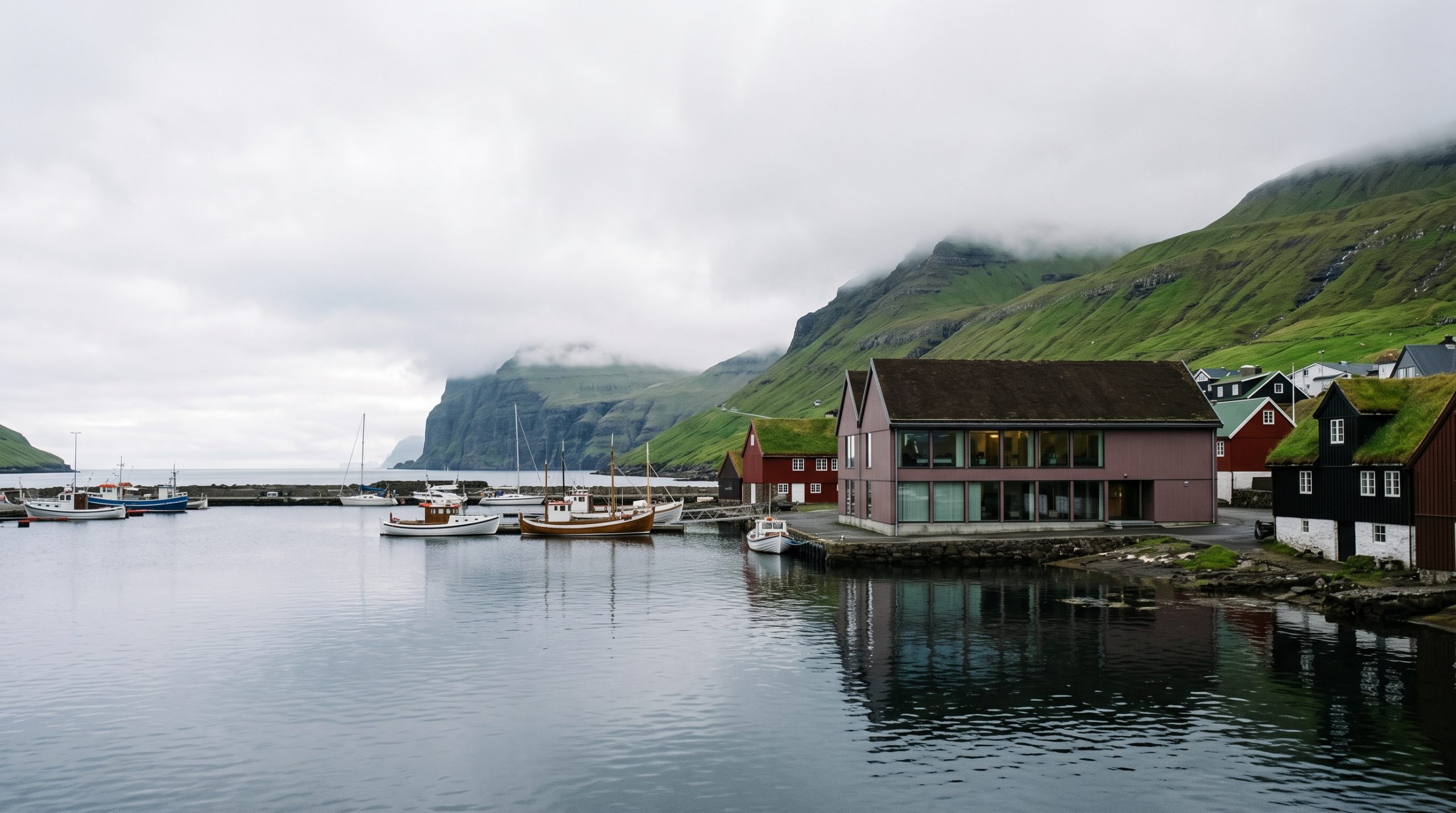
The legal part of a Faroese wedding happens in a municipal building on a small square in the middle of Tórshavn. Vaglið 1. The ceremony is short, it is run in Faroese and translated into English, and you walk out holding an international marriage certificate printed in both languages. It is not the reason anyone crosses the North Atlantic, and that is precisely why it pays to lock it down early and stop thinking about it.
Three numbers govern the whole thing. The days and hours the municipality actually performs ceremonies. The four weeks of notice it requires before your date. The four months a marital status certificate stays valid, which quietly decides when you are allowed to order it. Line those up and everything else is email.
One point before you read on. The municipality asks that inquiries about civil marriages come from the couple themselves rather than through a third party, sent to vigslur@torshavn.fo. This is the one piece of the planning we cannot lift off your shoulders. We can hand you the sequence, the dates and the wording. You press send.
The four-week rule, in one paragraph
Visitors can marry at Tórshavn City Hall with no residency requirement. Notice has to reach the municipality at least four weeks before the date, or six weeks for ceremonies in weeks 34, 35 and 36. Ceremonies run Monday to Thursday between 10 and 15, and Friday between 10 and 14. You leave with a certificate in Faroese and English.
What tends to slow the process down
On the scale that matters, this one sits closer to the easy end than most of Europe. There is no in-person notice appointment to attend weeks ahead, no residency to establish, no interview. The entire Faroese side of the process happens by email to a single address, and the office replies in English. Same-sex couples marry on exactly the same terms and follow exactly the same steps.
The friction is not in Tórshavn. It is at home, in the certificates you have to order, get apostilled where that applies, and possibly translate, all inside a validity window that opens four months before your date and closes on the date itself. That is where the delay lives, and it is entirely solvable with a calendar.
We are photographers and filmmakers, not lawyers. Rules change and circumstances differ, so confirm the detail with the relevant registry office or your own consulate before you book flights.
The days, the hours, and the weeks nobody gets married
The municipality performs ceremonies on weekdays only, and only within set hours, subject to a slot being free. Saturdays and Sundays are out, and so are Faroese public holidays. There are also whole weeks in the year when no ceremonies take place at all, which is the single most useful thing to know before you buy flights.
| When | What the municipality does |
|---|---|
| Monday to Thursday | Ceremonies between 10 and 15, if a slot is free |
| Friday | Ceremonies between 10 and 14, the last of the week |
| Saturday and Sunday | No ceremonies |
| Weeks 31, 32 and 33 | No ceremonies at all |
| Weeks 34, 35 and 36 | Normal hours, but notice is six weeks instead of four |
| Week 52 | No ceremonies at all |
| Faroese public holidays | No ceremonies |
Week numbers are not how most American couples think about a calendar, so translate them before you commit. Weeks 31 to 33 cover the end of July through the middle of August, shifting by a few days depending on how the year falls. In 2028 that closure runs from 27 July to 16 August. In 2029 the same three weeks land later, from 2 August to 22 August. Ólavsøka, the national holiday on 28 and 29 July, sits at or near the front of that stretch, and the whole country turns toward Tórshavn for it. Week 52 is the Christmas week.
The hour you are given shapes the rest of the day more than couples expect at 62 degrees north. Around midsummer the sun is still up well after 22:00, so even a 15:00 Thursday slot leaves an entire evening of usable light and the long, low, sideways kind at that. In the days around the winter solstice the sun sets in the middle of the afternoon, which means a 14:00 Friday ceremony gives you almost nothing afterward and everything before. Those are two completely different days, built from the same appointment. Our published galleries and films are the fastest way to see what a Faroese hour of light actually does to a coastline, and how differently the same headland reads under low cloud and under a clearing sky.
Fees and deadlines quoted here were correct at the time of writing and are worth re-checking with the office that issues them.
The paperwork, in collection order and in calendar order
Two different sequences matter here, and couples usually only think about one of them. There is the order in which you obtain the documents, and there is the order in which the clocks on those documents run out. Both are below.
The documents, in the order you need them
- Passports. Valid, both of you, and the same names that will appear on everything else you send.
- Your marital status certificate. This is the pivot of the whole process. It is valid for four months from the day it is issued, and it must not be older than four months on your wedding day. Order it too eagerly and it lapses before you use it.
- Or, if you are American or Canadian, the substitute. Neither country issues marital status certificates. The municipality accepts a marriage search letter covering five years, or a single status affidavit, in their place.
- An apostille, where your country needs one. Tórshavn publishes a list of countries whose documents it accepts without one. If yours is not on that list, the apostille has to be on the document before it reaches the office, not afterward.
- Translation, if anything is not in English. Documents that are not already in English must be translated by an authorized translator before you send them. A bilingual friend or a colleague at work does not satisfy this.
- Documentation that any earlier marriage has ended. If either of you has been married before, the municipality needs paperwork confirming that the previous marriage is legally over.
- The Notice of Marriage form. There is more than one version published, so pick the one that matches your circumstances. It can be sent no sooner than four months before the planned ceremony, and each of you signs your own. A notice more than four weeks old will not be approved.
- Your witnesses, by name and address. Emailed ahead of the day, not produced on the morning.
Everything goes to vigslur@torshavn.fo. You receive a confirmation from the municipality once all of the documents are approved, and that confirmation, rather than the moment you hit send, is the point at which the legal side is genuinely settled.
The same list, counted backwards from your date
| Time before the ceremony | What has to be true |
|---|---|
| 4 months | Earliest the Notice of Marriage can be sent. Also the earliest sensible date to order your marital status certificate. |
| 3 months | The comfortable target. Documents sent, one round of corrections still affordable. |
| 6 weeks | Hard deadline if your date falls in weeks 34, 35 or 36. |
| 4 weeks | Hard deadline for every other date in the year. |
| The working day before | You are in the Faroes, not in transit. Vágar Airport is roughly 45 minutes from Tórshavn by road. |
| Ceremony day | Passports in hand, two witnesses briefed, slot confirmed. |
The real minimum is four weeks. The minimum we work to is three months, and the reason is not caution for its own sake. Three months out sits comfortably inside the four-month window for both the notice and the certificate, leaves room for the office to come back once with a question, and means your travel is booked against a confirmed slot rather than a hoped-for one.
Where the four-month and four-week rules collide
This is the section we would want to read if we were doing it ourselves. None of it is dramatic. All of it is the kind of small structural detail that turns a relaxed plan into a scramble, and every item is easy to get right once you can see it coming.
Your marital status certificate has two clocks on it. Four months of validity from issue, and a wedding day that must fall inside those four months. Couples who organize early sometimes request it eight months out, then discover it expired in the drawer. Order it inside the window, not before you are ready to use it.
The Notice of Marriage has a shelf life of its own. A notice older than four weeks will not be approved. Signing it in February for a June date does not work. Sign it and send it in the same short stretch.
The window is soft at the front and hard at the back. No sooner than four months. No later than four weeks. That is a wider gap than it sounds, but it is a gap, and both ends are real.
Weeks 34, 35 and 36 quietly double the notice period. Six weeks instead of four. These are some of the better weeks to be in the Faroes, with the cliffs still green, the puffins mostly gone from Mykines and the light already lengthening into that low autumn angle. Plenty of couples land on them independently, then get caught by the extra fortnight.
Approval is not automatic on receipt. The confirmation comes when all documents are approved, which means there is a review, which means there can be a correction. Budget one round of it.
Nothing at the municipality happens over a weekend. A Monday ceremony has the previous Friday as its last working day. We treat that Friday as part of the wedding schedule rather than a travel day, and we would rather you were drinking coffee on Tinganes than sitting on a delayed connection.
The inquiry has to come from the two of you. Not from us, not from a planner, not from a friend who is good at admin. Write it yourselves, from an address you both check.
Your surname does not change here. The municipality cannot process name changes for people who are not registered as residents of the Faroe Islands. That happens at home, after the wedding, in whichever system you are registered in. Nothing on the certificate stops it. It simply is not a Faroese step.
There is a municipal charge, and it is payable in kroner. Tórshavn applies a fee to ceremonies for couples who travel in purely to marry, so put a line for it in the budget alongside the certificates you order at home. The Faroese króna is the Danish krone under another name, running at par, and Danish notes are accepted everywhere.
If you want the wider planning picture before you start pulling documents together, our destination elopement guides cover how the Faroese week actually behaves around ferries, tunnels and weather windows.
A ceremony here, with the marriage already signed
A large share of the couples we work with in the Faroes sign the legal paperwork at a courthouse or a county office at home, then fly out with nothing to file. This is not a lesser version of the day. In practice it is often the better-built one, and it deserves to be described properly rather than mentioned as an afterthought.
What it removes is the entire structure of this article. No four-week notice. No certificate validity window. No week 31. No Monday-to-Friday requirement, no 10 to 15 window, no working day held in reserve. What you gain instead is the ability to put your vows exactly where they belong, which in the Faroes is almost never indoors at a municipal desk.
That means you can stand above Sørvágsvatn at the hour the light comes around the headland rather than the hour a slot was free. You can hold the ceremony at Múlafossur in Gásadalur when the wind turns and the waterfall stops blowing back up the cliff. You can put it on Saksun’s tidal lagoon on a falling tide, or on the ferry crossing to Kalsoy, or at 05:00 on a June morning when Tórshavn is asleep and the whole island belongs to you. A celebrant reads, nobody is queuing to sign a register, and it is still the moment you will remember.
What does not change is everything on our side. The planning, the timeline built around light and real travel time, the permit research, the weather alternatives, the drone work where it is legal and appropriate, the delivery schedule. If you are weighing the two routes, our guide to how to plan an elopement walks through the decision without pushing you toward either one. Tell us which you are leaning toward and we will shape the day around it, or tell you honestly which month suits the shape you have in mind.
Your documents, our timeline
Our job starts where the paperwork stops. We hold your date against the municipality’s slot availability, so the timeline is not built on an hour that turns out to be taken. We work backward from whichever slot you are given, through the drive from Vágar, the ferry or tunnel to wherever the afternoon goes, and the point in the evening when the light finally does what you came for. We do not file documents, we do not email the office on your behalf, and we are not the ones who sign the register.
On witnesses, the cleanest arrangement is to tell the municipality in advance. If you cannot bring two people, they will arrange for two members of staff to be present and attest the ceremony, which takes the problem off the table entirely. We would rather be behind the cameras when it happens than putting one down to hold a pen.
The room at Vaglið is small and the ceremony is brief, which is exactly why the two-person setup earns its place on that particular morning. On a day covered by a photographer and a filmmaker together, one of us takes the wide frame of the room while the other stays close on hands and faces, and the vows are recorded with proper audio where conditions allow. Nothing is repeated for a second angle, because there is no second angle to stage. It happens once and it is covered twice. Coverage and what each experience includes are set out in full on our pricing page.
Team travel is included worldwide, so flights and accommodation for the team assigned to you are not something to work out alongside apostilles. Highlights reach you in 5 days and the full gallery or film in 3 weeks. There are eight of us, which means a colleague in reserve and a Faroese date that never rests on one person’s connection through Copenhagen.
Common questions
Can we get married at Tórshavn City Hall if we live in the United States?
Yes. There is no residency requirement, and the page is written for visitors. The one adjustment is the marital status certificate, which the United States and Canada do not issue. In its place the municipality accepts a marriage search letter covering five years, or a single status affidavit.
How far in advance do we have to send our documents to Tórshavn?
Notice has to reach the municipality no later than four weeks before your date, and no later than six weeks if the date falls in weeks 34, 35 or 36. The Notice of Marriage form cannot be sent any sooner than four months before the ceremony. We aim for three months out.
What time of day can we book the ceremony at City Hall?
Monday to Thursday between 10 and 15, and Friday between 10 and 14, subject to a slot being available. There are no weekend ceremonies and none on Faroese public holidays. Pick the earliest slot you can get if you want the afternoon and evening free.
Do we have to bring our own witnesses to a Faroese wedding?
Two witnesses sign the marriage register on the day, and their names and addresses go to the municipality by email beforehand. If you are traveling as a pair, say so in advance and the office will arrange for two members of staff to attest the ceremony.
Can we get married outside instead of at Tórshavn City Hall?
The municipality’s own guidance places the civil ceremony in the City Hall at Vaglið 1. Couples who want their vows on a cliff or beside a waterfall generally handle the legal signing at home first, or take an early City Hall slot and hold the ceremony they actually care about outdoors the same day.
Will our Faroese marriage certificate be accepted back home?
You are handed an international marriage certificate in Faroese and English straight after the ceremony. What your own state or country wants on top of that varies, so put the question to the office that will record the marriage where you live, since that is the office whose answer governs.
Can we get married in the Faroe Islands in August?
Partly. No ceremonies take place in weeks 31, 32 and 33, which covers the end of July into the middle of August. From week 34 onward the office marries couples as normal, but those first three weeks back require six weeks of notice rather than four.
Can we change our surname on the Faroese certificate?
Not through Tórshavn. The municipality cannot process name changes for people who are not registered as residents of the Faroe Islands, so the change is made where you are registered to live, after the wedding.
Choosing the hour first, then building the light around it
Once you know which slot you have, the rest of the day stops being guesswork. A 10:00 Tuesday in September and a 14:00 Friday in December are two entirely different films, and both of them can be very good if the plan is built from the hour outward rather than bolted on afterward. We currently book elopements across the 2027–2029 seasons, and Faroese weekday slots in the shoulder weeks are the ones couples ask about first.
The planning conversation stays in one written thread. Send the inquiry form with your date, or the range you are choosing between, and a reply with an initial brochure comes back within 24 hours. From there it is a tailored proposal, a signed contract, a 30% retainer, and planning begins.