The parking at Palenica Białczańska is the first thing we book and often the hardest. Spaces at the head of the Morskie Oko road are sold in advance online through the national park, they run out days ahead in summer, and the barrier only lifts around first light, currently from 5:30 in the March to November season. Nobody drives up at eight and improvises their way in.
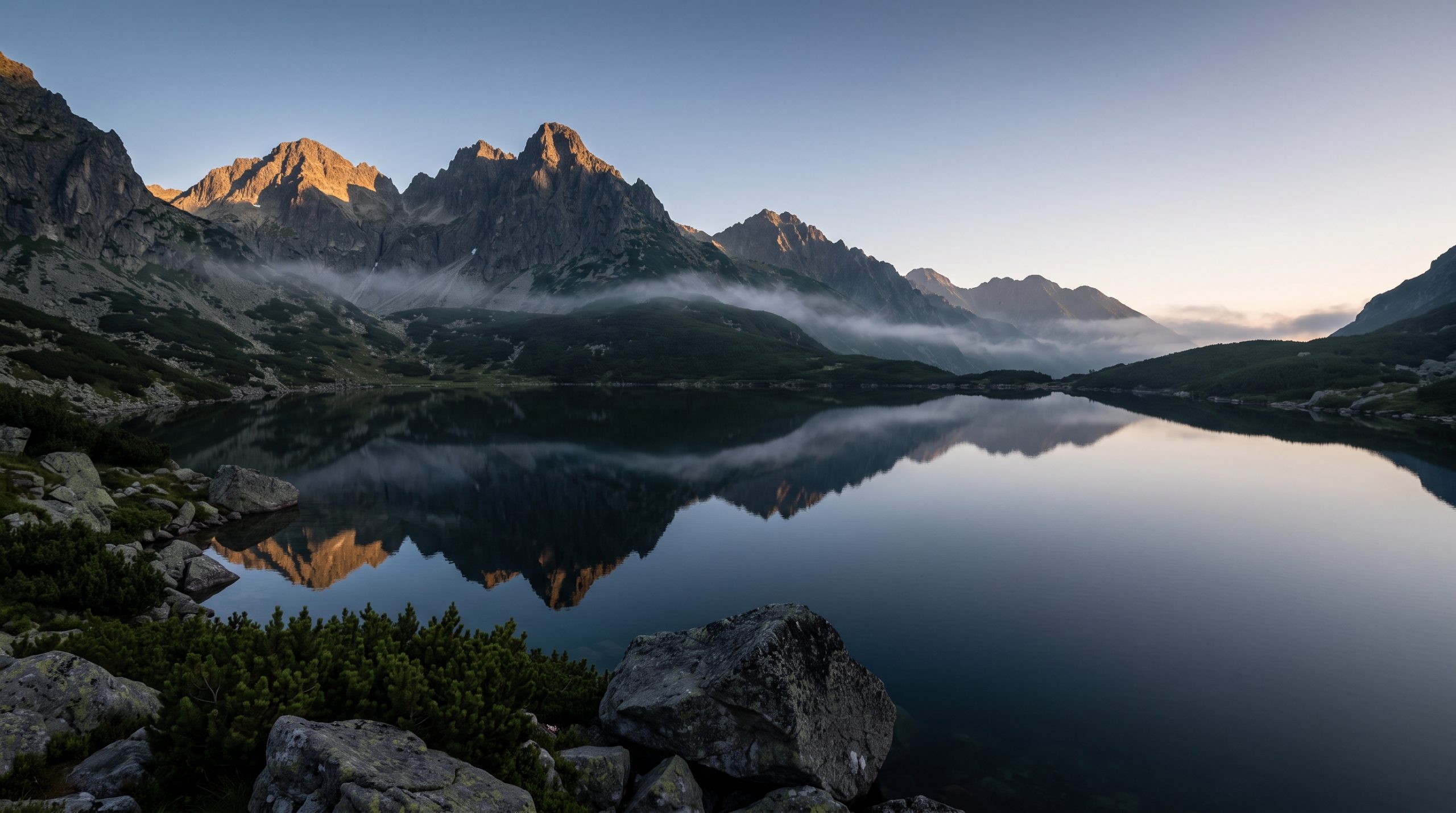
From that barrier it is roughly nine kilometers of asphalt to the lake, climbing steadily the whole way, about two hours on foot with a pack. Morskie Oko sits at 1,395 m in a basin walled by the Mięguszowieckie peaks, and this is the part most planning guides get wrong. The water does not catch the sunrise. The wall above it does, for twenty or thirty minutes, going copper while the lake stays flat slate blue. If you walk up expecting warm light on the water at the tabulated 6:24 sunrise of late September, you will spend the best window of the morning facing the wrong direction.
We are eight people: photographers Serg, Alex, Alex and Viktoria, and filmmakers Lara, Mike, Anthony and Stas. Photography, film and planning are one service here, not three vendors introducing themselves in a car park at 5am. Dates are currently open across our 2027, 2028 and 2029 Tatras seasons, and if you are still in the reading stage, our destination guides are a good place to keep going.
One team for photo, film and planning in the Tatras
We photograph, film and plan elopements across the Polish and Slovak Tatras, from the Morskie Oko basin to the open pastures above Zakopane. The same team designs the locations, builds the timeline around real light and walking times, researches permits, then shoots the day. Coverage starts at one full day with a dedicated photographer or a dedicated filmmaker.
The day, from the dawn barrier at Palenica to the last blue light
Two numbers govern a Tatra day. When the sun clears the horizon, and when the ridge in front of you finally lets it into the valley where you are standing. The first is arithmetic and you can plan it a year out. The second is why we walk the ground before we write a timeline.
| Date | Sunrise | Sunset | What that does to the day |
|---|---|---|---|
| 15 April | 05:50 | 19:32 | Snow still high on the ridges, crocuses in the Chochołowska Valley when the melt cooperates, an alarm you can live with |
| 21 June | 04:35 | 20:50 | Civil light from 03:52, so a lakeside ceremony at sunrise means leaving your room around 2:30 |
| 15 July | 04:51 | 20:42 | Warmest water and longest evenings, and the fullest trails between 10am and 4pm |
| 20 September | 06:24 | 18:45 | The kindest numbers of the year: two workable ends to the day, larch turning, thin crowds midweek |
| 10 October | 06:53 | 18:02 | One strong dawn and one strong evening with gold on the larch, and no midday worth using |
Those times are for Zakopane on a flat horizon. In the deep valleys the ridge holds the first sun back well past the tabulated minute, and on the high pastures it arrives early and low. That gap is the whole craft of timing a morning here, and it is why we place a ceremony by aspect rather than by postcode.
Here is a late September day on the Morskie Oko side, the shape we plan most often.
Coffee at 04:45 in Bukowina Tatrzańska or Zakopane, then twenty to forty minutes of driving depending on which side of the valley you slept on. We buy the park entry tickets online the night before, because the trailhead windows are not always staffed at that hour. On the road by 05:15, headlamps for the first half hour, and the ridge of Wołoszyn turning pink above you while you are still walking under trees.
At the lake by 07:15, with the wall lit and the shoreline still empty. Vows here, or another 45 minutes and 190 vertical meters up to Czarny Staw pod Rysami at 1,583 m, which is colder, rockier and a completely different film. The first day visitors reach Morskie Oko around mid-morning, so we are usually walking down as the uphill traffic thickens, eating a late breakfast at the shelter or back in the village before 11.
Then nothing, deliberately. Between 11 and 15 the light in a treeless basin is flat and hard and no amount of skill fixes it. Couples sleep, change, eat properly. We check the afternoon cloud and confirm which second location the weather has chosen for us.
Out again by 15:30, usually somewhere completely unlike the morning: Rusinowa Polana, a broad grazing meadow reached by a forgiving path from Zazadnia in a bit over an hour, with the whole High Tatra skyline laid out across one frame. Golden hour runs to 18:45 in late September, and the half hour after that, until civil dusk at 19:17, is where the frames we love most usually happen. The ridges go blue, the valley lights come on below, and nobody else is up there.
Sharing the trail, and the hours when you don’t
The road to Morskie Oko is the busiest walk in the Polish Tatras, and at 11am in August it is a procession. Horse carriages, families, coach groups up from Kraków. No photographer can crop that out and we would not pretend otherwise before you have booked flights.
What works is a clock, not a secret. Reserved parking at Palenica Białczańska or Łysa Polana, entry tickets bought the night before, on the trail while it is dark, ceremony done in the first hour of light, and back down before the day builds. What also works is not going there at all. The Chochołowska and Kościeliska valleys, Rusinowa Polana, the Gąsienicowa basin and the Slovak approaches all give you granite and space without the asphalt procession, and several of them work better in bad weather than Morskie Oko ever does.
Tell us the month you are looking at and we will tell you honestly which of those the light and the traffic favor. Check Your Date.
What the Tatras sound like, and why that ends up in the film
Wind is the defining condition above the treeline here. The halny, the warm wind that pours down off the ridges onto Podhale, scrubs the sky glass clear and makes everything extremely loud. A photographer can work in that. A film cannot survive it unless somebody is responsible for sound, which is why The Expedition puts a dedicated filmmaker beside a dedicated photographer and adds professional audio for vows where conditions allow. It also changes where we stand: vows in the lee of a boulder field rather than on the open crest, decided the week before rather than argued about at 07:10 with your hands cold.
The twenty minutes at Morskie Oko make the case better than anything. The wall is lit, the lake is not, and there are two completely different pieces of work sitting in that window. One is a still frame of two people small against warm granite, held for as long as the light lasts. The other is movement: cloud shifting across the face, water at your boots, the two of you walking the shoreline in real time. One person choosing between them loses one of them. Two people working the same twenty minutes get both, and nobody asks you to say your vows again for a second angle.
Then there is the actual audio of this range, which is why we keep pushing couples toward the quieter ground. Cowbells across Rusinowa Polana in the grazing season. The Rybi Potok stream under the last of the snowmelt. Wind combing through dwarf pine, boots on scree, the hollow knock of a wooden gate on a shepherd’s hut. A film built from real sound sits in a different category from one carried by a music bed, and you only get it if someone is recording while someone else is shooting stills.
Aerials are a bonus here, never a foundation. Flying inside the national park on either side of the border runs on permission from the park, with a defined area and a time window, so we ask early and build a film that stands up whether or not the answer is yes. Our galleries and films show how those pieces come together across a full day, and they are the most useful thing to look at before you write to us.
Included in every Tatra booking, from permit research to delivery
No line items appear later. Every experience, from a single day to a week across both countries, includes the following.
- Destination and location design for your dates, worked around aspect, altitude and how the light actually behaves in these valleys
- A custom timeline built on real sunrise, sunset and walking times, including the two hours up from Palenica if Morskie Oko is in the plan
- Permit research and logistics guidance, including park entry, parking reservations and access questions on both sides of the border
- Weather alternatives and backup planning at more than one altitude, because the Tatras change their mind by 11am
- Drone footage where it is legal, safe and appropriate
- Professional audio for vows and meaningful moments where conditions allow, on The Expedition
- Team travel worldwide: flights, accommodation and ordinary travel for the assigned team, with no European or long-haul distinction
- Highlights delivered in 5 days, and the full gallery or film in 3 weeks
The fee does not change with your guest count. Guests change access, permits, transport and the timeline, not the price. Nine kilometers of asphalt does its own filtering on a guest list, which is worth knowing before you invite twelve people to a lake.
Where coverage starts, and what Poland and Slovakia charge on top
The Adventure begins at $4,900: one full day, with either a dedicated photographer or a dedicated filmmaker. The Expedition begins at $7,900: one full day with both, working together, and audio for the vows. The Odyssey runs from two to seven days across one or several destinations, photography and film, quoted as a custom proposal. Full detail lives on our coverage and pricing page.
Getting our team to Poland is our cost, not yours. Flights and accommodation for the assigned photographer, filmmaker or both are inside the figure above, in the Tatras exactly as everywhere else.
What the mountains themselves charge, you pay directly, and none of it is large next to your flights:
- Polish park entry, per person, per entry: currently 11 zł, nudged up most Marches
- A reserved car space at Palenica Białczańska or Łysa Polana: currently in the region of 30 zł for a car, priced by season and day, bookable online only
- The horse carriage on the lower part of the Morskie Oko road, if you want the walk shortened
- Cable car tickets: Kasprowy Wierch on the Polish side, or Lomnický štít on the Slovak side at 89 euros from Tatranská Lomnica and 59 euros if you join at Skalnaté Pleso
- A licensed mountain guide, if you want ground above 2,500 m or off-trail terrain in Slovakia
- Accommodation, celebrant, any government or landowner permit fees, and unusual transport such as a 4×4 charter or a private boat
How a Tatra enquiry becomes a planned mountain day
- You send the inquiry form with your dates, or your best guess at them, and the region you are drawn to.
- We reply within 24 hours with an initial brochure.
- We put together a tailored proposal for your dates, your side of the border and your appetite for early mornings.
- Contract signed, 30% retainer paid. The rest of the payment plan is set out in the proposal.
- Planning begins: locations, timeline, permit research, parking reserved, weather alternatives held in reserve. If you want the fundamentals first, how eloping actually works covers the ground before the destination detail.
- The day itself, then highlights in 5 days and the full gallery or film in 3 weeks.
Who the Tatras suit, and which month suits which couple
These mountains reward walking. An eighteen kilometer round trip on asphalt, uneven granite above the lake, and a genuine chance that the plan changes at 11am because the cloud dropped. Couples who like that arrive at 07:15 grinning. Couples who do not should tell us, because there are three or four honest answers and all of them are ours.
If a 2:30 departure in late June sounds like a poor way to start a marriage, the same shape of morning begins at 06:24 in the back half of September, with warmer color and thinner trails. If you want the high ridge without the climb, the Kasprowy Wierch cableway runs every ten minutes and puts you at 1,987 m in a morning, though return ticket sales close two hours before the last run, so the mountain sets the pace rather than you. If your dates fall in deep winter, the Slovak high-mountain trails are shut from 1 November until late spring and off-trail movement is a guided matter between mid-June and 31 October, which makes February a valley, forest and shepherd’s hut day. Those days can be the best ones of the year, and they need to be planned as what they are rather than as a summer day with snow on it.
The one thing that does not work is a plan nobody has stress tested. Send us the month, the number of people and the amount of walking you actually want, and we will shape the day around it or tell you plainly which weeks fit it better.
Common questions
Can we legally get married in the Tatra Mountains, or should we do the paperwork at home?
Most American couples we plan for register the marriage at home and hold the ceremony that matters to them in the mountains, with a celebrant reading the vows. Poland’s legal route runs through a registry office, the USC. A registrar can agree to conduct a marriage outside the office premises for a set additional fee of 1,000 zł, and every foreign language document has to be translated by a sworn translator on the Polish Ministry of Justice list. Allow months, not weeks, and tell us early so the timeline holds both.
Do we need a permit to elope in Tatra National Park?
Both sides of the range are protected areas with real rules: you stay on marked trails, and on the Polish side every person carries an entry ticket. Anything beyond ordinary walking, aerials included, runs on the park’s permission rather than on assumption. The research and the asking are ours, and any fee that comes back is yours.
Can you fly a drone over Morskie Oko?
Not on a hunch. Flight inside the park is a permission matter with a defined area and window, so we raise it at the planning stage and design the film to work either way. When aerials are granted, they open the basin up completely. When they are not, the day still delivers a full film.
Is the Polish side or the Slovak side better for an elopement?
The Polish side gives you Zakopane as a base, Morskie Oko, Kasprowy Wierch and a dense, walkable set of valleys, along with a per-person park ticket and more company on the trail. The Slovak side gives quieter approaches, Štrbské Pleso and Tatranská Lomnica, the cableway to Lomnický štít, and a stricter calendar. The border crossing at Łysa Polana puts them roughly forty minutes apart, so a two day plan can use both.
What happens if the weather turns on our date?
We plan alternatives at three altitudes before you arrive, and we move down rather than cancel. Cableways pause in strong wind, so a ceremony never depends on a lift running. Low cloud in the Kościeliska Valley photographs beautifully, which is why it is often the answer rather than the consolation.
How far ahead do we need to book parking for Morskie Oko?
As early as your date is fixed. Spaces at Palenica Białczańska and Łysa Polana are sold online through the park and go days ahead on summer weekends. When a day is full, the shuttle parking at Bukowina Tatrzańska, Białka or Polana Zgorzelisko feeds the same trailhead, and we build the morning backward from whichever one we hold.
Do you charge extra for flying your team to Poland?
No. Team travel is included worldwide, with no European or long-haul distinction. Flights, accommodation and ordinary travel for the assigned team are already inside the figure you see.
When do we get our photos and film?
Highlights land 5 days after the day itself. The full gallery, or the finished film, arrives within 3 weeks.
Start with the month you have in mind
Everything on our side happens in writing, at whatever hour suits you: you send the form, we reply within 24 hours with the brochure, and the proposal follows. No hoops before you get useful information. Tell us the month, the kind of morning you want and how far you are willing to walk for it, and we will come back with the light, the access and the honest version of what that day looks like in the Tatras. Tell Us Your Story.