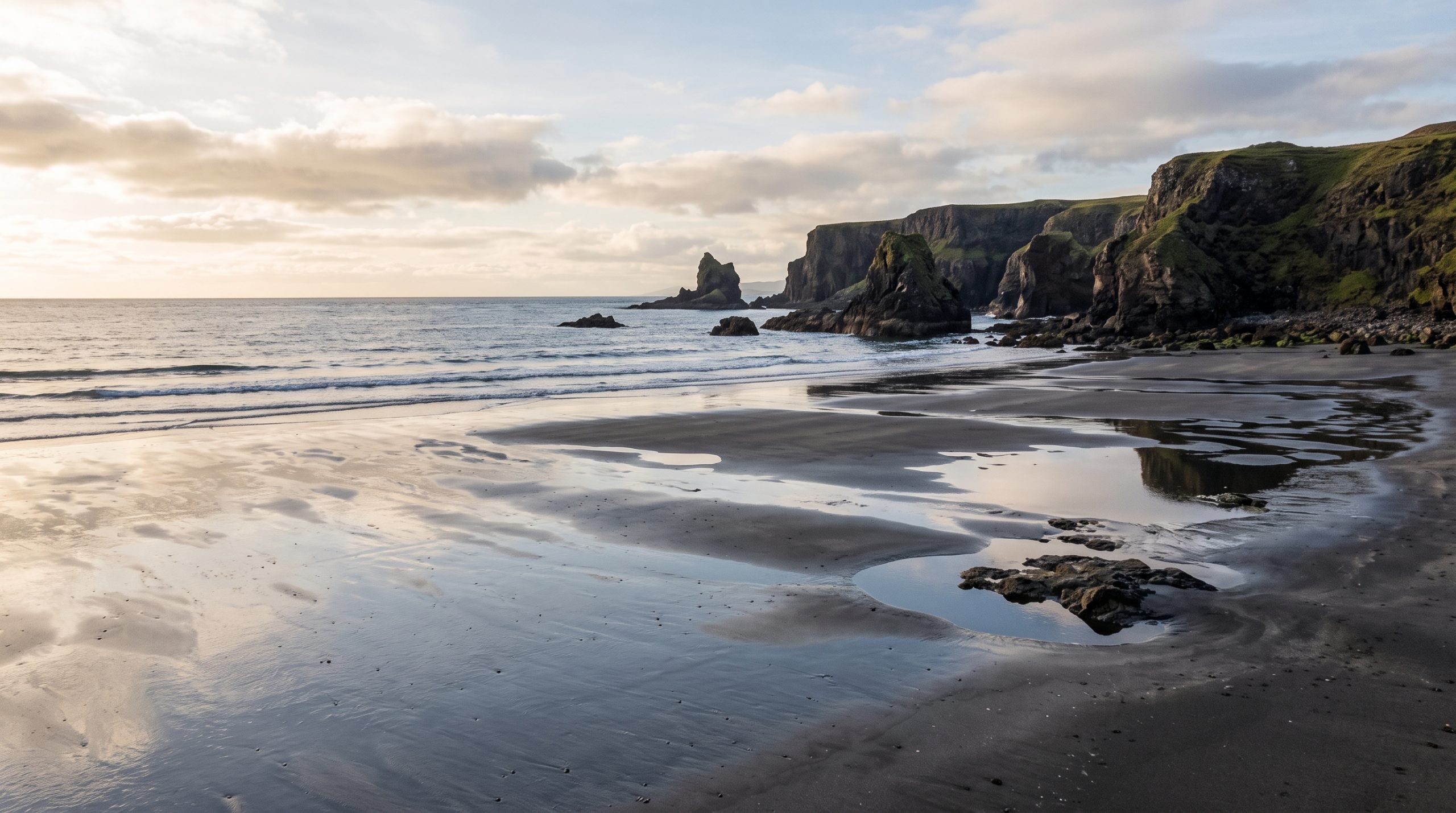
At high water, the beach at Talisker Bay is not really a beach. The sand is under the sea, the swell works up against a bank of rounded stones, and the wide mottled floor of black and white grains that pulled you here in the first place is somewhere below the surface. On a big spring tide the water moves through more than four metres between high and low, so the difference is not subtle.
Six hours later it is all back. Wet, dark, reflective, printed with the last wave. That is the planning problem at Talisker in one sentence: the place you are picturing exists for part of the day and not the rest of it, and the part when it exists moves about 45 minutes later every day.
The rest is manageable. It is 1.45 km from the road end to the sand on a flat track past a white house that has stood there since the 1720s, and the bay opens west into the Atlantic, so the light comes towards you rather than over your shoulder.
The tide decides where you stand
Talisker Bay’s sand is only uncovered as the tide drops, so the ceremony belongs in the hours either side of low water. Low tide runs about 45 minutes later each day, and the bay faces west, so the date worth choosing is the one where low water and the evening light land in the same part of the day.
Two clocks: low water and the light off the Atlantic
There are two low waters a day here, roughly twelve and a half hours apart, and both slide later as the week goes on. On one early December day, low water at Talisker fell at 1:31am and again at 1:58pm. By the following afternoon the second low had moved to 2:43pm. Across a seven-day stay that slippage works in your favour, because somewhere in the week low water sits exactly where you want it. Across a fixed 48-hour window it can just as easily sit at breakfast.
The size of the tide matters as much as the timing. Around new and full moon the range is at its biggest and the bay empties properly, sand running out to the rock pools at the northern end below the waterfall cliff. On the smaller tides in between, less sand shows and the stones stay closer to the water. Neither one is bad. They are different rooms to stand in, and we tell you which one your date gives you before you commit to it.
Then there is the aspect, which is the part most planning pages skip. The bay opens west with high ground behind it, so mornings here are flat and quiet: the beach sits in its own shade while the sun climbs somewhere behind the glen. Direct light arrives off the sea in the second half of the day. That is why almost every photograph you have seen of this bay was made in the evening.
How late that evening runs changes enormously through the year. In the third week of June the sun does not go down on this part of Skye until about 10:30pm, and the glow holds on afterwards. By mid-December it has gone before 3:45pm, and there is a second catch in the winter months: the low sun sets in the southwest, behind the headland that carries the sea stack, so direct light leaves the sand a good while before the published sunset time. Midsummer sunsets swing round to the northwest instead, out over open water at the mouth of the bay.
So the shape we aim for is easy to describe and fiddly to find. Vows about ninety minutes before sunset, low water within roughly two hours of that, and enough daylight left over to walk out without rushing. Tide predictions for this coast are published years ahead, which means we can do this for a date in 2027 with the same confidence as one next spring.
Your sat nav will send you to the distillery
Talisker distillery is not at Talisker. It sits at Carbost, and the bay is a further four miles west on a single-track road with passing places and cattle grids, twelve to fifteen minutes if nothing is coming the other way. Couples who type the famous name into a phone end up outside a whisky warehouse, looking at a sea loch four miles from the beach they came for.
The road finishes in a wide turning area with room for a handful of cars, and it is a working turning area, so keeping it clear matters more than parking close to the gate. When it is full, the move is to drop back along the road, where there is an old quarry, and walk the extra few minutes. There is no bus route and no coach park anywhere near this bay.
That parking is the crowd control, and it is worth being straight about what it does and does not do. Talisker is one of the most photographed beaches on Skye, and on a clear July evening you will not have it to yourself: there will be tripods on the stones waiting for the same sunset you are. It is also a genuinely wide bay. At low water the sand runs out far enough that a dozen people stop reading as a crowd, and we work the northern end under the waterfall cliff while the landscape photographers set up for the stack. Arriving early is not the fix here, because early is when the light is at its worst. Choosing the right evening in the right week is the fix.
1.45 kilometres in wedding clothes
From the road end, the left-hand track is signed to the bay. It goes through a gate and runs alongside Talisker House, the white house that dates from the 1720s and where Johnson and Boswell stayed on their Hebridean tour, then narrows and follows a burn down through a meadow. It rises slightly at the end and puts you out at the southern corner of the beach. Twenty minutes at a walking pace, 2.9 km there and back.
In a dress it is closer to half an hour, and that is fine, because nothing about it is technical. It is flat the whole way. It is also, after rain, properly muddy in patches, and the last stretch beside the burn is narrow enough that you walk in file rather than side by side, which is worth knowing if you were imagining an arm-in-arm approach. Boots on the track, change at the top of the beach, shoes in a bag for the walk out. Gates get closed behind us, because this is working farmland with sheep on it.
There is nothing at the bay itself. No toilets, no shelter, nowhere to buy a coffee. Everything you want for the two hours you are down there comes along the track with you, which is why we build the walk in and the walk out into the timeline as real blocks of time rather than rounding them off. Carbost, twelve to fifteen minutes back up the road, is where getting dressed and warming up afterwards happen.
Who can legally marry you here, and who to ask about the ground
Scotland makes this easier than most coastlines you could pick. Any two people can marry here regardless of where they live, and celebrants from Scotland’s humanist and belief organisations are authorised to conduct a legal ceremony anywhere in the country. There is no approved-venue list to get onto, so the beach needs no licence of its own.
What it does need is paperwork. You each complete a marriage notice, form M10, and submit it with your documents and the statutory fee to the registrar for the district where the ceremony takes place, not the district where you live. The latest you can lodge it is 29 clear days before the date and the earliest is three months, though registrars across Scotland ask for notices around ten to twelve weeks out, and that is the timing we plan to. The marriage schedule is then collected in person from the registrar before the day and returned to them afterwards, an errand that belongs in the travel week rather than on the morning itself.
The other half is the ground. The approach runs past a private house and across farmland, so a ceremony here is something to ask about rather than assume, and that conversation is ours to have. Permit research and landowner liaison sit inside every experience we run, and where a landowner or public body charges a fee, that part is paid by you directly. The wider legal shape of a Scottish elopement is set out in our guide to how eloping works.
When the wind takes the waterfall back up the cliff
The northern side of the bay is a wall of vertical cliff with a fall coming off the top of it, and on a windy day that water never reaches the beach. The wind catches it halfway down and pushes it back up the rock. It is one of the odder things on Skye and it happens often, because there is almost always wind here.
Which means wind direction shapes the hour more than rain does. A southwesterly straight into the bay puts spray in the air and noise into everything; a northeasterly comes over the land and leaves the beach comfortable. We read direction first, swell second, rain last, and set the ceremony position from that: hard against the stone bank when it is blowing, further out on the open sand when the air is still.
When the bay is not going to give us the hour we want, we move rather than stand there hoping. The glen behind the beach has sheltered ground a few minutes back up the track, with Preshal More rising over Talisker House. And the next low water is only about twelve hours away, so on a multi-day plan, shifting the ceremony by one evening is often the entire solution. The alternatives, and the point at which we switch to them, are written into your timeline before you fly.
Wet sand, mottled patterns, and a bay too wide for one frame
What rewards a camera here is the floor. Black and white sand lie mottled together and the pattern redraws itself with every wave, and at low water the surface stays wet enough to hold the sky and the two of you in it. The bay is also too wide to fit both headlands into a single frame, which sounds like a limitation and is the opposite: it means there is room to work. You can see how the wet-sand frames and the cliff-scale frames sit together in the films and galleries we have published.
Room matters when a photographer and a filmmaker are both on the sand. At low water there is enough distance for one of us to be in close for the vows while the other runs long from fifty metres out with the waterfall cliff behind you, and neither of us ends up in the other’s shot. Sound is the harder problem. Wind on an open west-facing beach will swallow a vow, so we place you with the stone bank taking the worst of it and put proper audio on the words instead of hoping a camera microphone copes. Two of us also means the low-water window gets used twice over, from two positions, in the same forty minutes.
Highlights reach you five days after the day itself, and the full gallery or film three weeks after. A full day here with a dedicated photographer and filmmaker working together starts at $7,900, and the other ways to cover a day at Talisker are set out on our pricing page.
This bay suits couples happy to let a tide table choose their date, and who like the idea of walking out in the last of the light rather than finishing at teatime. If you would rather be married in the morning, or you want the car within sight of the ceremony, Skye has coast that does both. Tell us what you want the hour to feel like and we will tell you honestly whether Talisker delivers it or which stretch of coastline will. Our destination guides are a good place to start comparing.
Common questions
How do we know whether low tide falls at a good time on our wedding date?
Tide predictions for this stretch of coast are published years in advance, so we can look up your date now. Low water shifts about 45 minutes later each day, which means that within any week on Skye there is a day when it lands in the evening. We usually build the date around that day.
Can we still get married on the beach at high tide?
The sand is under water at high tide, so the ceremony moves up onto the bank of stones at the top of the beach or into the sheltered glen behind it. Both work well. Neither is the wide reflective floor most couples come to Talisker for, which is why we plan around low water.
Is there anywhere at Talisker Bay to change out of walking shoes?
There is nothing at the bay: no toilets, no shelter, no building of any kind. Couples get dressed at their accommodation, walk the 1.45 km track in boots and change footwear at the top of the beach. Carbost, twelve to fifteen minutes back along the single-track road, is the nearest village with anywhere warm.
Do we need a permit to have our ceremony on Talisker beach?
There is no venue licence to apply for in Scotland, because a humanist or belief celebrant is authorised to marry you anywhere in the country. The paperwork is the marriage notice you both lodge with the registrar. The access track crosses a private estate and farmland, so we handle the landowner side as part of planning your day.
Will other people be there if we marry at sunset in July?
Probably, yes. This is one of the most photographed beaches on Skye and clear summer evenings bring landscape photographers with tripods. Numbers stay capped by the handful of parking spaces at the road end, and at low water the sand is wide enough for us to work the northern end under the waterfall with real space around you.
How long does the walk take in a wedding dress?
The track is 1.45 km each way and takes about 20 minutes at a normal pace, nearer 30 in a long dress. It is flat, and the only awkward parts are muddy patches after rain and the narrow single-file stretch beside the burn. Nobody needs to be a hiker for this one.
Pinning your date to a low tide
Working out which evening of your travel week has low water sitting under the last of the light is the first thing we do, before locations and before anything else. Send us the dates you are weighing up and we will come back with the tide and light picture for each of them, in writing, with the initial brochure inside a day. Everything after that runs the same way, by email, on your schedule, from wherever you are. Our Scotland calendar is currently open across 2027, 2028 and 2029. Check Your Date