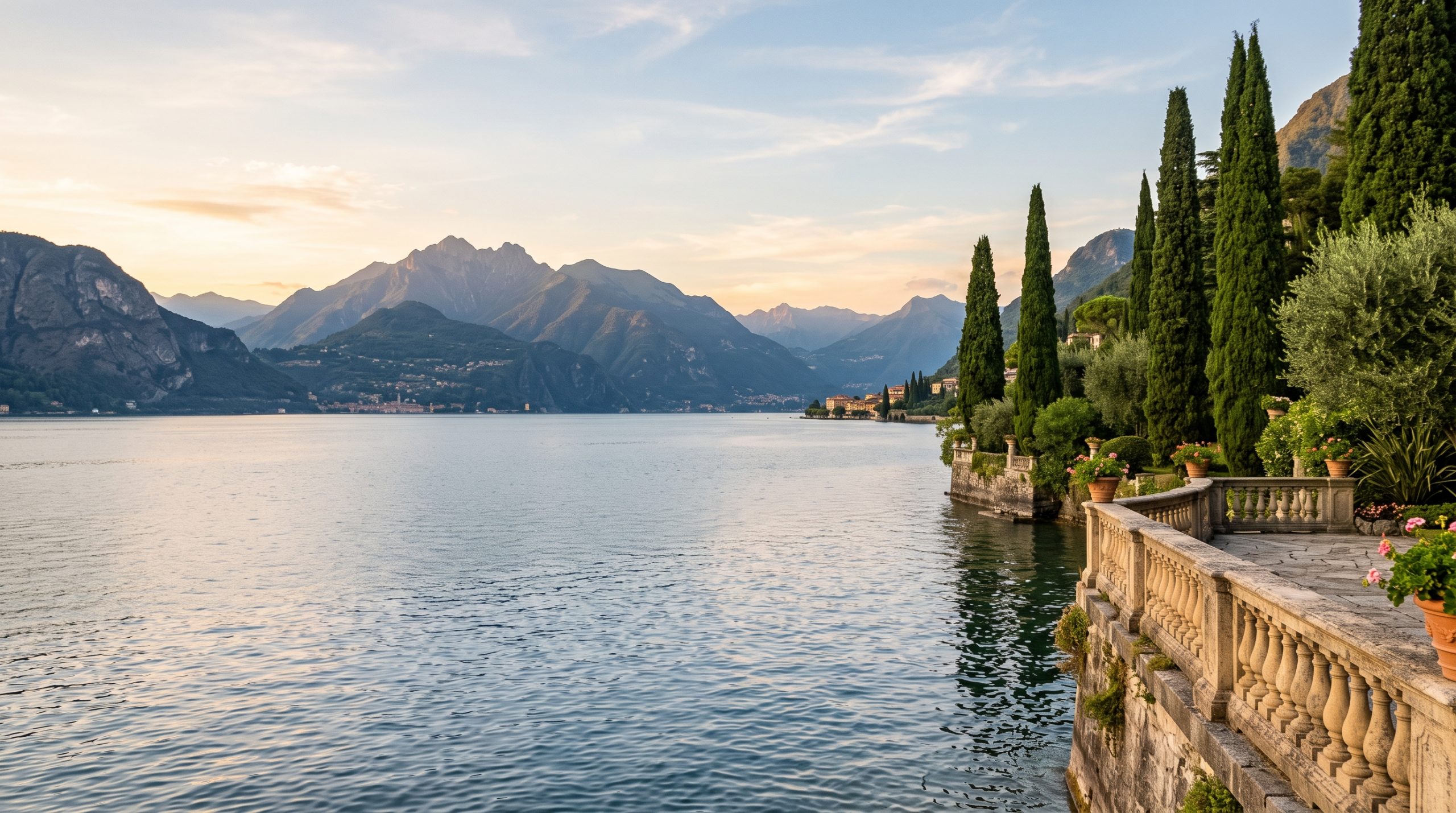
The water does not know. That is the first thing worth saying about a symbolic ceremony on Lake Como: the light coming off the mid-lake between Bellagio and Varenna, the Grigne standing up behind the eastern shore, the cypresses running down to a stone dock. None of it is checking whether a registrar signed something that morning.
What changes is the filing cabinet, not the view. A symbolic ceremony is not registered with any Italian authority, so there is no nulla osta to chase, no notice posted on a town hall board, no translation sworn in front of a court clerk in Lecco or Como. You handle the legal marriage at home, before you fly.
There is still a list. It is a different list, and nearly all of it is about access rather than status: who owns the terrace, which two days a week the villa closes to visitors, whether a boat can come alongside at the hour you want, and who at the comune says yes to a piece of public ground.
Symbolic on the lake, legal at home
A symbolic ceremony on Lake Como has no legal effect in Italy and nothing about it is filed here. No nulla osta, no publications, no sworn translations, no Italian-language script. You complete the legal marriage at home before you fly, then stand on the lake with your own words, your own hour and your own celebrant.
The difficulty rating: nothing to file in Italy
Straightforward. This is the shortest chain available to a visiting couple, and it is not a consolation route. Plenty of couples who could complete the civil marriage in Italy choose this anyway, because it hands back the three things the legal version has to control: the language, the hour and the ground. A courthouse morning at home costs you a signature and a parking space. It buys you a ceremony at six in the morning on a wooden dock at Fiumelatte, in English, led by someone who has known one of you since you were nineteen. If you want the fundamentals in order before any of that, our guide on how to plan an elopement covers the shape of the whole thing.
What follows is the order the tasks actually fall in, which is not the order most planning sites list them.
The order you actually do things in
Only one item on this list has a validity window, and it is not an Italian one. Nothing here needs an apostille for the ceremony itself, and nothing needs translating into Italian, because no Italian office ever sees any of it.
- Choose the shore, then the venue. Tremezzina and Lenno on the western side take the morning sun on their faces. Varenna and the eastern shore hold the last of it. That one decision fixes whether your ceremony is at breakfast or at dinner.
- Get the ground in writing. A contract that names the exact spot, the hours you have it, and whether photography and film are covered by the same booking or a separate one.
- Book the celebrant. The person leading a symbolic ceremony holds no public office and needs no registration, which is why a friend can do it. You book and pay them directly.
- Apply for the marriage licence at home. This is the one with the clock on it. Your county clerk sets both the waiting period before a licence can be used and how long it stays valid, so it lands near the end of the plan rather than the beginning.
- Marry at home. Before whoever your state recognises, in whatever room you like. Ten minutes, two signatures.
- Order certified copies of the certificate. More than you think you need. They are cheap at the counter and tedious to chase from another continent.
- Add an apostille only if something will be used abroad. An apostille is issued by the authority in the country that produced the document. For a symbolic ceremony on the lake, nobody will ask for one.
- Confirm access last. Boat times, gate codes, the walk from the road, and permission for aerials where the film depends on them.
What the legal route would ask of you instead
It is worth seeing the two side by side, because the difference is larger than most couples expect and it is almost entirely administrative rather than emotional.
| Element | Symbolic ceremony | Civil marriage at an Italian comune |
|---|---|---|
| Filed in Italy | Nothing | A full document chain lodged with the marriage office |
| Language | Whatever you speak | Italian, with an interpreter where the couple does not follow it |
| Witnesses | None required | Two |
| Where it can be held | Any ground whose owner agrees | Only in a room or garden the comune has designated for civil status |
| Council fee | None to the comune; the venue charges instead | Set by the comune and banded by day and hour |
| Afterwards | Nothing to collect | The certificate, then an apostille to have it recognised at home |
The mechanics of the legal route are public. The U.S. Embassy in Italy sets out the sequence for American citizens marrying here: obtain the atto notorio, take an appointment with the marriage office of the town hall where the marriage will take place, present the documents and make the declaration of intention to marry, then obtain the apostille on the marriage certificate once married.
Timing then belongs to the comune, and the rule is old and precise. Comune di Como publishes it on its own service page: the publication of marriage stays on the council’s online noticeboard for eight consecutive days, and the marriage may be celebrated from the fourth day after the publications are complete and within the following 180 days. The paperwork carries revenue stamps of 16 euros each, one where both parties are registered in the same comune and two where they are not, which is the sort of small thing that sends people back to a tobacconist on a Friday afternoon.
Room fees are the part that surprises people. Varenna now runs its own online booking portal for the three places it celebrates, the municipio, Villa Cipressi and Villa Monastero, with live availability by date and time band. For couples who are not resident in Varenna, the published expense contribution across the March to November season currently runs from about 1,200 euros for a weekday daytime slot to around 2,000 euros for the most wanted evening bands, with roughly 1,500 euros for Saturdays and public holidays. Varenna residents pay nothing at all. Como city runs a different arrangement again, celebrating in the Sala Consiliare and Sala Giunta at Palazzo Cernezzi, the Sala Ovale at Villa Olmo and the Tempietto in its grounds, with higher tariffs for non-residents. Fees and deadlines quoted here were correct at the time of writing and are worth re-checking with the office that issues them.
Build the symbolic day from the light backwards
The real minimum on the Italian side is genuinely short. A symbolic ceremony needs ground that will have you and a person willing to lead it. There is no notice period, because there is no notice. The real minimum on the American side is set by your county clerk and by nothing else.
The comfortable minimum is a different number, and it is the one we work to. We are booking 2027, 2028 and 2029, and the pattern on this lake is consistent: high summer Saturdays go first, and the shoulder weeks in May and late September are where the good hours still sit unclaimed.
- Twelve months out. Shore, then venue, then hour. Our destination guides are a decent way to work out which side of the water you actually want.
- Nine months. The ground held in writing. If Villa del Balbianello is on your list, this is when it happens rather than later.
- Six months. Celebrant confirmed. Boat confirmed. Guest access mapped, including the people who cannot manage a steep path.
- Three months. The timeline gets built around light and real travel time, closed days checked, aerial permissions confirmed where the film leans on them.
- The last six weeks. Home paperwork, on your clerk’s schedule.
- The week before. The courthouse morning. Certified copies ordered.
- The day itself. Nothing to file, nothing to collect, no office to be open or shut.
Where a no-paperwork plan still needs permission
The villa is a museum before it is a venue. Villa del Balbianello is the clearest case on the lake. FAI, the national trust that cares for it, hosts civil and symbolic ceremonies there along with aperitifs and dinners for up to 130 guests, and states on its own page that photography for weddings is chargeable and has to be booked in advance. So the absence of Italian marriage paperwork does not mean an absence of permission. It means the permission is commercial and it comes from the estate. Balbianello is also one of the most visited properties FAI looks after, which is exactly why the two days a week it closes to visitors, currently Mondays and Wednesdays outside public holidays, are the two days worth asking about first.
The approach is by water. Boats come alongside the villa’s own dock from the Lido di Lenno, either on the Bellagio Boat Service run or on a private taxi boat you arrange yourself. From Como, the SPT C10 bus reaches Lenno and you continue on foot or by water. This is not a place you drive to at ten past the hour because you left late, and building a ceremony hour around it means building the boat in first.
Public ground belongs to the comune. A piazza in Bellagio, the grass at Punta Spartivento where the lake divides into its two legs, a municipal beach at Lenno. Two people standing there are two people standing there. A ceremony with chairs, an arch and a gathering is an occupation of public space, and that is the council’s to authorise, not the venue’s and not ours. We ask before we design an hour around a spot, and we hold a private alternative within ten minutes of it.
The council slot and the private terrace are different products. Couples on the symbolic route sometimes assume they still owe the comune a fee. You do not. You are buying time on someone’s ground instead, and that ground usually has a public life of its own. Villa Cipressi runs as a hotel. Villa Monastero runs as a museum with a botanical garden that closes to visitors at a set hour. The question to ask is never only what it costs, it is what else is happening on the same terrace at the same time.
Almanac sunrise is not sunrise here. The Grigne behind Varenna and the ridges above Tremezzina hold the sun off the water for a good while after the time a weather app gives you. Plan a sunrise ceremony from that table alone and you can find yourself in flat blue shade with the sun still climbing rock. We time from the ridge line and the shore aspect, not the almanac, which is why the shore decision comes before the venue decision.
Aerials run on permission and a window. Drone footage is part of what we do where it is legal, safe and appropriate, and on a lake ringed with airspace and dense villages that is a question we settle before the film is planned around it, not on the morning.
What we can coordinate once the legal paperwork disappears
We plan around the constraints rather than discovering them. That means holding your date against the venue’s diary, researching the permits your specific locations need, guiding the logistics, building a timeline from light and real travel time instead of optimistic map distances, and carrying a weather alternative for every outdoor hour. It also means being straight about the boundary: we are photographers and filmmakers, not lawyers. Rules change and circumstances differ, so confirm the detail with the relevant registry office or your own consulate before you book flights.
A symbolic ceremony often has no witnesses and sometimes no guests at all. That is a large part of the appeal, and it changes what coverage has to do, because nothing else in the room is recording this. On the Expedition a dedicated photographer and a dedicated filmmaker work the same hour together, with professional audio on the vows where conditions allow, so what was actually said survives as sound and not only as a memory of sound. There are eight of us, which is why there is always a second camera on the ground and a colleague in reserve.
Team travel is included worldwide, flights and accommodation included, with no long-haul surcharge and no European exception. Highlights reach you in 5 days and the full gallery or film in 3 weeks. If you want to see how water, stone and low light actually come out before you commit to a shore, spend ten minutes in our published stories and films, which is the same work we would be making for you. Coverage and what each experience includes sit on our pricing page.
What stays with you is short and predictable: venue and landowner fees, your celebrant, accommodation, and any unusual transport such as a private boat to a promontory. Guest count does not move our fee. It moves access, transport and the timeline, which is a different problem and one we are happy to solve.
The way in is simple. Fill in the inquiry form, and a reply with an initial brochure comes back within 24 hours. If the shape fits, we build a tailored proposal for your dates, and planning starts once the contract is signed and a 30% retainer is paid. Tell us the shore you have in mind, or tell us you have no idea and want to be talked through it, and we will start there. Send Us a Message.
Common questions
Is a symbolic ceremony on Lake Como legally binding?
No, and that is the point of it. A symbolic ceremony is not registered with any Italian authority and creates no marital status in Italy or anywhere else. Couples who want the marriage to be legal complete it at home before travelling, then treat the ceremony on the lake as the one that matters to them.
Do we need any Italian documents for a symbolic ceremony?
None. No nulla osta, no atto notorio, no publication at a town hall, no sworn translation and no apostille. The only documents involved are the ones you already carry to travel, plus whatever your own county clerk required at home.
Can we marry at home and still hold the ceremony at Villa del Balbianello?
Yes. FAI hosts both civil and symbolic ceremonies at the villa, along with aperitifs and dinners for up to 130 guests, and photography for weddings is a chargeable booking made in advance. What you are arranging there is access and time, not legal status.
Do we need witnesses for a symbolic ceremony in Italy?
No. Two witnesses are required for a civil marriage in front of an Italian registrar. A symbolic ceremony has no register to sign, so you can have two people, twenty or nobody at all, and the guest count does not change our fee.
Can we hold a symbolic ceremony somewhere public like Punta Spartivento?
Sometimes, and it depends on the comune rather than on marriage law. Setting up a ceremony on public ground counts as occupying a public space, which the council authorises. We check that before designing the hour around it and keep a private alternative nearby.
How far ahead should we book a Lake Como date?
Our planning calendar is open across the 2027–2029 seasons. Nine to twelve months gives you a real choice of ground, especially if a named villa is involved. Varenna’s own booking portal shows live availability by date and time band, and the high summer Saturdays are always the first to disappear.
Will we need an apostille later if the ceremony is symbolic?
Not for the ceremony. An apostille only matters when a document issued in one country has to be recognised in another, and it comes from the authority that issued the document. Since the lake ceremony produces no certificate, there is nothing to legalise afterwards.
Can same-sex couples have a symbolic ceremony on Lake Como?
Yes. Italian town halls celebrate civil unions as well as marriages, and the paperwork route differs between them. A symbolic ceremony sidesteps the whole question, because the legal marriage has already happened at home under your own law and nothing is registered in Italy.
Standing on the dock with nothing to file
The best argument for this route is what the morning feels like. No office to reach by a certain hour, no interpreter, no folder of stamped paper riding in someone’s bag from Milan. Just the boat, the ground you booked, the person leading it and the two of you. Everything on our side runs in writing, so you can read, think and reply at whatever hour suits you, and nothing is ever waiting on a diary slot. Tell us the shore, the month and the hour you keep imagining, and we will tell you honestly what the light does there and what the water is doing that week. Start Your Story.