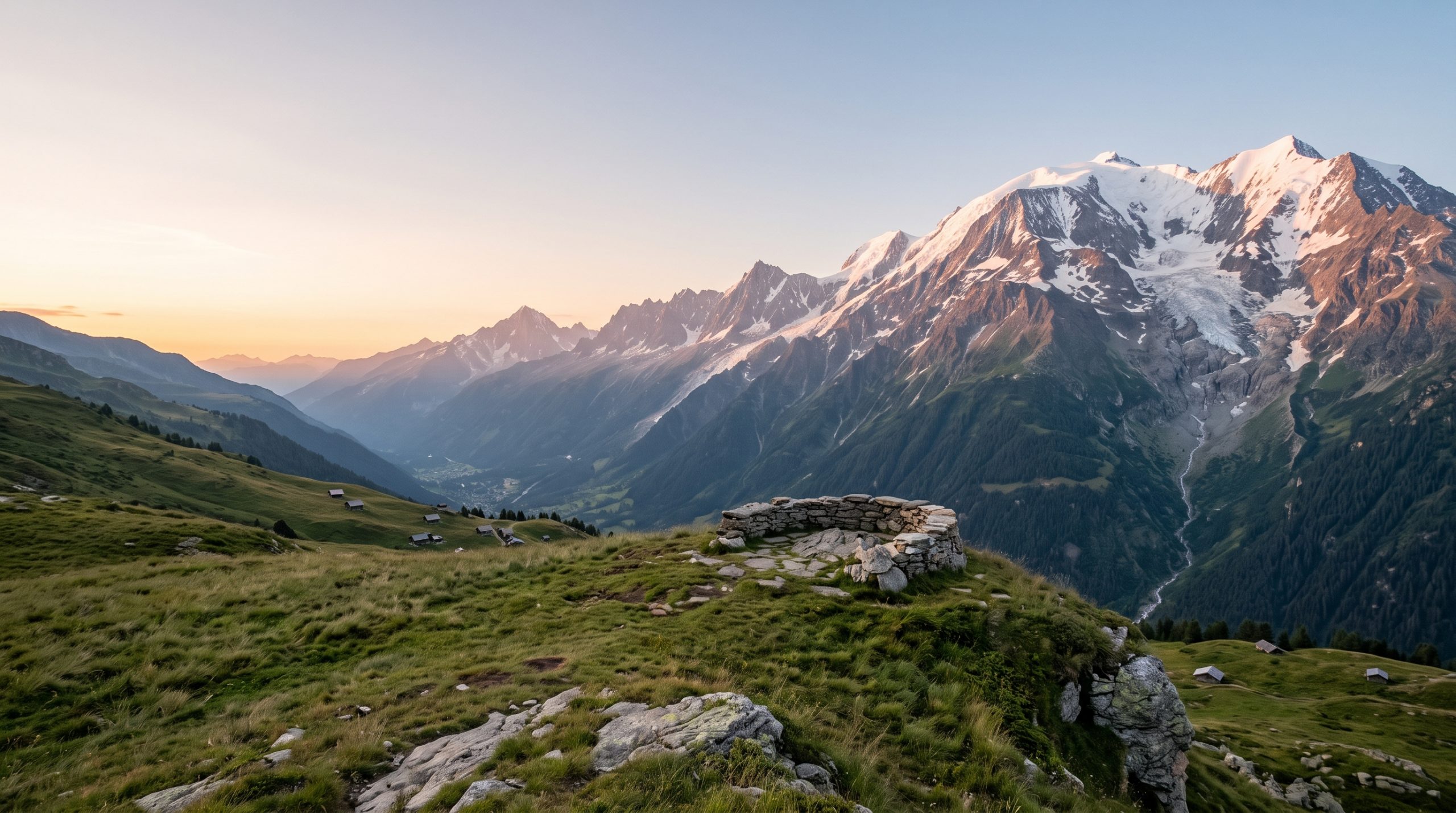
The mairie in Chamonix-Mont-Blanc states the rule on its own website with no softening at all: a marriage is celebrated in the commune where one of the future spouses, or one of their parents, has their domicile or residence. Read that sentence once and the whole plan clarifies itself. Very few couples flying in from Denver or Charleston will meet it, and almost none of them need to.
What they hold instead is a symbolic ceremony. No registrar, no banns, no document list, no office hours. Vows on a granite shoulder above the Mer de Glace at seven in the morning, or on the terrace at 3,842 m where the Aiguille du Midi cable car tops out after a twenty-minute ride from the middle of town. The legal marriage happens at home, before or after, and it is usually the least interesting hour of the entire plan.
Which means the cost question splits cleanly in two. What France charges you for, which is mostly lifts and mountain transport. And what coverage costs, which is us.
No French paperwork, one legal step at home
A symbolic ceremony in the French Alps has no legal standing, so it needs no French paperwork: no banns, no registry file, no witnesses, no state fee. You marry legally at home, then hold the ceremony on the mountain. Your spending in France is lifts, ground transport, any site authorization, and coverage.
The residency rule, and the route almost every visiting couple takes
In France, only the civil ceremony conducted at the mairie creates a marriage. Everything else, religious or secular, sits alongside it rather than in place of it. That single fact shapes every Alpine elopement plan, because the mairie celebrates marriages for people who belong to the commune. Chamonix words it as domicile or residence, and residence in that sense means living in the valley rather than visiting it.
The calendar is just as firm. Chamonix accepts a marriage file at the earliest one year and at the latest two months before the date you want, by appointment with the pôle proximité et citoyenneté at the mairie on place de l’Église, and the agent you meet issues the exact document list for your nationality. If you are not in the valley, that first contact can be opened by email.
There is no embassy workaround either. Under Title 22 of the US Code of Federal Regulations, American diplomatic and consular officers are not permitted to perform marriages, and as a rule marriages are not performed on the premises of a US embassy or consulate. Nothing in Paris shortcuts the commune rule.
So here is the difficulty rating, plainly stated. A legally binding French marriage is not realistically available to a couple visiting for ten days. A symbolic ceremony is genuinely straightforward, and it is the route the overwhelming majority of international couples in the Alps actually take. It is not a consolation prize. It is the version with fewer moving parts and more freedom in it.
What changes when you take that route:
- No French document list, no sworn translations, no apostille, no certificat de coutume to chase through a consulate.
- No banns period sitting between you and your date.
- No registrar’s diary deciding your hour, so you can begin at 5.40am if that is when the light reaches the Drus.
- No minimum number of witnesses and no minimum age for them, because nothing is being registered.
What does not change: the vows, the rings, the reading your sister sends over from Ohio, the language you speak in, the ground you stand on, and every frame of the film. Nobody watching will notice a legal difference, because on the day there is not one to notice.
This guide is practical planning help, not legal advice. Confirm the final requirements with the registry office or your consulate before booking travel.
Plan the mountain morning from the light backwards
Two timelines run in parallel here and they barely touch. The legal one moves at whatever pace your county or district office at home sets, and for most American couples that is measured in days rather than seasons. The mountain one is the slow one, because good sunrise dates in Chamonix are taken early and because lift tickets are sold against a named date.
The real minimum is short. With the legal step already handled at home, a symbolic ceremony in the valley can be built in about two months. The comfortable minimum, and the one we work to, is nine to twelve months for July and August, and roughly six for the quieter shoulder weeks in June and late September.
- Twelve to nine months out. Choose the week rather than the day, and choose the side of the valley. North-facing granite and south-facing meadow behave completely differently at sunrise, and that choice drives everything after it.
- Nine to six months. Contract signed and a 30% retainer paid. Planning begins at that point, and the date is held against ours rather than held loosely in an inbox.
- Six to three months. Ground selection and the custom timeline, built around real travel time between Chamonix, Montenvers and the Aiguilles Rouges side rather than around map distances. Our guide to planning an elopement covers the fundamentals underneath this stage.
- Three months. The mountain day gets fixed before anything softer, because dated lift tickets are the least flexible object in the plan.
- Six weeks. Any written authorization for protected ground goes in, along with the aerial plan and its time window.
- Four to two weeks. The legal marriage at home, and the certified copy of the certificate back in your hands before you fly. Do it in this order and the trip carries no administrative weight at all.
- The final week. Weather patterns, first lift times for your exact dates, and the alternative location confirmed as a real plan with its own timeline rather than a vague idea.
What the valley charges for, and what it does not
Standing on a mountain and saying something true to each other is free. Getting to the mountain is not, and in Chamonix the lift operators are the largest fixed cost of the day after coverage and where you sleep. These are the published adult tariffs at the time of writing.
| Access | Adult tariff | What it buys |
|---|---|---|
| Aiguille du Midi, return from Chamonix | €83 | The terrace at 3,842 m, about twenty minutes each way from the town center |
| Aiguille du Midi, one way | €61 | The same ride in a single direction |
| Aiguille du Midi, child return | €70.60 | Child rate covers ages 5 to 14; under 5 travel free |
| Montenvers rack railway, return | €31.50 | Montenvers at 1,913 m, looking straight down the Mer de Glace |
| Montenvers Mountaineer ticket | €42.30 | Return train plus the return gondola below the station |
| Mer de Glace Voyage | €49.70 | Train, gondola, ice cave and the Glaciorium |
| Vanoise national park core, professional stills and film | No fee | Written authorization from the park director |
Then the list of things that cost nothing, which is longer than most couples expect. The ground itself. The mairie, which has no role in a symbolic ceremony and therefore charges nothing for it. The ceremony, because no state body is involved in it. And in the Vanoise, further south in Savoie, the authorization for professional stills and filming inside the park core is issued without a charge, because the park has deliberately chosen not to bill applicants for it.
Our own coverage sits outside all of that: the Adventure starts at $4,900 with one dedicated photographer or filmmaker, the Expedition at $7,900 with a photographer and filmmaker working together, and the pricing page sets out what each of them includes.
Fees and processing windows can move. Treat the figures here as a planning snapshot and reconfirm them with the issuing office before you file.
Permits, drones and the Aiguilles Rouges
The first thing to unlearn is that the Chamonix valley sits inside a national park. It does not. Mont Blanc and its satellites are governed by a patchwork of local rules rather than one rulebook, which is why generic French park advice so often fails here. France’s two Alpine national parks, the Vanoise and the Écrins, are further south, and they run a different regime entirely.
What Chamonix does have, on the sunny side of the valley facing the massif, is the Aiguilles Rouges national nature reserve, created in 1974. It holds Lac Blanc and the Lacs des Chéserys, the two still-water mirrors every couple has already seen in a search result. Inside the reserve the rules are published without ambiguity: overflight prohibited, no dogs, no fires, no flower picking, no camping with bivouac by reservation only, and no swimming in Lac Blanc or the Chéserys lakes.
Overflight prohibited means exactly what it says. There is no aerial over Lac Blanc at any hour, so we plan the reserve as a walking morning and let the terrain do the work instead: long glass from across the basin, the couple small against the Aiguille Verte, the water flat at first light before the wind picks up. The aerial part of the film moves to ground elsewhere in the valley where it is legal and the light is doing something anyway.
Across the rest of France, a camera drone means the operator is registered on the DGAC’s AlphaTango portal, and the ceiling in the open category is 120 m above the ground. In the Alps that measurement behaves in a way flat-country pilots find surprising, because on steep terrain the 120 m is taken from the nearest point of the surface. A drone can climb with a face rather than against a fixed altitude line, and an alpine flight plan therefore looks nothing like a coastal one. Aerials run on a permission and a time window, and we confirm both before the film is designed around them.
If your Alps plan runs south into the Vanoise or the Écrins, the shape of the rule changes. Stills and filming carried out professionally or commercially inside the core of a French national park are prohibited unless the director of the park’s public establishment authorizes them, and the Vanoise takes its applications through the French government’s démarches portal. Approval is not a formality and it is not instant, which is why it belongs six weeks out in the countdown rather than in the last two weeks.
Permit research and logistics guidance are inside every experience we run, here and everywhere else we work. We identify what your chosen ground needs, prepare the applications that belong to us as the working crew, and tell you which government or landowner fees stay on your side. Our destination elopement guides go further into how individual regions differ.
Where Chamonix symbolic ceremonies usually snag
None of these are difficult. They are simply invisible until the week you need them, and every one of them is easier to solve in March than in July.
- The two-month wall at the mairie. Chamonix accepts a marriage file no earlier than one year and no later than two months before the ceremony date. Couples who spend a whole spring wondering whether the legal route might work for them find the window has quietly closed. Decide early, or decide to go symbolic and stop watching that clock entirely.
- The reserve boundary is not painted on the ground. The Aiguilles Rouges reserve begins where the map says it begins, not where the terrain visibly changes. A viewpoint that looks identical to the one 300 m along the path can sit under a completely different set of rules, which is why the aerial plan is drawn before the walking plan.
- Dogs. Dogs are not permitted in the Aiguilles Rouges reserve at all. If your dog is part of the day, and for a lot of couples it is the whole reason they are eloping rather than hosting, the dog frames belong lower in the valley and we build them in there.
- Montenvers is a half morning, not a stop. Allowing two to three hours for the full Montenvers visit including the gondola and the ice cave is the published guidance, and it is accurate. Couples who slot it between two other locations end up rushing the part they came for.
- Dated tickets. Lift tickets bought online are tied to the date you choose. That is fine, and it is exactly why we settle the mountain day first and arrange the softer, movable parts of the timeline around it.
- Tariff drift. Lift prices are republished periodically, so treat the numbers above as the shape of the budget rather than a quotation. The relationship between them holds steady even when the figures move.
- The certified copy nobody will ask for. No French office will ever ask to see your marriage certificate, because no French office is involved. It still matters at home, and if either of you changes name after the legal step, the passport, the flights and the hotel booking all have to agree with each other before you travel.
Choosing the hour, and who is standing where
Sunrise at 3,842 m and sunrise at 2,352 m on the Aiguilles Rouges side are two entirely different mornings, and they are not interchangeable. One depends on a cable car opening. The other depends on your legs and a head start in the dark. We build the timeline backwards from the light and forwards from the first lift, hold a second location in reserve with its own timings, and coordinate the ceremony hour so that vows land when the valley is still in shadow and the summits are not.
Because a symbolic ceremony requires no witnesses, the only people on the ledge are usually the two of you and us. On the Expedition that means a dedicated photographer and a dedicated filmmaker working the same moment from two positions, so nobody has to stop shooting to catch a ring or steady a piece of paper in the wind. It also brings professional audio for the vows where conditions allow, which at altitude is the difference between hearing what you said and reading it later.
Highlights reach you five days after the day itself, and the full gallery or film within three weeks. If you want to see how Alpine granite, glacier ice and 6am light actually resolve in finished work before you commit to a location, our published stories and films are the honest reference point. Team travel is inside every experience worldwide, so flights and accommodation for the crew assigned to you are not a line item you will be handed later.
What we do not do is file documents on your behalf. We plan around the constraints, hold the date, and keep the ceremony hour aligned with the light. The legal step stays yours, and it is the easy part. Tell Us Your Story and we will tell you which weeks in the valley actually suit the day you are describing.
Common questions
Is a symbolic ceremony in France legally binding?
No. In France only the civil ceremony conducted at the mairie creates a marriage. A symbolic ceremony carries no legal effect, which is precisely why it needs no French paperwork, no banns and no witnesses. Couples marry legally at home and keep the Alps for the ceremony itself.
Can Americans get legally married in Chamonix?
Only if one of you, or a parent, has domicile or residence in the commune. Chamonix publishes that condition itself, and residence means living there rather than staying there. For a couple visiting for a week or two it is not a realistic route, which is why the symbolic ceremony is standard.
Do we need a permit for a symbolic ceremony in the Alps?
The ceremony itself needs no permission because no authority is involved. The professional photography and filming can need it, depending on the ground. Inside the core of the Vanoise or the Écrins national parks, commercial stills and film require written authorization from the park director.
Can you fly a drone over Lac Blanc?
No. Lac Blanc sits inside the Aiguilles Rouges national nature reserve, where overflight is prohibited. Aerials for your film move to legal ground elsewhere in the valley, and the reserve hours are planned as a walking morning with long lenses instead.
How much are the Chamonix lifts for an elopement day?
An adult return to the Aiguille du Midi is currently 83 euros and an adult return on the Montenvers rack railway is 31.50 euros. The Mer de Glace Voyage ticket, which adds the gondola, ice cave and Glaciorium, is 49.70 euros. Tariffs are republished periodically.
Do we need witnesses for a symbolic ceremony?
No. Nothing is being registered, so there is no minimum number of witnesses and no minimum age for them. Plenty of couples stand alone with us. Others bring two people, or twelve, and the fee does not change with guest count; only access, transport and timeline do.
Should we marry legally before or after the trip?
Before, in almost every case. Handling it at home two to four weeks ahead means the certified copy is already in your hands, nothing administrative follows you onto the plane, and the mountain morning belongs entirely to the two of you.
Can the US Embassy in Paris marry us?
No. American diplomatic and consular officers are not permitted to perform marriages under Title 22 of the US Code of Federal Regulations, and as a rule marriages are not performed on embassy or consulate premises. There is no consular shortcut around the commune residency rule.
Planning a date in the valley
The valley works on a short season and a long lead time, and we are currently booking 2027, 2028 and 2029. Everything with us happens in writing: send the inquiry form, and a reply with our initial brochure comes back within 24 hours, followed by a tailored proposal for your dates and your ground. A signed contract and a 30% retainer start the planning.
Tell us the morning you are imagining, whether that is a cable car at altitude or two hours uphill in the dark to reach a lake nobody else has walked to yet, and we will tell you honestly which weeks in Chamonix deliver it. Check Your Date.