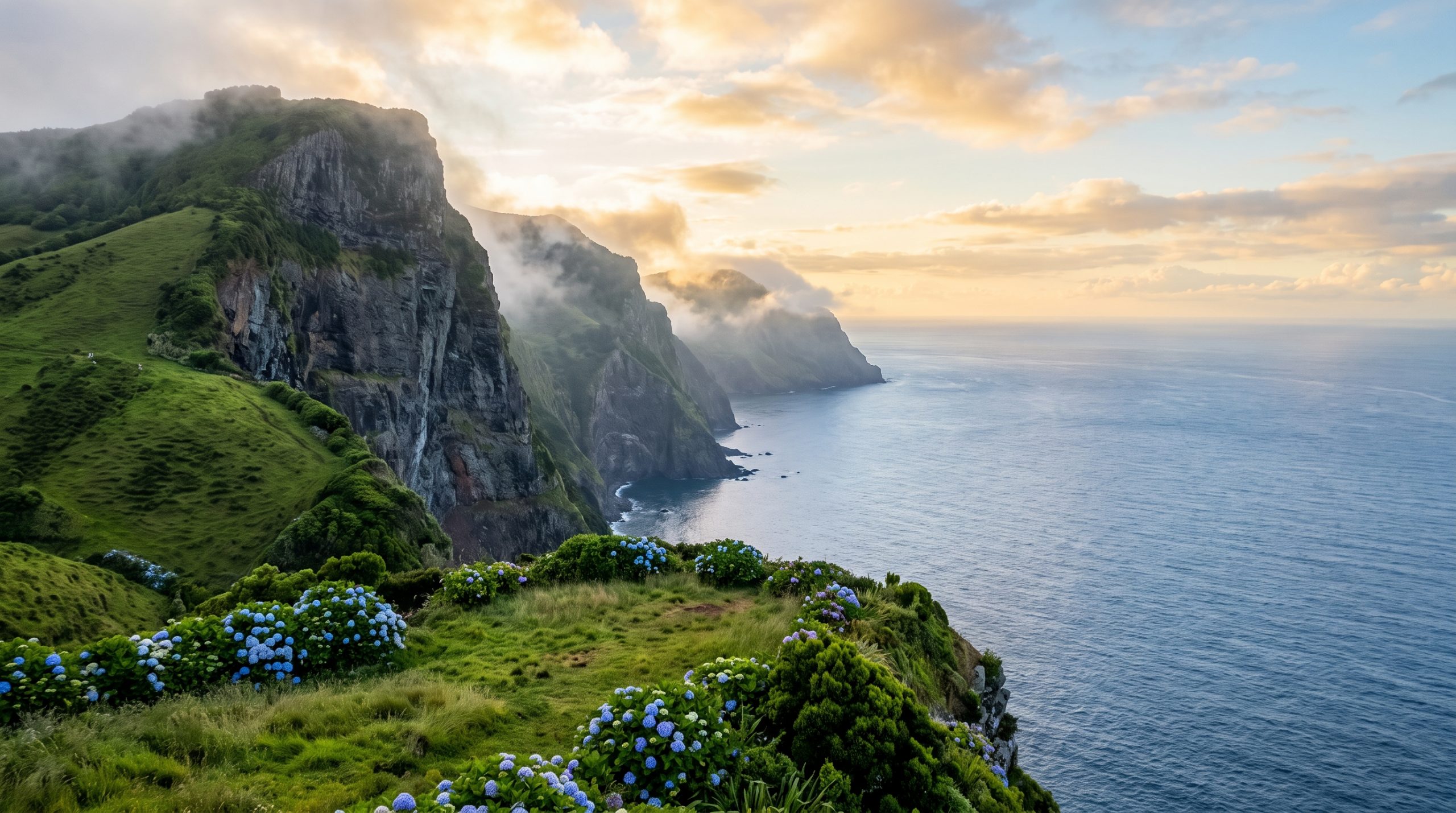
Ponta da Ferraria at low tide, a little after six in the morning, and the only other person on the lava shelf is a man testing the water with the back of his hand. No registrar waiting. No file open in a drawer in Ponta Delgada. Nothing to sign except a guest book if you brought one. A symbolic ceremony in the Azores is this day with the paperwork lifted out of it, and on an archipelago where the weather rewrites your morning, that is an advantage rather than a compromise.
Cost is the first thing couples ask about, and the structure is cleaner than most people expect. The ceremony itself carries no state fee, because the state is not part of it. What you pay for is coverage, movement around the islands, whoever stands up and speaks, and a short list of clearances that attach to filming, drone flights and private land rather than to marriage.
What follows is the whole shape: what the symbolic route needs, what the Portuguese civil route needs if you want the law to happen here, and the order to do things in. Our role is planning and documenting the day, not providing legal advice. Re-check personal requirements with the competent office before committing flights.
What a symbolic ceremony in the Azores actually needs
Nothing legal. No notice period, no documents, no state fee, because nothing is registered and no registrar attends. You choose the officiant, the hour and the ground you stand on. The permissions that do apply cover photography, filming, drone flights and private land, and couples who want legal status marry at home instead.
The symbolic route is simple; island permissions are the moving part
Straightforward. Of everything a couple has to arrange for a day in the Azores, the ceremony is the easy part, because there is no queue and no file. The difficulty sits in travel between islands, in cloud on the caldera rims, and in the hour you pick.
The Portuguese civil route is fiddly rather than closed. Portugal is unusually open here: there is no residency requirement for foreign citizens, and same-sex marriage has been legal since 2010. The preliminary marriage file can be opened at any conservatória do registo civil regardless of where you live, either in person or through a proxy holding special powers, and once it is approved you have six months to hold the ceremony. The state fee for the process is 120 euros. Portugal’s published guidance puts the registration at 200 euros where the marriage is celebrated away from the registry office or outside its ordinary hours, and if the registrar travels to your location, the couple arranges that transport or covers the cost of it.
Published guidance varies on one point worth knowing. Some wedding guides state that foreign couples must appoint a Portuguese lawyer to apply. The registry service’s own instructions are that the couple can organise the file themselves, or send a proxy with special powers, and the conservatória is the office whose answer governs. The prices and lead times here are a snapshot. Reconfirm them with the relevant authority before you build flights around them.
| Question | Symbolic ceremony | Portuguese civil marriage |
|---|---|---|
| Who officiates | Anyone you choose | A registrar, or a religious minister under Portuguese law |
| Where it can happen | Any location you have access to | The conservatória, or a location the registrar agrees to attend |
| State fee | None | 120 euros for the process, more for registration in some circumstances |
| Lead time | Set by travel and light, not by an office | File opened first, then six months to marry once approved |
| Documents | None for the ceremony | Identification, home civil records, apostilles and translations |
| What you leave with | Your film, your gallery, your rings on | A Portuguese marriage record |
Marrying at home first, in the order it happens
Most American couples we work with do the legal part at home, in a courthouse or a living room, and keep the Azores for the ceremony that means something to them. The order matters more than the effort.
- Decide which event is the legal one. If it is the one at home, everything below stays in your own state and nothing crosses the Atlantic as a requirement.
- Apply for your marriage licence at the county or state office that issues it. Every state sets its own waiting period and its own validity window, so ask how many days the licence is good for before you fix travel dates around it.
- Hold the legal marriage, with whoever your state requires present, and collect certified copies of the certificate rather than the single one you are handed.
- If you want that certificate usable abroad later, request an apostille from the Secretary of State of the state that issued it. Portugal accepts apostilled documents under the Hague convention, so that one certificate does the legalising work.
- Pack nothing legal for the islands. Bring the rings, the vows on paper, and anything your celebrant asks for.
Couples who want the reverse order, with the Azores ceremony first and the legal marriage at home afterwards, lose nothing at all. The photographs and the film are identical either way, and there is no rule about which comes first.
The clearances that do apply on the islands
This is where the actual permissions live, and none of them are about marriage.
Filming and photography
Anyone intending to film or photograph in the Azores makes a request through the Filmar em Portugal form on the ePortugal platform, naming the location and the dates. The regional tourism secretariat connects that request to the authority that governs the specific site, which may be a natural park service, a municipality or a private owner. Small ceremonies with two cameras are a long way from a film crew, but the request is the front door and using it means nobody at a gate is guessing about you. This is part of the logistics work we do before your date, and you can see how the islands look when it has been done properly in our published films and galleries.
Drone flights
Airspace is national. ANAC, the Portuguese civil aviation authority, publishes a geozone map that shows where flight is restricted, and operators register with ANAC before they fly. Inside a park, nature reserve or protected area, the Azores add a second step: authorisation from the Direção Regional do Ambiente, the regional environment department. So aerials run on a permission and a time window, and we confirm both before designing any part of the film around them. Where it is legal, safe and appropriate, drone footage is part of every experience we deliver.
Land, chapels and gates
On private ground, the owner’s yes is the permit, whether that is a quinta above Furnas, a tea estate on the north coast or a pasture with a view of Pico across the channel. A chapel is the parish’s decision, not the photographer’s. Inside the island natural parks, individual sites keep their own gates, hours and entrance fees, and those fees are paid by you on the day rather than folded into coverage.
Public viewpoints are free and open, which is a mixed blessing. Lagoa do Fogo has no admission fee and no set hours, and no real car park at the Pico da Barrosa viewpoint either, so vehicles line the verge and the ridge fills from mid-morning. Vista do Rei above Sete Cidades at eleven in the morning is a coach stop with a fence, and it photographs like one. Both places are extraordinary two hours earlier, in cloud that is still moving. That single fact shapes more of our Azores timelines than any permit does.
Build the Azores day backwards from the ceremony light
Sunset in Ponta Delgada lands close to nine in the evening at midsummer and is gone before six in December, and the archipelago runs an hour behind mainland Portugal all year. The hour of the ceremony is the fixed point, and everything else is counted back from it.
| Time before the date | What happens |
|---|---|
| 12 to 18 months | Island choice and the date held with the team. We are currently booking 2027, 2028 and 2029. |
| 6 months | Locations designed, celebrant approached, accommodation and flights booked around the ceremony hour rather than the cheapest fare. |
| 3 months | Image capture request submitted with locations and dates. Drone plan drafted, protected-area authorisation sought, private landowners contacted. |
| 6 weeks | Ground transport, guides and any inter-island leg confirmed, with a spare day between islands. |
| 2 weeks | Timeline built against the real sunrise and sunset times for your date, plus tide times for any coastal hour. |
| 72 hours | Weather read together, alternates chosen, order of the day confirmed in writing. |
The real minimum is short. A symbolic ceremony needs only travel, an officiant if you want one, and a team that is free, so it can be assembled in weeks. The comfortable minimum is six to nine months, and that is the runway we work to, because it is what lets us hold the good hour at the good site instead of taking whatever is left. If your date is closer than that, tell us anyway and we will tell you honestly what is still possible.
Where Azores symbolic plans usually snag
None of these are disasters. They are the details that decide whether a morning runs smoothly, and they are the reason a plan gets written down.
- The licence at home expires before the trip. State validity windows are shorter than most couples assume, and a licence issued too early is the most common wasted step in the whole chain. Fix the legal date after you know the travel dates.
- Treating the islands as one place. Nine islands sit in three groups spread across hundreds of kilometres of ocean. Ferries in the central group thin out badly outside the summer months, and connections to Flores and Corvo answer to the weather. A day of buffer between islands is not caution, it is arithmetic.
- Arriving at a public office late in the week. Registry offices keep weekday counter hours and close for national and regional holidays, and the Azores observe their own. Anything that needs a counter should be planned for a Monday, not a Friday afternoon.
- Booking the caldera and hoping. A rim can sit inside cloud while the coast twenty minutes downhill is clear and gold. We build every Azores day with a low-level alternate already chosen, so the decision at dawn is a choice between two good options.
- Ignoring the tide. Ponta da Ferraria reads completely differently at high water, and the same is true of the natural pools at Mosteiros and the lava shelves on Pico. The tide table sets the hour, and the hour sets the rest of the day.
- Leaving the celebrant until last. English-speaking celebrants are not thick on the ground outside São Miguel, and the good ones on the smaller islands hold few dates. This is the one human booking a symbolic ceremony genuinely depends on.
What we coordinate across island, weather and access
Photography, film and planning come from one team of eight, so the person designing your timeline is the person standing on the ridge with you. We hold the date, design the destination and the locations, research the permits and guide the logistics, build the timeline around light and real travel time, and keep the weather alternatives ready. What we do not do is practise law or file marriage paperwork. That line is firm and it works in your favour, because it means the legal question gets answered by the office that decides it.
Because a dedicated photographer and a dedicated filmmaker work the same day from the same plan, the ceremony hour can be set for the light rather than split between two vendors with different priorities. One of us can stay wide on the caldera while the other holds the vows close, and on our two-person coverage the vows are recorded with professional audio where conditions allow. Coverage, delivery timings and what each experience includes are set out on our pricing page.
Your side of the line is short: any government, venue or landowner permit fees, accommodation, the celebrant, vendors and activities, and unusual transport such as private boats, 4×4 charters or a mountain guide on Pico. Team travel is ours, in every destination, with no long-haul surcharge.
After the day, highlights reach you in five days and the full gallery or film in three weeks, which means the images land while the trip is still in your legs. If you want the shape of a planning process rather than a set of prices, our guide to planning an elopement covers the fundamentals, and the destination writing lives in our elopement guides.
Booking runs in writing. An inquiry gets a reply and our initial brochure within 24 hours, a tailored proposal follows, and planning begins once the contract is signed and a 30% retainer is paid. Send Us a Message with your island, your month and the hour you are imagining.
Common questions
Do we need any paperwork for a symbolic ceremony in the Azores?
None for the ceremony itself. Nothing is registered, so there is no notice period, no document list and no state fee. The paperwork that exists in an Azores day belongs to filming and drone clearances, private land permission, and your own legal marriage at home if you choose to have one.
Who can officiate a symbolic ceremony in the Azores?
Anyone you want. A professional celebrant working in English, a friend, a parent, or the two of you reading to each other with nobody else on the ridge. Because nothing is filed, there is no qualification for anyone to check and no script anyone can insist on.
Do we need a permit to hold a ceremony at Sete Cidades or Lagoa do Fogo?
Standing at a public viewpoint and exchanging vows is not something you apply for. Photographing and filming in the Azores does run through a request on the ePortugal platform, and the authority that governs the site can attach conditions. Lagoa do Fogo has no admission fee and no set hours; the real constraint is parking space and the arrival of coaches.
Can we fly a drone over the crater lakes for our film?
Where it is legal, safe and appropriate. Operators register with ANAC and check the published geozone map, and flights inside a park, nature reserve or protected area in the Azores need authorisation from the Direção Regional do Ambiente. We confirm the permission and the time window before building any aerial sequence into the plan.
How much does it cost to get legally married in the Azores instead?
The marriage process at a conservatória do registo civil is 120 euros, and Portugal’s guidance puts registration at 200 euros where the marriage is celebrated away from the office or outside ordinary hours, with the registrar’s travel arranged or paid by the couple. Add apostilles, certified translations and courier costs at home, and confirm the current figures with the office itself.
Do we need witnesses if the ceremony is symbolic?
No. Nobody is required, and nobody is a problem either. Our fee does not change with guest count, though guests do change access, permits, transport and the shape of the timeline, so tell us the number early.
Which island suits a symbolic ceremony best?
São Miguel gives you crater lakes, hot springs and black coast within one day’s driving, which is why most first trips go there. Faial and Pico work as a pair across the channel, with the caldera on one side and the highest ground in Portugal at 2,351 metres on the other. Flores is the most dramatic and the least dependable to reach. Tell us the kind of morning you want and we will tell you which island delivers it in your month.
Choosing your island and your hour
A symbolic ceremony in the Azores gives you the rarest thing in destination planning: a day whose shape is decided by light, tide and the two of you, rather than by an office calendar. We keep every planning decision in writing so the process works across time zones.
Tell us the month you are looking at, the island that keeps coming up in your searches, and whether you want to be awake for sunrise. We will come back with a timeline that fits the real hours of that date. Start Your Story.