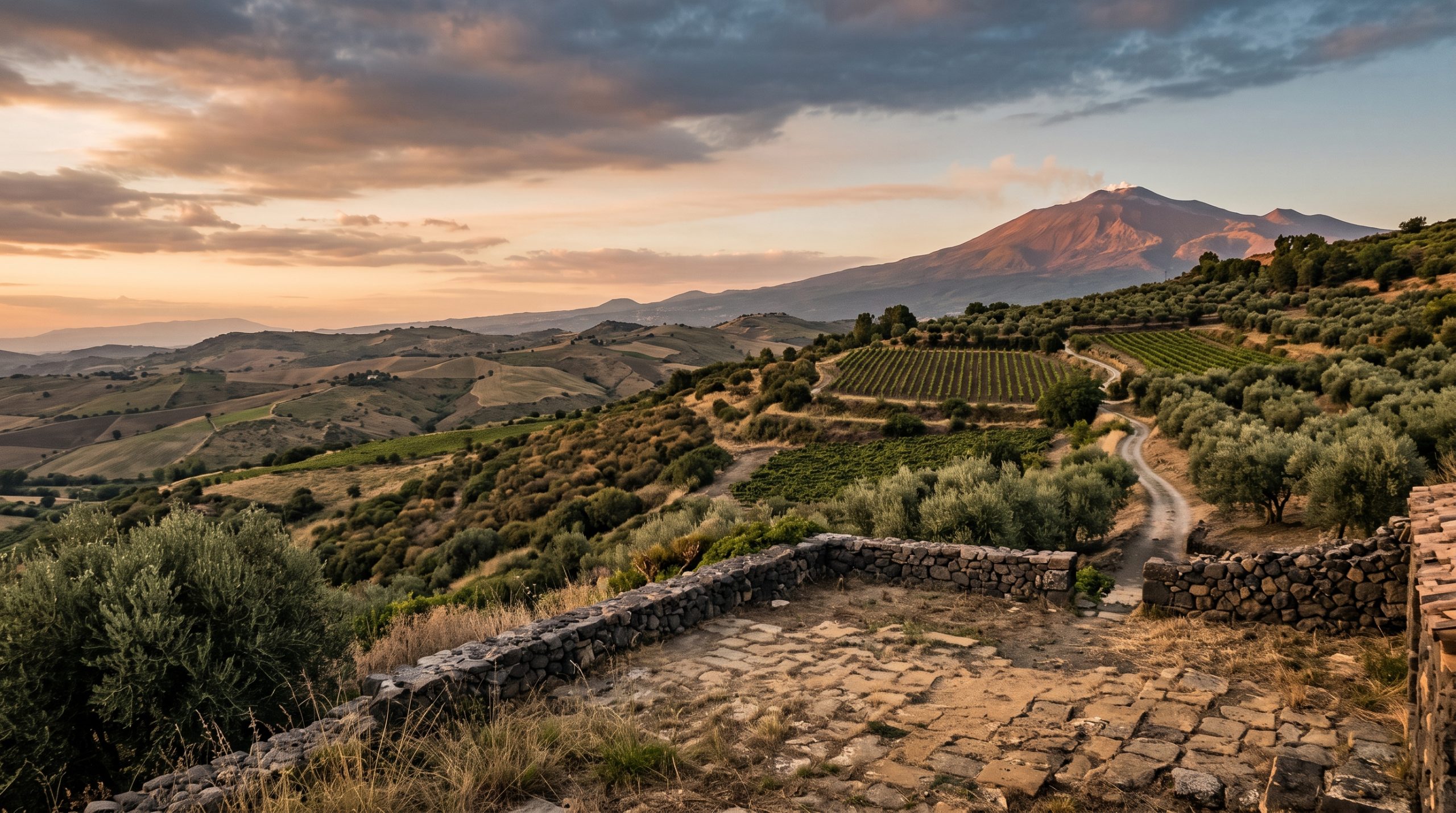
In late June the sun comes up over the Ionian off Taormina at about 5:37 in the morning. The Villa Comunale, the terraced garden Lady Florence Trevelyan laid out above the town after she settled here in 1884, opens its gate at eight. Two and a half hours of the best light on that coast happen behind a locked railing, and no amount of paperwork changes it.
That gap is the honest introduction to symbolic ceremonies in Sicily. The legal side asks nothing of you at all. No registry office, no sworn declaration, no consulate appointment, no Italian interpreter standing at your shoulder. What the island does ask about is the ground you want to stand on and the hour you want to stand there, and those two questions carry the entire planning job.
We work with couples who marry quietly at home and bring the ceremony here, and the pattern repeats. The legal marriage takes an afternoon in a county office. Permission to hold twenty minutes of vows in one specific place in Sicily, at one specific hour, is the part worth starting early. Both halves are set out below.
Where a symbolic ceremony sits in Italian law
A symbolic ceremony has no legal standing in Italy, and that is exactly why it works. There is no nulla osta, no atto notorio, no town hall appointment and no interpreter. You marry at home, then hold the ceremony in Sicily in any language, at any hour, wherever you have permission to stand.
Nothing to file, and the one thing to secure
As destination legal questions go, this one is straightforward. It is the easiest ceremony in Italy to arrange, because in the eyes of the Italian state nothing is happening: no register is opened, no officer of civil status attends, no certificate is issued. The difficulty has not disappeared, though. It has moved from a registry office to a landowner, a town hall property desk or the authority that runs a ticketed site, and those offices work to their own calendars.
Here is the order we work in with couples marrying at home and holding the ceremony in Sicily.
- Marry at home, on your own timing. For American couples that means a license from the county clerk in the county where the ceremony takes place. Each state sets its own waiting period and its own expiry window, and that is the only genuinely date-sensitive item in the whole plan, so check it with the clerk’s office rather than with a summary online.
- Order a certified copy of the marriage certificate. Nobody in Sicily will ask to see it. You will want it for a name change, for insurance and for the bank, and it is much easier to request while you are still in the same country as the office that holds it.
- Choose the ground before you fix the hour. Permission attaches to a place, not to a date, and the place decides how long the answer takes. A private estate can confirm in a week. A municipal garden on a hilltop in high season will not.
- Work out who actually governs that ground. A masseria outside Noto or a vineyard on the northern flank of Etna is a private owner and a single conversation. A public garden, a piazza or a town beach belongs to the comune. A ticketed archaeological site such as the Teatro Antico in Taormina is run by a regional authority, which is a separate office from the town hall, and a yes from one is not a yes from the other.
- Ask in writing, and get the yes in writing. Name the date, the hour, the number of people, whether there will be chairs, an arch or amplified sound, and how long you will be there. Vague requests sit in an inbox. Precise ones get answered.
- Book your celebrant. A professional celebrant, a bilingual friend or a family member can all lead a symbolic ceremony, in English, with no accreditation of any kind, because nothing is being registered.
- Set the hour last, against the light and the gate. This is where a timeline earns its keep, and it is the last decision rather than the first.
Aerial filming runs on the same logic. Registration and site permission come first, then we design the film around the window we actually hold, which is why we never promise you a shot before the permission exists.
Build the symbolic day around the Taormina light
Two timelines matter: the shortest one that genuinely works, and the one we would rather work to. On private ground, a symbolic ceremony can come together in six to eight weeks. On public ground in a town that receives serious visitor numbers, allow six months, and send the request before the summer rather than during it.
| Time before the date | What happens | Why then |
|---|---|---|
| 12 to 18 months | Ground chosen, date held with the team | We are booking 2027, 2028 and 2029, and the site shapes everything after it |
| 6 months | Written request to the comune, the estate or the site authority | Municipal answers travel at municipal speed, and Italian public offices thin out around Ferragosto on 15 August |
| 3 months | Celebrant confirmed, timeline drafted against sunrise and sunset for your exact date | Sunset in Taormina moves from 20:24 in late June to 19:00 by 20 September |
| 6 to 8 weeks | Home marriage license researched, courthouse date set | Some states expire a license in a matter of weeks |
| 2 weeks | Opening hours and permission reconfirmed in writing | Summer and winter hours differ, and staff who answered in March may not be the staff on duty in October |
| The week of | Final timeline issued with light times, drive times and a weather alternative | Sicily’s coast road and the hairpins above it are slower than any mapping app believes |
The six-month version is what we plan to. It leaves room for one office to be slow without anything else moving, and it means the ceremony hour is chosen for the light rather than for whatever slot is left. Our planning fundamentals for eloping cover the parts of that sequence that apply anywhere, not just here.
Hours, gates and getting a yes in writing
This is the section competitors skip, because it is unglamorous and it is where the day is actually won. None of it is difficult. All of it is easy to miss from six thousand miles away.
The gate opens after the light does
Taormina’s Villa Comunale costs nothing to enter and opens at eight in the morning, closing at midnight in summer and at eight in the evening in winter. Read those hours against the sun and the planning writes itself. In late June, sunrise is around 5:37 and sunset around 20:24, so the garden is useless to you at dawn and glorious in the evening. In mid-October the sun sets at about 18:15, comfortably inside opening hours. By early November it is down before five, and a garden that stays open until eight is offering you three hours of darkness. For a sunrise ceremony we use open ground instead: a terrace, the coast road, the ridge that looks back at the town.
Two offices on one hilltop
Taormina publishes its civil wedding tariffs as two separate sheets, one for Italian residents and one for foreign couples, on the comune’s own website. That is worth knowing even though you are not having a civil wedding, because of what happens when a request is worded loosely. Write to a town hall asking about a wedding and your email lands on the civil ceremony desk, which replies with a tariff sheet and a document list you do not need. Write that you are planning a short symbolic ceremony with no registrar, for a named number of people, and the request goes to the office that handles use of municipal space, which is the office that can say yes.
Money moves before the day, not on it
Where a fee applies for the use of a public space, it is normally paid in advance and the receipt forms part of the permission. Nobody arrives at a gate with cash and a smile. Build the payment into the plan four to six weeks out, keep the confirmation, and bring a printed copy with you, because the person on the gate at 7am is not the person who signed the authorization. Administrative charges and deadlines change, so re-check the current numbers with the office handling your application before you commit travel.
The last Sunday in October
Italian clocks go back on the last Sunday of October, and an evening ceremony planned in the spring can quietly lose an hour of usable light. If your date sits in the final week of October, we build the timeline on the clock that will actually be running.
Wind, and the fifteen-minute alternative
The Ionian coast below Taormina can be still at seven in the morning and busy with wind by eleven. We build the coastal hour around the forecast direction and hold a sheltered option nearby, usually a walled garden, a lemon terrace or the lee side of the bay at Giardini Naxos. Vows read into a headwind are hard to hear and harder to record, so on days with a filmmaker and professional audio we simply move the ceremony to the sheltered side and keep the exposed ground for the walk afterwards.
The old town does not let you drive to the door
Corso Umberto is a pedestrian street and vehicles stop at the edge of the historic centre, so the last stretch to most Taormina locations is on foot, in whatever you are wearing. It is roughly an hour from Catania airport to the town, then a walk. We put that walk in the timeline as its own line rather than absorbing it into a drive time, because it is the single most common reason a carefully planned first-light start begins twenty minutes late.
If you would rather the marriage itself happened in Italy
Plenty of couples do want the legal act on Italian soil, and it is entirely achievable. It is simply a different project, and it helps to see the whole shape of it before choosing.
For American citizens the U.S. Embassy in Italy sets out the chain. You need a valid U.S. passport, a birth certificate as an original or certified copy, and evidence of the termination of any previous marriage. You need an atto notorio, a declaration sworn by two witnesses who are over 18, hold valid photo identification and know you personally, and who cannot be family members. That declaration is made before an Italian consul outside Italy or, inside Italy, before a court official. The Embassy’s own advice is to obtain it at the nearest Italian consulate in the United States before you fly, because some Italian courts have long waiting lists for the service.
Then, in Italy, you swear a dichiarazione giurata before a U.S. consular officer and have it legalized by the legalization office of the Prefettura. With those in hand you make the Declaration of Intention to Marry at the marriage office of the town hall where the ceremony will take place, bringing an interpreter if you do not speak Italian. The ceremony itself is performed by the mayor or a deputy, with two witnesses of any nationality who are over 18 and carry photo identification, and an interpreter if one is needed. Afterwards you obtain the apostille on your Italian marriage certificate so it travels home with you. Italian consular guidance also asks for birth certificates to carry an apostille and an Italian translation.
One detail matters more than any of the individual steps. The Embassy notes that town halls interpret the rules in slightly different ways and may waive certain requirements, and it points you to the registrar’s office of the specific comune for the definitive document list and the deadline for submitting it. Two comuni forty minutes apart in Sicily can hand you two different lists, and the one that governs your marriage is the one where the ceremony happens.
The real trade is geography. A legal civil ceremony takes place in the town hall or in a location the comune has formally approved for the purpose, which in Sicily means a set of handsome municipal rooms, a handful of authorized villas and very few cliff edges. Legal marriage buys you the certificate; a symbolic ceremony buys you the ground. Same-sex couples face a further point of fact: Italian law provides for civil unions between partners of the same sex rather than marriage, which is one reason marrying at home and holding the ceremony in Sicily has become the usual shape of these days rather than a compromise.
We plan photographs, film and logistics rather than give legal advice; the registry or your consulate should confirm the requirements that apply to you. Our destination elopement guides go further into how individual regions handle location access.
If you already know the month and roughly the coast you are drawn to, that is enough to start with. Send Us a Message and we will come back with what is realistic for that window.
Witnesses, the ceremony hour, and what stays with you
Everything we do around a symbolic ceremony is planning rather than filing. Destination and location design, the permission research, the logistics guidance, a custom timeline built around light and honest travel time, and a weather alternative held in reserve for every outdoor hour. Team travel is included worldwide, so flights and accommodation for the team assigned to you are not a line item you negotiate. Highlights reach you in 5 days and the full gallery or film in 3 weeks.
What stays with you: the legal marriage at home, any permit or site fees themselves, the celebrant, accommodation, and unusual transport if you want it, such as a boat out of Giardini Naxos or a 4×4 on the tracks above Zafferana Etnea. Guest count does not change our fee. It changes access, permits and the timeline, which is why we ask about it early.
The coordination point where having a photographer and a filmmaker from the same team genuinely shows is the ceremony hour. A symbolic ceremony has no fixed script and no registrar to keep time, so it can be placed exactly where the light is best and run exactly as long as it runs. One of us holds the wide frame while the other is close enough to catch the vows, nobody is negotiating position mid-sentence, and on an Expedition the audio is recorded properly rather than salvaged afterwards. You can see how Sicilian light behaves across a full day in our published elopement stories and films.
Coverage runs from a single day with one photographer or one filmmaker up to a multi-day Odyssey across more than one part of the island, and the experiences and pricing page sets out how each one is built.
Common questions
Do we need any paperwork for a symbolic ceremony in Sicily?
None for the ceremony itself. No nulla osta, no atto notorio, no declaration at a town hall, no translations and no apostille. The only documents in the plan are the ones from your legal marriage at home, and no one in Sicily will ask to see them. What you do need is written permission for the place, if it is not private ground you have hired.
Will a symbolic ceremony in Sicily be recognized back home?
No, and it is not meant to be. A symbolic ceremony creates no marriage anywhere. Your legal status comes entirely from the marriage you complete at home, before or after the trip, which is why most couples handle the courthouse quietly and treat the Sicilian day as the ceremony that counts to them.
Can a friend officiate our ceremony in Sicily?
Yes. Because nothing is being registered, no accreditation is required of whoever leads it. A friend, a parent or a professional celebrant can all do it, in English, with a script you write yourselves. If you want the ceremony to run to a rhythm that films well, we will send you a shape to work from.
Do we need witnesses for a symbolic ceremony?
Not legally. A civil marriage in Italy requires two witnesses over 18 with photo identification; a symbolic ceremony requires nobody at all beyond the two of you and whoever leads it. Many couples still bring two people, or ask us to sign a keepsake certificate that has sentimental value and no legal weight.
Can we have our ceremony on a beach in Sicily?
Usually yes, with the right permission, and this is one of the clearest advantages of the symbolic route. Legal civil ceremonies happen only in the town hall or in locations the comune has formally approved, and open sand rarely qualifies. A symbolic ceremony can be held on a beach where the comune or the concession holder has said yes in writing.
How far ahead should we request permission for a public site in Taormina?
Six months is comfortable, and requests sent before June travel faster than requests sent during the summer. Private estates are quicker and can often confirm within a week or two. The date you actually want is the variable that decides how early to start, not the paperwork itself.
Should we marry at home before or after the trip to Sicily?
Either works, and the choice is emotional rather than practical. Marrying first means you land already married and the ceremony is pure celebration. Marrying afterwards keeps the vows in Sicily as the first time you say them out loud, and turns the courthouse into a formality on a Tuesday morning.
What to settle first
Pick the ground, then the month, then the hour. Everything else in a Sicilian symbolic ceremony follows from those three decisions, and none of them require a lawyer, a translator or a single stamped document. Tell us the coast you keep coming back to, whether you want to be up before the light or standing on a terrace at sunset in September, and how many people will be there.
Everything with us runs in writing, at whatever pace suits you. Send us your dates and you will have a reply and an initial brochure within 24 hours, then a tailored proposal, then a contract and a 30% retainer when you are ready to hold the date. Planning starts the moment that is done. Start Your Story.