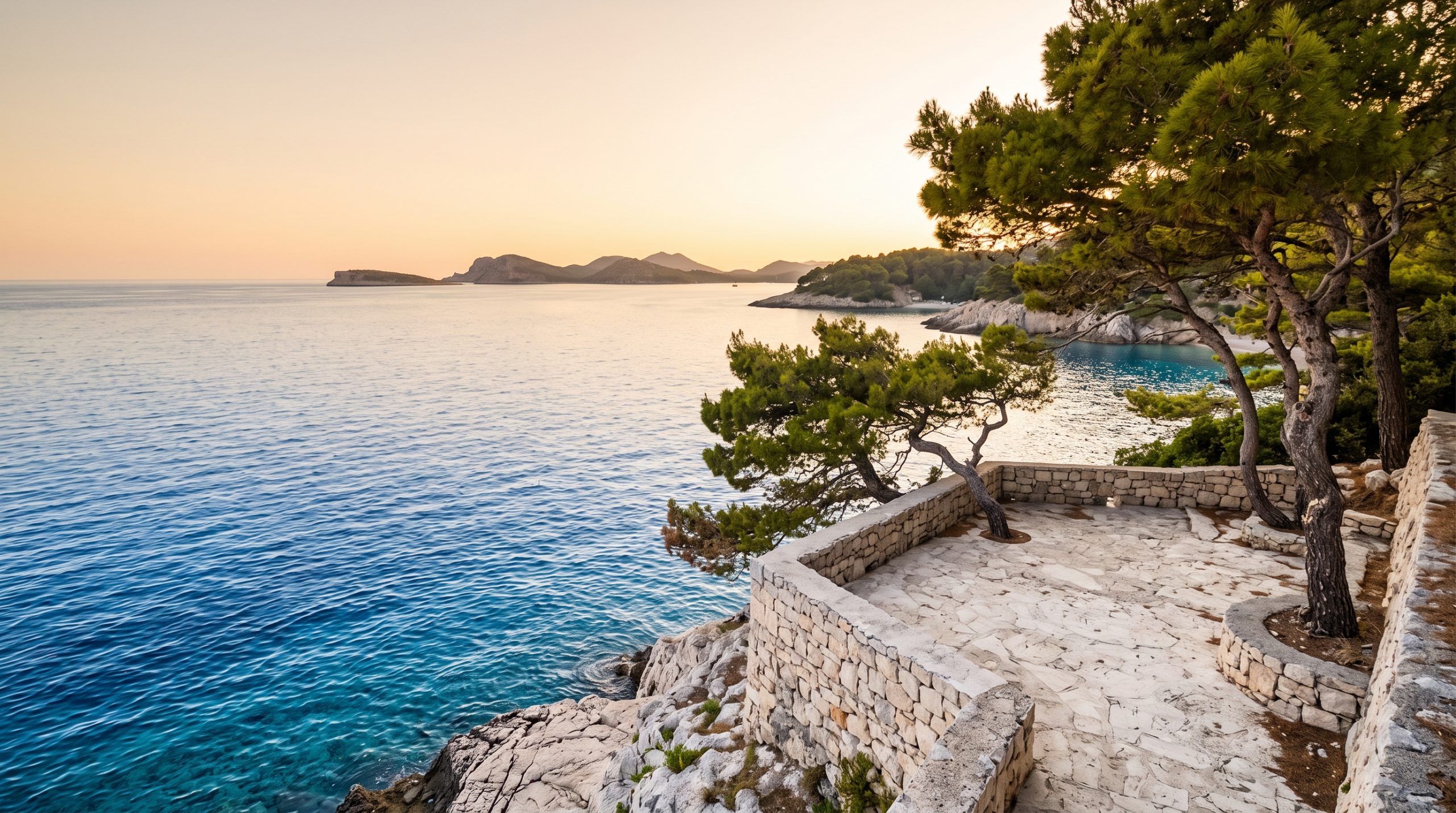
In late June the sun clears the ridge behind the Dalmatian coast just after five in the morning, and for the next half hour the water below goes the color of tin and then of apricot. That is the hour couples fly here for. No registrar in Croatia is going to meet you in it.
Which is the practical reason most couples who elope on this coast hold a symbolic ceremony. Vows, rings, someone they love reading a few lines, on ground they picked, at an hour they picked. The legal marriage happens at home, at a county office, in about ten minutes, often before the flights are booked. Croatia gets the part they will remember.
Below is what that actually costs, what it cannot do for you, and what changes if you decide you want the marriage itself to happen in Croatia. That route is entirely possible. It also runs on a 30-to-45-day clock, and that clock is what reshapes travel plans.
What it costs and what it cannot do
A symbolic ceremony in Croatia carries no legal weight and no state fee, so nothing is filed and nothing is charged by the government. You choose the hour, the ground and whoever leads it. Couples who want the marriage recognized sign the paperwork at home first, then hold the ceremony here.
The symbolic route is simple; the legal route carries the paperwork
On the scale of destination paperwork, a symbolic ceremony in Croatia sits at the very easy end. There is no notice period, no document chain, no interpreter requirement and no office hours to work around. What you need is permission to stand where you want to stand, and someone to lead the words.
The legal Croatian marriage is a different animal, and it is worth understanding even if you never use it. Marriage in Croatia is entered into before a registrar, the matičar, at the office for the district where the ceremony takes place, or before an officiant of a religious community that has a formal agreement with the state. Nobody else can create a marriage here. You give notice of your intention to marry in person at that office, and the ceremony date is then set for a point between 30 and 45 days after the notice.
Read that again, because it is the fact that rearranges itineraries. The notice is in person and the date sits at least a month later. For a couple flying in from Denver, that means two trips to Croatia, or a stay of five weeks and change. Published guidance varies on how early to make contact, and the Ministry of Foreign and European Affairs suggests reaching the office three months ahead. The office that actually sets your date is the local registry office, and its window is the 30-to-45-day one.
None of which makes the civil route a bad idea. Couples who are already spending three weeks in Europe, or who have family in Croatia, take it every year and enjoy it. It simply does not fit a nine-day trip built around one sunrise on Hvar. That is the whole reason the symbolic ceremony exists as a category, and it is not a compromise: the vows are the same vows, said in better light, with nobody watching the clock but us. Our guide to how eloping actually works covers the sequencing in more general terms.
If a 5am start is not your idea of a good morning, say so early. There is a gentler shape to the day that runs on late afternoon and dusk instead, and in late September the light is gone by about 6:40pm, which makes for a civilized schedule and a warm sea.
The symbolic day, line by line
The government line on your budget is zero. No registrar, no administrative fee, no off-premises charge, no sworn translation per page, no apostille to buy. That is the largest practical difference and it is worth saying plainly.
What does cost money is the ground and the people. Permission comes from whoever manages the place: a town office for a public square or a promenade, a park authority inside a national park, an abbey or a monastery for a courtyard, an owner for an olive terrace or a private cove. Some say yes for nothing, some charge a site fee, some want the request weeks ahead in writing. National parks add entry tickets for everyone in the group, ourselves included, and those are set season by season, so we confirm the current rate with the park before the timeline is fixed.
Someone has to lead it. A friend or a sibling can, and many of the best ones we have stood in were led by a brother who was visibly nervous for the first thirty seconds. Independent English-speaking celebrants work up and down the coast and set their own private fees. Either way, ask for the running order in advance so the ceremony lands inside the ten or fifteen minutes when the light is doing what you came for, rather than at whatever time everyone happened to be ready.
Then there is getting there. A cove on the far side of Vis, a Kornati islet, a headland on Pelješac at first light: those days need a boat with a skipper willing to leave the harbor at four in the morning, or a 4×4 up a track no rental car should attempt. That transport is booked in your name and paid by you, and it is usually the single biggest line after coverage. The upside is total control of the hour. You can see how the coast reads at that hour in our published galleries and films, which is a more useful answer than any description we could write here. If you are still choosing between islands, the destination guides are the place to start.
The Croatian civil file, in the order you collect it
If you do want the legal marriage in Croatia, this is the chain, in the order it has to happen. American couples have the best documented route of anyone, because the Embassy in Zagreb publishes its half of it. If your passport is from somewhere else, the equivalent documents carry different names, and your own consulate is the office that names them.
- A fresh birth certificate for each of you. For American couples the US Embassy in Zagreb is explicit that it must be a new copy issued within the past 90 days. The copy in your filing cabinet from 1994 will not do. It must show both parents.
- An apostille on each certificate. This comes from the Secretary of State of the state that issued the document, before you travel. US embassies and consulates cannot apostille American documents, so this is a mail-out you start early. The apostille goes on before translation, because the translator translates it too.
- Proof that you are free to marry. Croatian consular guidance asks for a certificate of no impediment, original and apostilled, and not older than three months. For US citizens the working equivalent is the Marriage Affidavit sworn in front of a consular officer at the Embassy in Zagreb. Download and complete the form but do not sign it: you sign in the officer’s presence. Appointments only, and the notarial fee is currently 50 US dollars, payable in cash or by card.
- Authentication of that affidavit inside Croatia. The Embassy’s affidavit then has to be authenticated by the International Legal Assistance Service of the Croatian Ministry of Foreign and European Affairs, at Trg Petra Petretića 2 in Zagreb. Two stops, two parts of the city, one working day if you plan it.
- Proof that any earlier marriage has ended. A divorce decree is the usual document, apostilled the same way and then translated by the same court interpreter.
- Sworn Croatian translations of everything. Translation must be by a court interpreter, in the UK by a Croatian interpreter from the consular list or in Croatia by a certified court interpreter. A fluent friend cannot do this, and a cheap online translation without the interpreter’s seal comes back to you.
- Notice of intention to marry, in person, at the registry office. The e-Citizens online route exists but is built for Croatian citizens marrying in official premises. You also confirm your two witnesses here: any adults with full legal capacity, and consular guidance lists a copy of the photo page of each witness’s passport, so collect those in advance.
- A court-appointed interpreter for the ceremony itself. The ceremony is conducted in Croatian. If neither of you speaks it, an interpreter must be present and the cost is yours.
Two fees are fixed nationally and they are almost comically small: 9.29 euros for drawing up the record of your intention to marry, and 18.58 euros for the ceremony before the registrar, 27.87 euros in total. The first copy of the marriage extract, the izvadak iz matice vjenčanih, carries no administrative fee because it is issued ex officio. If you want a church ceremony with civil effect, the registrar issues a certificate confirming you meet the requirements, and that certificate is valid for three months from the day it is issued. Use the quoted fees and timings as planning guidance, then confirm the live figures with the issuing authority before submitting anything.
Counting back from the ceremony date
The real minimum between giving notice and standing in front of a registrar is 30 days. The comfortable minimum is 45, because that end of the window means you choose the date rather than accept whatever the diary has left. We plan to the 45-day end every time.
| Step | What the rules allow | What we plan to |
|---|---|---|
| Order fresh birth certificates and proof you are free to marry | Under three months old when the office receives them | Ordered 10 to 12 weeks out, so a reissue still fits |
| Apostille from the issuing authority | Any time after the certificate is issued | The same week the certificates land |
| Sworn Croatian translation | After the apostille, never before it | Six to eight weeks out |
| Marriage Affidavit in Zagreb, then authentication at the Ministry | By appointment, both in Zagreb | One dedicated Zagreb day at the front of the trip |
| Notice of intention to marry, in person | 30 to 45 days before the ceremony | The 45-day mark, in the district where you will marry |
| Approval and charge for a ceremony outside official premises | Agreed with the office when you give notice | Confirmed in writing at that same visit |
For a symbolic ceremony, the equivalent table has two rows: permission for the ground, and the boat or the vehicle that gets you there. Both are usually settled two to three months out, and neither cares what day of the week you have chosen.
The details that decide whether the file works
These are the six things that come up again and again. None of them are hard. All of them are easier to fix three months out than three days out.
- The 90-day birth certificate. It is the requirement people are most surprised by, and it means ordering new copies specifically for this, not digging out old ones. Build in time for a second attempt if the state sends the wrong version.
- Apostille first, translation second. A sworn translation of a document that has not yet been apostilled leaves the apostille untranslated, and the file goes back for a second translation.
- The unsigned affidavit. Signing the Embassy’s Marriage Affidavit at your kitchen table voids the point of it. It is signed in front of the consular officer, and it is not finished until the Ministry has authenticated it.
- The charge for marrying outside the office. Croatia’s Ministry of Justice sets this as a special charge on top of the two administrative fees, and its size depends on how far the location is from the official premises, the time of the ceremony, and whether it falls on a Sunday or a public holiday. A remote clifftop at seven on a Sunday evening is the most expensive version of the same ceremony. Ask for the figure in writing when you give notice.
- Who your two witnesses are. A civil marriage needs two adults with full legal capacity present, with identification on the day. On a genuine two-person elopement that question has to be answered early rather than the night before.
- The EU passport shortcut. Under EU Regulation 2016/1191, public documents issued between member states on multilingual standard forms need no legalization and no translation. If one of you holds an EU passport and the paperwork comes from an EU state, ask specifically for the multilingual standard form and a large part of the chain disappears.
If you know your date, or you are weighing two islands and want to know which one gives you a sunrise ceremony without a 4am boat, write to us with what you have so far and we will tell you what the day would actually look like. Check Your Date.
What we plan, and what stays with you
Treat this as a planning map, not a legal opinion. The office issuing the documents remains the source of truth for your case. What we do is everything around that: destination and location design, a timeline built on real travel time and the hour the light works, permit research and logistics guidance, and a weather alternative held in reserve for every location. If you are marrying legally in Croatia, we hold your date against the registry office’s availability rather than assuming it, and we place the ceremony hour where the light is, not where the diary defaults to.
That last part is why we send a photographer and a filmmaker as one team rather than two bookings that meet at the trailhead. A symbolic ceremony often runs eight minutes. With both cameras on the ground and a shared timeline, those eight minutes get covered from two positions at once, with vow audio recorded where conditions allow, and nobody asks you to say anything twice. Highlights reach you five days after the day, and the full gallery or film three weeks after.
Coverage runs from one full day with a dedicated photographer or filmmaker at $4,900, or both of them working together from $7,900, and the full breakdown of what each experience includes is on one page.
Common questions
Is a symbolic ceremony in Croatia legally binding?
No. A marriage in Croatia is entered into before a registrar, or before an officiant of a religious community that has a formal agreement with the state. A celebrant, a friend or a family member leading your vows creates no legal marriage, which is why most couples sign at home first and treat the Croatian ceremony as the ceremony.
How much does a symbolic ceremony in Croatia cost?
Nothing goes to the government, because no government office is involved. Real costs are permission or a site fee for the ground you use, national park tickets where they apply, anyone you hire to lead it, unusual transport such as a boat or a 4×4, and your photography and film coverage.
Do we need witnesses for a symbolic ceremony?
No. Two witnesses are required for a civil marriage before a Croatian registrar, and they must be adults with full legal capacity carrying identification. A symbolic ceremony has no witness requirement at all, so a two-person elopement really is two people plus us.
Can we legally get married in Croatia on one short trip?
Not comfortably. Notice of your intention to marry is given in person at the registry office for the district, and the ceremony date is then set between 30 and 45 days later. That means two trips or a stay of over a month. Couples on a one-week trip almost always marry at home and hold the ceremony in Croatia.
How recent do our documents have to be?
The certificate proving you are free to marry should be no more than three months old, and the US Embassy in Zagreb requires an American birth certificate to be a new copy issued within the past 90 days, carrying the apostille of the issuing state. Order both with the ceremony date in mind.
Do we need a translator at a Croatian civil ceremony?
Yes, if neither of you speaks Croatian. The ceremony is conducted in Croatian and a court-appointed interpreter must be present, at your cost. Your documents also need translating by a sworn court interpreter. A symbolic ceremony needs neither, and runs in whatever language you want.
Can same-sex couples have a ceremony in Croatia?
A symbolic ceremony, yes, anywhere you have permission to be. Croatian marriage is legally defined as a union between a man and a woman, while life partnership has been registered before a registrar since the Life Partnership Act took effect in 2014, with the same 30-to-45-day notice and the same administrative fees. In practice, couples we work with formalize things at home and hold the ceremony here.
Where can we hold a symbolic ceremony in Croatia?
Anywhere the person who manages the ground agrees to. Olive terraces above Hvar, a cove reachable only by boat, a headland on Pelješac, a stone courtyard in Trogir, a national park with written permission and tickets. Sunrise is almost always easier to secure than sunset, because nobody else is asking for it.
Choose the hour first, the paperwork second
Decide where you want to be standing and at what time of day, and the legal question answers itself: if the answer is a clifftop at 5:15 in the morning, you are having a symbolic ceremony, and that is the right call. We are booking 2027, 2028 and 2029, and everything from here happens in writing, at whatever hour suits you. Send the form, and you will have a reply and an initial brochure within 24 hours, then a tailored proposal; planning starts once the contract is signed and a 30 percent retainer is paid. Tell Us Your Story.