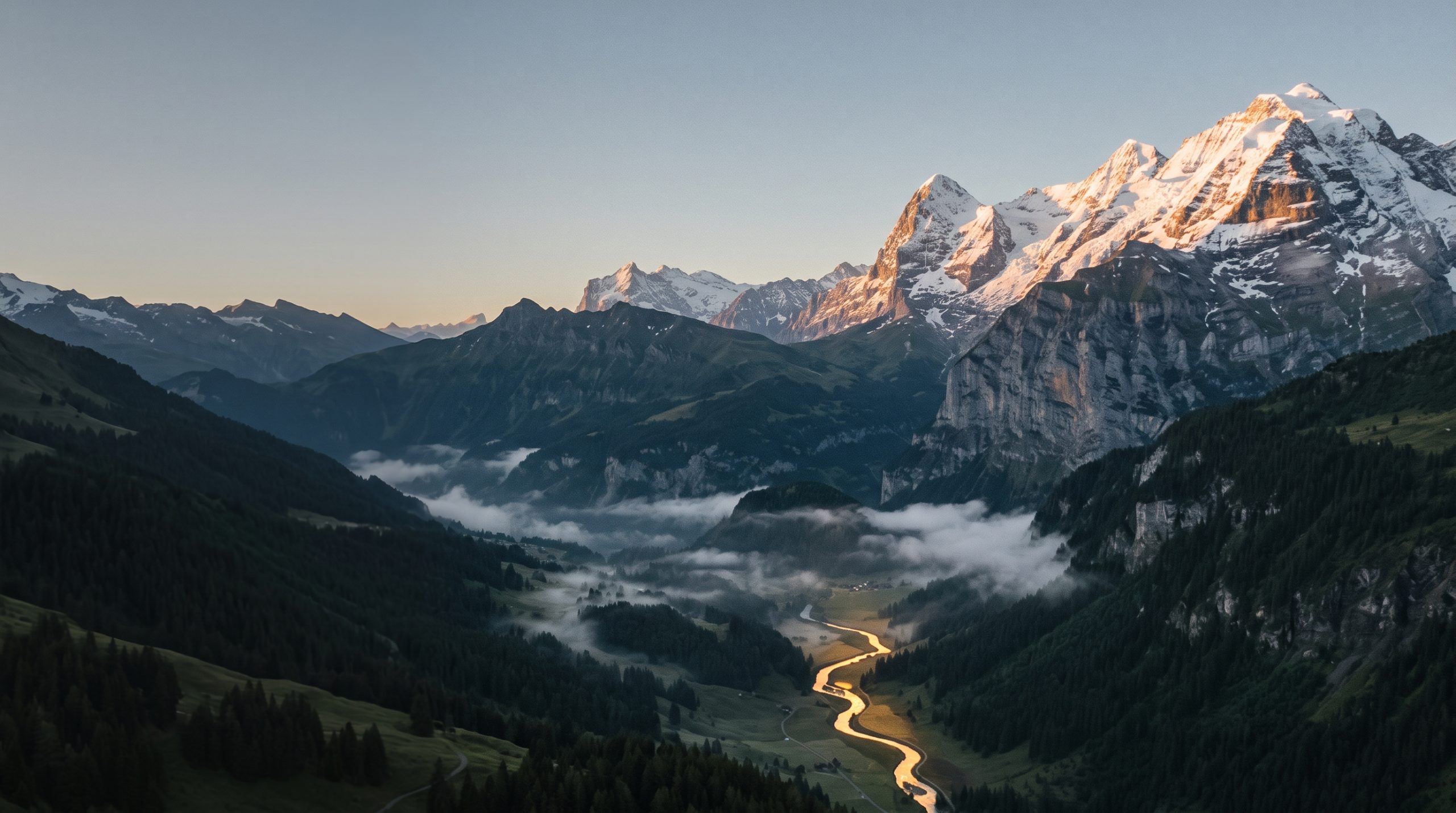
In the third week of June the sun comes up over Lauterbrunnen at about 5:35 in the morning and stays up until roughly 9:25 at night. The first cable car out of Stechelberg toward the Schilthorn leaves around 7:25. Those two clock times, most of two hours apart, shape a Swiss Alps wedding film more than any decision about cameras or edit style.
They also explain why the valley floor earns its place in the plan. Lauterbrunnen is a trench with cliffs on both sides and 72 waterfalls coming off them, Staubbach dropping 297 meters from a hanging valley in one unbroken fall. Official sunrise is not the moment light lands down there. The peaks go warm first, the walls hold their shade, and the meadows keep a cold blue for a long while afterward. That gap is a gift if you plan for it and a nuisance if you arrive expecting warm light at 5:35.
Over the ridge, Grindelwald station sits at 1,034 meters, 19.4 rail kilometers from Interlaken Ost, and by mid-morning the trains climbing out of it are full. We have stood at the famous viewpoints at ten in the morning in July. The light is flat, the foreground has people in it, and the same ground at half past five is empty and barely recognizable. Timing is most of the work here.
Where coverage starts in these valleys
We photograph, film and plan elopements across the Bernese Oberland and Valais as one eight-person team. One full day with a dedicated photographer or a dedicated filmmaker starts at $4,900, with team travel, planning, permit research and a timeline built around the light included. Highlights reach you in five days.
First light before five, sunset after nine
A June day in the Bernese Oberland hands you two good windows and a long bright middle that flatters nothing. We build for the windows.
The first one opens in the dark. Twilight is already working on the valley floor before five, and that is the hour for the things which only exist down there: mist coming off the Weisse Lütschine, the walls still black above you, the waterfalls loud because nothing else is making any noise. Vows at that hour tend to be the steadiest part of the day, because there is nobody within a kilometer of you.
Then the light climbs. It reaches the summits first and takes its time coming down the cliffs, which is why the second half of the morning belongs up high, and why the lift timetable quietly takes over the plan. Cars leave Stechelberg roughly every half hour from around 7:25, the last ascent goes mid-afternoon, and the last car down from the summit runs in the early evening. A day that needs late light at altitude therefore does not commute to it. It sleeps up there, in Mürren or Wengen or at Kleine Scheidegg, villages you reach by train or cable car rather than by car, so the morning starts on the ridge instead of ending there.
Zermatt runs on a different rhythm because the Gornergrat railway does. It works all year from early morning until after sunset, and on set dates in the season it runs a guided sunrise departure with the carriage lights switched off, which is the only scheduled way we know of to be high above a Swiss valley before the sun without walking up through the night. Getting off at Findelbach, Riffelalp, Riffelberg or Rotenboden lets us pick an altitude on the morning itself rather than a week ahead, and Rotenboden puts the Riffelsee within a short walk, where the Matterhorn shows up twice, once on the skyline and once in the water. From the top of the ridge the count is 29 four-thousand-meter peaks, with the Gorner Glacier lying underneath them.
Evening is the other window and in June it is generous. Sunset near 9:25 means you can eat properly, let the valley empty, and walk back out into good light with an hour still in hand. Around 21 December the whole day is roughly 8.6 hours long, which sounds like a loss and often is not. Sunrise, vows and last light sit close enough together that nothing has to be hurried and nothing has to wait.
| Time of year | Daylight in the valley | How we shape the day |
|---|---|---|
| Around 21 June | About 15.8 hours, sunrise near 5:35, sunset near 9:25 | Two separate windows with a long break in the middle for the ceremony, food and the climb |
| Spring and autumn | Between the two extremes, with the sun clearing the ridges later in the morning | One continuous arc, ceremony in the middle, and more chance of snow on the tops with green in the valley |
| Around 21 December | About 8.6 hours | Everything inside a single window, warm rooms between the outdoor hours, headlamps on the walk in |
If your date is already fixed, that is the fastest thing to settle. Check Your Date and tell us which of those two windows sounds more like you.
When the peaks sit in cloud all morning
This is what couples write to us about before anything else, and it deserves an answer made of planning rather than comfort. High valleys make their own weather, and no photographer or filmmaker anywhere can promise you a clean summit at seven in the morning on a date chosen eighteen months earlier.
What we can do is build the day at three altitudes before you land. Valley floor, mid-station, summit. Cloud parked at ridge height very often means the cable car climbs straight through it and comes out on top, and some of the strongest work we have ever made in these valleys came out of mornings when nobody in the village could see the mountain at all. Cloud that sits lower flips the plan the other way: the waterfalls, the forest, the river and the old barns are what the Lauterbrunnen floor is genuinely good at, and flat light does no harm to any of them.
Then we keep the movable parts movable. A vow exchange can slide by three hours on the morning without anyone minding. A Swiss civil ceremony cannot, because it is a legal appointment with two adult witnesses, conducted in the local language, inside a window that opens ten days after the registry office authorizes the marriage and closes three months later. So we hang the legal part and the filmed part on separate hooks, which is one of the first things we work out with you. Our notes on how to plan an elopement go through the sequence of paperwork and date-setting in more detail.
One more thing worth saying plainly: moving cloud is usually better on film than a cloudless sky. It gives the edit something to do.
Two cameras in the ninety minutes that matter
At altitude the good part of the morning is short. Between the moment there is enough light to work with and the moment the first public car unloads at the top, you might have ninety minutes. One person working alone in that window is constantly choosing: the wide frame with the light landing on the face of the mountain, or the close one where your hands are shaking slightly as you read what you wrote on the plane. Both matter. Only one of them gets taken.
On the Expedition, a dedicated photographer and a dedicated filmmaker work the same window together, which means neither has to choose. The light comes down an alpine face fast, in something like four or five minutes from the top of the ridge to the meadow. The filmmaker holds that move in a wide, locked frame while the photographer stays a meter from you. Nobody sprints between the two jobs and nothing is reconstructed afterward, which you cannot fake in an edit.
Wind is the other reason the pairing pays for itself up here. Ridges above Mürren and Zermatt are rarely still, and wind is what ruins vow audio. The Expedition carries professional audio for vows and the moments that matter where conditions allow, and having a filmmaker on the ground during planning means the ceremony spot gets chosen for the wind shadow as well as the view, often ten meters off the obvious place, with the photographer working the open side. That is a decision made at 6am by someone whose job it is, not a compromise found later.
Aerials work the same way. Switzerland has applied the European drone rules since 1 January 2023, so operators register, sit an online test and fly inside the open category, and the geographic restrictions genuinely differ from one valley to the next. We confirm the airspace and the time window before any part of a film depends on a drone, and we design the sequence so it stands up if the answer for your spot is no. Ground permissions run on the same logic: there is no national filming license in Switzerland, authority sits with the canton and the commune, and small handheld work is usually straightforward where tripods, lighting and larger crews are not. So we keep the kit on the ridge small on purpose and put the paperwork effort where it actually buys something.
Behind all of that there are eight of us, which is the unglamorous part of the answer. There is always a second camera already on the ground and a colleague in reserve, and the people who plan your day are the people who shoot it. The films and galleries on our stories page are the clearest way to see what one photographer and one filmmaker produce out of the same alpine hour, cut together rather than collected separately.
What travels with us, and what lands after
Every experience, at every level, includes all of this:
- Destination and location design, and a custom timeline built around light and real travel time, which in these valleys means lift departures rather than driving times
- Permit research and logistics guidance for the communes and cantons your day touches
- Weather alternatives and backup planning at more than one altitude
- Drone footage where it is legal, safe and appropriate
- Professional audio for vows and meaningful moments on the Expedition, where conditions allow
- Team travel worldwide: flights, accommodation and ordinary travel for the assigned team, with no European or long-haul distinction
- Highlights in 5 days, and the full gallery or film in 3 weeks
Those two delivery windows are dates, not hopes. The highlights land while you are probably still in Switzerland, which is deliberate, and the full set arrives three weeks after the day whether you eloped in Wengen in February or on the Gornergrat ridge in August.
The francs that go to someone other than us
One full day with a dedicated photographer and a dedicated filmmaker working together is the Expedition, from $7,900. One full day with one or the other is the Adventure. Two to seven days, in one valley or several, is the Odyssey, built as a custom proposal. All of it, including what each level covers, sits on the pricing page.
Team travel is inside that figure. There is no Switzerland surcharge, no long-haul supplement and no line for flights or our accommodation, in this destination or any other. Guest count does not change the fee either. Two of you or twelve, the number changes access, permits, transport and the timeline rather than the price.
What you pay to other people is worth setting out honestly, because Switzerland is not a cheap country to stand in. A civil ceremony, documents included, runs roughly 300 to 400 francs, and a Saturday or a venue outside the registry office pushes that up. Mountain railway and cable car tickets are priced per person and per section, so the number of ascents in the plan matters more than the distance. Nights up high, in Mürren, Wengen or on the Gornergrat, cost what mountain rooms cost. Add your celebrant, and any fee a commune charges for the permission we secure on your behalf. For anything airborne, Air Zermatt publishes a return flight to Testa Grigia from its Zermatt heliport at 140 francs per person, and private flying is quoted on request. The franc currently sits a little above the dollar, so read those franc figures as slightly more than the same number in dollars.
How a Swiss film enquiry moves into planning
- Send the inquiry form with your dates, your valleys if you have picked any, and what you actually want the day to feel like
- We reply within 24 hours with an initial brochure
- We build a tailored proposal around your date, the light it gives you and the access it allows
- Contract signed and a 30% retainer paid
- Planning begins: locations, timeline, permit research, weather alternatives, travel logistics
- The day itself, then highlights in 5 days and the full gallery or film in 3 weeks
The rest of the payment schedule is set out in the proposal, so you see it before you commit to anything. Dates are currently open across our 2027, 2028 and 2029 Switzerland seasons.
Common questions
Do we have to marry legally in Switzerland, or can we marry at home first?
Both work. A civil ceremony at a Swiss registry office is the only legally binding form here, it needs two adult witnesses, and it happens no sooner than ten days after the office authorizes the marriage and no later than three months after. If both of you live abroad, the office where you plan to marry runs that preparation, and it can be started through a Swiss embassy or consulate. Plenty of couples instead marry at home and treat the alpine ceremony as their vow exchange, which frees the date to move with the weather.
How much does the Swiss civil ceremony itself cost?
Around 300 to 400 francs including documents, with more for a Saturday or for a location outside the registry office. Allow one to three months for document checks if either of you is a foreign national, and longer if anything needs verifying through an embassy.
Can you fly a drone for our film in the Alps?
Often, and never as an assumption. Switzerland has applied the European rules since 1 January 2023, which means operator registration, an online test and flying inside the open category, and the geographic restrictions change from valley to valley. We check your specific locations during planning, and we build the film so it works either way.
What happens if the mountains are in cloud on our date?
We move within a plan that already has three altitudes in it. Cloud at ridge height usually means the lift takes you above it. Cloud lower down sends us to the waterfalls and forest on the valley floor, which look better in soft light anyway. The decision gets made the evening before and again at the trailhead, by us, with you told exactly what changes.
Do we really have to get up at four in the morning?
No, and some of our favorite Swiss days start late instead. June gives you sunset near 9:25 and a second window that is every bit as good as dawn, with the practical advantage that everyone has slept. Tell us which end of the day you actually want and we will build around it.
Can we book film only, with no photographs?
Yes. One full day with a dedicated filmmaker and no photographer is one of the two shapes the Adventure takes, and the planning, permit work and team travel are identical. The coverage and pricing page lays out how that compares with having both.
How far ahead should we book a Swiss Alps date?
Dates are currently open across our 2027, 2028 and 2029 Switzerland seasons. If you want a specific room in a mountain hotel above the valley on a specific night, that room tends to set your date before we do, so it is worth naming it in your first message.
How quickly do we see the film?
Highlights in 5 days, the full gallery or film in 3 weeks. Nothing about that changes because your day happened on a glacier instead of a beach.
Who these valleys suit, and what to tell us
Switzerland rewards couples who are relaxed about a plan that moves on the morning, who do not mind an hour on uneven ground, and who would rather stand somewhere quiet at 5:30 than somewhere famous at ten. If a pre-dawn start is not your idea of a good beginning, say so in your first message and we will build the day around evening light instead. If steep ground is not for you, there is more than enough to work with on the valley floors and at the mid-stations. And if you want deep snow and empty trains, the answer is not summer at all, and we will tell you which months to look at.
All of it runs in writing, from your first message to the final timeline, so you can plan across time zones on your own schedule. Send us your date, your two or three must-haves, and one thing you are worried about. We will come back with what that morning realistically looks like in the light your date gives you. Tell Us Your Story