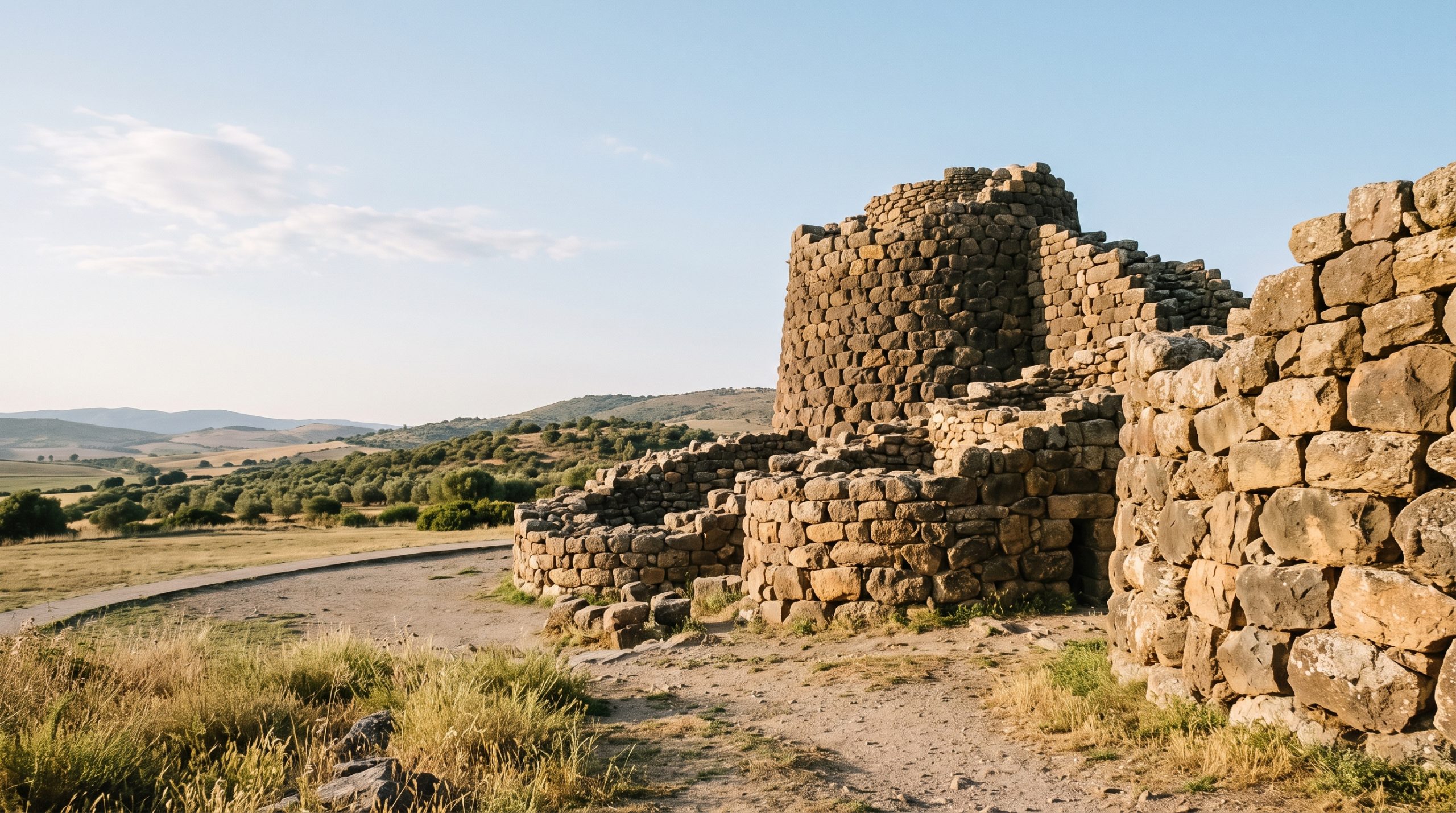
The doorway into the keep at Su Nuraxi is 2.07 metres high, and it faces due south. That one measurement decides more about a wedding day here than any view does. Barumini sits at nine degrees east, so the sun stands due south at around 1:25pm in summer, which means the single hour when direct light pours through that trapezoidal door is also the hour the minibuses from Cagliari are parked outside.
Stand on the outer wall at nine in the morning in mid-October and the sun is only fifteen degrees up, still in the southeast, and the village of round huts below reads as rooms and doorways rather than rubble. Come back at two in the afternoon in July and the most complete nuragic complex in Sardinia photographs like a heap of grey rock. Same walls. Four hours and one season apart.
So this is not a page about how handsome the tower is. It is about the three things that actually govern the day: an entry system that never lets you in alone, a sun that peaks at half past one rather than at noon, and a plain to the west that lines itself up with sunset around the equinox.
Every visit is accompanied, and that sets the shape of the day
Yes, you can marry beside this tower. The archaeological area opens every day of the year at 9am, but nobody walks it alone: guided visits leave every half hour and run about an hour. So the vows happen on ground held for you nearby, and the nuraghe becomes a booked chapter of the day rather than a venue.
An hour up from Cagliari, and the ground inside the walls
Su Nuraxi is on Viale Su Nuraxi, on the western edge of Barumini, about 63 kilometres by road from Cagliari. Reckon on an hour of driving, which puts an eight o’clock departure from the city at the ticket desk for opening. Public buses do run from Cagliari to Barumini twice a day, Monday to Saturday, taking around an hour and three quarters, and that is a fine way to see the site as a tourist and a poor way to run a wedding day.
The approach itself asks nothing of you. There is no trailhead, no climb, no scramble. The demanding ground is inside the walls, and it is Bronze Age basalt: uneven blocks, gaps, and places where you are stepping rather than walking. In wedding clothes that means one hand free for a hem the whole way round, flat soles you trust on rock, and the good shoes carried in a bag until you are back on level ground.
The keep is tighter still. You pass through that 2.07 metre door and a small entrance foyer into a round chamber 4.80 metres across, inside a tower with a base diameter of ten metres and fourteen metres of original height still standing. A tour group moves through it in single file. There is no room in there to arrange a train, and knowing that in advance is the difference between a lovely twenty minutes and a fussy one.
A door facing south, a sun that peaks at half past one
Almost every page about this place gets the light wrong, because it treats Italy as one time zone and leaves it there. Barumini is far enough west inside Central European Time that solar noon lands close to 1:25pm through the summer, and on the solstice the sun is 74 degrees up when it gets there. That is the moment the south-facing doorway of the keep fills with direct sun. It is also the flattest, hardest light of the day, straight down onto dry-stone basalt that lives or dies on texture.
The opening hour is what really matters, and it changes completely with the month. At 9am on the summer solstice the sun is already 32 degrees above the horizon and by ten it is 44. At 9am in mid-October it is 15 degrees up and sitting in the southeast, throwing every course of stone into relief. The first visit of an October morning and the first visit of a June morning are not the same experience, and no amount of skill closes that gap.
Evening is where the geography earns its reputation. The nuraghe was built on high ground looking west over a wide fertile plain, and around the September equinox the sun sets at an azimuth of 271 degrees, almost exactly due west, straight down that plain. By mid-October sunset has swung to 259 degrees and comes at about 6:45pm. In late June it goes down at 302 degrees, out over the north-western shoulder of the country, at nearly nine in the evening. Closing time here tracks the daylight, and the last guided visit starts an hour before the gates shut, so the low gold of a June evening belongs to the fields, the lanes and the plateau above rather than to the inside of the walls. In autumn the two things start to overlap, which is the single strongest argument for an October date.
Texture is the whole subject at Su Nuraxi. Raking light turns the bastion into masonry you can read, and the roughly fifty circular huts of the village into a settlement instead of a pattern. You can see how we handle stone, low sun and open country in our galleries and films, which is a more useful guide to what an October morning here looks like than any adjective we could write.
Half-hour tours, coach hour, and what arriving early really buys
Barumini is the standard day trip out of Cagliari, and the four-hour tours from the city are built around arriving here in the middle of the morning. Between roughly ten and four in high season, groups leave the ticket desk every thirty minutes and the site is genuinely busy.
Here is the part other pages will not tell you. Arriving early does not buy you an empty monument, because there is no version of this visit where you are alone with the stones. It buys you three real things: the first group of the day, a guide who is on their first tour rather than their eighth, and in the darker half of the year, low light. Where early is not enough, the answer is not an earlier alarm. It is a different month, or a different piece of ground for the part of the day that has to be private.
Room to work is the other consequence of a timed group visit. The crescent of courtyard around the twenty-metre well, and the top of the bastion, give you very little room to stand, and a photographer and a filmmaker who met that morning spend the hour stepping into each other’s frames. Ours have worked together for years and split the space by habit, one low and close at the doorway while the other holds the outer wall wide, then swapping without a word. Sound is the real constraint, because the mistral comes across the Marmilla from the northwest and there is nothing on this hill to break it, so vows recorded here get a sheltered position on the southern side of the bastion. A day with one photographer or one filmmaker starts at $4,900 and a day with both working as a pair starts at $7,900, with the rest set out on our pricing page.
Who decides what happens inside the walls
Su Nuraxi went onto the UNESCO World Heritage list in 1997 as the best-known example of the nuraghi, the Bronze Age tower complexes found nowhere else on earth. Its protection and promotion are entrusted to Fondazione Barumini Sistema Cultura, which runs the archaeological area along with Casa Zapata and the Giovanni Lilliu centre in the village on one ticket, currently fifteen euros for an adult, guided visit included. The rule that every visit is accompanied comes from ministerial provisions, not from local preference, which tells you plainly where the authority sits.
So anything beyond a normal accompanied visit is the Foundation’s decision to make, and it is asked for in writing, well ahead, by us. Permit research and logistics correspondence are part of what we do on every booking; fees payable to a government body, a venue or a landowner are yours to pay directly.
The marriage itself is a separate question from the monument. In Italy a civil marriage is celebrated by the mayor or by an official the mayor delegates, in a place that comune has approved, and once the publications are complete the ceremony has to take place within 180 days. That gives you two routes: a legal civil ceremony arranged with a comune, or vows you write yourselves held wherever the day works best, with the legal paperwork handled separately. Both are good answers. Our guide to planning an elopement walks through how the two fit together, and we ask which one you want early, because it changes which hour of the day we protect.
What we hold in reserve when the weather turns
The Foundation is straightforward about this: in weather that would not allow visits to be conducted safely, the archaeological area can be closed for a while. A timeline built here therefore always has a movable hour in it and an indoor anchor, and both are decided months before you fly.
Casa Zapata is the anchor. It is a sixteenth-century noble residence in the middle of Barumini, roofed, cool, and built over the top of another nuraghe that is preserved beneath its floors, and it is on the same ticket you already hold. It photographs nothing like the hill: dark timber and plaster instead of open basalt.
The other direction is up. The Giara rises abruptly behind the site to 550 metres, a basaltic plateau twelve kilometres long and about 45 square kilometres in extent across Gesturi, Genoni, Setzu and Tuili, grazed by the free-living Giara horses, the only wild horse colony left in Europe. In spring it carries cyclamen, orchids and the endemic yellow morisia, and its rain-fed pools, is paulis, hold water when the plain has dried out. Cork oaks there give shade and shelter that the nuraghe cannot, which is exactly why we like having it a few minutes up the road on a windy afternoon.
Who loves Su Nuraxi, and who wants the plateau instead
This place suits couples who would rather stand somewhere with 3,500 years of continuous meaning than somewhere with a famous view, who are content to see the inside of the monument in the company of a guide and other visitors, and who will trade a long June evening for a sharp October morning. If what you actually want is an hour among ancient stones with nobody else in sight at sunset, say so and we will build the day the other way round, with the plateau above and the quiet Marmilla lanes carrying the private hours and the nuraghe as a morning chapter. Our destination guides cover the same ground for other regions, and the honest answer for you might be a different month here rather than a different place.
Common questions
Can we hold the ceremony itself inside the archaeological area?
Entry to the archaeological area is accompanied, on guided visits that leave every half hour and last about an hour, so it is not ground you can hold privately with a standard ticket. Anything beyond a normal visit is decided by Fondazione Barumini Sistema Cultura, and we ask in writing during planning. In practice we place the vows on ground that is genuinely yours for the hour and treat the nuraghe as its own part of the day.
Is it worth getting up for the first tour at 9am?
In October, absolutely: the sun is fifteen degrees up and in the southeast, and the stonework has shape. In late June the sun is already 32 degrees up at nine, so the same tour gives you high light and you would be better spending the early hour outside the walls and the rest of the day in the lanes and up on the Giara.
Can I get into the tower in a long dress?
Yes, with a hand free. The keep door is 2.07 metres high with a small foyer behind it, and the chamber inside is 4.80 metres across, so the group moves in single file over uneven basalt. Flat soles for the site and the good shoes in a bag is the arrangement that works.
Can you fly a drone over Su Nuraxi for the film?
Aerials over a managed archaeological area and World Heritage property are a permission question rather than a kit question, so we ask for it in writing during planning and build the film to stand up without it. The plateau above and the open country west of the site give us scale either way.
What happens to our timeline if the site closes for weather?
The Foundation can suspend visits when conditions do not allow them to run safely, so every timeline we build here carries a movable hour. Casa Zapata in the village is roofed and already on your ticket, and the drive between the two is a matter of minutes rather than a rearranged day.
Building the day around the first tour
The shape that works most often is simple. Leave Cagliari around eight, be at the ticket desk for opening, take the first visit of the day while the stone still has an angle on it, then let the middle of the day go: lunch, shade, a change of clothes, Casa Zapata if the light is hard. Vows in the late afternoon on ground held for you, and the last hour on the plateau or out on the plain with the sun going down the west. Highlights reach you five days later and the full gallery or film three weeks after that.
We keep every planning decision in writing, which suits a transatlantic time difference far better than anything else. Send the form and you will have a reply and our brochure within 24 hours, then a proposal built for your date; a signed contract and a 30% retainer start the planning. Our planning calendar for Sardinia currently covers 2027, 2028 and 2029, and if you already have an October week in mind for Barumini, Check Your Date and tell us what you want the morning to feel like.