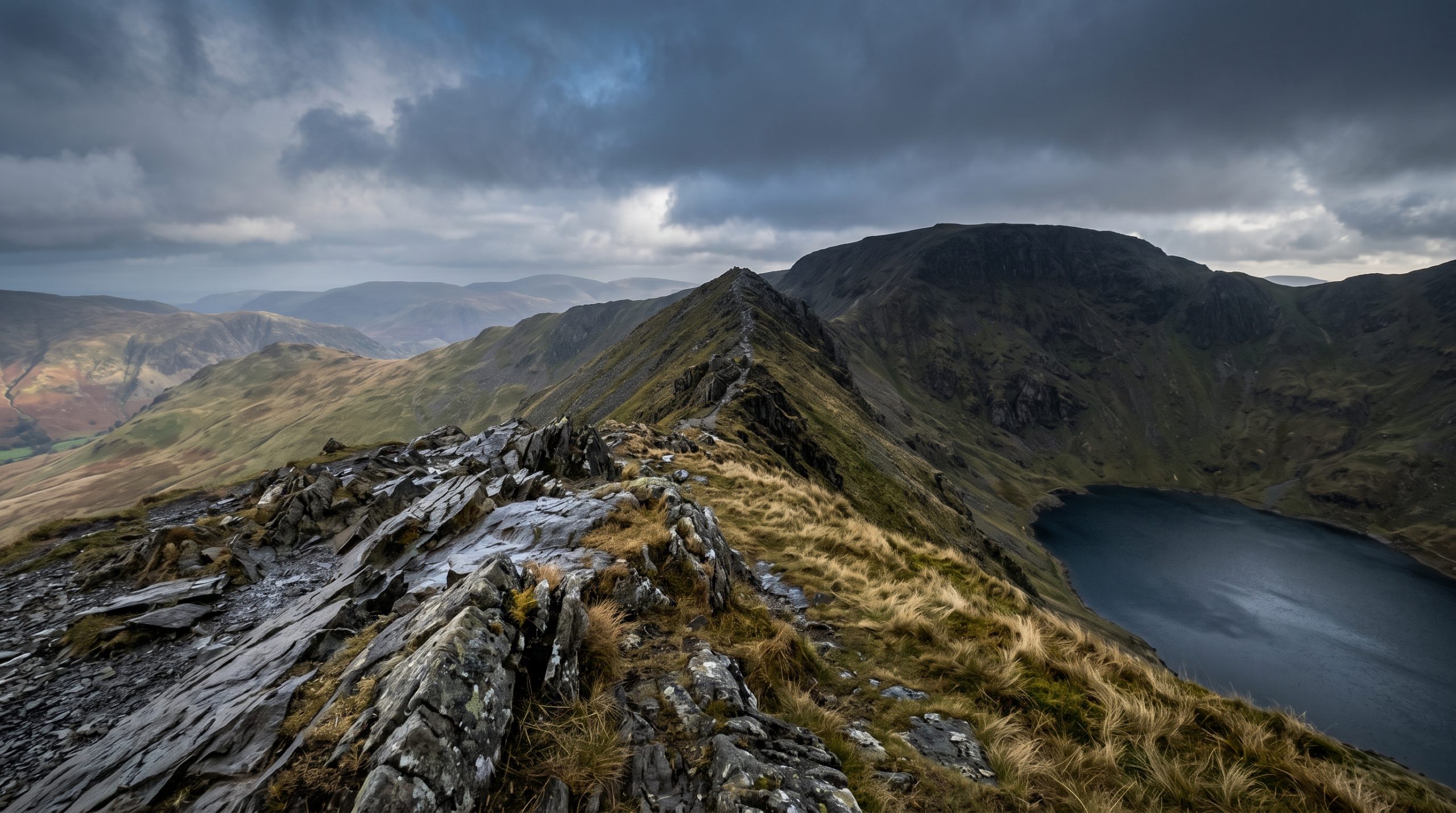
The official route card for Helvellyn by Striding Edge and Swirral Edge gives it to you straight: 7.7 miles, 820 metres of ascent, five to six hours, and a Grade 1 scramble in summer as well as in winter. Not one of those figures assumes a dress, a suit, two camera bags, or a couple who want to stand still on the crest for ten minutes and look at each other.
The gap between that route card and a wedding morning is the whole subject of this page. We have walked up Greenside Road in the dark enough times to know which parts of a Helvellyn plan bend and which parts refuse to, and the surprise for most couples is that the ridge is the easy problem. The paperwork is the harder one, and it comes down to a single rule.
Access, light, crowds, permission, and what to do when the cloud sits below the summit. In the order they actually decide things.
Twelve kilometres, 820 metres, and one legal catch
Striding Edge is a Grade 1 scramble on a 7.7 mile round from Glenridding with 820 metres of ascent, and there is no summit wedding permit to apply for. The reason is legal rather than generous: in England and Wales a marriage is registered at an approved venue, so the valley holds the paperwork and the ridge holds the vows.
The hem, the hands, and the crest itself
The route description calls the scrambling “easy but exposed”, which is accurate and tells you almost nothing about doing it in wedding clothes. From Hole-in-the-Wall, the col where the ridge proper begins, you are on rock rather than path. Both hands come into it. Not constantly, and not on anything a reasonably fit walker would call climbing, but often enough that you cannot be holding a hem at the same time.
So the hem gets managed a different way. The couples who do this well either carry the dress up in a pack and change at the col, or wear it from the car park with the skirt gathered and pinned, then let it go on the crest. Long trains are the one thing we would talk you out of here, because anything that drags will find every edge of rock between High Spying How and the summit plateau. A shorter dress works. So does a full-length one in a fabric that does not mind being sat on, knelt on and stuffed into a bag for twenty minutes.
Boots stay on for the ridge, and that is not a compromise as long as the ceremony spot is chosen with the swap in mind. We look for flat ground where two people can stand still and hold each other, rather than a narrow stance held for the benefit of a camera. Suits fare better than most people assume, though the jacket usually travels in a pack and arrives at the top uncreased while its owner does not.
The plateau at the very top is stony and broad, which comes as a genuine relief after the crest. It is also the only ground up there where a small group can spread out without anyone feeling they are queueing.
Dawn arrives straight up the corrie, and leaves it early
Red Tarn sits in a bowl with Striding Edge along its southern rim and Swirral Edge along its northern one, and the mouth of that bowl opens east, down Red Tarn Beck towards Ullswater. That one piece of geography governs every hour of a Helvellyn wedding day.
At the autumn equinox the sun clears the horizon around 06:56 and it rises almost due east, which puts it straight in through the mouth of the corrie, along the ridge line, and onto the crags of the east face. Nothing about that light needs improving. In late June sunrise is nearer 04:37 and comes from the north-east instead, over Swirral Edge and Catstycam rather than down the length of the ridge, and it means leaving the car park at around half past two.
Then the afternoon does something most Helvellyn plans fail to allow for. The sun swings west and goes behind the summit ridge, and Red Tarn drops into the shadow of its own skyline while there is still an hour or two of bright daylight sitting on Ullswater below. A five o’clock ceremony at the tarn in late September is not a golden hour ceremony. It is a grey bowl with a lit lake behind it. Evening light on faces means being up on the plateau or over the western brow towards Thirlmere, where the sun keeps working until it genuinely sets, around 19:15 at the equinox and closer to 21:53 at midsummer.
What that gives us is two entirely different days out of one mountain. The dawn version is rim light on wet rock, the couple small against the east face, the corrie filling with warm light from behind them. The evening version sits higher and softer, all sky and long shadows across the stones. You can see how both kinds of light behave in our published stories and films, and it is worth looking at them next to each other before you decide which one you are willing to get up for.
Who else is on the ridge, and from what time
Glenridding’s pay and display car park sits in the middle of the village, with public toilets alongside it, shops and cafes on the same street, and the Ullswater Steamers pier a short walk away. It is the obvious place to start, which is precisely the problem on a fine weekend. By mid-morning in summer the ridge carries a steady line of walkers, and on Striding Edge there is frequently nowhere to step aside and let anyone past.
Arrive early is not a slogan here, it is arithmetic. The published time for the full round is five to six hours. Being on the crest ahead of the first wave means passing the old mine buildings on Greenside Road in the dark and being off the ridge and onto the plateau by the time the day walkers reach Hole-in-the-Wall.
Midweek helps more than most people expect. So does October. What does not help is arriving at nine and hoping. If your date is fixed to a weekend in August, we plan the ridge as a dawn commitment and put the unhurried part of the day at the tarn or back in the valley afterwards. Tell us which of those two you would rather protect, and we build outward from that.
Glenridding Common belongs to the National Park, and that shortens the paperwork
The ownership matters. Glenridding Common runs to around 1,100 hectares and takes in the summit of Helvellyn along with both Striding and Swirral Edges, and it is National Park Authority ground, part of it held jointly with the National Trust. There is no private estate office to write to, which makes the permission trail shorter than most couples fear.
On the film side the National Park Authority’s position is plain: filming on public land needs permission from the authority responsible for that land, and filming on a public highway is a matter for Westmorland and Furness or Cumberland Council. Aerials sit inside the same conversation. We do the research and make the approach as part of planning; the fees themselves, where any apply, sit with you.
The marriage itself is where the real constraint lives. Since April 2022, civil ceremonies in England and Wales can be held outdoors, but only within the grounds of a venue holding a marriage licence, and a mountain summit is not one. Cumbria has more than 140 approved venues, from register offices to hotels and halls, and the registration service works to a daytime window, currently 08:00 to 18:00. So the legal ceremony happens in the valley, inside office hours, and what happens on the ridge is a celebrant-led exchange or a renewal of vows you have already made.
That leaves three sensible orders for the day.
| Order of the day | Hour on the crest | Legal ceremony | The trade |
|---|---|---|---|
| Register office the day before | Any hour you want, dawn included | Valley, previous day, inside the 08:00 to 18:00 window | Two dates to plan, and by far the calmest wedding morning |
| Ridge at dawn, paperwork that afternoon | 06:56 at the equinox, ahead of the walkers | Valley, mid-afternoon | You are most of a mountain day in by the time you sign |
| Paperwork first thing, ridge afterwards | Late morning into midday | Valley, first slot of the day | Flattest light and the busiest hour on the crest |
We plan the first of those far more often than the other two, and it is what we would suggest before you have even settled on a month. The planning fundamentals we work from go through the notice and registration side in more detail.
Two of us working a ridge that is one person wide
Striding Edge gives you no room to stand a photographer and a filmmaker shoulder to shoulder, so we do not try. One of us works ahead on the crest and shoots back along the ridge; the other drops a few metres onto the Red Tarn flank, low and wide, where the two of you read as figures on a skyline and neither camera catches the other operator. We swap ends at the col and again on the plateau. Sound is the second reason two people matter up here, because wind crosses that crest almost constantly, so we take the vows at Hole-in-the-Wall or just under the lee of the ridge where a microphone can actually hear a voice. One dedicated photographer or one dedicated filmmaker for the day is The Adventure, from $4,900. Both of us on the mountain together is The Expedition, from $7,900, which is where the professional audio for vows sits, and the full comparison is on our coverage and pricing page. Team travel to Cumbria is included either way.
When the cloud sits below the summit
Helvellyn keeps its own weather, and the top can be in cloud on a morning that looks settled from Glenridding. That is not something to be brave about. It is something to have already solved, so we build every Helvellyn day with a ladder of alternatives running downhill from the summit, all of them inside the same valley.
Red Tarn is the first step down. It sits below the ridge at the head of the Glenridding Beck path, and on a low-cloud morning the tarn with the edges half-showing above it is a stronger frame than the summit would have given you on a clear one. Hole-in-the-Wall, the col a little further on, hands you the ridge in profile with far less wind across it.
Below that, Greenside Road and the old mine buildings above the village give sheltered ground and hard industrial texture ten minutes from the car. Further out, Aira Force sits up the lake, with the National Trust car park at Glencoyne a mile and a half from the falls in one direction and a mile and a half from Glenridding in the other, on a path with uneven steps and a short stretch of road. In heavy rain the Ullswater steamer runs from the pier by the car park, and a lake in bad weather beats a fell in bad weather every time.
Season moves the plan too. The same route carries a winter grade as well as a summer one, which is why we build November to March days around Red Tarn, the mine road and the lake shore, and keep the crest itself for the months when it walks. If your date falls in that window and the ridge is non-negotiable for you, say so early and we will tell you honestly which weeks give you the best odds.
Common questions
Do we need a permit for a ceremony on Striding Edge?
Not for the ceremony itself. A legally binding marriage cannot be registered on open fell in England and Wales, so that part happens at an approved venue in the valley and there is nothing to apply for on the hill. What does need permission is filming on National Park land, and that request is one we make on your behalf during planning.
How long does the climb take in a wedding dress?
The published time for the whole round from Glenridding is five to six hours across 7.7 miles and 820 metres of ascent. With clothes to protect, kit to carry and reasons to stop, we plan the way up at around three hours and add a buffer at the col before anyone changes.
Is there anywhere to change out of boots before the ceremony?
Nothing built. There are public toilets beside the Glenridding car park at the start, and on the hill the practical changing spot is Hole-in-the-Wall, the col where the ridge begins, which has flat ground and a little shelter. We write that stop into the timeline rather than leaving it to chance.
What happens if the summit is in cloud on our morning?
We move down rather than call it off. Red Tarn and Hole-in-the-Wall usually sit below the cloud base on mornings like that, and the mine road above Glenridding, Aira Force and the Ullswater steamer give three further steps down. Those alternatives are chosen and checked before your date, not on the morning.
Can our guests come along Striding Edge with us?
Anyone comfortable on a Grade 1 scramble can. Guest numbers do not change our fee, but they do change the timeline, and a group moves at the pace of whoever is least happy on rock. A common shape is guests waiting at Red Tarn or the col while the two of you take the crest alone.
Is Swirral Edge an easier way down than Striding Edge?
It is shorter, but it is still hands-on ground, and the standard round is graded as a scramble in both directions. We treat the descent as its own hour with its own light rather than as the walk back to the car, and where a walking descent matters more to you, we take a different line off the plateau.
Building the day backwards from the crest
Every good Helvellyn plan starts with one decision: which hour on the crest you want, dawn or evening. The register office slot, the night before, the alternatives, where guests wait, all of it arranges itself around that single choice. Send us the month you are thinking about and we will come back with the sunrise time for your actual date, the shape we would build around it, and the ground we would hold in reserve. We handle the planning in writing so nothing depends on matching time zones, at your own pace: a reply and the first brochure reach you within 24 hours, and planning begins once the contract is signed and the 30% retainer is in. Our current Lake District availability runs across 2027–2029, and if Helvellyn turns out not to be your ridge, our destination guides cover the ones that might be.
When you are ready, Check Your Date and tell us the month you have in mind.