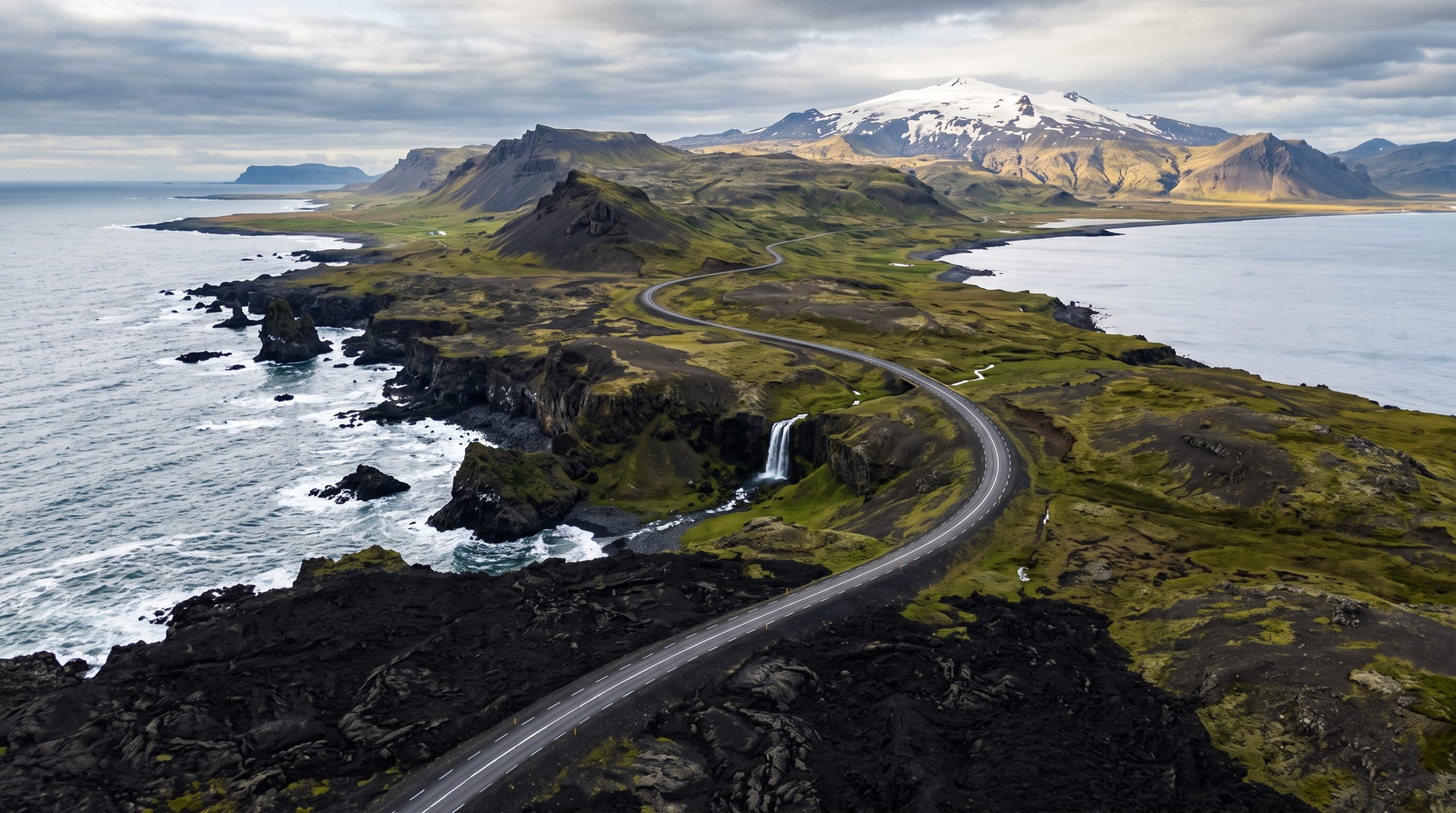
The car park at Kirkjufellsfoss reads your license plate on the way in. You settle up afterward at a machine, currently around 1,000 ISK for the day, and the camera knows if you come back the next morning. It is a small administrative detail attached to Iceland’s most photographed mountain, and it tells you what Snæfellsnes has become: managed, popular, and still completely workable if you get the order of the day right.
The peninsula is a loop. Route 54 rings it, Route 574 carries the western end through Snæfellsjökull National Park, and from Reykjavík it is roughly two hours to the north coast and closer to three to the far western tip. The south shore and the north shore take their light at opposite ends of the day, which is why a one-day route here only works in one direction.
This is the version we run, stop by stop, with the walking, the parking and the paperwork attached.
Búðir at breakfast, Kirkjufell near midnight
A one-day Snæfellsnes elopement route runs west to north: the black church at Búðir early, the 2.5 kilometer cliff path from Arnarstapi to Hellnar mid-morning, Djúpalónssandur through the afternoon, then Kirkjufell in the evening. In June that last stop sits near midnight. In December the same route shrinks to two stops.
| Stop | Walk from the car | Underfoot in wedding clothes | Hour that works |
|---|---|---|---|
| Búðakirkja, Búðir | Two minutes | Lava gravel, flat, fully exposed to wind off the bay | First light to mid-morning |
| Arnarstapi to Hellnar | 2.5 km one way, 45 to 60 minutes | Marked lava path, uneven, occasional rock steps | Mid-morning to early afternoon |
| Djúpalónssandur | About 10 minutes down, same back up | Lava descent, then loose rounded pebbles | Afternoon into evening |
| Kirkjufellsfoss | A few minutes from the ticketed lot | Short, flat, gravel, busy | Late evening in summer |
Stop one: the black church, before a coach could possibly arrive
Búðakirkja stands by itself in the Búðahraun lava field on the south shore, black timber with white trim, a low fence and a small old graveyard. A church has stood here since 1703, and the building you photograph today came out of an 1849 decision by the priestly council, on the condition that the residents of Búðir paid for it themselves. It is still a working parish church with roughly 120 registered parishioners, used for weddings and parish events rather than kept as a monument.
The arithmetic here is in your favor. A coach leaving Reykjavík at eight in the morning cannot physically be at Búðir before ten, so a 7:30 arrival gives you the lava field, the church and the whole southern skyline to yourselves. The ground is gravel and short turf, flat enough for any shoe, and the walk from the parking area to the church door takes under two minutes. What you feel instead of terrain is the wind. It comes straight off Faxaflói with nothing to stop it, so a long veil is a decision rather than an accessory, and we plan the first twenty minutes on the sheltered side of the building.
Snæfellsjökull sits behind the church to the west. Early on a clear morning the sun is low in the east, which puts warm light on the church gable and leaves the glacier pale and flat behind it. That reverses by evening, which is exactly why this stop goes first and not last.
Stop two: 2.5 kilometers of clifftop, and why you only walk it once
The coastal path between Arnarstapi and Hellnar is 2.5 kilometers one way and takes 45 to 60 minutes at a normal pace. It runs over old lava above the water, past the Bárður Snæfellsás statue at the Arnarstapi end, past bird cliffs where guillemots, razorbills and gulls pack the ledges through early summer, and past Gatklettur, the sea arch that fronts most photographs of this coast.
Here is the piece almost nobody writes down: in wedding clothes, this is a one-way walk. Doing it out and back is two hours of uneven lava, and a hem that survives the first leg rarely enjoys the second. So we put a car at each end, park at Hellnar, walk toward Arnarstapi with the light and the arch ahead of you, and drive back for the second vehicle afterward. Boots on the path, other shoes in a bag, and a change at the arch where there is level rock to stand on. The coast faces south and the ledges catch light through the whole middle of the day, so this is the stop that tolerates late morning better than anything else on the peninsula.
The path near the arch is narrow, and that matters for how two of us work. There is room for one person to stand close and no room for two, so the filmmaker drops twenty or thirty meters back along the trail and works long while the photographer stays in tight, and neither of them lands in the other’s frame. Sound is the real problem on this cliff, not space. Wind comes off the water constantly and the bird ledges are loud in June, so vows here get a lavalier and we angle you so the microphone sits out of the airflow, which is the kind of problem a filmmaker who plans the day with the photographer solves in advance rather than discovers at the arch.
Stop three: ten minutes of lava down to Djúpalónssandur
Djúpalónssandur is inside Snæfellsjökull National Park, and the way in is Nautastígur, the Path of the Bull, which drops from the parking area through lava to the beach in about ten minutes. It is steep in short sections and rocky rather than sandy. At the bottom you are on Djúpalónsperlur, the smooth black pebbles that give the beach its name, with two lagoons behind you and four historic lifting stones that fishermen once used to test their strength before going to sea.
Loose rounded pebbles swallow a heel completely. Flats or bare feet, and expect black grit on a white hem within a minute, which washes out and photographs as texture rather than damage. The climb back up is the only real ascent of the day and it is worth budgeting fifteen minutes for it rather than ten. Park rules ask everyone to stay on defined routes, so we pick a spot with room to stand on the pebbles instead of picking our way across the lava for a wider angle.
This beach is the best exposure problem on Snæfellsnes: black stone, white dress, and a sky that is often brighter than both. It faces southwest, so late afternoon and evening light comes in low and along the beach rather than down onto it, and the whole place changes character between two in the afternoon and nine at night. Our published films and galleries show how Iceland’s black coasts hold detail when they are lit from the side.
Stop four: Kirkjufellsfoss, which is not the ceremony spot
Kirkjufell rises off the north shore near Grundarfjörður, and it became a global landmark when it appeared as Arrowhead Mountain in Game of Thrones. The standard frame is taken from the falls a short walk from the car park, looking roughly west at the peak with water in the foreground. It is a genuinely good composition. It is also one of the hardest places in Iceland to photograph without other visitors in the picture, and we would rather tell you that now than at 9pm.
Arriving early is the usual advice, and on Snæfellsnes it fails in summer for a structural reason: late June gives Iceland about 21 hours of daylight and no dark hour at all, so the falls never empty out. At three in the morning there are already tripods on the path. What does work is treating the falls as a fifteen to twenty minute stop rather than the centerpiece, and holding the ceremony on the open north shore where the mountain reads as a clean pyramid from the fjord road and nobody is queuing for an angle.
The light rewards the late slot. From the falls you are looking west, and in high summer the sun swings around to the northwest very late in the evening, so the peak is lit from behind your right shoulder somewhere near midnight. Winter is a different proposition and, honestly, a kinder one for this spot: the sun stays low in the south all day, rakes the mountain’s flank sideways, and there are far fewer people standing in it.
If the falls picture is the reason Snæfellsnes is on your list at all, tell us. We will build the day so you get it in the quietest window the calendar allows, and be straight with you about which month that is.
Who you need permission from, and who you do not
Two offices matter, and they are not the same office. The legal side goes through the District Commissioner, the Sýslumaður, who confirms there is no impediment to the marriage before anyone stands on a beach. Both of you must be 18, originals of documents are required rather than copies, and anything not in English or a Scandinavian language needs a translation. Civil ceremonies are performed by district commissioners and religious ceremonies by certified ministers. Our planning guide to eloping abroad covers the document set in more detail.
The second office is the Nature Conservation Agency, which manages Snæfellsjökull National Park: 183 square kilometers, open all year, the first Icelandic national park to run from a mountain summit down to the ocean, with its visitor center at Malarrif. Photography, cinematography and drone applications inside protected areas go to that agency’s service portal, not to the park office, and not to the two parks that issue their own permits, Þingvellir and Vatnajökull. The published tariff currently sets the processing fee for filming and photography inside protected areas at 83,200 ISK.
The other two stops are simpler than couples expect. Búðakirkja is a parish church, so the inside is arranged with the parish in advance while the lava field around it needs nothing from anyone. Kirkjufellsfoss is private ground where the ticketed car park is the arrangement. Permit research and the logistics around it are part of every experience we run, and the government or landowner fees themselves are paid by you directly. One full day with a dedicated photographer or filmmaker starts at $4,900 and a day with both of them working together starts at $7,900, with everything each experience includes set out in full.
What the calendar does to this route
June is the generous month and the crowded one. With roughly 21 hours of daylight the loop can start at six in the evening and finish after one in the morning, with the strongest light saved for the last stop and the coach traffic long gone from the south shore.
December is the one that surprises people. Around the winter solstice Reykjavík gets a little over four hours of daylight, with sunrise near 11:20 and sunset near 15:30, and the drive out to the peninsula takes a good share of the morning. A four-stop route does not exist in that light. What exists is a two-stop day, run slowly, with the whole thing effectively one long low-sun hour, and accommodation on the peninsula rather than a return to the capital in the dark. Our destination guides get into how the shoulder months sit between those extremes.
Wind is what moves the plan most often, and the shape of the peninsula is the solution. The south shore and the north shore face opposite directions and sit within about an hour of each other by road, so a wind that makes the Arnarstapi clifftop unpleasant usually leaves the north side of the peninsula in the lee. We plan both coasts every time and decide on the morning.
One date in 2027 rewrites the route entirely. A total solar eclipse crosses West Iceland on 12 August 2027, and Snæfellsnes sits in its path. The road administration’s plan makes Útnesvegur, Route 574, one-way from Búðir toward Hellissandur from 12:00 that day, closes Öndverðarnesvegur, Route 579, entirely, and replaces it with national park shuttle buses. Visit West Iceland points out that parking capacity, not road width, is what limits how many people can be along the park road. A route on that date runs in one direction only and needs beds on the peninsula. We currently have Iceland elopement dates available through 2027–2029, and for that particular day we build backward from the traffic plan.
Common questions
How early do we need to be at Kirkjufellsfoss in June to have it to ourselves?
You will not have it to yourselves in June. There is no dark hour, so the path has people on it around the clock. We plan the ceremony on the wider north shore, where the mountain still dominates the frame, and use the falls as a short stop when the flow of visitors thins.
Can we get married inside the black church at Búðir?
Búðakirkja is a working parish church that does host weddings, and use of the interior is arranged with the parish ahead of time rather than on the day. Many couples we work with hold the ceremony outside on the lava field, which needs no permission and gives you Snæfellsjökull in the background.
Do we need a permit to fly a drone in Snæfellsjökull National Park?
Yes, and it goes to the Nature Conservation Agency rather than the park office. The published tariff currently charges 41,600 ISK to process a recreational drone application covering up to two protected areas. We confirm the permit and its time window before the film is planned around aerials.
Is there anywhere to change out of hiking boots on the western tip?
Mostly you change at the car with a door as a windbreak, which is what everyone does here. The national park visitor center at Malarrif is the nearest indoor stop to Djúpalónssandur, a short drive along the coast road, and the villages of Arnarstapi and Hellnar both have parking right beside the path.
Can we run this route as a day trip from Reykjavík in December?
Not this route. With a little over four hours of light and two hours or more of driving each way, a December day on Snæfellsnes has to be built around one or two locations and a night on the peninsula. It is a lovely day, just a much shorter and slower one.
Tell us which hour matters most
Send us the one thing you actually want from Snæfellsnes, the black church at first light or the mountain close to midnight, and we will build the rest of the route around it. the planning stays in one written thread, which means you can read a proposal at your own pace instead of on a schedule. An inquiry gets a reply and an initial brochure within 24 hours, then a tailored proposal, then planning begins once the contract is signed and the 30% retainer is paid. Check Your Date and tell us what the day should feel like.