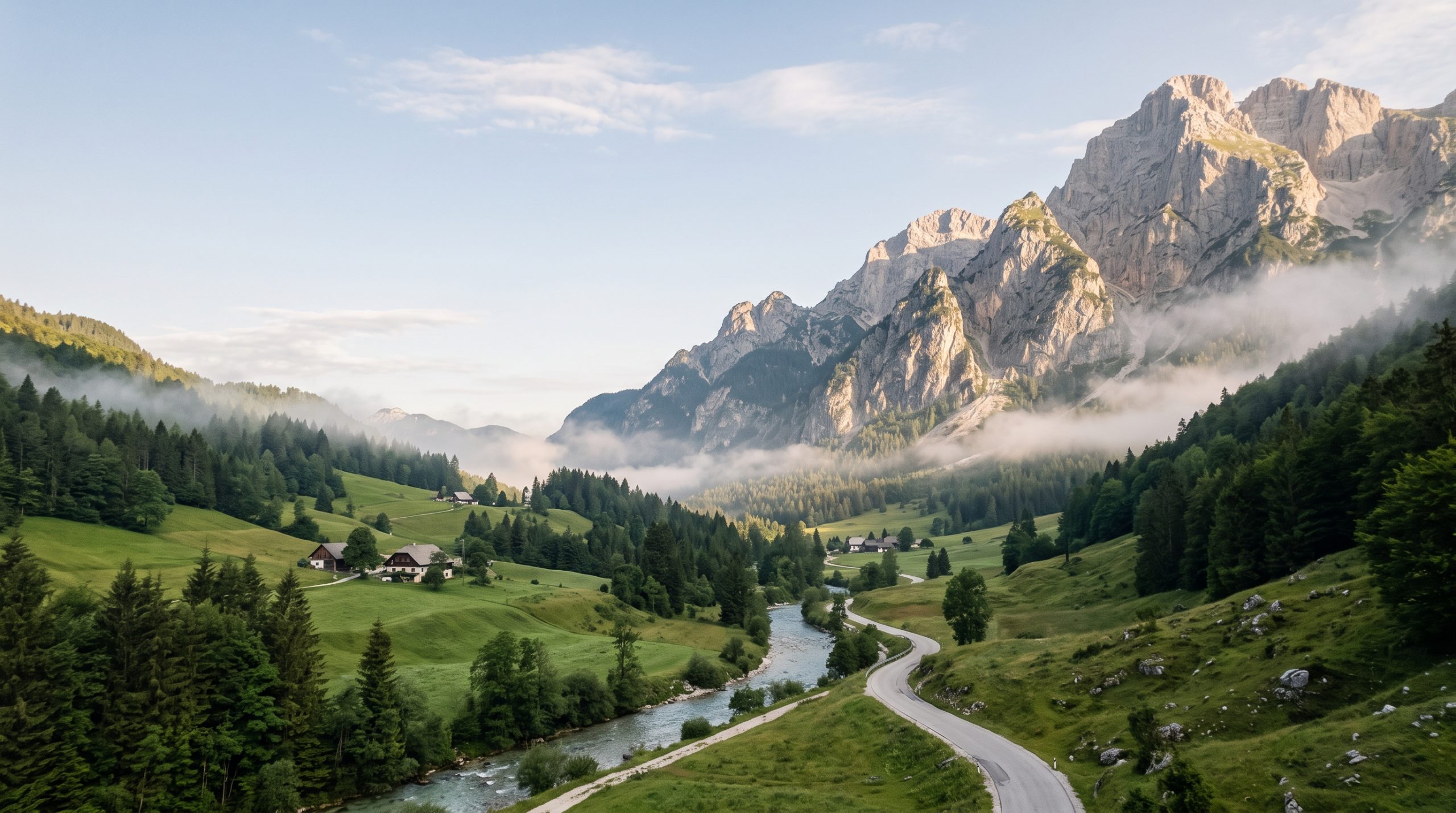
At half past five on a June morning the lane above the boathouses at Velika Zaka belongs to one delivery van and a rowing eight already out on the water. Twenty minutes of steep switchbacks puts you on the Osojnica rocks, where the island looks the way it looked in the photograph that sent you searching for a photographer. By eleven, that same rock is a queue.
The distance between those two hours is most of what planning a Slovenia elopement actually involves. The country is small, thirty-five kilometers from the airport to Lake Bled. It is also vertical, which means your phone’s estimate of a mountain drive and the drive itself are two different numbers, and the difference is where timelines fall apart.
What follows is the operational half: airports, honest drive times, where to sleep so the driving shrinks, what to book before you leave home, and how we shape a day around light that arrives in stages.
Four days, one airport, thirty-five kilometers
Fly into Ljubljana Jože Pučnik airport, drive thirty-five kilometers to Lake Bled, and give yourselves four nights: arrival, a settling day, the elopement day, and one weather day held in reserve. There is no nonstop from North America, so every American routing connects through a European hub and you should land a day early.
Getting in: Ljubljana against Venice against Zagreb
Ljubljana Jože Pučnik, still called Brnik by everyone who lives near it, is the right answer for almost every couple. One terminal, one baggage belt, a rental desk you can walk to. Its limitation is the route map: transatlantic passengers arrive on a second flight, usually out of Frankfurt, Munich, Paris or Istanbul.
Venice Marco Polo tempts people because it carries seasonal nonstops from several US cities. The trade is roughly 270 kilometers of driving on the wrong side of a transatlantic flight, plus an Italian border, autostrada tolls and a Slovenian vignette. It works well if you sleep a night in Italy on the way through, and not at all as a same-day transfer to a ceremony morning.
| Airport | Distance to Bled | Plan on driving | Why you would choose it |
|---|---|---|---|
| Ljubljana Jože Pučnik (LJU) | 35 km | 45 minutes | Closest by a wide margin, tiny terminal, all US routings connect |
| Venice Marco Polo (VCE) | 270 km | 3 hours 30, with a stop | Seasonal nonstops from the US, worth it only with a night in Italy |
| Zagreb (ZAG) | 207 km | 2 hours 30 | Sensible if the Julian Alps are one half of a two-country trip |
Where planner minutes become mountain-road minutes: planner minutes against real minutes
The A2 motorway from the airport towards Lesce is quick and honest, and nothing after it is. Off the motorway you share two-lane valley roads with tractors, cyclists in numbers and campervans that brake for every viewpoint. None of that is a problem unless the timeline was built on the planner’s number.
Vršič is the clearest example. The pass climbs above 1,600 meters on fifty numbered bends, several still cobbled, with nowhere to overtake. A planner gives you an hour and a quarter from Kranjska Gora down to Bovec. Two hours is the number to plan on, three if you stop at Lake Jasna and again at the source of the Soča, which you should. The pass is seasonal, open from late spring into late autumn, so it is not a road for a February date. If your month is April or May and a location beyond it matters, we build the day so it works either way.
The Bohinj basin behaves differently. Thirty kilometers from Bled and quick at six in the morning, the same road at ten in July is a slow parade hunting parking at Ribčev Laz. So we arrive before eight, or we take Bohinj in the evening.
Two more places where the map understates things. The lanes above Kropa climbing to the church of Sv. Primož narrow to a single track with passing places, and meeting a farm vehicle costs five minutes of reversing. Vintgar Gorge is not a road at all: the trail runs 1,600 meters over boardwalks, about forty-five minutes at walking pace, with an electric shuttle covering the last stretch from the parking area.
| Route | Distance | Route planner says | We plan on |
|---|---|---|---|
| Ljubljana airport to Bled | 35 km | 30 minutes | 45 minutes |
| Bled to Bohinj (Ribčev Laz) | 30 km | 35 minutes | 50 minutes, an hour in August |
| Bled to Sv. Primož above Jamnik | 30 km | 40 minutes | 55 minutes |
| Bled to Kranjska Gora | 45 km | 45 minutes | 1 hour |
| Kranjska Gora to Bovec over Vršič | 50 km | 1 hour 15 | 2 hours |
| Bled to the upper Soča at Trenta | 80 km | 1 hour 45 | 2 hours 30 |
One border note: if any leg comes down from Austria, the Karavanke tunnel is tolled separately from the vignette, so budget for both.
Bled, Bohinj, Kranjska Gora, Bovec: the bed that shortens the drive
Where you sleep is the biggest lever on how the day feels, because it decides how much of your morning happens in a car. Bled has the beds, the food and the shortest transfers. Bohinj has quieter water and closes earlier. Kranjska Gora puts the north side of Vršič twenty minutes from your door. Bovec is the emptiest of the four and the longest drive in, and it is the right call for couples who came for the Soča.
| Base | Plan on, from the airport | Within an hour of you | Suits |
|---|---|---|---|
| Bled | 45 minutes | Vintgar, the Radovna valley, Sv. Primož, Bohinj, Bled castle | First light on the water and the shortest driving of any base |
| Bohinj (Ribčev Laz, Stara Fužina) | 1 hour | Savica, Vogel, the Voje valley, Bled | Quieter shoreline, hiking from the door, early nights |
| Kranjska Gora | 1 hour | Lake Jasna, Zelenci, Planica, the north side of Vršič | High ground, a Vršič day, two borders close by |
| Bovec | 2 hours 30 | The upper Soča, Boka, the Mangart approach | Turquoise river, the fewest people, the longest arrival |
| Ljubljana | 30 minutes | Old town, castle, the airport | Arrival and departure nights, not the elopement day |
If you are still weighing regions rather than hotels, our destination guides are the place to start, and we will tell you which of these four bases fits the month you are holding.
Paperwork, timed tickets and the vignette
The Administrative Unit
A marriage in Slovenia is registered with the Marriage Registry Office of the Administrative Unit, the Upravna enota, covering the place you want to marry. According to the US Embassy in Ljubljana, you register the forthcoming marriage between two weeks and six months before the date, submitting both birth certificates with an apostille from the issuing US state, both passports, and a certificate of no legal impediment. Because no US authority issues that certificate, American citizens can swear an affidavit at the embassy instead. Many couples sign at home and keep the Slovenian day entirely for the ceremony, a legitimate choice we cover in our guide to how eloping actually works.
Vintgar, and anything else with a timed entry
Vintgar Gorge is open between April and October, with hours that move through the season. Entry is currently ten euros for an adult, and tickets are bought online with a reserved entry time rather than at the visitor centre. The gorge managers say plainly that the busiest window is ten in the morning to one in the afternoon, which tells you which hours not to ask for. Book the first entry of the day, weeks ahead in July and August, and the boardwalk is yours.
The motorway vignette
Slovenia sold its last sticker years ago. The e-vignette is linked to your registration plate, bought online, and a seven-day one for a standard car currently costs sixteen euros. It can be bought up to thirty days ahead, so it belongs on the same list as the rental car. If you rent inside Slovenia, check whether the car already carries one.
Aerials and the park’s consent
Triglav National Park is explicit in its own code of conduct: drone use in the natural environment requires the prior consent of the national park. The flight itself sits under the EU rules that Slovenia applies through its Civil Aviation Agency, with operator registration and geo-zones around the airport and settled areas. We confirm the park’s position and the airspace for the specific spot and hour before designing a film sequence around aerials, and we design it so the film stands if the answer there is no. Permit fees charged by a government, park or landowner are billed at cost; the research and applications are ours.
Light in a basin ringed by high ground
Almanac sunrise and useful sunrise are not the same event here. In the last week of June the sun is up a little after five, but the first direct light lands on the west shore and the slopes above it, not on the water at your feet, and the basin fills in over the next half hour. Evening runs late: in June there is workable light past nine, which is why a summer ceremony at Bled is often an evening one.
By the second half of October sunrise has slipped past seven, the larches on the Pokljuka side turn, and first light means a civilized start rather than a brutal one. Autumn brings valley fog that can sit on the lake until mid-morning. Fog is a look you cannot book, but we hold a plan that drives up out of it in case you want ridgeline instead.
In winter Vršič is out of the conversation and the day stays low: Bled and Bohinj under snow, the Radovna, and the Kamnik Alps to the east, where a six-seat chairlift climbs from 1,407 meters to 1,665 meters in five minutes onto a plateau of shepherds’ huts.
What holds up at the ceremony hour
Wind off water at six in the morning is colder than the forecast number, and it moves fabric constantly. Silk and chiffon are wonderful on film in that wind and miserable to stand still in, so bring a wool or cashmere overlayer you like being photographed in, not an emergency fleece. Footwear matters more than couples expect: gravel forest roads, wet boardwalk timber, limestone slick with dew until the sun reaches it. Carry the ceremony shoes and walk in boots. On the pass, count on close to ten degrees cooler than the lakeshore.
Buffers, two vehicles and a location held in reserve
All of this turns into three habits. We put at least thirty minutes of buffer in front of anything with a fixed time, whether a gorge entry slot or the hour you asked to say your vows. We start earlier than feels necessary, because in a valley that hands out light in stages that half hour decides whether you arrive in it. And we hold a second location within twenty minutes of the first, chosen for different weather, so a low cloud base changes the frame rather than the plan.
Two vehicles is the other quiet advantage. On a day running from the lake over the pass, the filmmaker can go ahead to see whether the bend you wanted is full of campervans while the photographer stays with you and keeps the morning unhurried. Two sets of gear on a long drive also mean a card or a battery never ends a sequence. There are eight of us, so there is always a second camera on the ground and a colleague in reserve, and team travel is included wherever the day happens.
The Adventure gives you a full day with a dedicated photographer or a dedicated filmmaker. The Expedition puts both on the ground together, with professional audio for the vows where conditions allow, and it suits any day involving real driving. Coverage and what is billed separately are set out on our pricing page. Guest count does not change the fee, though it does change access, permits, transport and how tight the timeline can be.
To see how the Bled basin and the Soča read in photographs and on film, spend ten minutes in our recent stories and films, then send us the month you are holding. Check Your Date.
Common questions
Do we have to do the legal paperwork in Slovenia, or can we marry at home first?
Either works. To marry in Slovenia you register with the Administrative Unit covering your location, two weeks to six months ahead, with apostilled birth certificates, passports and a certificate of no legal impediment; US citizens can swear an affidavit at the embassy in Ljubljana instead. Plenty of couples sign at home and keep the Slovenian day for the ceremony.
How many days do we need in Slovenia for an elopement?
Four nights is what we plan around: arrival, a settling day, the elopement day, and a weather day in reserve. Three works if you accept that the best morning of the three is the one you take. If you want the lake, the pass and the Soča as separate days, that is the Odyssey, two to seven days.
Is Lake Bled too busy for an elopement in summer?
Between roughly ten in the morning and early afternoon the lakeside path and the viewpoints are genuinely crowded, and no framing hides it. Before seven, and after eight in the evening, it is a different lake. Bled rewards couples willing to be awake early; if that is not you, we build the day around the Radovna, Bohinj and higher ground instead.
Can we fly a drone over Lake Bled and inside Triglav National Park?
The park requires its prior consent for drone use in the natural environment, and the flight sits under the EU framework Slovenia administers through its Civil Aviation Agency, including geo-zones near the airport. We confirm both for your locations and hours before planning any aerial sequence, and we include drone footage where it is legal, safe and appropriate.
Can we get to the Soča valley and back to Bled in one day?
Yes, in the open season, and it is a long day. Trenta is eighty kilometers over Vršič, and we plan two and a half hours each way rather than the planner’s hour and three quarters. If the river matters more than the lake, sleep in Bovec or Kranjska Gora and save five hours of driving.
Do we need a rental car, or can we manage with transfers?
Rent a car. Buses do connect the airport with Bled through the day, some routings changing in Kranj, but a four in the morning start with gear for two is not a bus problem. We drive ourselves in every destination, so your car only carries you.
How soon do we see the photographs and the film?
Highlights reach you five days after the day itself. The full gallery, or the film, follows within three weeks.
Choose the month first, then the viewpoint
Pick the month and Slovenia decides most of the rest: whether Vršič is in play, whether sunrise is a five o’clock start or a seven o’clock one, whether the lake is empty at eight. Tell us the dates you are holding and what you want the morning to feel like, and we will tell you honestly which valley and which hour delivers it. The first brochure is back within a day, a tailored proposal follows, and the signed contract with a 30% retainer opens the detailed planning. Our Slovenia calendar currently covers 2027–2029. Tell Us Your Story.