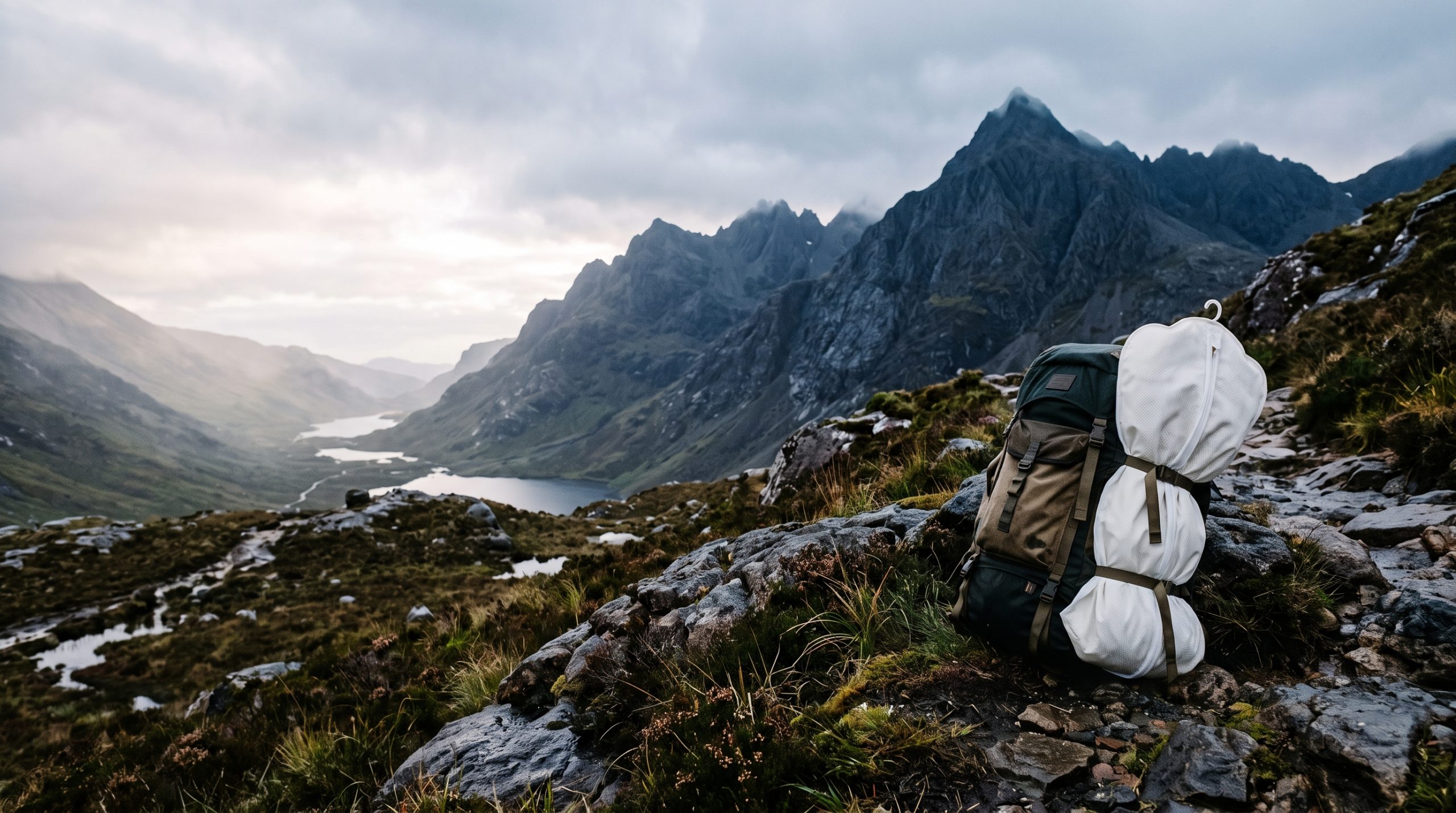
Sgurr na Stri is 494 metres high, which sounds modest until you read the standard walking description of the final ascent: rough, rocky, pathless, and needing careful route-finding. That one line decides almost everything about wearing a dress up here.
The reward is not in question. Walkers who have been everywhere in Scotland come back from this small summit calling the view the finest in Britain. Loch Coruisk lies directly below it, the whole Cuillin amphitheatre stands across the water, and the sea runs out behind that. You cannot see any of it from a road.
What is in question is logistics. The dress, the shoes, the celebrant, your witnesses and the wind all have to arrive in the same place within the same hour, on ground with no path and at a river with no bridge. That is solvable. It mostly comes down to which way you walk in.
What the dress actually has to survive
It survives well, with a plan for the ground under it. Between the car and the summit cairn there is bog, a river crossing with no bridge, and a final pull over bare gabbro knolls with no path. Couples walk in boots, carry the dress in a dry bag, and change in a sheltered dip near the top.
Three ways in, and what each one asks of you
Glen Sligachan is the classic. You start from the car park on the east side of the river at Sligachan, the opposite bank to the hotel, and pass the statue of Norman Collie and John MacKenzie before the path settles into the glen. The footpath is clear for most of the distance, and the walking is straightforward until the very end. It is also around 20 kilometres there and back with something like 850 metres of climbing, and most parties are out for seven to nine hours. As a wedding day, that is a full mountain day with a ceremony in the middle of it.
Kilmarie, on the single-track road to Elgol, is shorter and steeper: roughly 15 kilometres round trip with about 950 metres of ascent. A vehicle track climbs west from the roadside over the Am Mam pass and drops to Camasunary bay in about an hour. From the bay you cross the river and climb some 500 metres of hillside to the summit. This is the route we build most of these days around, because it puts a beach, a bothy and a bay into the plan as well as a summit.
The third way is by water. Boats leave Elgol jetty for Loch Scavaig at the foot of the Cuillin: Bella Jane sails daily from April to October with one and a half, three or four and a half hours ashore and one-way trips for walkers, and Misty Isle has been working the same water out of Elgol for decades under skipper Seumas Mackinnon. The landing at the head of the loch is a set of steep iron steps bolted over rock, usable at any state of the tide, with a white climbers’ hut a short way above them. From sea level you have the whole 494 metres above you and no path on it. It is the quickest way to arrive and the least flexible way to leave.
| Way in | Ground | Time | How the dress travels |
|---|---|---|---|
| Glen Sligachan | About 20 km return, roughly 850 m of ascent | Seven to nine hours for most parties | Carried the whole way, changing high on the hill |
| Kilmarie over the Am Mam | About 15 km return, about 950 m of ascent | An hour to Camasunary, then the climb | Carried, with the bay working as a staging point |
| Elgol boat into Loch Scavaig | Sea level to 494 m, pathless above the loch | Landings of 1.5, 3 or 4.5 hours ashore | Iron steps first, so soft shoes and dry bags |
Gabbro, heather and the changing spot below the cairn
The upper hill is roughly half rocky slope, about a third heather moorland and the rest grass, and the top is not a single point but a cluster of gabbro and basalt knolls. Gabbro is superb rock to stand on. It is also coarse enough to file your fingernails, and a hem dragged across it comes away frayed. Heather hides holes. Between the knolls you gain and lose a few metres over and over, which is why route-finding counts for more here than fitness does.
So nobody walks in the dress. In practice that means boots and trousers to within twenty minutes of the top, the dress in a dry bag, and a change in the last sheltered dip below the summit knolls, where there is rock to sit on and enough shape in the ground to break the wind. A gathered hem or a detachable train makes that final stretch far easier than a fixed floor-length one. Shoes travel separately, and the last few metres are often better barefoot on warm gabbro than in anything with a heel. Boots go back on before the descent.
Be honest with yourself about the walk before you commit to it. This hill suits couples who like being out all day and are unbothered by wet feet and an early alarm. If that is not the day you want, tell us: Camasunary bay, the Coruisk lochside and the shore at Elgol all sit inside the same plan and ask far less of you, and we would rather build the day you actually want than the one that looks hardest on paper.
The unbridged river, and what we do when it is up
From Camasunary the line to the hill crosses about 700 metres of machair to the Abhainn Camas Fhionnairigh. There is no bridge. When the river is full or the tide is high, that crossing becomes the thing most likely to move the plan, so we watch the rainfall in the days before and the tide for the morning itself, and we hold a northern line around the back of the hill in reserve. The coast path onward to Coruisk meets the Bad Step, a slab dropping into Loch Scavaig with a narrow ledge across it. There is a marked easier line at a higher level, and that is the one a dress uses.
Dawn lights the ridge, dusk turns it to silhouette
Sgurr na Stri sits on the south-east side of Loch Coruisk, which means the Cuillin stand across the water to the west and north-west of you. Understand that geometry and you have the day. Morning sun arrives over your shoulder and lands on the ridge faces above the loch, so gullies and buttresses separate out, the water takes colour, and a couple on the knolls is lit from the front. Evening reverses it. The sun drops behind the main ridge, the Cuillin flatten to a black cut-out, and the basin loses direct light long before the sky does. Both are worth photographing. Only one of them lights faces during vows.
That is why we put the ceremony in the morning here and keep the evening for the walk out, or for the bay. It is also the argument for the climb at all. The view from the shore at Elgol is genuinely good, and it is where the coaches stop, photographed from the same short stretch of shingle by everyone who turns up for sunset. From the summit you are above Loch Coruisk looking into the horseshoe rather than across a bay at the outside of it.
Crowds, honestly: this is one of the few well-known Skye viewpoints where arriving early is genuinely enough. Boat passengers with an hour and a half ashore stay on the lochside paths near the landing, and almost nobody climbs. How the place resolves into finished work is easier to see than to describe, so the wide frames and the films in our published galleries and films are the honest answer to what a morning up here looks like.
Two cameras among the summit knolls
Those knolls are the reason two of us can work up here at all. A photographer and a filmmaker can settle on separate humps a few metres apart at slightly different heights, so neither appears in the other’s frame, which is not the case on a narrow summit where everybody ends up standing in a line. Wind is the real variable, because the top is open to Loch Scavaig and the sea, so we choose the lee side of a knoll for the words and, on The Expedition, run professional audio through the vows. Aerials over the Coruisk basin depend on permission and a wind window, and we confirm both before any part of the film leans on them. One full day with a dedicated photographer or filmmaker starts at $4,900, and a day with both working together as The Expedition starts at $7,900, with the full detail of each on our pricing page.
Celebrants, notice periods and who owns the hill
Scotland is unusually generous about where a marriage may happen. Belief celebrants authorised by the Registrar General can conduct a legal ceremony anywhere in the country, so there is no approved-venue list to work around and no licensed room to book. A summit with no path to it is as legal as a registry office.
The paperwork is the part with dates attached. You each submit an M10 marriage notice to the registrar for the district where the ceremony will take place, rather than the office nearest home, and it must arrive no earlier than three months and no later than 29 days before the date. Councils advise not leaving it past about six weeks, which is sound. A separate form names your celebrant and your witnesses, which raises the least romantic fact on this page: your witnesses climb the hill too, and so does your celebrant.
The ground is John Muir Trust land. The Trust’s holdings in southern Skye take in the Strathaird estate, and its staff and volunteers maintain and monitor the paths you walk in on. Where landowner agreement is expected for a ceremony we ask for it in writing during planning, and we settle the fallback location at the same time as the first choice, so nothing needs improvising on the morning. Permit research and logistics guidance are ours; any government, venue or landowner fees are yours. If the legal sequence is new to you, our guide to planning an elopement sets it out in order.
Common questions
Can we legally get married on the summit of Sgurr na Stri?
Yes. A belief celebrant authorised by the Registrar General of Scotland can conduct a legal marriage anywhere in Scotland, including a 494-metre summit with no path to it. The requirement is paperwork rather than a venue licence: marriage notices lodged in time, and a celebrant who has agreed to the location.
Is there time to reach the summit on the Elgol boat?
Only on the longest landing. Bella Jane offers up to four and a half hours ashore as well as one-way trips for walkers, and the summit is 494 metres of pathless ground above the iron landing steps. A shorter landing is a lochside plan rather than a summit plan, and we will say so while we are building the timeline.
What happens if the river at Camasunary is too high to cross?
We use the northern line around the back of the hill, or we hold the ceremony at Camasunary bay and treat the summit as the evening option. Because the location is named in advance with the celebrant, that alternative is agreed during planning instead of on the morning.
Where do we change out of walking boots and into the dress?
In the last sheltered dip below the summit knolls, roughly twenty minutes from the top, where there is rock to sit on. Everything travels up in dry bags. Boots go back on before the descent, because gabbro and deep heather are no ground for wedding shoes.
Do our witnesses have to walk the whole way?
They do, so choose them with that in mind. From Kilmarie it is around 15 kilometres with about 950 metres of ascent for everyone present. Couples whose witnesses would rather not climb often marry at the bay and keep the summit for the two of them afterwards.
Building your morning above Loch Coruisk
A day here has a clear shape. Away from Kilmarie in the dark, over the Am Mam as the sky comes up, the river crossed early while it is low, the climb done in boots, then the change in the dip below the cairn so the vows land while the Cuillin are lit across the water. After that, a long descent with the light behind you and nothing to hurry for. Highlights reach you within five days, and the full gallery or film within three weeks.
Dates are currently open across our 2027, 2028 and 2029 Scotland seasons, and everything between us happens in writing: your inquiry, our reply and first brochure within 24 hours, a proposal built around your date, then planning that begins once the contract is signed and the 30 percent retainer is paid. If the country is still open, our destination elopement guides are the place to browse. If Skye is already settled, tell us the week you have in mind and we will tell you what the river and the light are likely to be doing, and what we would need from you to hold it. Check Your Date.