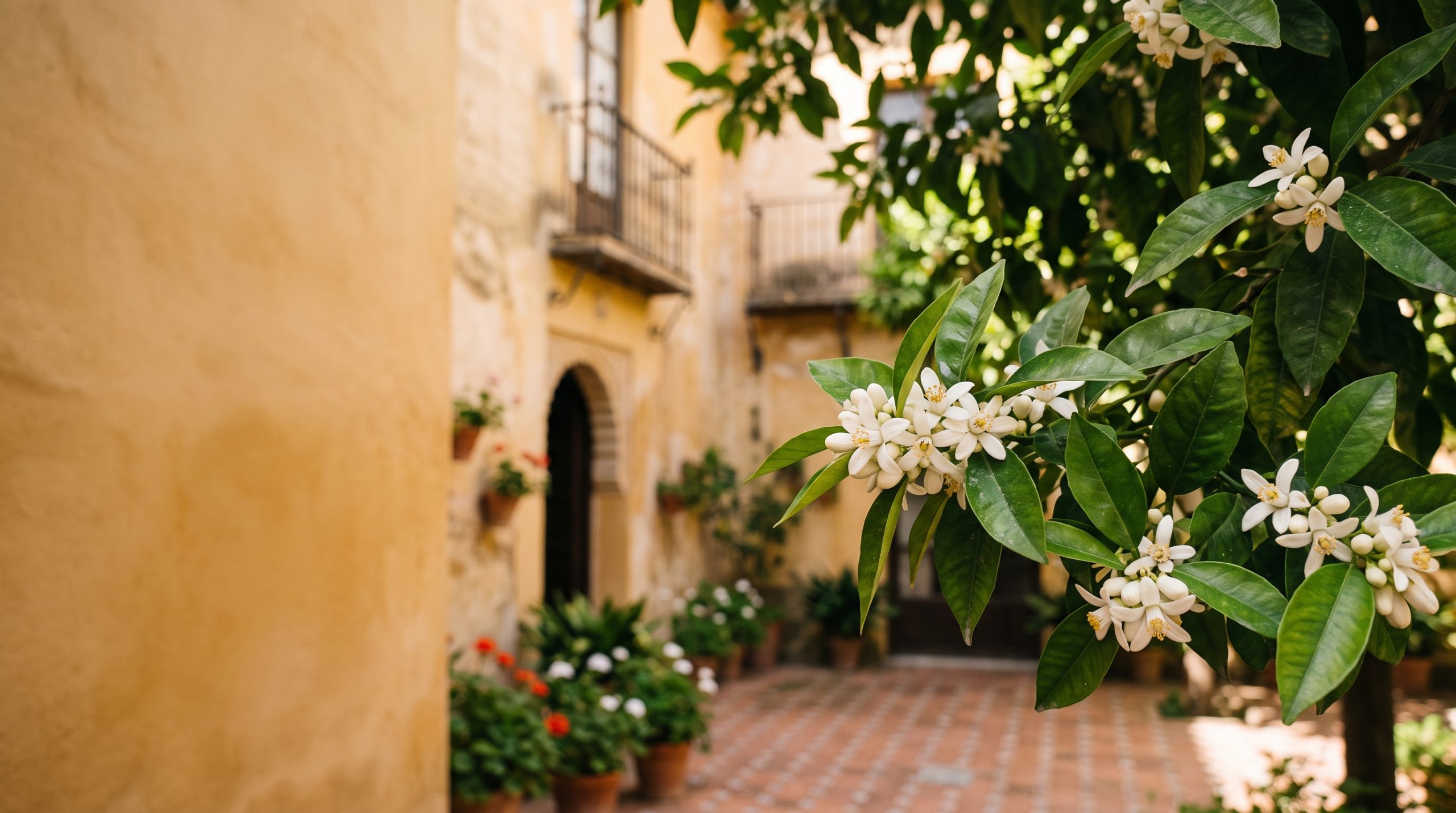
The azahar arrives without warning. One evening in late February you walk a street in Santa Cruz that smelled of nothing the day before, and it is suddenly thick with orange blossom. Seville keeps around 40,000 ornamental bitter orange trees, more than any other city in the world, and they all flower within a couple of weeks of each other.
Then it goes. Bloom begins in late February, peaks through March and trails into April, and any individual flush lives less than a month. Warmer winters have been pulling the whole thing earlier, which is why the scent no longer reliably waits for Holy Week the way older guidebooks promise it will.
So the window is real, it is narrow, and it moves. Below are the weeks we would book, the sunrise and sunset times that decide the shape of the day, the festival dates that close the middle of the city, and what we do with a couple whose date is already fixed in a month we would not have chosen.
The three weeks the city actually smells of it
Book the second or third week of March. Bloom starts in late February, peaks across March and fades through April, and each flush lasts under a month. In mid-March the sun rises at 7:34am and sets at 7:30pm, the streets warm up by ten, and Semana Santa has not yet taken over the center.
Month by month: blossom, heat, rain and usable light
Light times below are for the fifteenth of each month, which is close enough to plan a timeline around and far more useful than an average temperature. Our destination elopement guides go deeper on locations; this table is about when.
| Month | Conditions | Sunrise and sunset | Crowds | Our verdict |
|---|---|---|---|---|
| January | Coldest of the year, nights near 6°C, wet spells | 8:37am, 6:29pm | Lowest of the year | Empty streets, no scent |
| February | Buds swelling, first scent in the final days | 8:13am, 7:03pm | Still quiet | A bet on an early bloom |
| March | Peak azahar, cool mornings, warm afternoons | 7:34am, 7:30pm | Building fast | The weeks we would book |
| April | Spring warmth, showers still on the table | 7:49am, 8:58pm | Easter and Feria peaks | Lovely, crowded, blossom going over |
| May | Hot afternoons, very long evenings | 7:14am, 9:25pm | High | Evenings only |
| June | Properly hot and dry | 7:02am, 9:46pm | High | Dawn and 9pm, little between |
| July | Highs near 36°C, 2.2mm of rain across two days | 7:15am, 9:44pm | Heavy in the monuments | First light or nothing |
| August | Highs near 36°C, heat index around 41°C | 7:40am, 9:16pm | Locals away, visitors stay | Workable with a fixed date |
| September | Heat easing in the last ten days | 8:06am, 8:32pm | Steady | Late September is underrated |
| October | Warm days, clocks go back late in the month | 8:32am, 7:47pm | Thinning | Our second choice after March |
| November | Rain returns, mild afternoons | 8:03am, 6:13pm | Low | Soft light, short day |
| December | Wettest month, 79mm over 14 rainy days, 18°C by day | 8:31am, 6:07pm | Low until Christmas | Quiet, warm-toned, plan-dependent |
How far the blossom dates move, and what happens if you miss them
The bloom is a range, not a date. It opens in late February, peaks in March and can still be going into April, but the trees respond to the winter that preceded them rather than to the calendar, and a mild February brings everything forward by a week or two. Sevillanos have been remarking on earlier flowering for years now.
Here is how we translate that into odds. A date between 8 and 22 March gives you a very strong chance of walking into full scent, because that fortnight sits in the middle of the range in an early year and in an early year it is already open. The first days of April are a genuine gamble: in a late year they are perfect, in an early year the petals are already on the pavement. February is the same bet in reverse.
If the bloom has gone over before you land, the day does not collapse. The green is dense, the courtyards are cool, the tilework holds color in flat light, and the streets at 7:30am belong to you whatever the trees are doing. We say this because a date fixed around family flights cannot be moved for a flower, and it should not have to be.
Semana Santa and Feria: the fortnights that close the streets
Two festivals decide where you can physically stand in Seville. Holy Week runs 29 March to 5 April in 2027, 21 to 28 March in 2028, and 9 to 16 April in 2029. Feria de Abril traditionally follows two clear weeks later, out at the Los Remedios fairground: in 2027 the lights go on at midnight on Monday 20 April and the fair runs Tuesday 21 to Sunday 26 April.
Read those dates against the blossom and a pattern appears. In 2027 Holy Week lands squarely on the peak azahar fortnight, so couples chasing scent that year should look at the first three weeks of March instead. In 2028 Easter falls late and the whole of March is clear, which makes it the cleanest blossom year of the three we are currently booking.
None of this rules out a date inside Semana Santa. It changes the map. Processions hold the center for hours at a time, barriers go up along the carrera oficial, and vehicle access to the old town becomes theoretical. We answer that by building those days on the far bank in Triana, in the gardens south of the Alcazar, or forty minutes out of the city entirely, then walking back into the center late in the evening when a procession becomes the most extraordinary backdrop in Spain rather than an obstacle. The planning fundamentals behind that kind of day sit in our guide to eloping.
July and August, and how we make a fixed August date work
July is the driest month of the Seville year, with about 2.2mm of rain falling across two days, and highs sit near 36°C. August matches it for heat and pushes the apparent temperature to around 41°C in the afternoon. Add the fact that the sun does not peak until half past two and you get a middle of the day that is long, white and unusable for anything except a shaded courtyard and a cold drink.
If your calendar is open, we would move you to mid-March or the second half of October and we would say so in the first reply. If it is not open, because of visas or school terms or the only fortnight two families can travel, August still works and we build it differently. Vows at eight in the morning while the stone is still cool. Everything meaningful finished by half past ten. A long, deliberate gap through the afternoon. Then back out at eight in the evening for the last hour of sun and the blue hour that follows it, which in mid-August runs until about a quarter past nine.
Tell us the date you actually have rather than the date you think we want to hear, and we will either build the day around the shade or tell you honestly which fortnight would serve you better. Tell Us Your Story.
Solar noon at half past two, and what that does to the film
Seville sits west of the Greenwich meridian and runs on central European time, so the clock is roughly an hour and a half ahead of the sun. In summer the sun is at its highest around 2:25pm; in December, around 1:20pm. Every timeline we write for Andalusia starts from that offset, because a ceremony set for five in the afternoon in June is a ceremony in full overhead glare.
What this means month by month is straightforward. In mid-June sunrise is 7:02am and sunset 9:46pm, giving 14 hours and 44 minutes of daylight and a genuinely luxurious evening: the good light runs from about a quarter past eight to sunset. In mid-March the day is shorter at just under 12 hours, and the warm windows are tighter, roughly 7:40 to 9am and then 6:15 to 7:30pm. In mid-December there are only 9 hours and 36 minutes of daylight, but the sun never climbs high, so the whole short day carries a low warm angle and nothing needs to be rushed except the closing time of the gates.
One clock note worth putting in your calendar: Spain moves to summer time at 2am on Sunday 29 March 2028, which happens to be Palm Sunday. Sunrise that morning jumps from 7:15 to 8:13. A dawn ceremony booked for the Saturday and a dawn ceremony booked for the Sunday are two different mornings.
That March morning window is about 80 minutes long, and it is the clearest argument we know for having two people working at once rather than one person choosing. While the photographer is close, working the vows and the hands and the faces, the filmmaker is wide, holding the empty street and the sound of the fountain before the city wakes up. Our published stories and films show what that looks like when the light is only good for an hour and both cameras are already in position. The coverage shapes, and which of them puts a dedicated photographer and filmmaker on the ground together, are set out on our pricing page.
How Seville gate times and the wet-weather backup fit together
Seasonal opening hours matter more here than closures, because Andalusia does not really shut. The Real Alcazar runs 9:30am to 5pm from 1 October to 31 March, and 9:30am to 7pm from 1 April to 30 September, with last admission an hour before closing and only four closed days in the year. That winter timetable is the single most misunderstood fact about a March elopement: the Alcazar gardens are shut a full two and a half hours before sunset, so they are a morning stop in March and an evening one from April. The gates open at 9:30 and the first hour is the only quiet one.
Rain is concentrated and predictable. Most of the annual total of roughly 520mm falls between November and February, and December is the wettest month at 79mm spread over 14 rainy days. That is close to one day in two, which is why a December date gets a written weather plan rather than an optimistic shrug.
The plan is specific and it exists before anyone flies. A ceremony hour that can move by two hours in either direction without breaking the timeline. Named indoor and arcaded alternatives chosen by wind direction, not by convenience, because rain in Seville usually comes in on a south-westerly and the sheltered side of a courtyard depends on it. A second location within fifteen minutes of the first. And the honest note that after the last Sunday in October sunset drops to around 6:30pm, so an autumn day starts earlier than couples expect and we say so in the first draft of the timeline.
Common questions
Will the orange blossom definitely be out in the third week of March?
Very probably, not definitely. The bloom opens in late February, peaks in March and each flush lasts under a month, so a date between 8 and 22 March catches it in almost every year, early or late. We plan the day so the trees are a gift rather than a dependency.
Should we plan our elopement during Semana Santa?
You can, as long as the day is built for it. Holy Week is 29 March to 5 April in 2027, 21 to 28 March in 2028 and 9 to 16 April in 2029, and during it the old town belongs to the processions. We work Triana, the gardens and the countryside by day, then use the center late.
How hot is Seville in August, really?
Highs sit near 36°C and the apparent temperature reaches around 41°C in the afternoon. The mornings are the answer: at eight the stone is still cool and the streets are empty. We finish the ceremony before half past ten and go back out after eight in the evening.
What time is sunset in Seville in March?
Around 7:30pm in mid-March. Spain moves to summer time at 2am on 29 March 2028, and sunset immediately shifts to about 8:43pm while sunrise slips from 7:15 to 8:13. Which side of that Sunday your date sits on changes the whole timeline.
Is December worth considering for a Seville elopement?
Yes, with a plan. December brings 79mm of rain over 14 days and only 9 hours 36 minutes of daylight, but daytime highs stay near 18°C, the sun stays low all day, and the monuments are as quiet as they ever get. It is the best month here for having a place to yourselves.
Which of the next few years has the best March for blossom?
2029. Easter falls on 16 April that year, so Holy Week sits well clear of the peak azahar fortnight and every March week is available. In 2027 you have until 29 March, and in 2028 the first three weeks of the month are the ones to hold.
Choose the week by the version of Seville you want
Dates are currently open across Seville’s 2027–2029 seasons, so all three of the March windows above are still open to plan around. Send us the dates you are weighing, even if they are three separate fortnights in different months, and tell us what matters most: the scent, the empty streets, the long June evening, or the fact that your grandmother can only fly in October. We will tell you what each of those weeks actually gives you in Seville, and where we would put the ceremony hour in each one.
We keep the Seville planning in one written thread, so you can come back to it in your own time. You send the form, you get a reply and an initial brochure within 24 hours, and a tailored proposal follows. If it fits, a signed contract and a 30% retainer start the planning, and we begin building the timeline around the light rather than the other way around. Check Your Date.