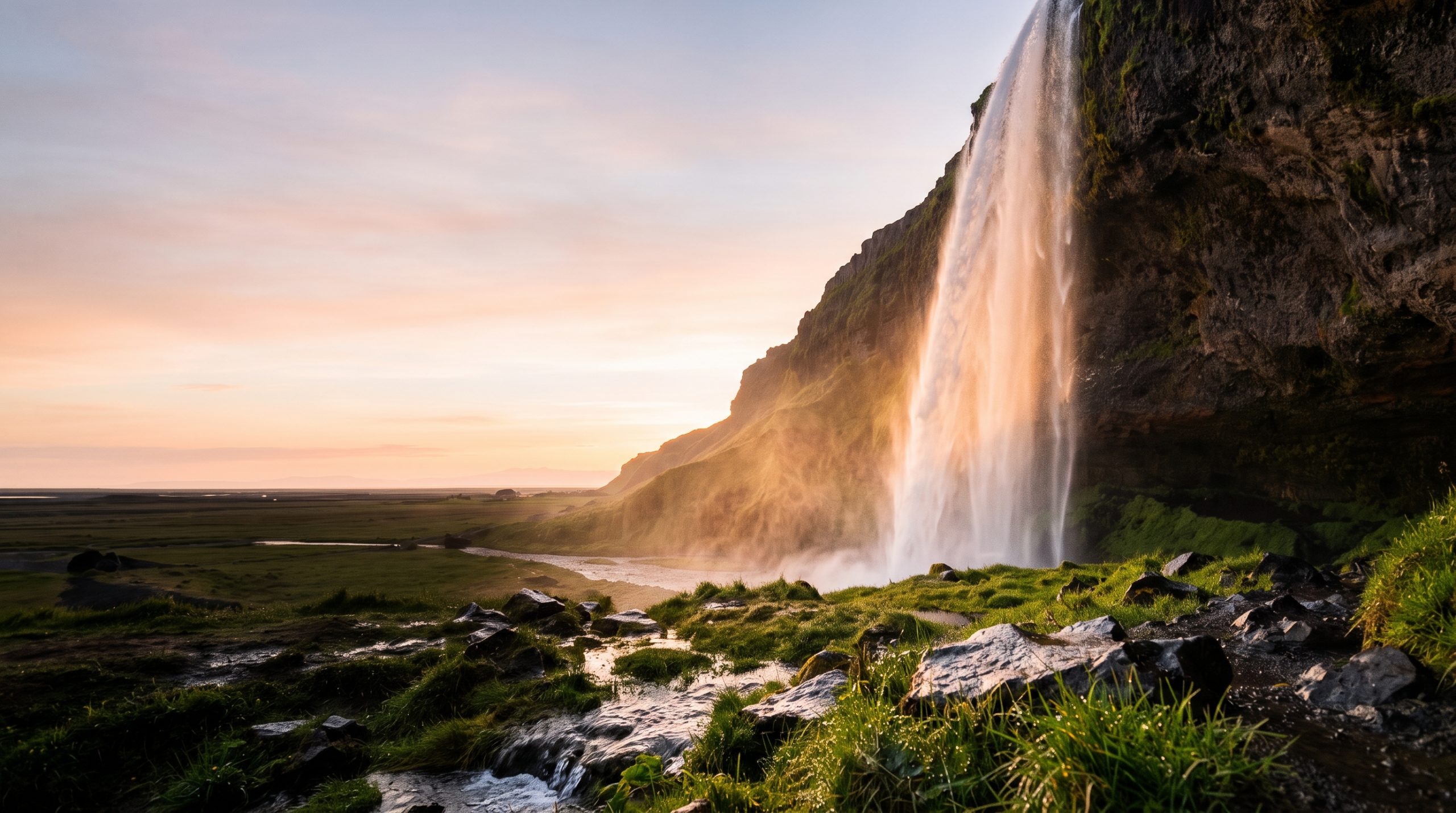
The car park at Seljalandsfoss looks straight at a cliff that faces west. That single fact reorganises the whole day. The waterfall most people photograph before lunch is standing in its own shadow, and the light everybody actually came for arrives late, after the day tours have rolled on east toward Vík.
The other fact is the water. A path climbs from the base into an alcove behind the falls, and it is wet the entire way. Not damp. Wet, with a fine drizzle that settles on everything and spray that finds a lens in seconds.
Put those two together and you get a very particular shape of elopement: boots on for the walk in, shoes swapped at the car, vows timed to the last hours of light, and a hem that will still be heavy at dinner. There are not many places on earth where you can stand behind sixty metres of falling water and look out through it at the sunset.
The cliff faces west, and that sets the whole day
Seljalandsfoss charges no admission and keeps no opening hours, so eloping here is a question of timing rather than access. The walk behind the falls is short, stepped and permanently wet. The cliff faces west, which puts the water in shadow all morning and lights it as the sun drops toward the sea.
From the Ring Road to the base, in a dress
Seljalandsfoss sits 129 kilometres from Reykjavík along Route 1, which is about an hour and fifty minutes of driving with no stops. Doing that twice in a day for an evening ceremony is a poor use of the light. Hvolsvöllur is roughly twenty minutes away, 22 kilometres west, and there are farm stays and guesthouses along the plain between the two, which is where we usually build the day from.
The turning is a few hundred metres off the Ring Road and you can see the falls from the car before you park. Parking is charged now, as at most of the big South Coast sites, currently around 1,000 ISK for a car through the Parka app or the machine at the entrance, and the ticket covers the rest of the day. That matters more than it sounds. It means we can look at the site in the afternoon, drive twenty minutes for something to eat, and come back for the ceremony hour without paying twice.
At the car park there are toilets, a small shop and a food truck. That is your changing room, and there is nothing else closer, so plan on arriving in whatever you can walk in and swapping at the boot of the car.
From the car park to the base is a flat gravel walk of a couple of minutes. Anybody can do it in anything. The path behind the falls is a different animal: steps, a narrow line across the rock, a real gain in height, and a surface that is almost always coated in spray. In wedding clothes, three things happen. A long skirt picks up water on the steps and gets heavier the whole way up. A veil behaves like a sail the moment you clear the shelter of the cliff. And smooth soles are no use at all on wet basalt, so most of our couples walk it in trail shoes or boots and change in the alcove or back at the base.
Most visitors are in and out of the whole site in forty-five minutes to an hour. We plan on two to three hours here, which is what gives us room to shoot the base while everything is still dry, take the walk behind late, and not be hurrying anyone across wet stone.
Standing behind the water: room, roar and two cameras
The alcove behind Seljalandsfoss is not a cave so much as a scooped-out shelf in the cliff, and it is narrow. Two people with cameras cannot stand shoulder to shoulder there and both come away with a clean frame. So we split it. One of us takes the shelf and shoots out through the curtain toward the west; the other works from the base or from the rising path with a longer lens, catching the two of you as small figures inside the water. Then we swap positions and do it again from the other side. Because the photographer and the filmmaker come from the same team of eight rather than meeting each other on the morning, that swap takes about ninety seconds instead of a quarter of an hour of negotiation on a wet ledge.
Sound is the honest limitation. Directly behind the falls the noise is total, and no microphone will lift a whispered vow out of it. So we place the vows where they can actually be heard and felt, usually at the base off to one side of the spray or in the gorge next door, and we keep the walk behind for the image rather than the audio. That is a decision made in the planning, not on the day.
As for how it photographs, this cliff gives you two completely different pictures within thirty metres of each other. From the front, a tall thin ribbon and a lot of green in summer. From behind, silhouettes, backlight and the shape of the water from the inside. Our published elopement stories and films show what that difference looks like once it is edited together, and how the film uses the sound of the falls as its own soundtrack.
Reading the hour: shadow, rainbow, and light through the curtain
Seljalandsfoss faces west, so it stays in shadow through the earlier part of the day and grows brighter as the sun gets lower. Photographs made here in the afternoon are bright and clean. Photographs made at nine in the morning are flat, grey and lit from behind the cliff, and no amount of editing puts back what the sun never delivered.
Three things follow from that aspect, and they are the reason we build the timeline backwards from the evening.
- At the base, looking up at the falls, you are facing roughly east. A low sun in the west sits behind your shoulders, which is exactly the geometry that puts a rainbow in the spray. That is why so many good frames of this waterfall have one, and why the morning almost never does.
- From the shelf behind the water, the view looks west, out over the coastal plain. In summer the sunset colours come through the curtain from the far side, which is a picture you can only make from inside the cliff and only in the last part of the day.
- Under the midnight sun the good hour is not an hour. It stretches, which means a ceremony that would be a scramble in September can be unhurried in late June, with the low light holding for a long time and the car park nearly empty.
Winter inverts everything. Daylight is short, the sun never gets high, and the whole cliff face takes a low raking light for most of the few hours it is up. It is a genuinely beautiful window, but it is narrow, and it wants a timeline written to the minute rather than a loose plan. That is the sort of thing our elopement planning fundamentals cover before you have booked anything at all.
The coaches, and why arriving early is the wrong advice here
Almost every South Coast day tour out of Reykjavík stops at Seljalandsfoss, and the standard internet advice is to get there early to beat them. For a ceremony, that advice is backwards. Early gets you an emptier car park and a waterfall in shadow. Late gets you both halves of what you want, because the coaches have moved on down the Ring Road and the sun has finally come round to the front of the cliff.
What we will not tell you is that you will have it to yourselves. This is a roadside waterfall with a food truck in the car park, and on a July evening there will be other people at the base. The alcove is the one spot where that stops mattering, because it holds very few people at a time and the noise takes everyone else out of your ears.
If solitude for the vows matters more than this particular waterfall, tell us early. We will site the ceremony somewhere quieter and use Seljalandsfoss for the part of the evening it is unbeatable at. Gljúfrabúi, the next fall north along the same cliff, hides in a gorge reached by wading a shallow stream over stepping stones. Kvernufoss, further east behind the Skógasafn museum, is also walked behind and sees far fewer visitors, with parking at 750 ISK on the Parka app that holds until midnight. Both sit in our South Iceland elopement guides.
What you actually pay for here
The waterfall has no gate, no ticket and no closing time. On site you pay for the parking, a little under ten US dollars at recent exchange rates, and nothing else. The legal marriage is not attached to the ground either: it is administered by the District Commissioner, the Sýslumaður, with the paperwork submitted and approved well before the date.
Aerials run on permission rather than goodwill. Inside protected areas the Nature Conservation Agency issues it, and operations outside normal limits go through Samgöngustofa, so we confirm what applies to this cliff on your dates before any aerial is written into the film. Permit research and landowner contact are ours; the permit fees themselves are yours. Full-day coverage starts with The Adventure at $4,900 for one dedicated photographer or one dedicated filmmaker, and The Expedition at $7,900 when both work the day together, with the rest on our pricing page.
When the ice takes the path, and what we do instead
From late autumn the spray starts to freeze on the rock behind the falls, icicles grow down the cliff face, and the route behind the water closes until conditions change. It is not a maybe. Plan a January elopement around standing behind Seljalandsfoss and you are planning around something that may simply not be available, which is why our winter timelines for this site are written for the base and the gorge, with the walk behind treated as a bonus if it is open when we get there.
Wind is the other mover, and it is a daily question rather than a seasonal one. An easterly pushes the spray straight out over the viewing area and turns the base into weather; a lighter day leaves you with drizzle rather than a soaking. We watch the direction for the week beforehand and hold two sheltered alternatives close by: the gorge at Gljúfrabúi, which cuts most of the wind out, and Nauthúsagil, a narrow ravine about ten kilometres further inland where the walls do the same job. Skógafoss, further east on the Ring Road, cannot be walked behind at all, but the 428 steps up its flank give you the view from above and a completely different frame if the plain is blowing.
None of this changes the fee. Weather alternatives, backup planning and a timeline built around light and real travel time are in every experience, because on this coast a plan with only one version of itself is not a plan.
Common questions
Is the path behind Seljalandsfoss open in winter?
Often not. Ice builds on the steps and icicles form on the rock face, and the route behind the falls closes until it clears. We plan winter days here for the base and the neighbouring gorge, and treat the walk behind as an extra if it happens to be open on the day.
Will my dress be ruined if we walk behind the falls?
It will get wet, and the hem will stay wet. The path is coated in spray year round, so a long skirt picks up water on the steps and carries it. Most couples do the base first while everything is dry, walk behind late in the evening, and accept a heavy hem for the last hour.
Is there anywhere to change at Seljalandsfoss?
There are toilets at the car park alongside a small shop and a food truck, and that is the only option on site. In practice people change at the car. We build the timeline so the walk in happens in boots and the switch to proper shoes takes place where it will not cost you the light.
Can we hear each other during the vows behind the waterfall?
Not really. Directly behind the curtain the noise takes over completely, which is lovely for the film and hopeless for words. We site the vows just off the spray or in the gorge next door where you can hear each other, then use the alcove for the images afterwards.
Do we need a permit to have a ceremony at Seljalandsfoss?
The site has no admission and no opening hours, and the legal marriage is handled through the District Commissioner in advance rather than on location. What varies is anything extra we bring, aerials in particular, and whether the landowner or municipality needs notice. Confirming all of that is part of the planning we do for you.
Building your evening at this cliff
A day here has a natural shape. Mid-afternoon somewhere east-facing while Seljalandsfoss is still in shadow, an early dinner along the plain, then the drive back for the last hours of light, the base first, and the walk behind the water as the sun goes down over the coast. Highlights reach you five days later. The full gallery or film follows within three weeks.
Our Iceland calendar is currently open across 2027, 2028 and 2029, and the planning from your first message to the date stays in one written thread, on your schedule, across time zones. Send us the date and where you are thinking of staying, and we will reply within 24 hours with a brochure and an honest read on whether that week gives you the evening this waterfall is capable of. If it does not, we will tell you which month does. Tell Us Your Story.