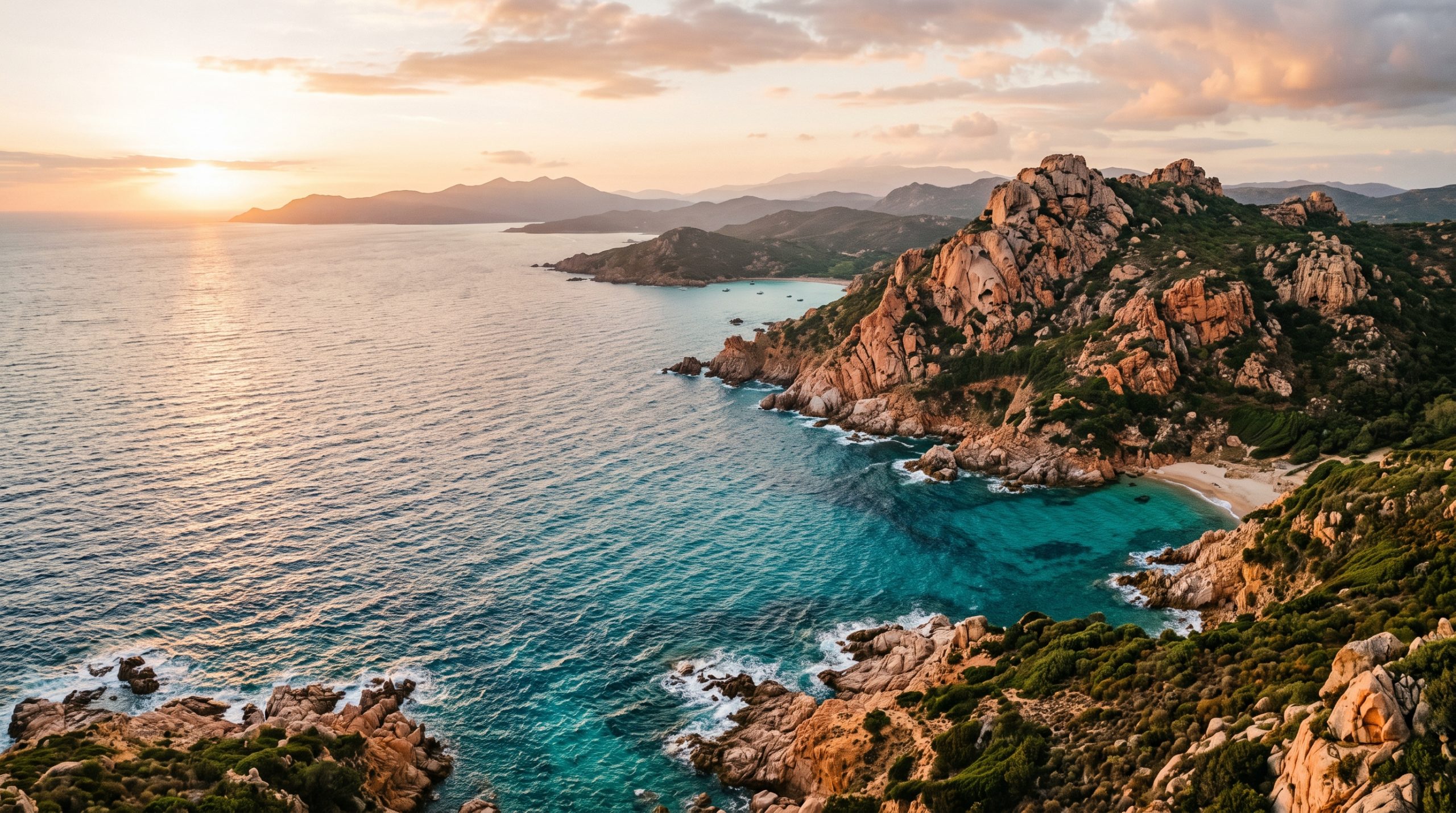
Cala Goloritzé is the cove couples send us most often, and almost nobody reaches it the way they picture. Boats are not allowed to land there. They stop at a buoy line roughly 300 meters off the pebbles, so the only way onto that beach is the trail down from the Golgo plateau above Baunei: about an hour and a half on white limestone. From April to October you need a reservation for one of 250 places, released in a 72-hour window, at 7 euros a head.
The other thing the captions leave out is the wind. The maestrale arrives from the northwest, and when it settles in for a day or two the taxi boats stay on their moorings in Cala Gonone while the east-facing coves go glassy. For a photographer that changes the water. For a film it changes the vows, because a microphone hears wind long before a lens shows it.
So this page does two things. It tells you where film coverage on this island starts, and it shows you what that figure is actually buying on a coast where the light, the boats and the beach caps all have opinions about your timeline.
Two coverage shapes, and where each one starts
We photograph, film and plan elopements across Sardinia as one team. One full day with a dedicated filmmaker and a dedicated photographer working together starts at $7,900. One full day with a single dedicated photographer or filmmaker starts at $4,900. Team travel to the island is included in both, and multi-day coverage is quoted on request.
Dawn on the Gulf of Orosei, dusk behind the Supramonte
Sardinia’s east coast faces the sunrise, which sounds obvious until you build a day around it. In mid-September the sky starts to lift around 06:40 on the Ogliastra coast and the sun clears the sea near 07:05. There is no ridge to wait for. The cliffs take direct light in the first minute, and that is why the ceremony goes at the front of the day here rather than the end of it.
This is a shape we run often, from a base at Santa Maria Navarrese or Baunei in the second half of September.
- 05:45. Leave the coast. The hairpins from Baunei up to the Golgo plateau take longer than any map suggests, so the timeline carries thirty minutes of slack.
- 06:40. First light on the plateau. Juniper, pale rock, and the free-roaming donkeys and pigs that will walk through at least one frame.
- 07:05. Sunrise straight out of the sea. Vows here, while the air is still and the microphone can hear you clearly.
- 07:45. Onto the trail. The descent to Goloritzé takes around ninety minutes and the rock gets better the lower you go.
- 09:15. The cove, still close to empty. Walkers who started at a civilized hour are an hour and a half behind you.
- 10:30. Climb out. The way up is slower than the way down and we film very little of it.
- 11:00 to 16:00. Nothing. Midday sun on white limestone is the hardest, flattest light on this coast and no amount of skill fixes it. Swim, eat, sleep.
- 16:30. Out again: a headland, the plateau, or a chartered boat if the day includes one.
- 18:20. Direct light leaves the east coast before official sunset, because the sun drops behind the Supramonte first. We turn and shoot toward the cliffs instead of the horizon.
- 19:25. Sunset for the rest of the island. Here it is warm reflected light on rock, and dusk runs to about 19:50. The closing frames of the film come out of that half hour.
Shift the same day by four months and it becomes a different piece of logistics.
| Window | First light | Sunrise | Sunset | What it changes |
|---|---|---|---|---|
| Mid-May | 05:30 | 06:02 | 20:35 | Cool sea, weekday coves nearly empty, maestrale more likely |
| Late June | 05:20 | 05:52 | 20:55 | Earliest sunrise of the year, and roughly sixteen hours between first and last light |
| Mid-September | 06:40 | 07:05 | 19:25 | Warmest water, kinder start, boat traffic thinning after the first week |
| Mid-October | 07:05 | 07:30 | 18:40 | Everything fits inside twelve hours; La Pelosa’s booking season has closed, Baunei’s has not |
A late June day is the one couples underestimate. To hold both ends of the light you are awake at 04:45 and still working at 21:20, which is a genuinely long day on your feet and worth deciding on deliberately rather than discovering in the moment. Mid-October gives you the same coast inside twelve hours. If you are still choosing between regions, our destination guides work through them one at a time.
When the maestrale is up, we change coasts
Sardinia’s saving grace is that it has two weather sides and about two and a half hours of driving between them. The maestrale exposes the north and west, from Stintino down through the Sinis, while the Gulf of Orosei sits in the lee and goes quiet. A scirocco out of the south flips that around, and the west coast becomes the sheltered one.
Planning for it is mostly a matter of not locking yourself in. Cove access on the Baunei coast is booked per beach and released within days of the date, not months ahead, so we hold a first choice and a real alternative rather than a hopeful one. The Golgo plateau sits twenty minutes inland from the water and stays workable when the sea is lively. On a strong maestrale day the taxi boats out of Cala Gonone stay put, so any part of the film that depends on a hull gets built as an option rather than a foundation.
The wind also has a daily rhythm worth using. The first hour after sunrise is usually the stillest of the day, which is another reason vows sit early here. We confirm the shape of the morning with you the evening before, in writing, and if that means a different cove than the one on the plan, you already know both.
One team on a path only wide enough for one
Sections of the Goloritzé trail are single file, and there are ledges above the cove where two people cannot stand and shoot the same subject. A photographer and a videographer who were hired separately and met at breakfast will find this out at 07:05, and one of them will lose the frame. Ours settle the high line and the low line the night before, because the same people who planned the day are the ones carrying the cameras down it.
Audio is the sharper difference here. With a filmmaker on the team, vows go on a lav under a collar and a shotgun with real wind protection, positioned by someone whose only job at that moment is sound. That is what stands between a film of your ceremony and a film of the maestrale. On the Expedition, professional audio for vows and other meaningful moments is part of the coverage wherever conditions allow.
Light works differently for the two crafts too, and this coast makes the gap obvious. Film locks its shutter near 1/50 for natural motion, so at 09:15 on pebbles that throw white light straight back up, the filmmaker is working behind heavy neutral density while the photographer simply stops down. Two different problems, solved in the same ten minutes, with neither person standing around waiting for the other. Aerials sit in the same category: drone footage is included where it is legal, safe and appropriate, which in Italy means operator registration, insurance and a zone check confirmed before anyone plans a shot around it. Above the Gulf of Orosei that is the only way to show how far the cliffs go up behind you.
There are eight of us, four photographers and four filmmakers, so there is always a second camera on the ground and a colleague in reserve. You can see how that comes out on the galleries and films we have published, which is the honest way to judge whether a Sardinian dawn holds up in motion as well as in stills.
What travels with us, and where coverage starts
Every experience, from a single day to a multi-day Odyssey across two to seven days, includes the same foundation.
- Destination and location design, and a timeline built on real light and real driving time on Sardinian roads.
- Permit research and logistics guidance for the coves, the plateau and the comune.
- Weather alternatives and backup planning, including the second coast.
- Drone footage where it is legal, safe and appropriate.
- Professional audio for vows and meaningful moments on the Expedition, where conditions allow.
- Team travel worldwide: flights, accommodation and ordinary travel for the assigned team, with no long-haul distinction.
- Highlights delivered in 5 days, and the full gallery or film in 3 weeks.
Guest count does not move the fee. Ten people on a cliff path change access, permits, transport and pacing, not the price. Full coverage figures and what sits inside each experience are on the pricing page, and Our planning calendar for Sardinia currently covers 2027, 2028 and 2029.
What Sardinia charges separately
- Cala Goloritzé access, currently 7 euros per person, with 250 places at a time from April to October and booking opening 72 hours ahead.
- Contributions collected by boat operators on the Baunei coast, where Cala Mariolu is capped at 700 visitors a day and Cala Biriala and Cala dei Gabbiani at 300 each.
- La Pelosa at Stintino, 3.50 euros per person, with 1,500 daily places between 08:00 and 18:00 from 1 June to 30 September. The cap does not apply after 18:00, which is exactly when we work there.
- Gola su Gorropu, a cash ticket at the kiosk, currently around 5 euros a head.
- Comune fees for a civil ceremony, which vary town by town, plus the revenue stamps for an Atto Notorio if you take the full Italian legal route: two at 16 euros and one at 10.62 euros.
- Accommodation, your celebrant, flowers, and any unusual transport such as a private boat into a cove or a 4×4 up a track.
None of those are ours to mark up, and none of them are a surprise if the proposal names them before you sign. If you have a month in mind, Check Your Date and we will tell you what that month does on this coast.
How a Sardinia film enquiry moves from first message to plan
- You send the inquiry form with your dates, or a rough month, and whatever you already picture.
- We reply within 24 hours with an initial brochure.
- We write a tailored proposal: coverage shape, a first timeline for your dates, and the access your locations need.
- Contract signed and a 30% retainer paid. The remaining payments are set out in that proposal.
- Planning begins: locations, timeline, permit research, weather alternatives, all of it in writing.
- The day happens. Highlights reach you in 5 days, the full gallery or film within 3 weeks.
If you are earlier than that in your thinking, our guide to planning an elopement covers the ground that comes before dates and permits.
The couples this island suits
Sardinia rewards people who are willing to be on a limestone path before the sun is up, who are steady on uneven ground for three hours across a morning, and who can hear that the coast has changed overnight without the day falling apart. That last one matters more than fitness.
It also rewards a bit of restraint about where to be in high summer. The Costa Smeralda in the second week of August is busy, and the light where the crowd parks at Porto Cervo is flatter than the photographs suggest. We would rather put you 90 minutes south on a coast with the same water and a tenth of the traffic.
If a 04:45 alarm is not your idea of a good start to a marriage, say so early. Mid-October hands you a 07:30 sunrise and a day finished by 19:10, and there are headlands and coves ten minutes from a parked car that photograph as well as anything you walk two hours to reach. Tell us the kind of morning you actually want, and we will tell you which month and which coast do that best.
Common questions
Do we need a photographer and a filmmaker, or can one person do both?
One person can do both, and on quiet ground it works well. On the Baunei coast it costs you something specific: whoever is holding the stills camera at 07:05 is not the person minding the audio. If the film matters as much as the photographs, two dedicated people are the reason it sounds like a ceremony rather than a windy morning.
Can two Americans get legally married in Sardinia?
Yes, through the comune, and the paperwork is the part to plan early. The Italian side wants an Atto Notorio, sworn either before an Italian consul in the United States or before a court official in the city where you marry. The American side wants a sworn statement made in person before a US consular officer in Italy, and the nearest of those offices is on the mainland, not on Sardinia. Many couples handle the legal marriage at home and keep the ceremony here. We build the timeline around whichever route you choose.
What happens if the maestrale blows on our date?
We move to the sheltered side. The east coast lies in the lee of a northwest wind, the Golgo plateau twenty minutes inland is calmer again, and the shape of the morning is confirmed with you the evening before. Anything that depends on a boat is planned as an option, never as the only version of the day.
Can a boat drop us on the beach at Cala Goloritzé?
No. Boats hold at a buoy line roughly 300 meters offshore, so access is on foot from the Golgo plateau, about ninety minutes down and rather more back up. If that walk is not for you, Cala Mariolu, Cala Sisine and Cala Luna are reachable by sea and photograph beautifully.
When do we actually see the film?
Highlights arrive within 5 days, while you are still traveling. The full gallery or film follows within 3 weeks.
Is drone footage part of the coverage in Sardinia?
Yes, where it is legal, safe and appropriate. Italian aerial work runs on operator registration, insurance and a zone check for the specific spot, and we confirm all three before we plan a sequence that needs height. Where a zone rules it out, the film is built without it rather than around it.
Does the price change if we bring our parents and a few friends?
No. The fee is the same for two people or twelve. Guests change access, permits, transport and how fast the group moves along a trail, which is a planning question rather than a pricing one.
Which month gives the best light with the fewest people in the coves?
Late May and the second half of September, with early October close behind. September keeps the warm water and hands you a 07:05 sunrise instead of a 05:52 one, which changes how the whole day feels.
Your Sardinian week, on paper first
We handle the planning in writing so nothing depends on matching time zones, across whatever time zones sit between your kitchen and this island, so nothing needs to be arranged live. Send your dates and the coast you are drawn to, and we will come back with a real shape for the day: the hour the light lands, the cove that suits it, and what the paperwork wants from you. Tell Us Your Story.