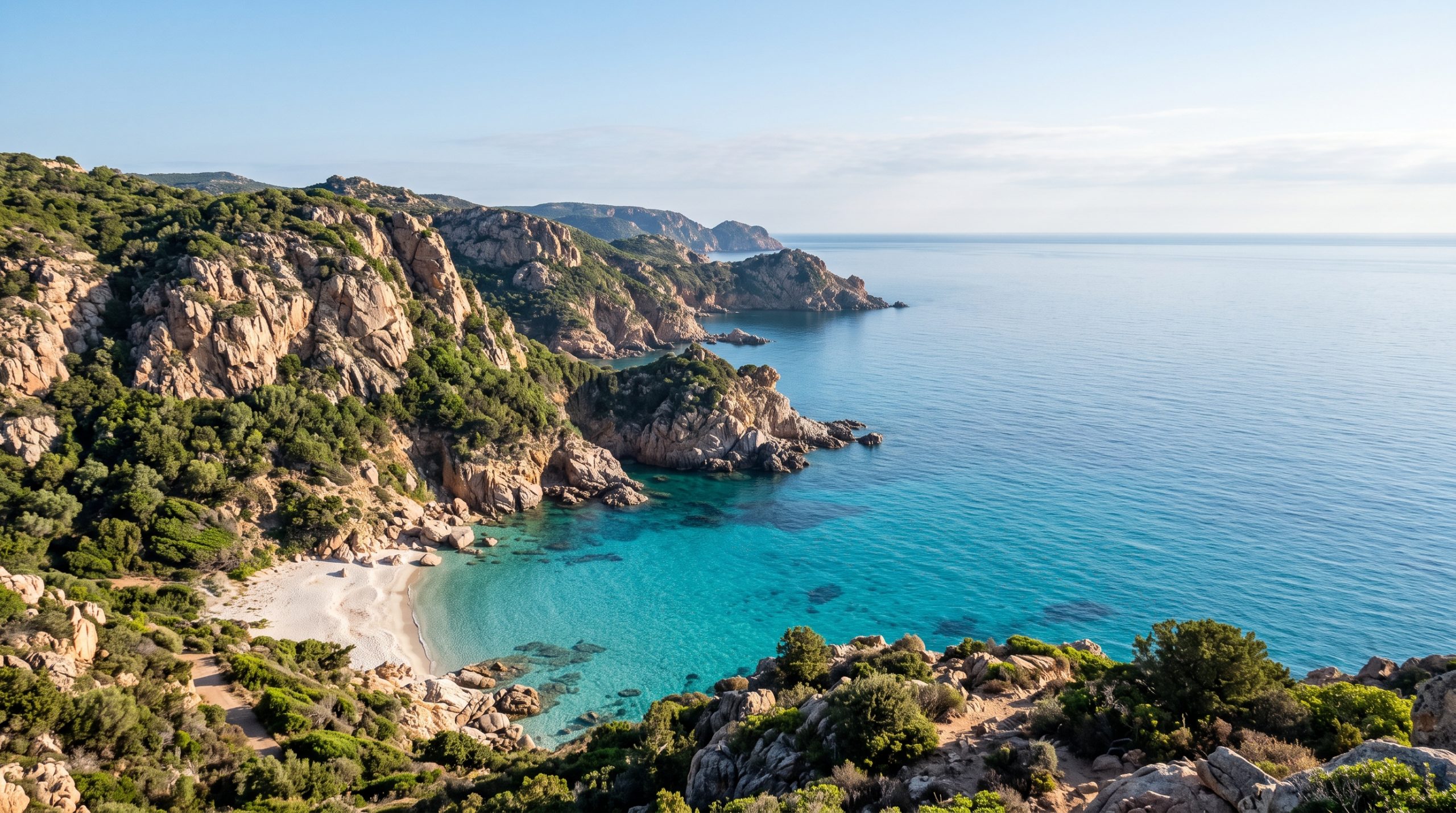
The trail to Cala Goloritzè starts at Su Porteddu on the plateau above Baunei, and it runs about 3.5 kilometers down to the water with roughly 500 meters of height to give back on the way out. Only 250 people are let through in a day. The ticket is currently 7 euro a head, it goes on sale a few days before you walk, and the checkpoint at the trailhead is staffed from 7:30am. No photographer on this island can promise you that cove eighteen months out. What we can promise is a day that works whether or not the ticket lands.
The second thing worth knowing before you choose an hour. Sardinia sits far enough west inside its own time zone that the sun peaks at about 1:20 in the afternoon, so everything runs late by American instinct. In the last days of June the sun lifts out of the sea off the Gulf of Orosei around 5:52am and there is still workable light at 9:25pm. Between roughly 9:45am and 5pm it sits higher than 40 degrees, and 73 degrees at its peak, which is glorious for water color and unkind to faces.
So a Sardinian elopement is not one long sweep of coastline. It is two strong ends with a genuine gap in the middle, and the gap is where the island hands you everything the beach guides skip: the Golgo plateau, holm oak shade on the edge of the Supramonte, an hour in Baunei itself, a village pinned to limestone 500 meters up and less than 5 kilometers from the sea.
Sardinia coverage: one day, two cameras, capped coves
Photography, film and planning come from one team of eight here, not from a photographer plus a videographer who meet on the morning. The Adventure covers one full day with a dedicated photographer or filmmaker and starts at $4,900, team travel to Sardinia included. Location design, permit research and a light-led timeline sit inside every booking.
First light at 5:20, last light at 9:25 on the Gulf of Orosei
We are moving by 4:40am on a June date. The road from the coast up to Baunei climbs hard, and standing somewhere useful before civil dawn at around 5:20 decides more about the day than any location shortlist does.
The Gulf of Orosei faces east, which means the sun arrives out of open water rather than over a ridge behind you. That is the vow hour. Sunrise at about 5:52 in late June, and for the twenty minutes after it the limestone above Pedra Longa turns from grey to warm apricot while the sea is still flat enough to hear. Nobody else is up. The coach traffic on the SS125 has not started, the boats have not left Santa Maria Navarrese, and the pair of you are alone with two cameras and a good deal of open rock.
Cala Goloritzè cannot be a sunrise location, because the checkpoint at Su Porteddu opens at 7:30am. That is useful rather than restrictive. It means the ceremony belongs on high ground or on the road down to Pedra Longa at first light, and the cove becomes the mid-morning walk when you are already married and the pressure is off. Boats are not allowed to land on the beach there, so everyone arrives on foot, in the same slow trickle, spread across a whole morning.
By 9:45 the sun is above 40 degrees and climbing toward 73. We stop fighting it. This is when we drive up to the Golgo plateau, where juniper and low stone walls hold shade that the coast simply does not have, or find a long table somewhere in Baunei and let the middle of the day be lunch. Couples who plan a Sardinian day as eight straight hours of beach spend the best light sitting in a car park queue.
Late afternoon deserves honesty. From about 5:30pm the light softens beautifully, but the east coast turns its back on it. The cliff walls that make the Gulf of Orosei so photogenic at dawn stand west of the water, so the famous coves fall into shade long before the 8:54pm sunset. If you want sun on skin at the end of your day, that hour belongs on the ridge tops above Baunei with a clear western horizon, or on the other side of the island entirely. We tell couples this at the planning stage rather than at 6pm on the day.
The final stretch is the calmest part. Sunset around 8:54, last usable light at 9:25, then a drive back down with the windows open. A September date runs the same shape on a gentler clock: sunrise near 7:06, sunset near 7:23pm, dinner at a normal hour, sea still warm from the summer.
Capped coves, short booking windows, and how a day survives both
The worry we hear most often about Sardinia is not weather or paperwork. It is access. Couples read that the places they fell for now run on tickets and daily caps, and they assume an elopement here has become a lottery.
The caps are real, and they are a good thing. Cala Goloritzè takes 250 visitors a day at 7 euro each. La Pelosa at Stintino sells around 1,500 places a day at 3.50 euro through its own official booking site, with staffed access from 8am to 6pm across the summer season, and a rule that beach mats replace towels on the sand. Similar systems now cover Tuerredda near Teulada, Cala Brandinchi and Lu Impostu at San Teodoro, Punta Molentis at Villasimius, Bidderosa at Orosei, La Rena Bianca at Santa Teresa Gallura, and Cala Coticcio inside the La Maddalena Archipelago National Park.
Here is how we plan around it. No day we design depends on a single ticketed cove. Every Sardinian timeline we write has two or three anchor locations that are open ground, plus the ticketed one held as an upgrade we chase the moment its window opens. Where a gate is staffed from 8am, the first light hour sits outside the controlled window anyway, and we confirm the current rules with that comune before we build anything around them. On the day, the difference between a good morning and a wasted one is usually forty minutes of driving that we already mapped in March.
The other half of the answer is knowing which authority governs which patch of ground. In Sardinia that is rarely the hotel or the beach club. It is the comune, the national park, or the regional forestry agency, and each one has its own diary, its own fee and its own idea of how much notice is polite. Permit research and logistics guidance sit inside every booking. Our destination guides go deeper on individual regions if you want to read before you write to us.
What a filmmaker changes when the maestrale is up
The maestrale comes out of the northwest. It is strongest from late autumn through spring and it still pulses through the summer, which matters because it does two opposite things at once. It scours the haze out of the air and lifts water clarity to a level no still day produces. It also makes the exposed north and west coasts choppy while Villasimius, Costa Rei and the Gulf of Orosei stay calm in the lee.
A photographer working alone on that morning can still win. Fast shutter, wind in the dress, and the clarity is a gift. What suffers is everything a film needs: vows spoken into a moving microphone, drone footage in gusts, the slow shot that holds long enough for you to feel the place. This is exactly where one team covering photography and film pays for itself. On a maestrale morning we are not negotiating between two companies with two opinions. Our photographer and our filmmaker are in the same car at 4:40, reading the same forecast, and they will move the whole day to the eastern lee together rather than split the difference.
The practical shape of that: the filmmaker takes the sheltered side of a granite outcrop or a rock terrace so vows land clean on professional audio, which is part of The Expedition where conditions allow. The photographer works the exposed edge, where the wind is doing the interesting work. Drone footage flies in the windows the wind drops, usually the first hour after sunrise, and only where it is legal, safe and appropriate. Italian airspace rules and local restrictions decide that, not enthusiasm, so we confirm the permission and the window before we plan any aerial into a film.
What you get back reads as one piece of work rather than two overlapping ones, because it was planned that way in February and shot that way in June. Our published galleries and films are the honest test of that, and worth ten minutes before you decide anything.
Check Your Date and tell us the week you are thinking about. We will tell you what the light is doing then and which coast we would build around.
What is on us, and what you pay for on the island
Inside every Sardinian day
- Destination and location design, and a custom timeline built around real light and real drive times, not map distances.
- Permit research and logistics guidance, including which comune or park authority governs the ground you want.
- Weather alternatives and backup planning, including the east coast and west coast versions of your day.
- Drone footage where it is legal, safe and appropriate.
- Team travel worldwide, so flights, accommodation and ordinary travel for the assigned team are already in the figure.
- Highlights delivered in 5 days. The full gallery or film in 3 weeks.
The Expedition adds professional audio for vows and the moments that matter, where conditions allow. Guest count does not change the fee. It changes access, permits, transport and timeline, which is a planning conversation rather than a pricing one.
Where coverage starts, and the Sardinian costs beside it
The Adventure gives you one full day with a dedicated photographer or filmmaker. The Expedition, from $7,900, gives you a dedicated photographer and filmmaker working the same day together. The Odyssey runs from two to seven days across one or several destinations with photography and film throughout, quoted as a custom proposal. Full detail sits on the coverage and pricing page.
Paid locally, and separately: government, venue and landowner permit fees, which vary by comune. Beach access tickets, currently 7 euro at Cala Goloritzè and 3.50 euro at La Pelosa. Paid coastal parking through the season. Your accommodation, celebrant and any vendors. Unusual transport, which in Sardinia usually means a private boat along the Baunei coast, a 4×4 across the Supramonte tracks, or a mountain guide if you want the ridges above the gulf.
Six steps from your first message to a planned Sardinian day
- You send the inquiry form with your dates, or the month you are circling.
- We reply within 24 hours with our initial brochure.
- We write you a tailored proposal: the coverage that fits, and the region and shape of day we would build for that week.
- You sign the contract and pay a 30% retainer.
- Planning begins. Location design, the hour-by-hour timeline, permit research, the alternative version of the day.
- The remaining payments run exactly as set out in your proposal, and after the day itself your highlights arrive in 5 days with everything else in 3 weeks.
Our current Sardinia availability runs across 2027–2029. If you are new to the whole idea, our guide to how to plan an elopement covers the fundamentals we assume from here.
Who this island suits, and which month suits you
Sardinia in June rewards a specific kind of couple. You are up at 4:40 without resenting it. You are steady on limestone that has been polished smooth by generations of goats, and 3.5 kilometers down with 500 meters back up sounds like part of the fun rather than the price of it. You are relaxed about a plan that may switch coasts at breakfast because the maestrale filled in overnight.
If a pre-five alarm is not your idea of a beginning, the answer is not a different photographer. It is a different month. Late September and early October give you sunrise near 7:06 and sunset near 7:23pm, a sea still holding the summer, and coastal roads that have emptied out. The same coast, four hours of clock handed back to you.
If long descents are not your thing either, we build a day that never asks for one. Alghero’s walled lanes at dawn, the headland at Capo Caccia, the wind-carved granite at Capo Testa where you park minutes from the good ground, the wine country inland from Oristano. There is a version of a Sardinian elopement that involves no scrambling at all and still looks like nowhere else in the Mediterranean. Tell us plainly what kind of morning you want, and we will either shape the day around it or tell you which month and which coast fits it better.
Common questions
Do you book the beach tickets and permits, or do we?
We do the research and tell you exactly what to buy and when the window opens, and we handle the correspondence with the comune or park authority. The fees themselves are paid by you, because the permits and tickets are issued in your names.
Can we legally get married in Sardinia, or should we sign the paperwork at home?
Both routes work. A legal civil ceremony in Italy is arranged through the comune, and the documents run through your own authorities at home plus a consular step in Italy before that comune will hold the ceremony, on its own timetable and for its own fee. Plenty of couples we work with sign at home and hold their ceremony here with a celebrant. We research both versions for your date and hand you the list.
Is Cala Goloritzè realistic when only 250 people a day get in?
It is realistic as part of a day, not as the whole day. Tickets are released a few days ahead rather than months, so we design the morning around locations that need no ticket and chase the cove the moment its window opens. Boats cannot land there, so if it does come through, you walk in with a spread-out trickle of hikers rather than a crowd.
Can you fly a drone on the Sardinian coast?
In many places, yes, and we include drone footage where it is legal, safe and appropriate. Italian airspace sits under national aviation rules with an altitude ceiling and a visual line of sight requirement, and individual comuni and national parks add their own restrictions on top. We check the airspace for your specific locations, confirm the permission and the time window, and only then plan aerials into the film.
What happens to our date if the maestrale is blowing?
We move, and we already know where to. Every Sardinian plan we write carries a sheltered version, which usually means shifting from the exposed north and west coasts to the lee of the east, around the Gulf of Orosei, Costa Rei or Villasimius. The wind also strips the haze out of the air, so those days often produce the clearest water we photograph all year.
How far ahead should we book a Sardinian date?
We are taking 2027, 2028 and 2029 now, and the popular end is the shoulder season on the east coast. Beach tickets and boats cannot be locked that far out, but the team, the region and the shape of the day can, and that is the part that actually determines whether your morning works.
When do we see the photos and the film?
Highlights reach you 5 days after the day itself. The full gallery or the finished film follows within 3 weeks, which for most couples lands while they are still somewhere on the island or only just home.
What happens after your first Sardinia message
The full planning trail stays written and easy to revisit. You send a note with your month or your week, we come back inside 24 hours with the brochure, and the proposal follows in the same thread at whatever hour suits you both. No pressure, no rush, and an honest read on what your date will actually be like on that coast.
Tell us the week and the kind of morning you want, and we will build the rest around it. Tell Us Your Story.