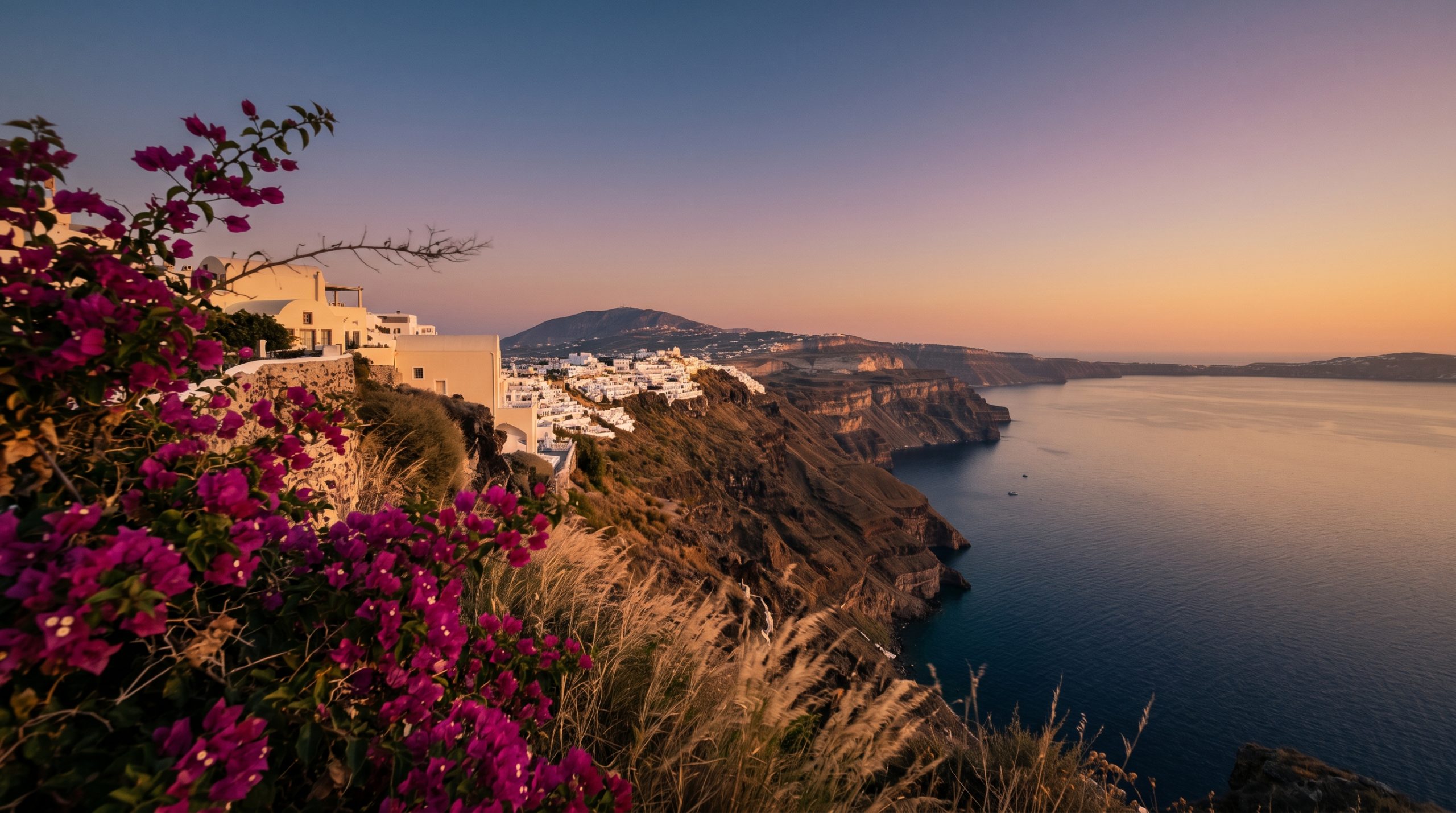
In late June the sun leaves the caldera at 20:41, and it goes down at roughly 300 degrees on the compass, which puts it over open water north of Thirasia. By late October it drops closer to 255 degrees, straight down behind Thirasia’s northern tip, under four kilometers across the water from the Oia castle. Same viewpoint, different island in the frame, different hour on the clock.
That is the kind of detail that decides where two people stand on a caldera evening, and almost nobody checks it before booking. Santorini is not a difficult island to photograph. It is a difficult island to photograph without four hundred other people in the shot, and the whole difference between those two things is a schedule.
We are Unmapped Stories, eight photographers and filmmakers who plan destination elopements and then shoot them ourselves. This page covers what a film costs here, what a second camera changes on a caldera rim, and how a day gets built around the island’s own clock rather than a template.
What we cover on Santorini, and where it starts
We photograph, film and plan Santorini elopements as one service, the same eight people doing all three. Choose one full day with a dedicated photographer or filmmaker, one full day with both working together, or two to seven days across the Cyclades. Team travel to Greece is included, and coverage begins on our pricing page.
Dawn on the east coast, blue hour above the caldera
The caldera faces west. Everything follows from that. There is no sunrise over the water from Oia or Imerovigli, because the sun comes up behind you, over the island’s own spine, and direct light lands on the rim a few minutes later than the printed sunrise time. What you get instead is better than a sunrise over water: warm frontal light on the whitewash, cold blue shade still sitting in the cliff below it, and empty lanes.
If you do want the sun climbing out of the sea, that is the east and south coasts. Kamari and the pumice cliffs at Vlychada are about half an hour’s drive from Oia, and both are ours at that hour.
A mid-September day runs like this. First usable light around 06:35, sunrise 07:01, and an hour and a half on the rim before anyone else is on it. Coffee, a change of clothes, then the middle of the day handed back to you, because between eleven and four the paths are full and the light is directly overhead. Late afternoon depends on the wind, which we come back to. Sunset at 19:26, then a 26 minute run of blue hour while the village lights come on and the sky goes properly deep. By nine the lanes are quiet again, which is when the night frames get made.
The June day and the October day are two different days
In mid-June, first light arrives at 05:29 and sunset is not until 20:38, with blue hour holding until about 21:09. That is a fifteen hour envelope, an alarm before five, and a genuine dinner break in the middle. By 25 October the same day has folded in on itself: sunrise 07:35, sunset 18:30, everything closer together and cooler on the rim. Neither version is better. They need different timelines, and building the wrong one is the single most common way a Santorini day gets wasted.
The sunset crowd, and the two hours nobody uses
Santorini now works to a cap of 8,000 cruise passengers a day, and it is still busy. The two hours before sunset at the Oia castle are the densest patch of ground on the island. We will say plainly what a competitor might not: that spot is not worth it. You are shoulder to shoulder, there is no room to move, and the sun is setting directly into the lens, so faces go flat and dark unless the whole frame is built around backlight. We do not put a ceremony there.
What works instead is a short list we keep updating. The footpath above Imerovigli, where the rim bends and the crowd thins within ten minutes of walking. The saddle below Skaros Rock. Water level at Ammoudi. The inland villages, Pyrgos and Emporio and Megalochori, where the alleys are narrow and shaded and nobody is looking for a view. And the twenty minutes after everyone else has decided the show is over.
Access at Ammoudi is worth a sentence of its own, because it changes. As things stand, the road down from the Oia ring road junction is closed to general traffic, supply vehicles run between 5am and 10am, and the municipality operates a small number of passenger vehicles for visitors. The walking path from Oia down to the bay is open. We confirm the arrangement in force for your actual date before a sunset at water level goes into the plan.
What motion does to whitewash, wind and water
Santorini is a still island. No forest to move, no waterfall, no long grass. The things that actually move here are the wind, the sea, the ferries crossing to Thirasia, a cat on a wall, the bells, and the two of you. That is a short list, and it is exactly why the film matters more here than in places with more going on. A still frame gives you one instant of a veil in a north wind. The film gives you twelve seconds of that fabric doing something nobody directed, against a wall that has not changed in a hundred years.
The wind is the meltemi, a northerly that runs through the Aegean summer and peaks from mid-July to mid-August. It builds through the afternoon and early evening and usually eases at night. That single pattern reorganizes the day: exposed rim work goes to the morning in high summer, the sheltered inland courtyards take the afternoon, and vows get placed against a wall or in a courtyard rather than out on an open terrace at six in the evening. On the Expedition, where professional audio is part of the coverage, that choice is the difference between hearing what you said to each other and hearing air.
Aerials are the other thing a caldera is made for, because the drop is the subject and only a drone reads it properly. Greece follows the European rules through the Hellenic Civil Aviation Authority: operators register, the open-category ceiling is 120 meters above ground, geographical zones apply, and flying over assemblies of people is out. The archaeological sites, Akrotiri and Ancient Thera, sit under the Ministry of Culture, which issues filming permits and calculates the fee case by case, with aerial work one of the factors that moves it. So aerials get planned for dawn, over open ground, with the permissions confirmed before the film is built to depend on them.
Here is the part that only shows up on the ground. A caldera footpath is a wall on one side, a drop on the other, and about the width of two people. One camera has to be in front, and whoever is in front is in the other one’s frame. When a photographer and a separately hired videographer meet for the first time on the morning, that gets negotiated in the alley, at 07:05, in the best light of the day. We settle it the night before, because we are one team with one timeline, and because with eight of us there is always a second camera on the ground and a colleague in reserve. You can see what that looks like finished, film and stills from the same hours, in our published stories and films.
What travels with us, and where coverage starts
In every Santorini experience
- Destination and location design, and a custom timeline built around real light and real travel time on the island
- Permit research and logistics guidance, including the municipality paperwork sequence and site permissions
- Weather alternatives and backup planning, with a sheltered option held for every exposed location
- Drone footage where it is legal, safe and appropriate
- Professional audio for vows and meaningful moments on the Expedition, where conditions allow
- Team travel worldwide, included: flights, accommodation and ordinary travel for the assigned team
- Highlights delivered in 5 days, and the full gallery or film in 3 weeks
- A price that does not change with guest count, because guests affect access, transport and timeline rather than the fee
Where the numbers start
The Adventure is one full day with one dedicated photographer or one dedicated filmmaker, from $4,900. The Expedition is one full day with a dedicated photographer and a dedicated filmmaker working together, from $7,900. The Odyssey covers two to seven days, photography and film, one destination or several, and is quoted as a custom proposal. There is no half day. We currently have Santorini elopement dates available through 2027–2029.
Getting us to Santorini is our cost, not yours, and that is true of every destination we work in. What Santorini adds on top is paid locally in euros: government and municipality fees for a civil ceremony, the celebrant, a private terrace or venue fee where the ground belongs to a hotel, and the Ministry of Culture filming fee if the film includes an archaeological site, invoiced by the competent service before the date. Accommodation and vendors are yours, as is anything unusual on the transport side, such as a private boat out into the caldera. We will tell you which of those your plan actually triggers before you commit to it. Check Your Date and we will come back with the shape of it.
How a Santorini film date moves from enquiry to hold
- Send the inquiry form with your dates, your rough headcount and what you picture.
- We reply within 24 hours with an initial brochure.
- We write you a tailored proposal for the day and team you actually need.
- You sign the contract and pay a 30% retainer. The rest of the schedule is set out in the proposal.
- Planning begins: locations, timeline, permit research, and the alternatives for wind and heat.
- The day itself, then highlights in 5 days and the full delivery in 3 weeks.
If you are earlier than that and still working out the order of the pieces, start with our guide to how eloping actually works and come back to us with questions.
Who the caldera suits, and which month suits you
This island rewards couples who will be up before five in June, walk on uneven stone in whatever they are wearing, and let the plan move on the morning when the wind swings north. The Karavolades stairs down to the old port run to nearly 600 steps. The Ammoudi path is not a staircase you take lightly in a long dress, though plenty of people do, and we plan the shoes.
If a pre-dawn alarm is not your idea of a good start to a marriage, say so in your first message. There are two honest answers and both of them are ours. Late October gives you a 07:35 sunrise and cool air on the rim, which is a civilized way to get the same empty lanes. Or we build the day from the afternoon forward, use the inland villages while the coast is busy, and put everything into sunset and the blue hour after it. Couples who want warm water and a 21:00 blue hour take June or July and accept the early alarm. Couples who want the caldera to themselves take the shoulder months. Tell us which of those sounds like you, and if a different month or a quieter island fits it better, we will say so. Our destination guides are a good place to compare before you decide.
Common questions
Can we legally get married on Santorini as Americans?
A civil ceremony is arranged through the Municipality of Thira. Documents such as full birth certificates and proof that you are free to marry need an apostille and a Greek translation before the municipality will accept them, and the ceremony is scheduled once they are approved. We research the current requirements and guide the sequence and timings. The fees themselves are paid by you.
Are drones allowed over Oia and the caldera?
Under the rules the Hellenic Civil Aviation Authority applies, operators register, the open-category ceiling is 120 meters above ground, published geographical zones apply, and flying over assemblies of people is not permitted. Akrotiri and Ancient Thera additionally need Ministry of Culture permission, with the fee calculated per application. We fly aerials at dawn over open ground and confirm every permission before the film relies on them.
Will other tourists end up in our photographs?
Not in the frames that matter, if the day is timed properly. Between first light and about half past eight the rim is genuinely quiet, and the twenty five minutes after sunset empty out fast because most visitors leave the moment the sun is gone. The middle of the day is crowded everywhere on the caldera, so we do not schedule anything important into it.
What happens to the sound in our film if the meltemi is blowing?
We move the vows, not the microphone. The meltemi peaks from mid-July to mid-August, builds through the afternoon and eases at night, so in those weeks vows go into a sheltered courtyard in Pyrgos or against a wall in Oia, and the exposed rim gets used for the wide film frames where wind is an asset. The Expedition includes professional audio for exactly this reason.
Can we still get down to Ammoudi Bay for sunset?
The walking path from Oia down to the bay is open, and the road from the ring road junction is currently closed to general traffic with municipality-run vehicles handling visitors and supply vehicles allowed between 5am and 10am. Arrangements at Ammoudi change, so we check what is in force for your date and build the descent into the timeline rather than assuming it.
How soon do we see the photos and the film?
Highlights land 5 days after your day, which is usually while you are still in Greece. The full gallery or the finished film follows within 3 weeks.
Do we pay for your flights and hotels to Greece?
No. Flights, accommodation and ordinary travel for the assigned team are included, in Santorini and in every other destination we work in. There is no European or long-haul distinction and no travel line item to negotiate.
Can we add a second island after Santorini?
Yes, and it is often the better film. Two to seven days across one or several destinations is the Odyssey, planned as a custom proposal around ferry times and light rather than around a package. A quieter Cycladic island the morning after the caldera day gives the story somewhere to go.
The next thing that happens
Everything between your first message and your morning on the rim happens in writing. The brochure, the proposal, the timeline, the wind alternatives, the permit sequence: all of it arrives as something you can read in your own time zone and answer when you feel like it. Send us your dates and the version of Santorini you have in your head, whether that is 05:29 on an empty footpath or a long October evening, and we will write back with the day we would build for it. Tell Us Your Story.