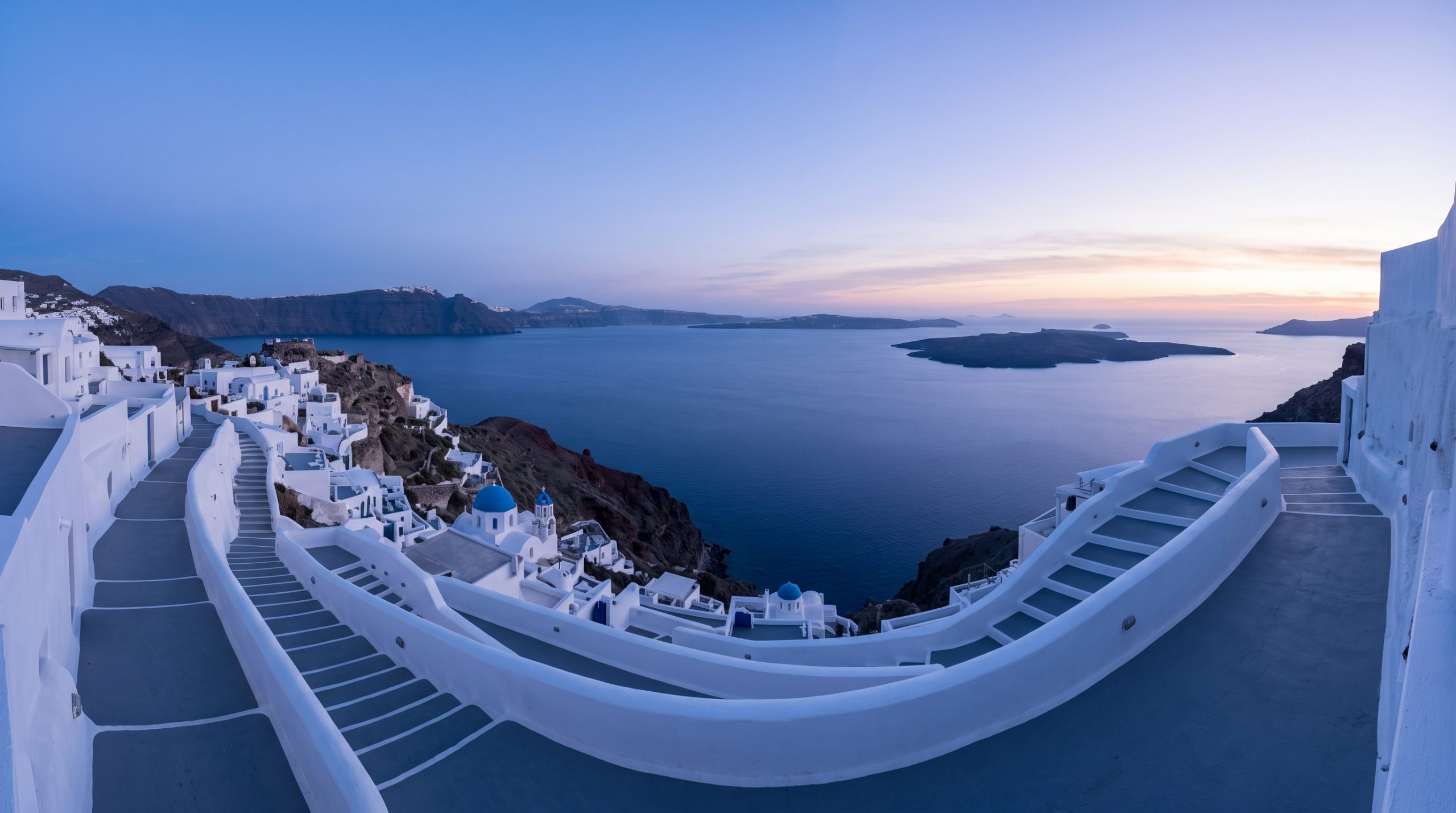
Mid-May, ten past six in the morning, on the footpath between Imerovigli and Oia. Two people, a church bell, and a cat that follows you for a hundred meters. By half past nine the same stretch of path is a slow-moving line of day visitors. Nothing about Santorini is quiet by chance, and nothing about it is hopeless either. It is a timing problem with a known answer.
The answer starts at the port. Santorini works to a hard daily ceiling of 8,000 cruise passengers, and the ships that fill it are scheduled into a tight band between 07:00 and 08:00. Almost everything you have read about crowds on the caldera happens downstream of those two hours.
This is the operational version of a Santorini elopement: the drive times to plan on rather than the ones your phone shows, sunrise and sunset by month, where to sleep if you want to be standing on the rim at 06:20, and which pieces carry a lead time long enough to change your date.
The window that belongs to you
Santorini is genuinely empty from first light until around 09:00. Cruise arrivals are capped at 8,000 passengers a day and cluster between 07:00 and 08:00, and the flow ashore takes another hour to reach the rim villages. Vows at sunrise on the caldera, then the south of the island by mid-morning, gives you a private day.
What the 8,000-passenger cap actually changed
The cap is the most useful fact in Santorini planning. The island holds cruise arrivals to 8,000 passengers a day, and for 2028 the port counts each ship at its full berth capacity rather than the 80 percent it assumed the season before, which tightens how many ships fit into one day. Passengers going ashore also pay a landing levy that reaches 20 euros a head at the peak of the season.
What matters to your morning is the shape of the arrival rather than the total. Ships come alongside between 07:00 and 08:00 and most are away again by early evening. The move ashore is metered rather than instant: passengers are landed in batches, and the cable car up to Fira lifts a car every twenty minutes. Thousands of people do not materialize in Fira at once. They build across the morning, and Oia, eleven kilometers further along the rim, fills noticeably later than Fira does.
So the day divides cleanly. Before 08:00 the rim is yours. From roughly 10:00 to 17:00, Fira and Oia are busy working towns and no amount of clever framing changes that. Once the ships leave, the crowd on the caldera becomes land-based instead of ship-based, and it goes to one place.
That place is the castle at the western tip of Oia, and this part is worth saying plainly. At sunset it is a viewing gallery, people standing shoulder to shoulder along the walls with phones up. The light out there is as good as its reputation. The position is not, and we do not put a ceremony hour in it.
Hour by hour on real Santorini light
Sunrise and sunset shift by more than two hours across the season here, and the two ends of the day do not move together. Plan the timeline on the month, not on an average.
| When | Sunrise | Sunset | What it does to the day |
|---|---|---|---|
| Mid-May | 06:10 | 20:15 | Fourteen hours of daylight. Holding both ends means two separate blocks with a long gap. |
| Late June | 06:00 | 20:40 | The latest sunset of the year and the widest gap between first and last light. |
| Mid-August | 06:35 | 20:10 | Hottest middle hours and the most reliable wind on the rim. |
| Mid-September | 07:00 | 19:25 | The most human-sized day of the year on this island. |
| Mid-October | 07:20 | 18:50 | Short enough to hold sunrise and sunset in one comfortable day. |
| End of October | 06:35 | 17:25 | The clocks go back on the last Sunday in October and sunset lands before dinner. |
Here is a September day, built on that 07:00 sunrise and 19:25 sunset.
- 05:45 Getting ready indoors with the lamps still on. The lanes outside are empty enough to hear the wind in them.
- 06:20 Out on the rim in blue hour. The sun comes up behind the island rather than over the caldera, so the west-facing walls sit in soft, even light for a while before anything hardens.
- 07:00 Sunrise, and vows on a rim terrace or on the path above Imerovigli.
- 07:50 The first ships come alongside. We are already walking in the other direction.
- 08:30 Breakfast off the rim, dress hung up, shoes off.
- 09:30 South. The black sand and striped cliff at Vlychada, then the Akrotiri side of the island.
- 12:00 Off the clock through the heat. Nothing photographs well at two in the afternoon in Santorini, and pretending otherwise wastes the part of the day you should be resting.
- 17:00 Inland to Pyrgos, where the lanes climb and the vines grow low and coiled against the wind.
- 18:40 Back to the rim for the last forty minutes of light, well away from Oia’s castle.
- 19:25 Sunset, then dinner with no timeline attached to it.
The two ends of that day look nothing alike, and that contrast is the reason we shoot both. Our published elopement stories and films show how a Santorini morning reads against a Santorini evening: the empty blue-hour rim, then the same cliffs warm and gold after the ships have gone.
Where the map lies between the airport and the rim
Santorini is small enough to cross in under an hour, which is exactly why route planners get it wrong. There is one main road spine, the road passes through villages rather than around them, and in the last hour before sunset the traffic all moves the same way, toward Oia.
| Route | Distance | Map time | Plan on |
|---|---|---|---|
| Airport (JTR) to Fira | 6 km | 10 min | 25 min |
| Airport (JTR) to Oia | 17 km | 25 min | 40 min |
| Fira to Oia by car | 11 km | 12 min | 25 min, and double that in the hour before sunset |
| Fira to Oia by KTEL bus | 11 km | 20 min | 35 to 45 min with the wait, roughly hourly |
| Fira to Oia on the caldera footpath | 10.5 km | 2.5 hours | 4 hours with stops, plus an hour for the Skaros detour |
Two things follow from that table. The bus network hubs at Fira station, and the airport service runs from about 06:15 in the morning until about 23:00, so a 05:45 start is never a bus start. And taxis are not a plan: the island’s licensed fleet is roughly forty cars in total, arranged in advance rather than waved down outside a hotel.
Nothing with wheels reaches the caldera edge either. The last stretch of every arrival on the rim is lanes and steps, and dress bags and camera cases go down them by hand. The Fira to Oia footpath is a genuinely fine walk and it is not a wedding-clothes route in August, because 10.5 km of exposed rim has almost no shade on it. We use short sections of it, in the direction that keeps the sun behind you.
Choosing a base you can leave at 5am
Sleep as close as possible to whatever the first hour is built around, because the drive at 05:45 is the one you will resent. Oia sits 17 km from the airport, the furthest of the rim villages, and it is the right base only if the morning happens on that end of the caldera. Imerovigli is the high point of the rim with Skaros below it, and its lanes empty out earlier in the evening and stay quieter at dawn. Firostefani gives you the same caldera line with a walk into Fira for anything you forgot.
Inland changes the arithmetic. Pyrgos is high and cool at night, out of the rim traffic completely, and the pre-dawn road from there is empty, which is exactly what you want at that hour. The Vlychada and Akrotiri end trades caldera views for black sand and space, and it works well as a base for a two-part day. Our destination elopement guides go further into how the villages differ once you are actually staying in them.
Paperwork, drone files and lead times that bite
A civil ceremony on the island is applied for through the Municipality of Thira, in Fira. American documents need an apostille from the state that issued them and a certified translation into Greek, which is the step couples underestimate, because it runs through a state office and a translator rather than anything on the island. We research the requirements and build the timeline around them, and the government, venue and landowner fees themselves are paid by you. Our guide to planning an elopement covers the sequence in general terms.
Aerials work the same way, just with a different authority. Drone flying in Greece runs through the Hellenic Civil Aviation Authority. Any camera-equipped drone needs operator registration regardless of how little it weighs, a pilot flying here needs a remote pilot certificate issued inside the European system, and the flight itself needs an application for the area you intend to fly. Registration alone takes several working days, and the area application sits on top of that, so we settle aerials months ahead rather than in the week of your date. Where a specific location cannot be cleared, we design the film so it never depended on the air in the first place.
The rest of the lead time is accommodation and us. We are currently booking 2027, 2028 and 2029, and planning starts once the contract is signed and a 30% retainer is paid.
How we build the day around the ships
We fix the ceremony hour first and bend everything else around it. On Santorini that means it never sits against the 07:00 to 08:00 arrival band, and never against a ferry departure if you are carrying on to another island afterwards. Every drive in the timeline is written with the plan-on number from the table above, so a delay behind a cement truck in Firostefani costs you nothing that matters.
Having photography, film and planning inside one team is not an abstraction on an island this tight. At 06:20 one of us is with you on the terrace while the other is already two hundred meters along the rim, standing in the spot you will walk to, checking whether the light has cleared the ridge yet. Two vehicles, two full sets of gear, and eight people on the team means a colleague in reserve rather than a single point of failure at the far end of a long flight.
The Expedition adds professional audio for vows, and Santorini is a place where that shapes the plan. The meltemi comes over the rim hardest in July and August, so we hold a courtyard or a wall-sheltered corner for the vows themselves and keep the open rim for everything after. Weather alternatives are built the same way, always closer than you think and always scouted, not guessed. One full day with a dedicated photographer or filmmaker starts at $4,900, the version with a photographer and filmmaker working the day together starts at $7,900, and the multi-day Odyssey is quoted per plan on our pricing page.
If you have a month in mind and want to know what your morning would realistically look like, check your date and tell us how early you are willing to be awake.
Common questions
What time do we have to start to have the caldera to ourselves?
In September, indoors at 05:45, on the rim by 06:20, vows around the 07:00 sunrise. In late June sunrise is 06:00, so the whole plan moves an hour earlier while the ships still arrive at the same time, which leaves a shorter free window rather than a longer one.
Which month gives us the quietest rim and a day we can actually stand?
Late September and October. Sunset falls from 19:25 in mid-September to 18:50 in mid-October, so sunrise and sunset fit in one day without a six-hour hole in the middle. After the clocks go back on the last Sunday in October, sunset is 17:25 and the whole day compresses again.
Do we need a rental car, or can we manage on buses and taxis?
You need a car or a private driver. Buses route through Fira station and start at about 06:15, which is too late for a sunrise on the rim, and the island’s taxi fleet is only around forty cars. We build transport into the timeline and tell you which legs are worth a driver rather than your own steering.
Can Americans get legally married on Santorini?
Yes. A civil ceremony is applied for through the Municipality of Thira, and your documents need an apostille from the issuing state plus a certified Greek translation. We research what your specific paperwork needs and schedule it backward from your date. The government and venue fees are paid by you.
Can you fly a drone over the caldera on our wedding morning?
Where it is legal, safe and appropriate, yes. It runs through the Hellenic Civil Aviation Authority: operator registration, a remote pilot certificate from inside the European system, and an application for the specific area. Registration alone takes several working days, so this is confirmed early in planning, never on the morning.
Is Oia at sunset worth it on the wedding day?
Not for the ceremony. The castle walls fill with people standing shoulder to shoulder, and a ceremony there is a performance for strangers. We put your last light on another part of the rim, and if you want the famous view you can walk in afterwards as two guests among many rather than as the couple everyone turns to look at.
What does the wind do to a dress on the caldera?
It moves everything, and in July and August it does it all day. Choose a fabric that reads well in motion rather than one that only works still, bring flat shoes for the rim steps, and expect hair to be part of the picture. For the vows themselves we hold a sheltered corner so the words are audible on the film.
How far ahead should we book a Santorini elopement?
We are booking 2027, 2028 and 2029. Rim accommodation with a caldera view is the piece with the longest queue, so the base is usually the first thing we settle with you, and the rest of the day is built outward from where you sleep.
Where your Santorini day starts
Send us the month you are considering, the shape of morning you can honestly imagine yourselves enjoying, and whether the two of you want the rim, the black sand or both. If the month you have picked fights the day you have described, we will tell you which weeks fit it better. Everything with us happens in writing rather than on a schedule: the inquiry form comes back within 24 hours with an initial brochure, then a tailored proposal for your date. Tell Us Your Story.