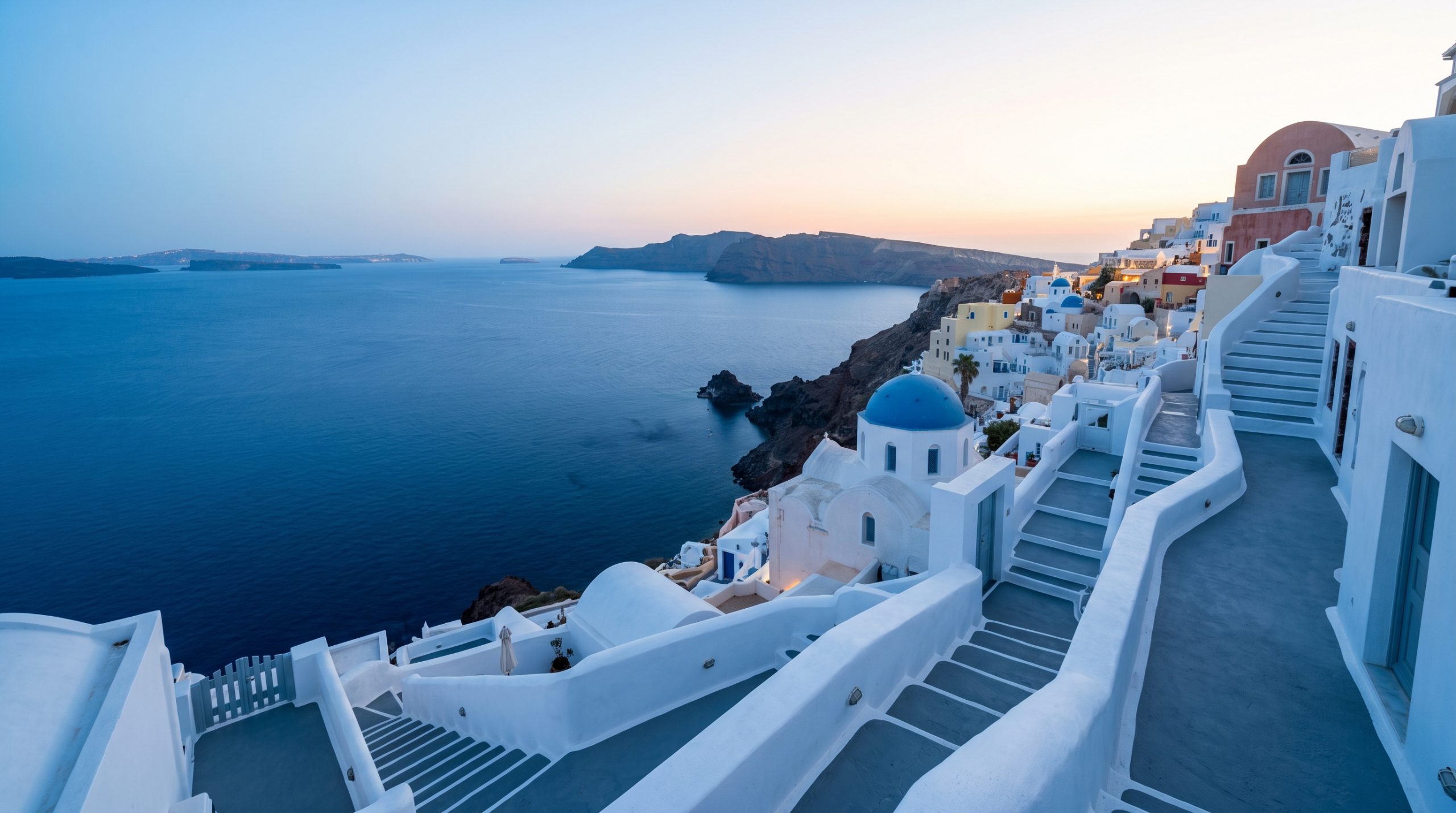
At the June solstice the sun clears the horizon over Santorini at six in the morning, and first light is already on the caldera by half past five. That half hour is the reason we ask couples to be dressed, out of the door and on the cliff path by five.
The rest of the reason is arithmetic. The island’s own port authority counts around 900,000 cruise arrivals a year, and the cable car that lifts them from the Old Port up into Fira is rated at roughly 1,200 passengers an hour. None of that has begun at 05:10. The path between Imerovigli and Oia at that hour holds a delivery van, two cats and whoever else decided sleep was negotiable.
Then there is the wind, which decides more about how a dress behaves than any planning guide admits. This page is logistics rather than a love letter. The times, the drives, the month-by-month numbers, and what we do with all of it when we build your day.
The reason the alarm goes off at 4:40
In mid-June, first light reaches Santorini around 05:30 and the sun is up by 06:00. A 4:40 alarm puts you on the caldera rim in blue hour, married in the first warm light at about 06:15, and sitting down to breakfast before the day’s first coach parks in Oia. The wind is also at its quietest.
First light, sunrise and the hour the island wakes
Sunrise shifts by an hour across the season, so 5am is a June and July number rather than a rule. The times below are for Santorini and hold to within a minute or two from year to year. The last column is the point where the sky stops giving you anything to work with.
| When | First light | Sunrise | Sunset | Light gone |
|---|---|---|---|---|
| Early May | 06:00 | 06:25 | 20:05 | 20:35 |
| Mid-June | 05:30 | 06:00 | 20:35 | 21:05 |
| Mid-July | 05:40 | 06:10 | 20:35 | 21:05 |
| Mid-August | 06:10 | 06:35 | 20:10 | 20:35 |
| Mid-September | 06:35 | 07:00 | 19:25 | 19:50 |
| Mid-October | 07:00 | 07:25 | 18:45 | 19:05 |
Two things fall out of that table. The earliest sunrise of the year lands on 13 June, and a mid-June day runs fifteen and a half hours from first light to the last of the blue. By mid-September that same dawn shape begins at 06:35 and the whole usable span has shrunk to a little over thirteen hours, which is a far kinder day to be married inside.
04:40 to 10:00 on the caldera rim
04:40. Alarm, and coffee that somebody set up the night before. Hair and makeup should be finishing at this point rather than starting, which means the clock runs backwards from here and we will tell you exactly how far back in your timeline.
05:00. Out of the door. In Oia and Imerovigli the good ground is walkable from the cave houses, and that single fact is the strongest argument there is for sleeping on the rim rather than down at the beaches.
05:15. Blue hour on the whitewash. The village reads cool and grey, the caldera is still ink, and the only sound is a generator somewhere below you. This is the quarter hour people do not know exists, because they have only ever seen these villages at 8pm.
05:30. First light. The sun comes up behind you, over the island’s high inland ground, so the cliffs opposite and Thirasia across the water turn warm while you are still standing in shade. Faces stay soft for another twenty minutes or so.
06:00. Sunrise. We do not put the vows on this minute, because the light is at its best a little after it.
06:15. Ceremony. Fifteen minutes past sunrise the sun is low and warm and it holds that way for a good half hour, long enough for a real ceremony rather than a rushed one. If you have brought guests, this is where their walk from the hotel gets built into the plan.
06:45. Down toward Ammoudi Bay, or along the rim, depending on wind direction. We drive the Ammoudi road rather than take the stepped path from below Oia castle, which is steep, uneven and completely unshaded, and which nobody should meet in ceremony shoes.
07:30. The first walkers appear on the castle path. From here the rim stops being yours, and the difference between 07:30 and 09:00 in Oia is the difference between two photographs.
08:15. Breakfast, still in the dress if you want it, and the tenders are only just starting to move in the caldera below.
10:30 to 17:00. Nothing. August afternoons sit around 29 to 31 degrees Celsius, in the mid to high eighties Fahrenheit, and the wind is climbing all the while. This gap is not laziness, it is what makes a second evening block possible.
18:30 onward. Optional and worth it: the inland villages, the vineyards, or the dark sand on the east coast, then sunset at 20:35 in June and blue hour until 21:05. The finished work from a day built this way carries two completely different light signatures, which is easiest to understand by looking at full galleries and films from days we have shot. Your highlights come back within 5 days and the full gallery or film within 3 weeks.
Where the map lies: eleven kilometres, forty minutes
Santorini is small, and that is exactly what fools people. Fira to Oia is about 11 kilometres of road and a route planner puts it at thirteen to seventeen minutes. We plan on forty. There is one coast road, it passes through Firostefani and Imerovigli with no room to overtake, and it carries buses, delivery vans, quad bikes and pedestrians who are looking at the view rather than at the traffic.
| Leg | What the planner says | What we put in the timeline |
|---|---|---|
| Fira to Oia by road, 11 km | 13 to 17 minutes | 40 minutes in season |
| Fira to Oia on the cliff footpath, 10.5 km | 2.5 hours | Half a day, in trainers, on a different date |
| Oia down to Ammoudi Bay | A few minutes on foot | 20 minutes by road, with the car waiting |
| Old Port to Fira by cable car | A 3 to 5 minute ride | Never on the wedding morning |
The Fira to Oia footpath deserves its reputation. It is roughly 10.5 kilometres along the rim, most people take between two and a half and five hours, and adding the Skaros Rock spur puts another hour on it. It is also completely the wrong way to move between two locations on your wedding morning. Walk it in trainers on the day before or the day after, and let us drive you on the day itself.
The public buses run between Fira and Oia roughly hourly, take about twenty minutes and cost two to three euros, which is a good way to explore the island and a poor way to arrive at your own ceremony. And if you are staying in Kamari or Perissa, understand that a dawn ceremony on the rim means a pre-dawn drive across the island in the dark, on the same road, with a wedding dress in the back seat. Sleep where the ceremony is. If you are still deciding between islands rather than between villages, our destination elopement guides are the better starting point.
Getting to the island at all is straightforward, with a caveat about timing. Santorini airport has no long-haul services beyond the Middle East, so American couples connect through Athens or a European hub, and the Athens run is dense: around 110 flights a week between the two, roughly sixteen a day. That density is your friend. A missed connection costs you hours rather than the date, as long as you have arrived with days to spare rather than hours.
What the wind is doing at five in the morning
The meltemi is a dry northerly that blows across the Aegean from roughly mid-May to mid-September, peaking between mid-July and mid-August, commonly at force 4 to 7 on the Beaufort scale through the Cyclades. Its pattern is the thing worth planning around: strongest through the afternoon and early evening, easing overnight. Five in the morning is the calmest air Santorini gives you all day.
That changes what you can wear and where. At 05:30 a cathedral veil, a long train and unstructured chiffon all behave. At 18:00 in early August the same veil is a two-person job and the same chiffon is a flag. If your dress has a train and you want it in the film, the dawn block is where that happens.
Footwear is the other thing couples underestimate. The rim paths are cobbled, stepped and uneven, and they are polished smooth in places by a century of feet. Flats or trainers for everything between locations, the good shoes going on when we are already standing where the vows are. Bring one layer with some weight in it for the first hour, because the cliff edge is genuinely cool before the sun arrives, and it comes off by 07:00. Jackets are the same story in reverse in August: on for the ceremony, off for the walking.
Aerials at first light, and what we confirm before planning them
Greece runs drone operations under the European framework, with the Hellenic Civil Aviation Authority as the licensing body, a registered operator ID on the aircraft, and the official Drone Aware GR map as the reference for zones. The airport zone covers part of the island, and archaeological sites sit under the Ministry of Culture with their own separate permission route. Dawn is the best window for aerials anyway, with calm air and almost nobody underneath.
What matters for your film is the order of operations. We confirm the zone and the permission before we design a sequence that depends on aerials, and we always hold a version of the film that stands up without them. Permission research and logistics are part of what we do; any government, venue or landowner fee is paid by you.
How we build a dawn day that holds
A 4:40 start has no slack in it, so the slack has to be engineered. We scout the exact ground the morning before, at the same hour, because a cliff path at 05:15 in June is a different place from the same path at 11am on a scouting walk. We keep a second location in reserve fifteen to twenty minutes away, chosen for a different wind direction, so a northerly does not cost you the ceremony. And we never put the ceremony hour immediately after a drive that has to work perfectly.
Photography, film and planning come from one team here, which stops being an abstraction at 04:45 on a Santorini morning. Two vehicles leave, not one. Your filmmaker can be in position on the rim holding the frame while your photographer walks with you out of the hotel, and neither of them is introducing themselves to the other in the dark. There are eight of us, so there is a second set of bodies and gear in reserve, and the assigned team’s flights and accommodation are included wherever the destination is. Coverage options, from a single-day experience to a multi-day one, are laid out on our pricing page. If you want the legal side handled in parallel, civil ceremonies here are registered through the Municipality of Thira and your documents need an apostille and a Greek translation before they are submitted, which is the kind of sequencing our guide to planning an elopement walks through.
One honest note about fit. Santorini at dawn is one of the great mornings anywhere, and it asks you to be awake at an hour that some couples will find joyless on their wedding day. That is a real preference, not a failing. Tell us what kind of morning you actually want and we will either shape the day around a later start or point you at the months where dawn arrives at a civilised hour. Check Your Date and tell us which one sounds like you.
Common questions
What time does the sun rise in Santorini in June?
In mid-June the sun clears the horizon at about 06:00, with first light on the caldera from around 05:30. The earliest sunrise of the year falls on 13 June. Sunset in the same month is around 20:35, and there is usable light until roughly 21:05.
Is a 4:40 alarm really worth it on our wedding morning?
For the rim villages, yes, and it is not only about crowds. You get the calmest wind of the day, low frontal light on the cliffs, and an hour or so before the first walkers reach the Oia castle path. If a very early start does not appeal, say so early and we will build a later shape instead.
Can we hold the ceremony in Oia itself at sunrise?
Often, yes. At 06:15 the rim is quiet in a way it never is again that day, and the same terrace at sunset is the busiest ground on the island. Which precise spots are usable depends on landowner and venue permission, which we research as part of your planning.
Do we need permission to fly a drone over the caldera?
Aerials in Greece run under the European framework with the Hellenic Civil Aviation Authority, using a registered operator ID and the official Drone Aware GR zone map. The airport zone covers part of the island and archaeological sites are governed separately by the Ministry of Culture. We confirm what is available at your location before we plan any part of the film around it.
Can we cover both sunrise and sunset on the same day?
In September and October comfortably, because the whole span from first light to last light is a little over thirteen hours. In mid-June it is fifteen and a half, so we split the day with a genuine midday break and one end becomes the main event. Couples who want both ends at full strength usually spread them across separate days with our multi-day Odyssey.
How many days before the wedding date should we arrive?
Two clear days on the island as a minimum, three if you are flying from North America. Paperwork with the Municipality of Thira happens locally, jet lag is real at 04:40, and the meltemi can rearrange ferry timetables in July and August. Your exact arrival date goes into the timeline we build with you.
Your dawn, and the month it belongs to
We are booking 2027, 2028 and 2029, and the first thing we will want to know is the month you have in mind, because that sets your alarm before anything else does. Send us the dates and roughly what you picture, and you will have a reply and our brochure within 24 hours. Everything happens in writing, at whatever pace suits the two of you, from the first message through to the timeline itself. Tell Us Your Story.