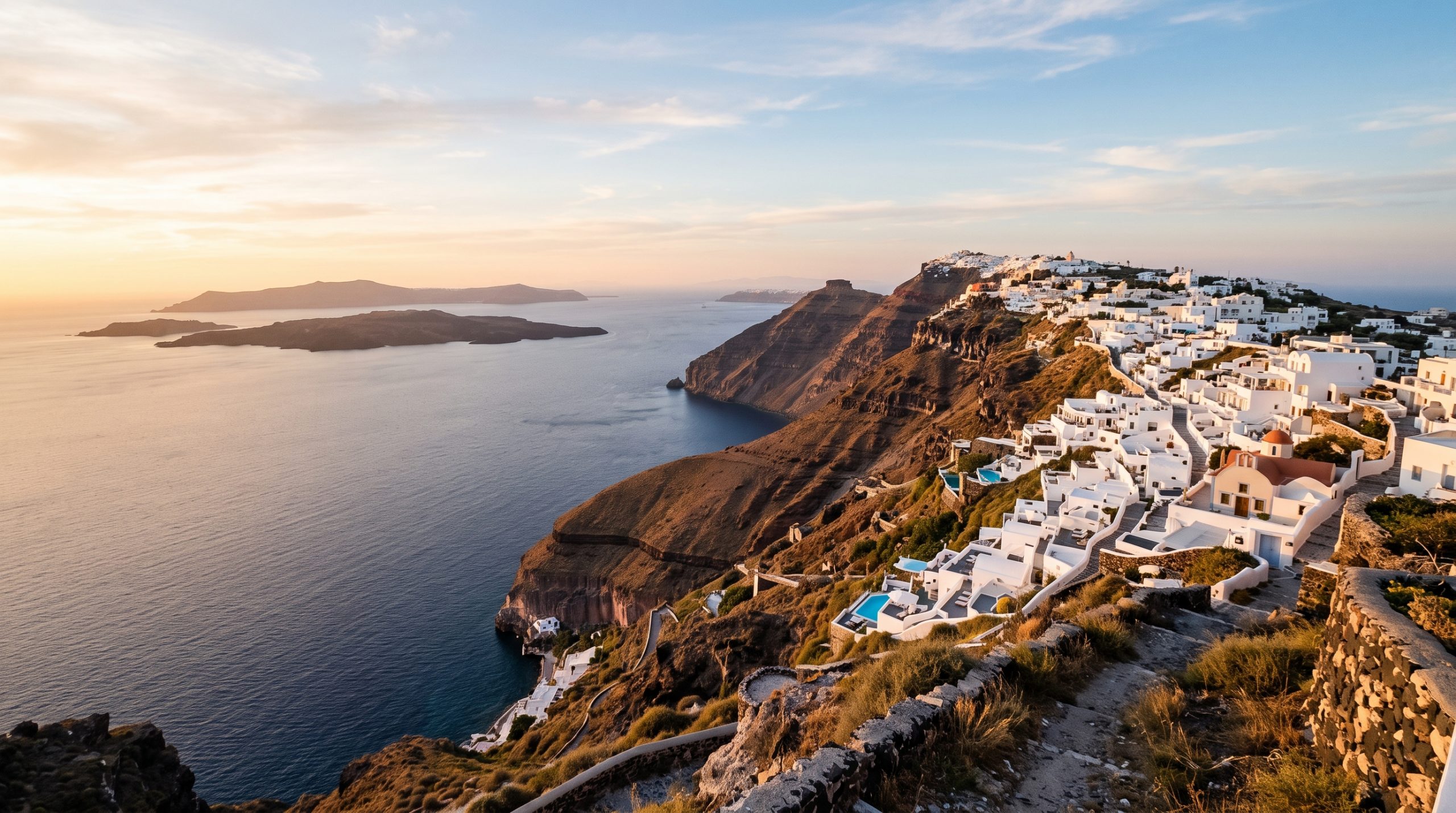
At 6:20 on a mid-September morning, the stone path between Imerovigli and Oia belongs to about four people and a cat. Sunrise is at 7:00, but the sun climbs from behind the island’s eastern ridge, so the first half hour up here is all reflected light. The lime-washed walls work like a reflector the size of a village, and nothing has a hard edge on it yet.
By eleven the same path is a different island. Santorini’s port now works to a daily ceiling of 8,000 cruise passengers, with a seasonal levy of up to 20 euros a head on top of it, on an island where roughly 15,500 people actually live. In 2023, before the cap came in, around 800 cruise ships called here.
None of that needs to show up in your photographs, and it does not have to shorten your day. It does mean the day has to be built the right way around: two working windows about twelve hours apart, and a long, unhurried middle where the island is busy and you are not.
One team, one island, three coverage lengths
We are eight people, four photographers and four filmmakers, and we cover Santorini ourselves: photography, film and the planning behind both. Coverage starts at one full day with a dedicated photographer or filmmaker, extends to a photographer and filmmaker working together, and runs up to two to seven days across one or several destinations.
Two windows a day: first light on the rim, half an hour after sunset
Santorini hands you two short windows and a big middle. In mid-September the sun is up at 7:00 and gone by 19:26, and the light worth planning around sits in the forty minutes either side of those two times. Everything between them is logistics: where you sleep, how far the car has to drive, which lane still holds shade at five in the afternoon. A September day looks roughly like this.
- 06:20 On the rim path above Imerovigli, fifteen minutes before the glow arrives at 06:34. This is the calmest air of the whole day.
- 07:00 Official sunrise, though the sun needs a few more minutes to clear the high ground inland. When it does land, the walls go from grey-blue to warm in about two minutes.
- 07:15 to 08:30 Vows on a private terrace. Shutters are down, the lanes are empty, and you can stand in the middle of a village and hear a church bell instead of a tour guide.
- 08:45 The stair down to Ammoudi Bay, close to 280 uneven steps below Oia. The water is flat, the tavernas are still closed, and the red cliff takes the early sun beautifully.
- 10:00 to 16:00 We stop. Ships alongside, sun straight overhead, heat building. Sleep, swim, eat, change. If you would rather keep moving, the south coast at Vlychada has pale wind-carved pumice cliffs and almost no one on them.
- 16:30 Inland to Pyrgos, Emporio or Megalochori: lava-stone walls, deep shade in the alleys, no coaches at all.
- 18:15 Back on the caldera rim, with the west-facing cliffs starting to warm up.
- 18:50 to 19:26 The last direct light on the cliff face. If you want your vows in this hour instead of the morning, this is where they go.
- 19:26 to 19:52 Twenty-six minutes of civil twilight, and the best of the day. The terraces empty within minutes of the sun going, taverna lights come up, and the whole rim holds a blue that no filter reproduces.
- 20:30 Dinner, plus a handful of night frames with village lights if you want them.
Shift the month and the whole structure slides with it, which is why we build the timeline after you pick a date rather than before.
| When | Sunrise, approx. | Sunset, approx. | What that does to the day |
|---|---|---|---|
| Mid-May | 06:10 | 20:15 | Long light, warm sea air, wind still mild most days |
| 21 June | 06:00 | 20:40 | Nearly fifteen hours between windows, so the midday break is compulsory |
| Mid-September | 07:00 | 19:25 | The easiest day on the island to shoot end to end |
| Mid-October | 07:20 | 18:50 | Dawn at a sensible hour, dinner straight after blue hour |
| After the clocks go back, late October | 06:35 | 17:30 | Sun down before dinner, so the whole plan moves earlier |
Sharing the rim with the day’s 8,000
The crowd here is real, and the useful thing about it is that it runs to a timetable. Ships come alongside through the morning and are gone by evening. Oia’s western terraces fill up an hour or more before sunset, then release just as fast; a local tour operator told CNN the streets are “silent by 9 p.m.”
So we work the edges of that timetable rather than pretending it does not exist. The morning window before the first tenders. Private terraces where the only people in the background are the two of you. The east coast and the inland villages, where almost nobody points a camera. And the blue-hour window straight after the terraces empty, which is the one moment when the most photographed view in the Cyclades is genuinely quiet. We also aim along the rim rather than at the three domes everyone queues for, because the caldera itself is the subject and it dwarfs anything anyone could stage in front of it.
Send us the month you are looking at and we will tell you which weeks in it hold up: Check Your Date.
Two cameras inside a twenty-six minute window
The case for photo and film from one team is not abstract on this island. It is those twenty-six minutes between 19:26 and 19:52, and the fact that vows get read once.
In that window a photographer wants to be close, two or three meters out, working the last warm light against a white parapet. A filmmaker wants the opposite: distance, a clean line for a gimbal move, and sound that is not mostly wind. On a rim path a meter and a half wide, two people who met that morning spend the window backing out of each other’s frames and negotiating in whispers. When it is one team, the walk is choreographed the day before. Who leads, who hangs back, where the two of them cross, which forty seconds belong to the film and which belong to the stills.
Santorini’s surfaces sharpen the point. At dawn the caldera cliffs face away from the sun and the sky does all the lighting, so a photographer can stand almost anywhere and be fine. Film is less forgiving: start a walking shot in the shade of a lane and finish it on a terrace in hard sun, and the two halves never quite match. So the film sequence is built to travel with the sun rather than across it, and the stills route fits inside that, instead of the other way around.
Then there is the wind. The meltemi, the dry northerly that runs down the Aegean in summer, peaks in the afternoon and early evening and is usually softest at first light, and it is a sound problem before it is a picture problem. The Expedition brings professional audio for vows and the moments that matter, and audio wants the sheltered side of a wall. That is why we schedule vows into the morning window when a couple is happy with it, and why we favor terraces that sit below the parapet line rather than on top of it.
Aerials work the same way. Greece follows the European drone framework, with flight notification filed in advance, and archaeological ground is closed to drones without written permission from the Ministry of Culture. We confirm where and when a drone can legally fly before we plan a shot that depends on one, and the caldera sequence is designed to stand up on its own if the answer is no. You can see how the stills and the film sit together in our published galleries and films, which is the closest thing to watching a day like this from the outside.
What sits inside every Santorini booking
- Destination and location design, and a timeline built around real light and real driving time. The map lies about Oia to Vlychada.
- Permit research and logistics guidance: which terraces belong to a hotel, which need the municipality, which are simply better at 07:00 than at 19:00.
- Weather alternatives and backup planning, written down before you fly, including the sheltered version of every exposed location.
- Drone footage where it is legal, safe and appropriate.
- Professional audio for vows and meaningful moments on The Expedition, where conditions allow.
- Team travel worldwide: flights, accommodation and ordinary travel for the assigned team.
- Highlights delivered in 5 days. The full gallery or film in 3 weeks.
Where coverage starts, and what Santorini adds in euros
Coverage starts at one full day. There is no half day, and that is a light decision rather than a commercial one: the two windows worth building a day around sit twelve hours apart, and a half day makes you surrender one of them.
| Coverage | Length | On the ground | From |
|---|---|---|---|
| The Adventure | One full day | One dedicated photographer or one dedicated filmmaker | $4,900 |
| The Expedition | One full day | A dedicated photographer and filmmaker, working together | $7,900 |
| The Odyssey | Two to seven days | Photography and film, one or several destinations | Custom proposal |
Team travel is inside those figures, worldwide, with no long-haul surcharge and no European exception: flights, accommodation and ordinary travel for the assigned team are covered whether the day happens on Thira or on the other side of the world. Guest count does not move the number either. A group of twelve changes access, permits, transport and timeline, not the fee. The full breakdown lives on our coverage and pricing page.
What Santorini adds on top, paid by you and quoted locally in euros:
- The civil paperwork. Documents apostilled and translated into Greek, then lodged with the Municipality of Thira. The Greek side carries small government charges through the online e-paravolo system, currently around 30 euros to authenticate a US affidavit of no impediment.
- The celebrant or registrar, and an interpreter where you need one. A Greek civil ceremony requires two witnesses, one of whom can interpret.
- Location fees. Many of the finest caldera terraces are hotel property, the owner sets the fee, and a few are closed to non-guests altogether. We tell you which is which before you book the room.
- Accommodation, flowers, hair and makeup, dinner.
- Unusual transport: a private caldera boat for the last hour of light, a helicopter, a 4×4 for the rough tracks in the south.
How a Santorini package becomes a held date
- You send the inquiry form with your dates, or just the month you are circling.
- We reply within 24 hours with our initial brochure.
- We build a tailored proposal: coverage shape, who from the team, a first sketch of the day.
- Contract signed.
- A 30% retainer holds the date, and the remaining schedule is set out in the proposal.
- Planning begins in earnest: locations, timeline, permit research, weather alternatives.
Our current Santorini availability runs across 2027–2029. If the legal side is happening in Greece rather than at home, that step starts early too, because the license is generally issued eight days after the application is lodged, and our planning fundamentals for eloping cover the order things need to happen in.
Who Santorini fits, and who we would move to September
This island rewards couples who are willing to be awake before the light. The 6:20 version of the caldera rim and the 11:20 version are not the same place, and the difference is an alarm clock. It also helps to have steady legs: 280 steps at Ammoudi, polished marble lanes in Fira, and stone paths with no handrail between the villages.
It suits couples who are relaxed about a plan that changes on the morning. If the meltemi is up, we swap the exposed terrace for the sheltered one and move the vows an hour, and the day is better for it.
If pre-dawn is genuinely not your idea of a good morning, say so in your first message. The evening window can carry a whole day on its own, and we will build the plan from 16:00 to nightfall instead. If what you want is the caldera without August heat and afternoon wind, mid-May, late September and early October are the weeks we would steer you towards, and we will tell you honestly which of them fits the shape you are describing. And if you want Santorini plus somewhere with no ships at all, that is the two-to-seven-day shape, built across more than one island. Our destination guides are a good place to see how those pairings work.
Common questions
Can we legally get married in Santorini as Americans?
Yes. A civil ceremony can be held anywhere in Greece, and the application is lodged with the Municipality of Thira with your documents apostilled and translated into Greek. The license is generally issued eight days after the application goes in and stays valid for six months. You need two witnesses, one of whom can interpret. Plenty of couples handle the legal step at home instead and hold the ceremony here without paperwork attached, and we plan both versions the same way.
Do you offer a half-day elopement package in Santorini?
No, our shortest coverage is one full day, and Santorini is the clearest example of why. The two windows worth photographing, first light on the rim and the half hour after sunset, sit about twelve hours apart. A half day forces you to pick one and lose the other, and the middle of the day is the part you were going to rest through anyway.
Can we have Oia at sunset without a hundred people behind us?
Yes, with timing rather than luck. The terraces pack out ahead of sunset and clear within minutes afterwards, so we put the ceremony and the closest work in the morning or in the twenty-six minutes of twilight that follow the crowd leaving, and we frame along the caldera rather than into the queue.
How windy is Santorini in July and August, and what does that do to the film?
The meltemi blows most reliably in July and August, strongest through the afternoon and early evening, and usually gentlest at first light. It affects sound more than pictures, so on wind-heavy days we move vows into the morning window, use terraces sheltered by a parapet, and keep a lower, calmer alternative fifteen minutes away.
Can you fly a drone over the caldera?
Where it is legal, safe and appropriate, yes. Greece follows the European drone framework with advance flight notification, and archaeological ground is off limits without written permission from the Ministry of Culture. We check the specific location and time window before we plan any shot around a drone, and the film is designed to work without one.
How many of you actually come to Santorini?
One dedicated photographer or filmmaker on The Adventure, and a photographer and filmmaker together on The Expedition. Because there are eight of us, there is always a colleague in reserve rather than a stranger subcontracted at the last minute, and the two people on your day already work together every month.
When do we get the photos and the film?
Highlights land within 5 days, while you are probably still on the island or on your way home. The full gallery or film follows in 3 weeks.
Which month gives us the caldera with the fewest people?
Mid-May, late September and early October give you warm stone, workable light and a thinner crowd than July. Watch the clocks in late October: once they go back, the sun is down around 17:30, so the whole day shifts earlier and dinner happens in the dark.
Your first message, and the next 24 hours
Everything we do together happens in writing. You send the form, we reply within 24 hours with our brochure, and the questions go back and forth by email at whatever hour suits you, which matters across the seven-hour gap between Greece and the east coast.
Tell us the dates you are considering, whether you want the sunrise version or the evening version, and how many people are coming. We will come back with a shape for the day, the light times for your exact date, and an honest word about the weeks that would serve you better if the ones you picked will not. Tell Us Your Story.