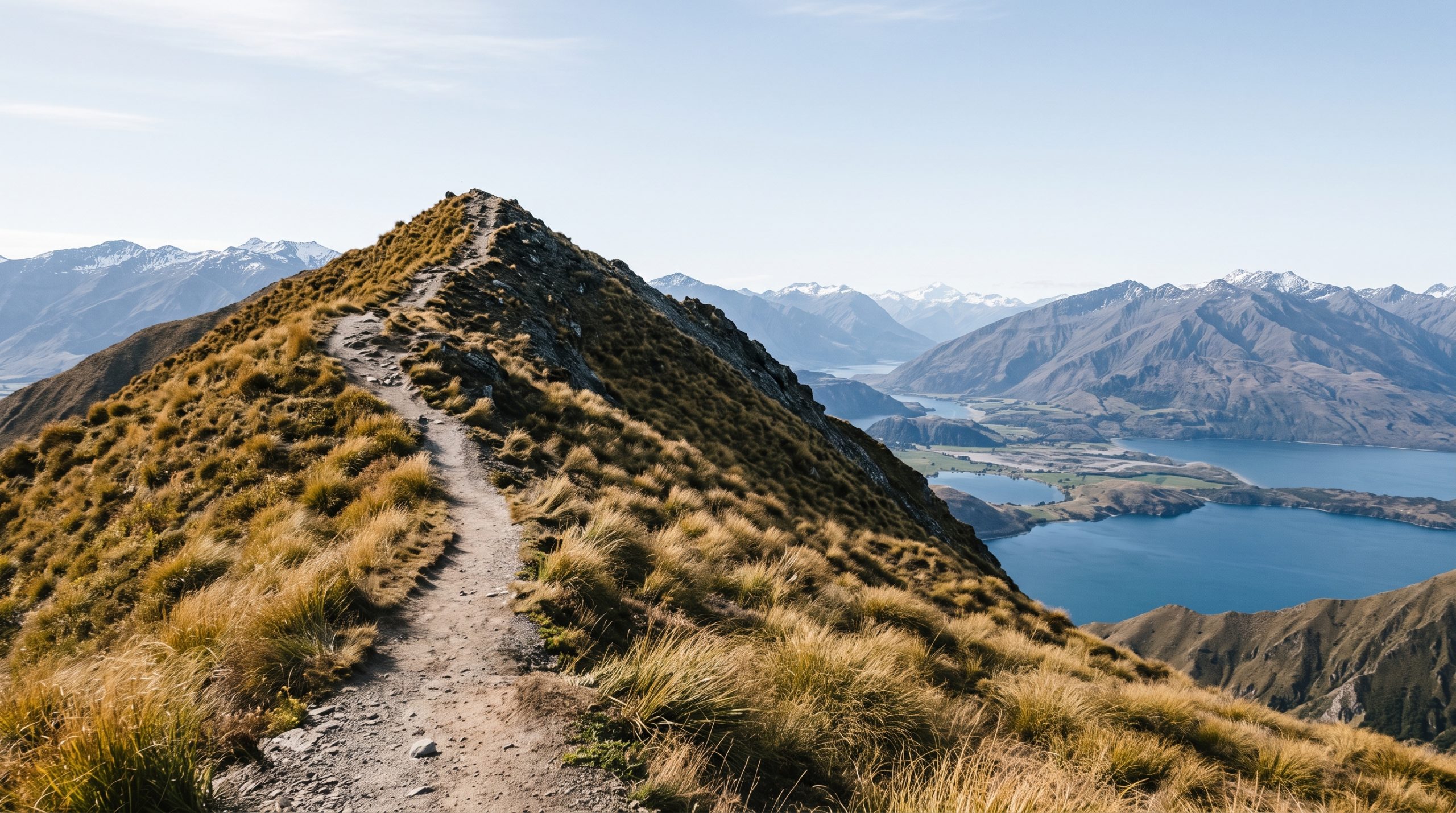
The Roys Peak track shuts for forty-one days every spring. From 1 October to 10 November the hill goes back to the sheep for lambing, and it opens again on 11 November. The Department of Conservation adds one line to that closure notice: it reopens in time to hike the track for sunrise. That tells you what people come here to do.
The rest of the year it is 16 kilometres return with over 1,200 metres of vertical gain, which DOC rates at five to six hours. A helicopter can have you standing above Lake Wānaka in a fraction of that, and it makes for a fine morning. This page is for couples who want the four hours before the vows to be part of the film.
What follows is the climb as we plan it. Real times from the car park, when light reaches the lookout and when it leaves the spur, what New Zealand asks for on paper, and what 1,200 metres of gravel does to a hem.
Three hours up, then vows on the spur
You can. The lookout sits on public conservation land above Lake Wānaka, and two people marrying there need no landowner’s permission, only a New Zealand marriage licence and a celebrant willing to climb. Budget three hours up from the car park in boots, more if you are carrying dresses, cameras and water.
Six kilometres from town, 1,200 metres above it
The car park is 6 kilometres west of Wānaka on the Mount Aspiring Road, which is a ten-minute drive from almost any bed in town. It is large and free. New Zealand’s own tourism board tells visitors parking is limited at peak times and suggests walking or biking to the trailhead, which is a polite way of saying that on a fine February day the gravel fills up. Arriving at 3am solves that particular problem permanently.
The first hour is a steep four-wheel-drive zigzag across private farmland. The track is wide, obvious and easy to follow with a headlamp, and DOC grades it as an easy standard track, which refers to the surface and not the effort. Above the farm boundary you cross into the conservation area and the surface narrows into tussock. No dogs and no bikes are allowed on it. There is no water anywhere on the hill, and no shade at all once the sun is up.
Three hours up is a fair figure for a fit pair carrying nothing. With two camera bags, a dress in a compression sack, tripods and four litres of water between us, we plan on three and a half to the lookout and we set the alarm accordingly. The famous lookout is not the top. The 1,578 metre summit is another kilometre and a half of ridge beyond it, and most couples never go, because the frame they came for is the one below.
Climbing in wedding clothes is the part nobody writes about, so here it is plainly. Nothing on this hill is built for changing clothes, so you climb in boots and leggings and you change on the ridge with a jacket held up as a screen. A long train collects grit from the moment it touches the track, and the descent is where DOC’s own note about slippery gravel earns its place, so the dress goes back in the pack for the walk down. Bring a layer that lives just outside the frame. The ridge is exposed and the temperature drops fast up there even in midsummer, and a bare shoulder at 1,300 metres in a westerly stops being romantic in about ninety seconds.
Why the lookout is a morning place
The spur everyone photographs points north, out over the bay, with the ridge dropping away to the water and the mountains stacked behind it. At sunrise the light arrives from over the ranges east of the lake and lands on that whole bay evenly, which is why the lookout has become a sunrise place rather than a sunset one.
Evenings work differently, and knowing the difference is most of the job. Late in the day the bulk of Mount Roy sits between the spur and the western sky, so the lookout falls into shade while the peaks across the water are still holding colour. That is a beautiful thing to film and a difficult hour in which to marry, because the light on the far shore is not light on your faces. When couples ask us for an evening on this hill, we usually build the vows lower down and keep the ridge for the last hour of the walk, when the whole valley goes gold beneath you.
Timing shifts hard through the year, and it changes the whole shape of the morning. Around the summer solstice the sun is up in Wānaka before six and the light hangs on past nine at night, so a sunrise ceremony at the lookout means leaving the car park somewhere near 3am. By mid-April the sun comes up closer to quarter past seven, the hill is quiet, the air is cold and clean, and the same climb starts at a far more human hour. That is why we tend to steer couples who want a summit sunrise towards autumn rather than January. You can see how the ridge and that early light actually render in our published elopement films and galleries, which is more useful than any description we could write here.
Crowds follow the same clock. Sunrise at the lookout is genuinely quiet in the shoulder months, and arriving early is enough. In the middle of a settled summer, arriving early is not enough on its own, because a slow queue forms at the photo spot from mid-morning. Our answer is not to fight it. We put the ceremony in the first light, work the spur while it is still ours, and use the descent for the rest, because the switchbacks facing the lake are quietly better frames than the one everybody knows.
The forty-one days the track is closed
The lambing closure from 1 October to 10 November catches more couples than anything else on this hill, because it lands squarely on southern spring, which is when a lot of Americans want to travel. There is no way around it and no permit that opens the gate. DOC points people to the Isthmus Peak Track instead, describing it as a similar length and difficulty with an equally spectacular view, and it sits on the neck of land between Lake Wānaka and Lake Hāwea. We are happy to plan an October morning there rather than pretend Roys Peak is available.
Winter is a different conversation. Snow and ice sit on the upper track through the cold months, so we keep high ridge mornings for the shoulder seasons and build June and July days around the lake, the willows and the lower hills, where the mornings are still, clear and almost empty. February and March give you settled weather and long days with the most company. Late April and early May give you cold starts, thin crowds and the friendliest sunrise hour of the year. Our destination guides go month by month if you want to compare regions before you commit to one.
Who needs permission here, and who does not
Start with the part that surprises people: nothing about the two of you standing on a public track and exchanging vows requires anyone’s approval. No landowner, no council, no booking. The permission that matters on a day like this is ours, not yours.
What New Zealand does require is a marriage licence. You apply online through the Department of Internal Affairs at least three working days before the date, the licence is valid for three months, and the fee is currently NZ$150 when an approved celebrant marries you. The New Zealand dollar has been trading near sixty US cents lately, so that is roughly ninety dollars in the currency you are probably budgeting in. The licence names where you intend to marry, and if the weather moves you off the hill, the office that issued it needs to be told. We plan the alternative before you apply, so the paperwork already covers it. You also need two witnesses, and on a day where both a photographer and a filmmaker are with you on the ridge, that requirement quietly takes care of itself.
Our side of it is the concession system. Commercial filming on public conservation land runs through DOC’s permissions process, and drone work has its own application route, so aerials over this ridge depend on a permission and a window that we confirm before we plan any of the film around them. Permit research and the logistics that follow are part of every experience we run. Government and landowner fees themselves sit with you, and we tell you what they are before you commit to anything. If you are still working out the order of all this, our guide to planning an elopement lays out the sequence.
Standing room for two cameras on the spur
The lookout is a narrow spur with a fence line and a lot of air below it, and that geometry decides how two of us work. One takes the low position on the spur, close in for the vows. The other climbs thirty or forty metres back up the track for the wide frame that makes you look like two people on the edge of a country. Neither of us appears in the other’s shot, and nobody is asking you to repeat anything. Wind is the real constraint at 1,300 metres, which is why the audio on an Expedition day goes on you rather than on the camera, and why we shelter the ceremony spot behind the ridge crest when a northwesterly is running. Both shapes of coverage, and what each one includes, are set out on our coverage and pricing page: The Adventure from $4,900 with one dedicated photographer or one dedicated filmmaker, The Expedition from $7,900 with both of us climbing with you.
What the climb gives you that the flight cannot
A helicopter is the default here for good reason. It puts you somewhere with no track at all, it is over quickly, and it is a genuinely good day out. We arrange those too, as a charter alongside the coverage. What it does not give you is the four hours beforehand.
On foot, the film has a first act. There is the head torch on gravel, the moment the valley behind you fills with grey light, the sitting down on a rock at 1,000 metres because your legs have had enough, and the pair of you arriving somewhere together having actually got there together. That shared effort shows up in the photographs in a way nothing else replicates. It is the difference between being delivered to a view and earning one.
This hill rewards couples who like being up in the dark and do not mind arriving at their own ceremony slightly out of breath. If that is not your idea of a good morning, tell us plainly and we will shape something else with the same lake in it. That might be an evening on the lower ridge, or a flown ceremony somewhere no track goes at all. Guest numbers work the same way. Our fee does not change with headcount, but 1,200 vertical metres does its own filtering, so most couples marry up here with our team as witnesses and gather everyone in town that evening.
Common questions
Can I really climb Roys Peak in a wedding dress?
Not the whole way, and you would not want to. You climb in boots and layers with the dress in a pack, change on the ridge near the lookout, then change back for the descent, where the gravel is loose. We carry the dress on the way up and the day is timed with those two stops written into it.
What time do we have to leave the car park for a sunrise ceremony?
Three to three and a half hours before sunrise. Near the summer solstice that puts you on the gravel around 3am, because the sun is up in Wānaka before six. In mid-April, with sunrise closer to quarter past seven, the same start feels much kinder.
Is Roys Peak open in October?
No. The track closes for lambing from 1 October to 10 November and reopens on 11 November. For an October date we plan the morning on the Isthmus Peak Track between Lake Wānaka and Lake Hāwea, which DOC itself names as the comparable alternative.
Do we need to bring witnesses up the hill with us?
New Zealand requires two witnesses to sign. On a day with both a photographer and a filmmaker on the ridge, we can sign, so nobody has to climb 1,200 metres purely to hold a pen. Your celebrant makes the climb too, and we build the timeline around their pace as much as yours.
Do we have to walk all the way to the summit?
Almost nobody does. The lookout is where the view everyone knows opens up, and the 1,578 metre summit is a further kilometre and a half of ridge. If you want it, we plan for it, and the extra hour is worth it for the full circle of the Southern Alps.
Putting a date on this hill
We currently have New Zealand dates available through 2027–2029, and from the first reply onward, the whole process stays in writing. You send us the form, we reply within 24 hours with our initial brochure, and from there it is a tailored proposal, a signed contract and a 30% retainer before planning begins. Nothing about it needs you awake at an odd hour, which suits couples planning a New Zealand morning from the other side of the world. Highlights reach you five days after the day itself, and the full gallery or film three weeks later.
Tell us the month you are looking at and whether 3am sounds like an adventure or a punishment, and we will tell you honestly what the hill is doing then. Check Your Date and we will start with the light.