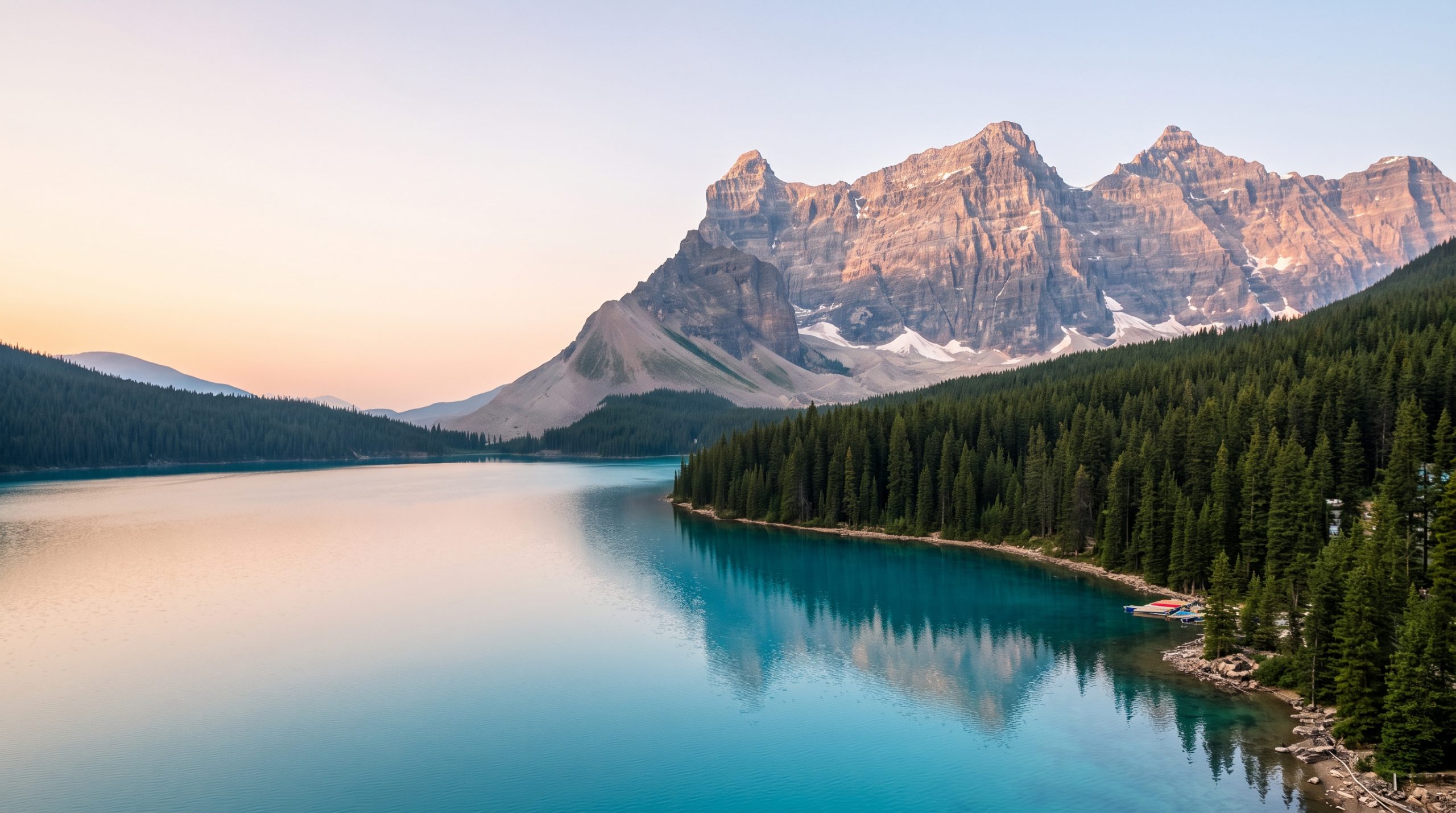
At the June solstice the first usable light in the Bow Valley arrives around 4:40 in the morning, and the last of it is still sitting on the Sawback Range at 10:45 at night. Eighteen hours. Eleven degrees of latitude south, in Estes Park, the sun on that same date is down by about 8:35 in the evening and the alpine has gone quiet while Banff is still working.
That gap is why one camera or two gets answered differently in the Rockies than almost anywhere else we work. A single photographer can carry a tight, well-built day completely, and we say so below without flinching. Stretch the same day across two far-apart ends of light, a shuttle timetable that starts before dawn, and a permit slot that will not move, and the arithmetic changes.
Here is our recommendation, the honest case for the opposite, and the three Rockies specifics that usually settle it.
Our answer for one day in the Rockies
For a single day in Banff, Lake Louise or Rocky Mountain National Park, book a photographer and filmmaker together. The Rockies hand you two widely separated ends of light with a fixed access window between them, and two people cover that spread without thinning either end. One camera suits a short day that stays near the road.
The Adventure and the Expedition, on access, timing and trade-offs
Both are full days. Both include the planning, the permit research, the weather alternatives and the team’s flights and accommodation, in Alberta and Colorado alike. The difference is how many hands are free when the light does two things at once.
| Where it shows | The Adventure | The Expedition |
|---|---|---|
| On the ground | One dedicated photographer or one dedicated filmmaker, all day | A dedicated photographer and a dedicated filmmaker on the same timeline |
| Starting point | From $4,900 | From $7,900 |
| A June day with light from 4:40 a.m. to 10:45 p.m. | One end covered properly, or both at a jog | Both ends covered, with the middle used for travel instead of recovery |
| Vows out loud | Kept in the one medium you chose | Professional audio for vows and meaningful moments, where conditions allow |
| Weather moving through the valley | One person picks a side and commits | One stays on your faces, one takes the sky |
| Shuttle seats and permit paperwork | One extra seat to reserve alongside yours | Two extra seats, reserved at the same time as yours |
| Best at | Quiet, mobile days on one trail system | Spoken vows, moving weather, two ends of light in one day |
Those two figures are starting points for a full day, and neither one moves because you invited six people instead of two. The rest of what sits inside each, including delivery times and what you pay for separately, is set out on the coverage and pricing page.
What one photographer does better on the Moraine Lake shuttle
Moraine Lake Road has been closed to personal vehicles since June 2023. You reach the lake on the Parks Canada shuttle from the Lake Louise Park and Ride, on Roam public transit, or with a licensed commercial operator, and the road itself is shut to every vehicle from mid-October until snowmelt allows it to open in early June. Everyone on your day needs a seat, booked in advance, on the same departure.
One person is one seat, one pack, and one set of footprints on the rockpile at 5:30 in the morning. Parks Canada’s wedding registration is clear that nobody gets exclusive use of an area, so you are standing in a public place with other people’s tripods thirty feet away. A smaller group reads as two visitors who happen to be dressed well. That matters more than it sounds like it should.
A single photographer is also faster over ground. If the plan is a ceremony at a designated site near Estes Park in the morning, portraits along the Bear Lake Road corridor, and an early dinner, one photographer covers all of it and nothing about the result is thin. The same is true of a compact Banff day that never leaves the Bow Valley floor. If what you want to keep is stills, a photographer with the whole day and no handover is the strongest version of stills we make.
The trade is real and it is worth naming. One person shooting a ceremony cannot also be making stills of it, and one person cannot be at Bear Lake for 5:15 a.m. and on the Vermilion Lakes boardwalk for a 9:50 p.m. sunset with anything left in between.
What the second camera keeps that a still frame cannot
Sound is the honest answer, and it is the one couples underrate until they hear it. Wind moving across a lake at 9,000 feet, meltwater running hard in late June, your own voice cracking on the third line of the vows you wrote on the plane. The Expedition adds professional audio for vows and meaningful moments where conditions allow, which is why the film comes back with the ceremony in it rather than a music bed over silent lips.
Movement is the second answer. Along Trail Ridge Road, where eleven miles of pavement sit above 11,500 feet, weather does not arrive so much as slide across the tundra in front of you. A photograph implies that. A film holds the forty seconds of it. When cloud tears off a peak behind you, two people mean nobody has to choose between your faces and the sky.
The third is simple coverage of the ceremony itself. With two people, the wide frame and the close one exist at the same moment rather than in sequence. Nothing is reconstructed afterwards, and nobody asks you to walk back down the aisle you just walked up.
This is the part of the decision that reading cannot settle. Open our published stories and films, watch one film through, then look at the photographs from that same day. Two mediums holding the same hour is a different thing from one medium doing it twice.
Three Rockies specifics that decide it
The June day is ninety minutes longer in Alberta than in Colorado
On 21 June, Banff gets about 16 hours 35 minutes between sunrise and sunset, with usable light from roughly 4:40 a.m. to 10:45 p.m. Estes Park gets about 15 hours 5 minutes on the same date, and the sun is gone before 8:40 in the evening. That is an hour and a half of extra spread in Alberta, all of it stacked into the evening, and it is the single strongest argument for two cameras in a Canadian Rockies summer.
By the September equinox the two are within a few minutes of each other, both a little over 12 hours. A late-September day in either range is short enough that one person can genuinely hold both ends of it, walk out at dusk, and not have missed anything. Season changes this answer more than geography does.
The access window is fixed before you are
Rocky Mountain National Park has run a timed entry system through the summer, with the Bear Lake Road corridor reserved from 5 a.m. to 6 p.m. and the rest of the park from mid-morning to mid-afternoon, roughly from late May to mid-October. Arrive before the corridor window opens and no reservation is needed, which is exactly why our Colorado days so often start in the dark. A ceremony there also needs a wedding special use permit, currently 300 dollars, applied for up to a year ahead, tied to a designated site with its own guest limit and its own hours.
Elevation sets the rest of the calendar. Trail Ridge Road, the highest continuous paved road in the United States at 12,183 feet, opens to through travel in the last week of May in a normal year and closed for the winter on 14 November in 2027. Old Fall River Road usually does not open until the first week of July. Plan a high alpine ceremony for early June and you are planning it for a road that is still under snow, so we build those weeks on lower ground and save the tundra for August. There is more of this in our destination elopement guides.
Aerials happen outside the park boundary
Drone flight is prohibited in Banff National Park without written authorization from the superintendent, and the National Park Service applies the same rule in Rocky Mountain. Parks Canada also does not accept applications for commercial film projects in Banff, Yoho or Kootenay between 1 June and 30 September. A summer film in those parks is therefore built as a registered private ceremony carried in two hands, with no rig, no crew and no production footprint. Where a film genuinely wants air, we place that sequence on ground outside the boundary where flying is legal, and confirm it before it goes anywhere near your timeline.
Which of these fits the week you have
You have one day and you will be at the Lake Louise Park and Ride by 5 a.m. Take both cameras. That day runs from a pre-dawn shuttle to a 10 p.m. sunset over the Bow River, and it is the clearest case in either range for a photographer and filmmaker together.
You have one day, you are staying in Estes Park, and the shape you want is a morning ceremony at a designated site, a long lunch, and a walk. One photographer, all day, is a complete answer. Tell us that is the day you want and we will build it that way without trying to talk you upward.
You are writing vows and you know you will want to hear them again in five years. That points at film with real audio, and once film is on the ground you almost always want the stills alongside it rather than instead of it.
The legal ceremony changes the frame count too. Colorado allows self-solemnization: a 30 dollar licence from any county clerk, valid 35 days, no officiant and no witnesses, signed by the two of you and returned within 63 days. Alberta needs an authorized officiant and two adult witnesses, with a 40 CAD government fee for the licence and 90 days to use it. That means an Alberta ceremony has three extra people standing in it, all of whom need to be somewhere useful in the frame, which is more choreography than one camera can quietly manage. Our guide to planning an elopement covers the paperwork side.
You have three days and you want Banff and Jasper, roughly 230 kilometres apart along Highway 93. That is not a one-day question at all, and it is what the Odyssey exists for: two to seven days, photography and film, one or several destinations, proposed for the route you actually want to drive.
Tell us the constraint you are working around, whether that is a single free Tuesday, a 5 a.m. limit on how early anyone in your family will get up, or a ceremony that has to be legal on the day. Send Us a Message and we will tell you which shape we would build for it.
What generic Rockies coverage advice misses
The standard line online is to book the photographer now and add a filmmaker later if there is room. That advice was written for places where you can add a person on the morning. The Rockies are not that kind of place. Shuttle seats to Moraine Lake are reserved in advance, timed entry slots are reserved in advance, the wedding permit names who is coming, and the parking lot at the trailhead fills before sunrise in July. Deciding in March to add someone to a June date means finding another seat on the same 6 a.m. departure and another window at the gate. Deciding at booking means both were reserved together, in one pass, by the people doing your permit research.
The second thing the internet gets wrong is what the second person is for. A second shooter is another photographer making more of the same pictures. That is not what this is. The second person is a filmmaker holding a different medium, and the two outputs do not overlap, they interlock.
The third is the assumption that a photographer and a videographer can simply be assembled. Two freelancers who met over email spend the first hour of a Rockies morning negotiating who stands where, and in June that first hour is the best light of the day. We are eight people. The pair who walk up the trail with you have run the same timeline before, they split ground without discussing it, and there is a colleague in reserve behind them.
Common questions
Can one photographer cover a Moraine Lake sunrise and a Vermilion Lakes sunset on the same day?
In late June that is a spread of roughly seventeen hours between the shuttle and last light, so something in the middle gets sacrificed. One photographer can do both ends of a September day comfortably, when the gap is around twelve hours. In midsummer we would rather split it between two people.
Do we need a permit for a filmmaker at a Rocky Mountain National Park ceremony?
Your ceremony needs a wedding special use permit, currently 300 dollars, at one of the park’s designated sites, and each site carries its own guest limit and hours. Who has to be named on the application varies by park and by what is being filmed, and working that out is part of the planning we do before your date is locked.
Can you fly a drone at Moraine Lake or Bear Lake?
No. Drone flight is prohibited in Banff National Park without written authorization from the superintendent, and the National Park Service holds the same line in Rocky Mountain. When a film wants an aerial, we plan it for ground outside the park boundary where flying is permitted and confirm that before it enters the timeline.
Should we get legally married in Colorado or in Alberta?
Colorado is simpler. Self-solemnization means a 30 dollar licence, valid 35 days, no officiant and no witnesses required, returned within 63 days. Alberta asks for an authorized officiant and two adult witnesses, with a 40 CAD government fee and a 90 day licence. Many couples marry legally at home and treat the mountain ceremony as the real one.
Does bringing guests change what we pay?
No. Our fee is the same for two people as for twelve. Guests change access, permits, transport and the timeline, not the price, and in Rocky Mountain National Park they also change which designated sites are available, since each one has its own limit.
How soon do we see something after the day?
Highlights land within 5 days. The full gallery or film follows within 3 weeks. That holds whether you booked one photographer in Estes Park or a photographer and filmmaker on the Icefields Parkway.
Tell us how your Rockies day should run
Dates are currently open across 2027, 2028 and 2029 across Banff, Yoho, Jasper and the Colorado Rockies, and everything between us happens in writing. Send the date, the range and the one thing you are certain about, and you will have a reply and a brochure within 24 hours, then a proposal built around the light and the access windows on that specific day. Tell Us Your Story.