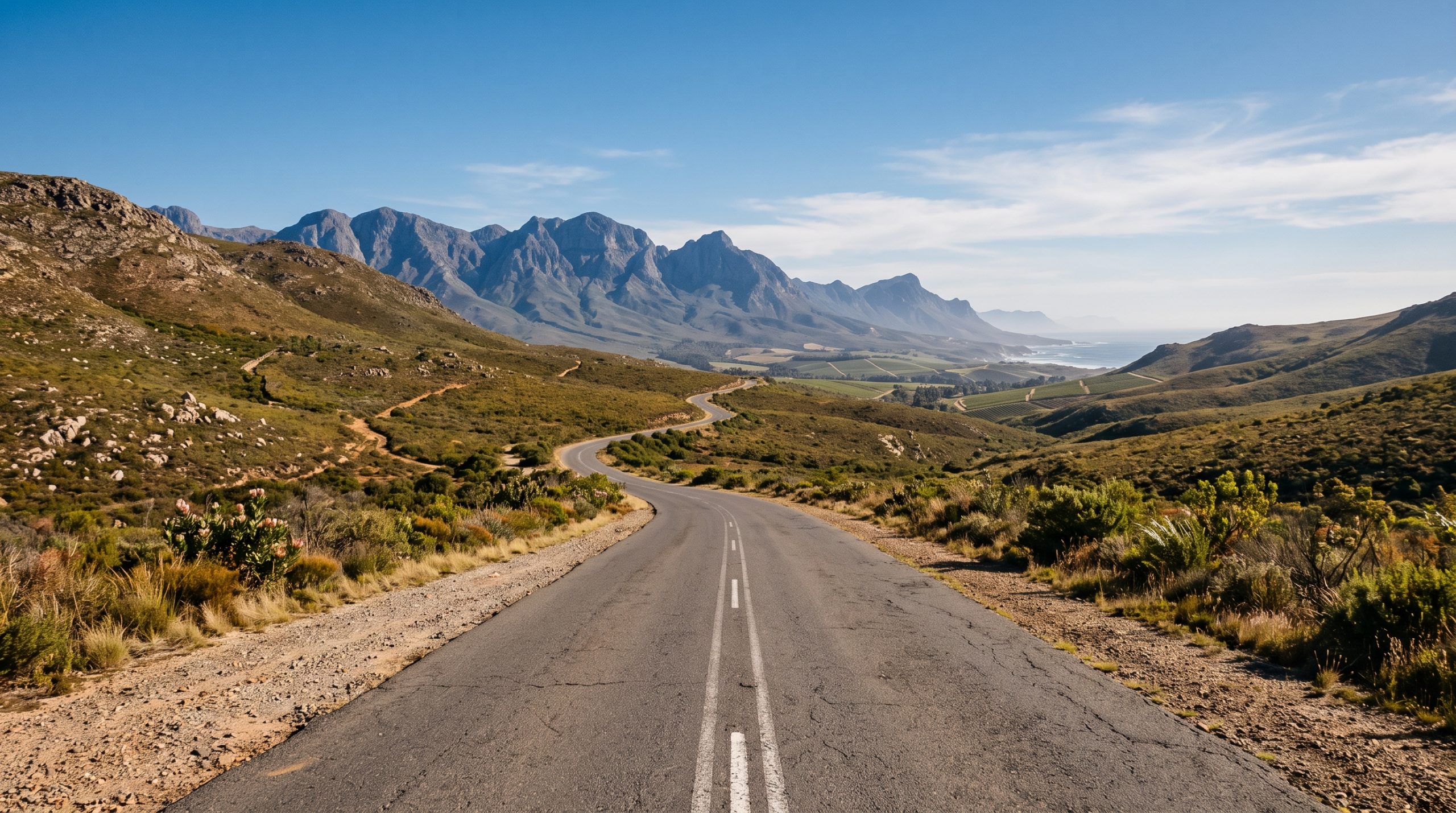
In the first weeks of December the sun is up over False Bay before 5:30am. The gate into the Cape of Good Hope does not open until around six. That half hour is the whole problem with planning a South African elopement day off a route planner: the roads are better than most Americans expect, the distances look modest, and almost nothing opens when the light is at its best.
Chapman’s Peak Drive is nine kilometers long and carries 114 curves between Hout Bay and Noordhoek. A map gives it a few minutes. In practice it is twenty-five, more if a tour coach is ahead of you and the pull-offs are full, and the road closes outright in severe weather. That ratio, between the number on the screen and the number on the clock, repeats everywhere in this country.
So this is the operational half of the planning. What to hire, what your drives actually cost in hours, which gates and cableways set the shape of the day, and where we put the buffers. If you want the earlier stage of it, the shape of the day itself, start with our guide to planning an elopement and come back here for the driving.
Kilometers into hours: the conversion we plan on
Hire a car, reserve an automatic early, and remember you drive on the left. Then convert distance honestly. We plan on 100 km/h average on the N1 and N2, 75 on two-lane roads, 40 on a mountain pass, 30 on gravel. Most gates open after sunrise, so a 122 km day eats a morning.
| Road | Posted limit | What we plan on | Why the difference |
|---|---|---|---|
| N1 and N2 freeway | 120 km/h | 100 km/h average | Trucks crawl the passes, and the freeway drops to two lanes with no overtaking lane |
| Two-lane R-road | 100 km/h | 75 to 85 km/h | Farm traffic, stop-go roadworks control, and towns that cut the limit to 60 |
| Tarred mountain pass | Signed curve by curve | 40 km/h | Blind bends, cyclists, and the fact that you will want to stop |
| Farm gravel | 100 in law | 30 km/h | Corrugations, loose surface, cattle grids, dust behind anything you follow |
| Sani Pass, unpaved | No useful number | Two hours for the climb | Gradients as steep as one in three, 4×4 only, and a control point at each end |
Those averages are not pessimism. They are what we have measured on days when we had to be at a specific rock at a specific minute.
The car, the licence and the fuel stop
A US licence works here, because it carries your photograph and is printed in English. Rental desks want that licence, your passport and a credit card in the driver’s name. Bring all three to the counter and the pickup takes fifteen minutes.
- Automatics are the smaller half of the fleet. Reserve one when you book flights, not the month before. If you end up in a manual, you are learning left-hand gear changes on Chapman’s Peak, and nobody enjoys that in wedding clothes.
- There is no self-service fuel. An attendant fills the car and cleans the windscreen, and a small cash tip is normal. Cards work at most stations, but keep notes in the door pocket.
- Small cash covers the rest of the day. Toll plazas, the attendant, and the car guards in reflective vests who watch vehicles in public parking areas.
- Chapman’s Peak Drive is a toll road. The plaza sits at the Hout Bay end and takes cards. Rates are reviewed periodically, so treat it as a small line item rather than a fixed one.
- One car or two. If your day involves a dress, a hair and makeup artist and a two-hour transfer, a second vehicle is not luxury. It is what keeps the first one calm.
The 122 kilometers that is never ninety minutes
Hermanus sits 122 km from Cape Town. The clean route is the N2 over Sir Lowry’s Pass, whose summit viewpoint at around 420 meters gives you the whole of False Bay in one frame, then the R43 turnoff at Bot River. On a Tuesday at eleven in the morning, that is a comfortable hour and a half.
Leave a city hotel between 7am and 9am and it is not. The N2 and N1 into Cape Town are congested through those hours and again from roughly 4pm to 6pm, and the queue starts long before you reach the pass. For a morning ceremony in the Overberg we either leave before six or we base you on that side of the mountains the night before. There is no version of this where you sit in commuter traffic in a dress and arrive relaxed.
The coastal alternative, Clarence Drive on the R44 from Gordon’s Bay through Rooi-Els and Betty’s Bay, is the more beautiful road by a wide margin. It is also the wrong road for getting somewhere on time. Cliffs on one side, water on the other, pull-offs every few hundred meters, and you will use them. We drive Clarence in the direction that has no deadline at the end of it, or we treat it as the location rather than the transfer, which is usually the better idea anyway.
Two more places where the screen and the clock disagree on the Cape Peninsula. Chapman’s Peak faces west, so it is a last-light road rather than a sunrise one, and when the south-easter is really up we plan on Ou Kaapse Weg instead and keep the pass as the bonus. And the drive down to Cape Point through Simon’s Town runs through a string of small towns where the limit drops to 60, past a working naval harbor. It is a lovely hour. It is not a forty-minute dash.
Sunrise before 5:30, gate open at six
Cape Town’s light swings hard across the year. The shortest day, 21 June, carries nine hours and fifty-three minutes of daylight, running from roughly 7:50am to about 5:45pm. In the first days of January the sun sets just after 8pm. Around the equinoxes in late March and late September, first and last light land near 6:45 in the morning and 6:45 in the evening. After sunset you have around half an hour of usable civil twilight before the sky goes flat.
The winter numbers are the friendly ones for a wedding day. A 4:30pm ceremony in June happens in gold rather than glare, and you are not asking anyone to wake at four. The catch is that gates in the winter half close earlier too, so the ceremony either happens outside a gate or well before it shuts.
| Access | When it opens | Where that sits against the light | How we work with it |
|---|---|---|---|
| Cape of Good Hope gate, Table Mountain National Park | Roughly 06:00 October to March, 07:00 April to September | In December the sun beats the gate by half an hour | First light on the False Bay shore outside the reserve, Cape Point from mid-morning |
| Table Mountain Aerial Cableway | Not before 08:00 in any season, weather permitting, with a maintenance shutdown in the winter half | Two to three hours after a summer sunrise | A late-morning slot, never the ceremony hour, with a ground-level location held in reserve |
| Chapman’s Peak Drive | Daily, closed in severe weather | West-facing, so it belongs to the last hour of light | Sunset frames here, then off the pass while there is still glow in the sky |
| Private farms and reserves | By written arrangement with the landowner | The only reliable way to be standing somewhere before 6am | We ask for early access in writing during planning, months out |
The Cape of Good Hope also carries a conservation fee, currently R515 per adult for international visitors, reviewed by SANParks every November. The funicular up to the old lighthouse is ticketed separately from the gate. Permit and entry fees like these are paid by you; working out which ones apply, and what each gate needs in writing, is our job.
Passes, gravel, and the Sani Pass question
Sani Pass is the one route couples ask us about most and understand least. It climbs the Drakensberg escarpment into Lesotho on an unpaved surface with gradients as steep as one in three, it is a genuine 4×4 road on the South African side, and the climb alone takes a good two hours. There is a control point at the bottom and another at the top, both keeping daylight hours and currently closing at 18:00, with a stretch of no-man’s-land in between. Passports live in the car, not in the hotel safe.
All of which makes Sani a morning, not an afternoon, and a chartered 4×4 with a local driver rather than a rental sedan. That charter is billed to you directly, like helicopters and private boats, and we arrange it as part of the timeline. A Sani day is a wonderful thing if you want the whole day to be the drive. If four hours in a vehicle is not your idea of a wedding morning, the escarpment from the valley floor gives you the same wall of rock with none of the climb, and we would rather you told us which of those you actually want.
The same logic covers gravel elsewhere. The Cederberg and much of the Karoo run on dirt, and dirt is where route planners are at their most optimistic. Thirty kilometers of it is an hour, plus the stop you will make because the light did something. Our destination guides go region by region on what each one asks of a vehicle.
Aerials: what has to be in place first
Paid aerial work in South Africa runs on two pieces of paper from the Civil Aviation Authority: an RPAS Operator Certificate held by the operating entity, and a Remote Pilot Licence held by the person flying, with the aircraft itself registered. Separately, SANParks does not permit recreational drones to overfly Table Mountain National Park at any location, which covers Cape Point, Lion’s Head and Signal Hill. So aerials get planned where they can genuinely happen, usually on private farms and reserves where landowner permission and airspace both line up. We open that conversation at the proposal stage rather than in the wedding week, because neither piece moves quickly.
Two vehicles, buffers, and a location held in reserve
Here is what the driving means for the way we work. On an Expedition day your photographer and filmmaker are ours, from one team, and they usually run two vehicles. While you are still at the first location, the second car can already be at the next one, checking whether the wind has swung onto the wrong side of the ridge and whether the pull-off has three minibuses in it. When the transfer is ninety minutes each way, that is the difference between arriving to look and arriving to work. A second set of cameras in a second car is also why a long drive never becomes a single point of failure.
The buffers follow from the tables above. A ceremony hour never sits adjacent to a gate closing time. A long return leg over a pass happens in daylight, with the last frames made where we can walk back to the car. Every timeline we build carries a second location fifteen to twenty minutes away with a different aspect, so a wind shift costs you a short drive rather than the hour you cared about. You can see how those days come out in our galleries and films, and the delivery runs the same way each time: highlights in five days, the full gallery or film in three weeks.
Team travel is included worldwide, so our flights, accommodation and ordinary transport in South Africa are not a line on your budget; the coverage options and what each includes sit on our pricing page. Guest numbers change access, permits and transport rather than the fee. If you have a route in your head already, Check Your Date and send it to us, and we will tell you honestly where the hours do not add up.
Common questions
Do we need an international driving permit to drive in South Africa with a US licence?
No. A US licence carries a photograph and is printed in English, which is what the law asks for. Take it to the rental desk with your passport and a credit card in the driver’s name, and reserve an automatic well ahead, because they are the minority of the fleet.
Can we have a sunrise ceremony at Cape Point?
Not at first light. The Cape of Good Hope gate opens at roughly 06:00 from October to March and 07:00 from April to September, while the December sun is up before 5:30am. We put first light on the False Bay coast outside the reserve, where the sun rises over water anyway, and move into the park from mid-morning.
How much does it cost to enter Cape Point?
The conservation fee for international adult visitors is currently R515, reviewed by SANParks each November. The funicular to the old lighthouse is a separate ticket. Entry and permit fees are paid by you; the research into which permits your day needs, and the applications, are part of what we do.
Is a 4×4 worth hiring for a Cape Town elopement?
For the peninsula, the winelands and the Overberg, no. A normal car reaches everything, including Chapman’s Peak. A 4×4 matters on routes like Sani Pass and on some private reserve tracks, and in those cases we would rather charter a vehicle with a driver than have you drive it yourselves.
How long does the drive from Cape Town to Hermanus really take?
Around ninety minutes for the 122 km on the N2 outside peak hours. Between 7am and 9am, or 4pm and 6pm, add thirty to forty minutes for traffic before Sir Lowry’s Pass. Via the coastal R44 through Betty’s Bay, plan on well over two hours, because you will stop.
Can you fly a drone over Table Mountain or Cape Point?
No. Table Mountain National Park does not allow drones to overfly the park at any location. Aerial footage comes from private land and reserves where the landowner and the airspace both allow it, flown by a licensed pilot under an operator certificate, and we confirm all of that before a film depends on it.
When is traffic worst around Cape Town?
Roughly 7am to 9am inbound and 4pm to 6pm outbound on the N1 and N2. That is also when the airport transfers stack up. We schedule long transfers outside those windows, which often means an early start and a slower, better road.
Send us the route before you book the cars
Most driving mistakes on an elopement day are made months earlier, when the flights and the base town get chosen. Tell us the region, the month and the two or three places you cannot imagine skipping, and we will send back a shape for the day that respects both the light and the road. The planning stays in writing and moves at your pace: you write, we return a brochure and honest first thoughts within a day, and a tailored proposal follows. Our calendar currently spans 2027–2029, in the Cape and well beyond it. Tell Us Your Story and we will start with the map.