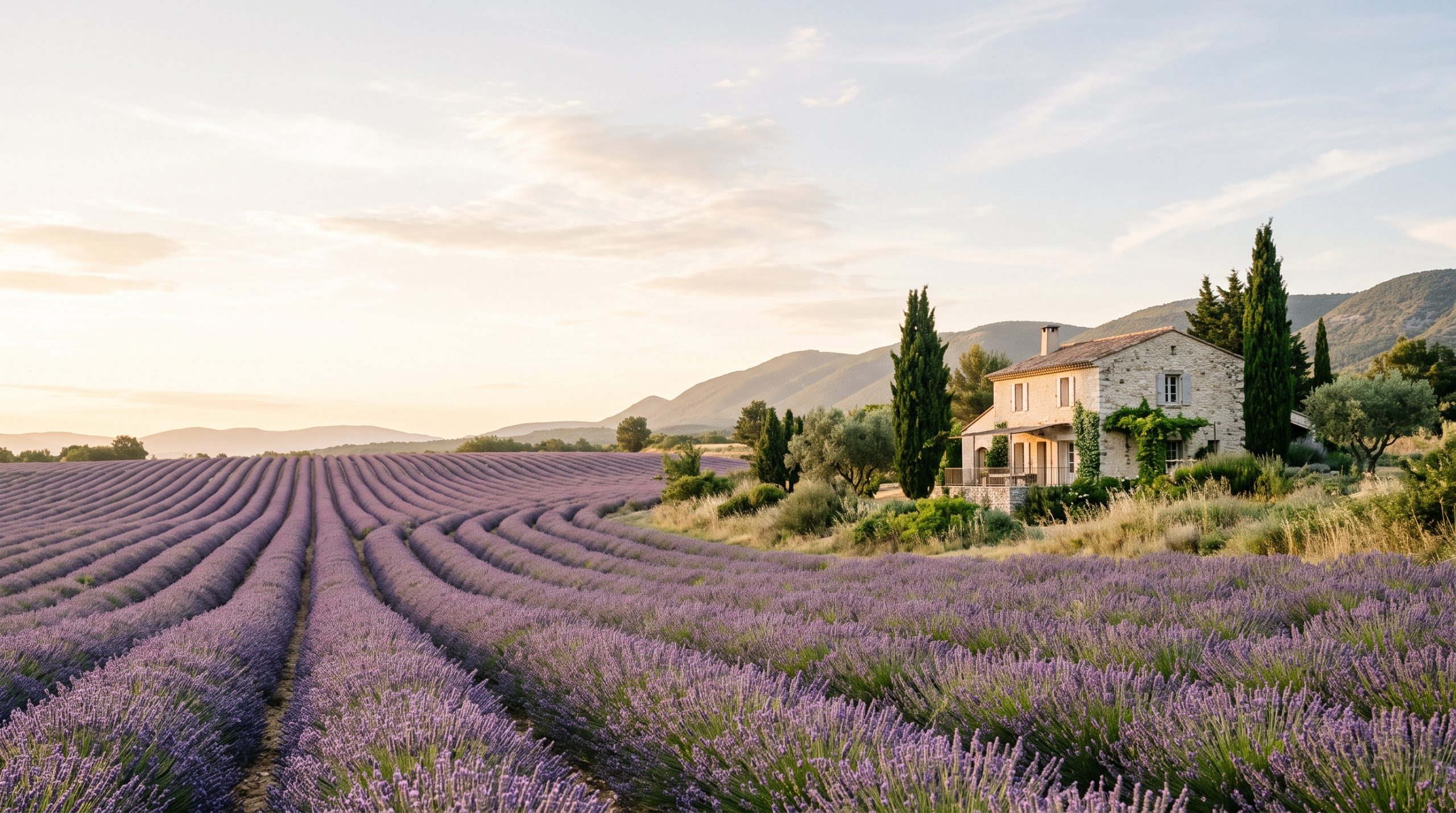
On the Valensole plateau in the first week of July, the light everybody travels for lasts about twenty minutes. The sun clears the low eastern skyline a few minutes before six, runs flat along the rows, and by half past seven it is high enough that the purple flattens to grey-blue and heat begins to shimmer over the plants. Anyone who tells you the plateau photographs well at ten in the morning has not stood on it at ten in the morning.
That is the whole planning problem in Provence, and it has a second half. The Alpes-de-Haute-Provence tourism board puts the Valensole window between mid-June and mid-July, with the flowers usually at their peak in early July and harvesting beginning around mid-July. So you have roughly four weeks of purple, and inside each of those days you have two short, far-apart hours worth working. At the June solstice Valensole gets 15 hours and 31 minutes of daylight. Dawn and dusk are not neighbours here.
The other thing worth knowing before you pick a field on a map: these are farms. The same tourism board asks visitors plainly to stay out of the rows and keep to the paths, because walking through lavender damages the plants and that crop is somebody’s year. We do not walk couples into fields. We ask the person who farms it, or we work the headland and the track edge, where the rows read just as well and nothing gets crushed.
Photo, film and planning for a bloom-week day in Provence
We photograph, film and plan elopements across the Valensole plateau, the Luberon hill villages and the Verdon country above Moustiers-Sainte-Marie. One team of eight handles all three, and team travel to Provence is included. A full day with a dedicated photographer or a dedicated filmmaker starts at $4,900. Bloom-week dates are planned around a region, never a single field.
Twilight at 5:20am, last light at 10pm: how we split the day
A bloom-week day with us is two days with a hole in the middle, and we say that out loud in the timeline rather than pretending the plateau is workable at noon.
In the first days of July, civil twilight over Valensole starts around 5:20am and sunrise lands close to 6:00am. We want you standing where you are going to stand by 5:15, which usually means leaving wherever you are sleeping at about half past four with coffee in the car. That pre-sunrise half hour is the softest light of the whole day: no shadows, the lavender holding its true violet, mist sitting in the dips between plots. It is also silent apart from the bees, which start on lavandin far earlier than most people expect.
Sunrise itself gives us the frame you have seen a thousand times and it is genuinely worth the alarm: low sun burning straight down an east-facing row. From 6:00 to about 7:15 we work fast and move little. Hot air balloons often go up over the plateau at this hour, and when they do, they earn their place in the film.
By eight the day changes character. Cars arrive at the famous roadside plots, Gordes starts charging for parking at 8am, and the view of the Abbaye de Sénanque from the road above becomes a queue of tripods. If you want the abbey, we go before the paid parking clocks on, or we skip it and say so honestly. From roughly nine in the morning the plateau has almost no shade, the light goes white, and telephoto frames dissolve into shimmer. There is nothing to be gained by shooting through it.
So we break. You eat, sleep, swim, get out of the sun for five or six hours. This is where a symbolic ceremony becomes a real advantage: because it is not tied to a mairie’s opening hours, we can put your vows at eight in the evening instead of two in the afternoon.
The evening return is longer and gentler than the morning. We are back on the ground by seven, ceremony around eight when the light finally softens, and then the long gold that runs to sunset just after 9:20pm. Civil dusk holds until close to 10pm, and that last half hour after the sun has gone is the best of the day for film: the plateau turns cool and blue, the cicadas stop, the whole thing goes quiet. If we are in the Luberon rather than on the plateau, that is when the stone in Gordes and Roussillon holds the last warm colour while the sky above it has already turned.
Two ends of one day, roughly nine hours apart, and about fourteen hours between your first alarm and the last frame. We build the timeline around real driving times between the plateau, the Verdon and the Luberon, not around a wish list of five villages.
Twenty minutes of low sun, in stills and in motion at the same time
Here is the specific reason we exist as one team rather than a photographer who recommends a filmmaker he met once.
That sunrise frame down a lavender row is not a place. It is a twenty-minute state of the light, and it cannot be repeated later. A photographer wants to get low, put a single lavender head across the sun, shift one step left and change the whole picture. A filmmaker wants the opposite: a stable path, a slow move, a continuous take that lets the row slide past. Those two things happen in the same twenty minutes, in the same forty metres of ground, facing the same direction. One person carrying both cameras chooses one and loses the other, and what you get back is one strong medium and one apologetic one.
With a dedicated photographer and a dedicated filmmaker working together, the choreography is planned the night before rather than negotiated at 6:05am. You walk the row once. Two people cover it in two media. Nobody asks you to do it again for the other camera while the sun climbs.
Provence adds sound to that argument more than most places we work. Lavandin at six in the morning is loud with bees. Cicadas come in as the heat builds and cut out again at dusk. The mistral, which is strongest and most frequent in winter and can blow for several days at a time, leaves behind the hardest, clearest blue sky in Europe and a hiss through the rows that no library track imitates. On the Expedition, professional audio for vows and the moments around them is part of the coverage where conditions allow, so what your film sounds like is planned rather than left to chance.
Aerials belong here too, in daylight, inside France’s open-category drone rules and the national restriction map, on a window we confirm before the timeline is built. Low sun on the plateau throws every row into relief from above, and there is no substitute for it. Over village crowds or abbey grounds we do not fly, and we will tell you that at proposal stage rather than on the morning. You can see how these two mediums come back from a day like this in our published stories, films and galleries.
What happens if the fields are cut before your date
This is the one thing couples actually worry about in Provence, and it deserves a straight answer instead of reassurance. Lavender is a crop. Cutting starts when the farmer decides, not when your date arrives, and a hot spring pulls everything forward. Valensole’s own lavender festival sits in mid-July, and in a hot year plenty of fields around it are already stubble by then.
We plan for that by treating altitude as the variable, not luck. The plateau is low country and goes first. The Sault plateau at the foot of Mont Ventoux is higher, grows fine lavender rather than lavandin, and runs weeks later.
| Where | Usual purple window | What it means for your day |
|---|---|---|
| Valensole plateau | Mid-June to mid-July, peak early July, cutting from about mid-July | The wide horizon frames, stone farmhouses, balloons at dawn |
| Luberon low country, Gordes to Roussillon | Late June into the first days of July | Hill villages, ochre, the abbey view, short drives between locations |
| Sault and the Ventoux foothills | July into August | Smaller plots, cooler air, a late date that still finds colour |
So a mid-July date is not a problem to be absorbed, it is a reason to plan the day uphill. An early-June date means greener rows with more contrast against ripening wheat, which films beautifully and photographs differently from the postcard. Either way we scout in the days before your date and confirm the exact ground late, while the shape of the day, the hours and the drive times are locked long before. Our destination elopement guides go deeper on how the regions differ month by month.
Tell us the dates you can travel and we will tell you which part of Provence those dates actually suit. Check Your Date.
Everything inside a Provence day, and the euros that stay local
Included in every experience
- Destination and location design for the plateau, the Luberon and the Verdon, matched to your dates.
- Planning and a custom timeline built around light and real travel time, not a template.
- Permit research and logistics guidance, including landowner and village access.
- Weather alternatives and backup planning, wind direction included.
- Drone footage where it is legal, safe and appropriate.
- Professional audio for vows and meaningful moments on the Expedition, where conditions allow.
- Team travel worldwide: flights, accommodation and ordinary travel for your assigned team, with no European or long-haul distinction.
- Highlights delivered in 5 days. The full gallery or film in 3 weeks.
Your fee does not move with guest count. Two of you or twelve, the number changes access, permits, transport and the timeline, not what you pay us.
Where coverage starts, and what Provence charges separately
The Adventure covers one full day with one dedicated photographer or one dedicated filmmaker. The Expedition covers one full day with a dedicated photographer and filmmaker working together, from $7,900. The Odyssey runs two to seven days across one or several destinations as a custom proposal. Full detail sits on the pricing page, and there is no half-day version of any of them.
What you pay locally in Provence is genuinely modest by destination-elopement standards. Government, venue and landowner permit fees are yours; the research and the asking are ours. A visit to the Abbaye de Sénanque is ticketed, currently 8 € for an adult. Roussillon’s paid car parks run at 4 € for the day, with free ones a kilometre or so out of the village, and the town lifts parking charges entirely over winter. Accommodation, your celebrant, flowers and vendors are booked in your name. Anything unusual on wheels or in the air stays separate too, so a sunrise balloon charter over the plateau or a 4×4 up a farm track is quoted to you directly.
How a Provence enquiry becomes a held date
- Send the inquiry form with your travel window and the shape of day you have in mind.
- We reply within 24 hours with an initial brochure.
- We build a tailored proposal: coverage, the team assigned, and a first read on light and access for your dates.
- Contract signed and a 30% retainer paid.
- Planning begins. Location design, timeline, permit research, weather alternatives.
- Delivery. Highlights in 5 days, the full gallery or film in 3 weeks.
The remaining payment schedule is set out in your proposal, so nothing about the money is a surprise later. We are currently taking Provence elopement bookings for 2027 through 2029.
The couples the plateau rewards, and the months that suit them
Provence in bloom week rewards couples who will get up at half past four once, walk on dust and loose stone in good shoes, and let a five-hour gap sit in the middle of their day without feeling cheated. It rewards people who care more about the quality of one hour than the quantity of villages visited. And it rewards the relaxed: we will name the field two days out, not two months out, because the farmer decides and we would rather be right than early.
If a 4:30am start is not your idea of a good morning, say so in your first message. September in Provence starts far later, with sunrise around 7:20am, warm stone, vine colour instead of lavender and almost none of the summer traffic. If you want green and cool with water in the frame, the Verdon and the villages above it hold up in the shoulder months when the plateau is bare. If you want the purple and you also want quiet, the higher ground toward Sault gives you both, later in the summer.
None of those are consolation prizes. They are just different days, and we would rather design the one you actually want than sell you the one on the postcard. New to the mechanics of eloping abroad, from paperwork to who stands where, our guide to how to elope covers the fundamentals before you write.
Common questions
Can we legally get married in Provence as Americans?
Not easily. French law requires at least one of you to have lived in the commune for roughly a month of continuous residence before the mairie will marry you. Almost every couple who writes to us about Provence handles the legal paperwork at home and holds a symbolic ceremony here, led by a celebrant, at whatever hour the light is best.
When exactly is the lavender out on the Valensole plateau?
The Alpes-de-Haute-Provence tourism board gives mid-June to mid-July, with peak colour usually in early July and cutting starting around mid-July. Higher ground near Sault runs later, through July and into August. Weather moves both windows by a week or more each year, which is why we plan by region.
Can we stand in the lavender rows for photos?
Only with the farmer’s agreement, and we ask on your behalf. The tourism board asks visitors to stay out of the fields and keep to paths, because treading between rows damages the plants. Plenty of the strongest frames are made from the headland, the track and the field edge anyway.
How early do we really need to be up?
For an early-July plateau morning, on location at 5:15am, which means leaving at about 4:30am. Sunrise is close to 6:00am and the best light runs from twilight to roughly 7:15am. If that is one alarm too many, we shape the day around the evening instead and tell you what you gain and lose.
Do the same people plan, photograph and film the day?
Yes. Photography, film and planning come from one team of eight, so the person who built your timeline is on the ground with you, and there is always a second camera and a colleague in reserve. You are not introducing a photographer to a videographer at 5am in a lay-by.
Can you fly a drone over the lavender fields?
Where it is legal, safe and appropriate. That means daylight, inside France’s open-category rules and the national restriction map, on a window confirmed before we build the timeline. Low sun across the rows is one of the best aerial subjects in Europe. Over village crowds and abbey grounds we stay on the ground.
What happens if the mistral blows on our date?
We use it. The mistral is strongest and most frequent in winter, it usually passes in a few days, and it leaves the clearest sky you will ever shoot under. We plan which side of a row and which shelter we work from by wind direction, and we hold a lower, sheltered alternative in the timeline so the day moves rather than stops.
What to send us if Provence is the one
Your travel window, however loose. Whether purple is the point or just a bonus. What time of day you are actually good company. Anything you already know you want to be doing at eight in the evening on that date.
Everything from there happens in writing, at whatever hour suits you: you send the form, we reply within 24 hours with a brochure, and a tailored proposal follows. No hurry, no pressure, and honest answers about which weeks of the Provençal summer fit the day you are describing. Tell Us Your Story.