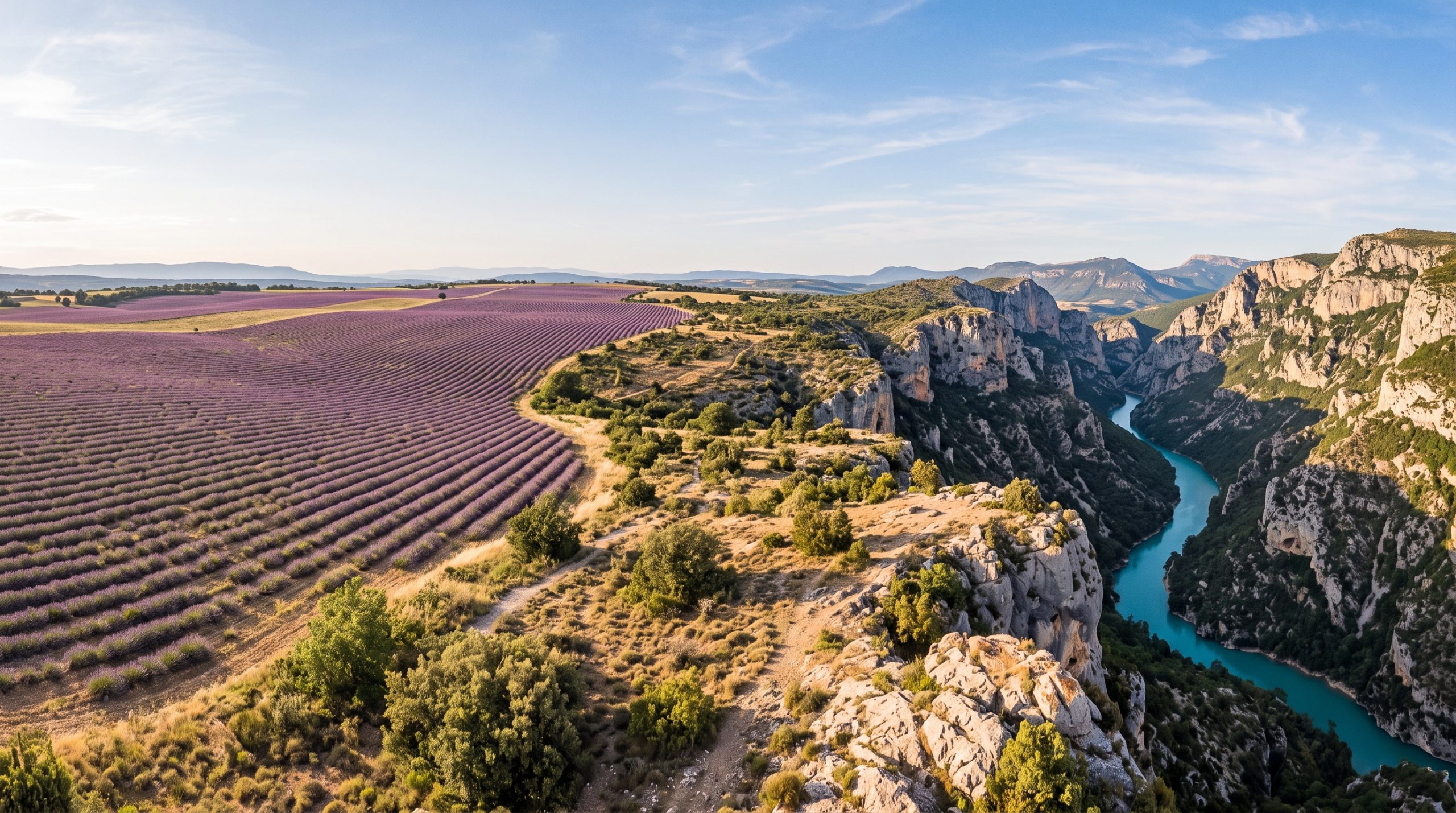
On the Valensole plateau in the last days of June, the sun clears the horizon at 5:56, and the rows only read purple while the light is still arriving sideways. Stand in the same spot at half past seven and the color has thinned. Stand there at one in the afternoon and you have gray-green stripes, a white sky, and a car parked on the verge every hundred meters.
That one fact governs a Provence elopement more than any venue decision you will make. Sunset on the same date falls at 21:22, which puts the two usable ends of the day fifteen and a half hours apart, with a long bright middle nobody should be photographing in. Provence is not a place you shoot straight through. It is a place you shoot twice, properly, with a lunch, a swim and an hour of doing nothing in between.
We are eight people: Serg, Alex, Alex and Viktoria on stills, Lara, Mike, Anthony and Stas on film. We plan Provence days around that gap instead of pretending it is not there, and we do the planning and the shooting ourselves. If you have been reading our destination elopement guides and have landed here to work out what booking us actually involves, this is the page that answers it.
Eight of us, one full day, two ends of the light
We are a photography, film and planning team working with couples across the Luberon, the Valensole plateau and the Verdon. Coverage starts at one full day with a dedicated photographer or a dedicated filmmaker, and team travel to Provence is included. Highlights reach you in five days, and the full gallery or film in three weeks.
A June day on the plateau: 5:20am to 10pm
First light on the plateau in late June arrives around 5:20, a good half hour before the sun itself. That is when we leave, because the drive from most of the mas country up onto the fields is twenty to thirty minutes and the field has to be yours before anyone else is awake.
The first block runs from about 5:40 to 7:15. Sunrise at 5:56 gives low, long, forgiving light straight down the rows, and the air is still cool enough that the cicadas have not started. That matters more than it sounds: vows spoken at half past six sit on clean air, and the same words at two in the afternoon come with a wall of insect noise behind them that no amount of editing removes. We put the ceremony in that first block whenever the day allows it. The drone goes up in the same window, while the air is calm and the plateau is empty.
By half past seven the good light has gone and you are hungry. So we stop. Coffee and something greasy in Valensole or Riez, then the middle of the day belongs to you rather than to us. Couples swim in the turquoise water at Lac de Sainte-Croix, sleep, eat a long lunch under a plane tree. We use those hours to check the evening locations, watch the wind and, in summer, read the day’s access level for the wooded massifs, which is set by prefectural order between 15 June and 15 September and published for the day ahead.
The second block starts around half past five. Ochre country at Roussillon works best here and not at dawn, for a practical reason nobody mentions: the Sentier des Ocres does not open until 9:00 in July and August, so the red cliffs are an evening subject or nothing. The two loops take roughly 30 and 50 minutes, and the trail closes at 19:30 in high summer, which leaves the last two hours of light for the villages.
That is the part of the day we would fight for. Gordes empties out after the day visitors leave. The paid lots ring the village and the streets themselves are on foot, five to ten minutes uphill, and from about eight o’clock the lanes are yours, the stone is holding heat, and the drop down to the valley is full of haze. Sunset at 21:22 is not the end of it either. Usable light hangs on until nearly ten, and the last twenty minutes over dry limestone are the frames couples end up printing.
None of this is fixed. A September or October date changes the shape completely, and for some couples it changes it for the better. Our planning fundamentals for eloping cover how we build a timeline backwards from light, and this is what the raw numbers look like on the plateau across a season.
| Window | Sunrise | Sunset | What the day feels like |
|---|---|---|---|
| Mid-May | 06:11 | 20:54 | Green wheat and poppies, lavender still gray. Cool mornings, mistral more likely. |
| Late June to first week of July | 05:56 | 21:22 | Peak color on Valensole. Earliest start of the year, longest gap in the middle. |
| Late July | 06:17 | 21:08 | Plateau largely cut. Higher fields around Sault still standing. |
| Third week of September | 07:20 | 19:38 | Vineyards turning, warm stone, quiet villages. No lavender. |
| Early October | 07:44 | 19:02 | A whole elopement day inside civilized hours. Softest light of the year. |
If the fields are cut before your date
This is the real question couples arrive with, so here is the honest version. The strongest color on Valensole usually lands between the end of June and the first week of July. Harvest on the plateau often begins around mid-July, and in a hot dry year some fields are down by roughly the 25th. You are booking a working farm’s calendar a year or two ahead, and nobody can promise you one specific field on one specific morning.
What we can do is plan in altitude. The fields around Sault sit between roughly 700 and 900 meters on the flanks of Mont Ventoux, and they flower later: early July into mid-August, with cutting usually starting in the first or second week of August. A date in the third week of July that is too late for the plateau is close to ideal up there. So we choose the region from your date, rather than asking you to choose your date around one plateau.
Three other things make the difference. We hold more than one field for your window and check them in the days before, because a field that looked right in June can be cut in a morning. We shoot from the tractor lanes and the field margins with the grower’s agreement, never inside the plants, which is also why we want you there at 5:50 rather than at nine. And we build the day so lavender is one chapter rather than the whole story: ochre cliffs, limestone, lake water, vineyard rows, a village lane at dusk. If the rows are gone, the day loses an hour and keeps its shape.
Wind, cicadas and one pass down a lavender row
A lavender field gives you one clean pass. You walk the tractor lane once, in one direction, in low light, and then the sun is up and the row is trampled and the moment is over. That is the specific reason we send a photographer and a filmmaker into the same forty minutes rather than asking one person to cover both.
With one camera, that pass becomes either stills or motion, and whichever one you did not get gets recreated later in flat mid-morning light, which is exactly why so many Provence films look like they were shot on a different day from the photographs. With two of us working the same pass, the stills come from one side and the moving frames from the other, the drone is already up in the calm dawn air, and nothing has to be repeated for the camera. You walk it once. We keep both versions.
The mistral is the other half of this argument. It comes down the Rhone valley cold and dry, and Provençal tradition holds that it blows in threes: three days, six, nine. On film it is a gift, because lavender in wind is one of the few landscapes that genuinely moves, and a veil in a mistral does things no still frame can hold. On audio it is the enemy. The Expedition adds professional audio for the vows, so on a windy morning we put the ceremony in the lee of a stone wall or inside a bastide courtyard, keep the wide windy frames for the film, and take the wind out of the words. That decision gets made on the morning by the two people who are actually holding the cameras.
Sénanque is worth being straight about, because it is the photograph everyone has seen. The abbey’s own rules ask that nobody enters the lavender in front of it, so that the monks’ harvest survives the summer. Drone flight is not permitted over the abbey or in its valley, and commercial use of its image and name is restricted. It is a beautiful place to stand for ten minutes on a ticketed visit. It is not a set, and any team promising you that particular frame is promising something that is not theirs to give. We would rather show you what a Provence day looks like when it is planned properly, which is what our published galleries and films are for.
There is one more thing eight people buys you. There is always a second camera on the ground and a colleague in reserve, so a delayed connection into Marseille on the day before is a logistics problem for us to solve rather than news you have to hear.
Coverage, delivery and the local costs on top
Every experience we run in Provence includes the same foundation, whichever length you pick.
- Destination and location design across the Luberon, Valensole, the Alpilles and the Verdon
- A custom timeline built around real light and real driving time, not a template
- Permit research and logistics guidance, including the drone rules that apply to each site
- Weather alternatives and backup planning, including a sheltered option for a mistral morning
- Drone footage where it is legal, safe and appropriate
- Team travel worldwide, so flights, accommodation and ordinary travel for your assigned team are already in the figure
- Highlights in 5 days and the full gallery or film in 3 weeks
The Expedition adds professional audio for vows and the moments that matter, where conditions allow. Guest count does not change the fee. It changes access, permits, transport and the timeline, which we handle, but the price you are quoted is the price whether it is the two of you or the two of you and nine people who flew in.
| Experience | Length | Who is with you | From |
|---|---|---|---|
| The Adventure | One full day | A dedicated photographer or a dedicated filmmaker | $4,900 |
| The Expedition | One full day | A dedicated photographer and filmmaker, working together | $7,900 |
| The Odyssey | Two to seven days | Photography and film, one or several regions | Custom proposal |
The Odyssey is what most couples end up with when the answer to Valensole or the Verdon turns out to be both. Two days lets you put the lavender morning and the gorge on separate dates instead of racing between them. Full detail sits on our experiences and pricing page.
Some costs in Provence are yours rather than ours, and it is easier to see them now than in a proposal. Accommodation, whether that is a mas outside Gordes or a small hotel in Moustiers. A bilingual celebrant for the ceremony. A rental car, which is not optional out here. Paid parking at every hilltop village worth walking, Gordes included. Tickets to the Sentier des Ocres, currently around 3 euros a head. A ticketed visit if you want to see inside Sénanque. Government, venue or landowner permit fees where a site charges them, though the research and the paperwork are ours. And anything unusual you want to move on: a private boat on Lac de Sainte-Croix, a 4×4 up a track, a helicopter over the gorge.
If you already know your date and roughly where you want to stand, that is enough to start. Send us the date and the two or three places you keep coming back to, and we will tell you honestly what fits into one day and what does not. Check Your Date.
How a Provence package moves from first message to hold
- You send the inquiry form with your date, or your rough window if the date is still moving.
- We reply within 24 hours with an initial brochure.
- We build you a tailored proposal for the length and shape that actually suits your plan.
- You sign the contract and pay a 30% retainer. The remaining payment plan is set out in the proposal.
- Planning begins: locations, permit research, the hour-by-hour timeline, the backup for a windy morning.
- We shoot the day. Highlights land in 5 days, everything else within 3 weeks.
Dates are currently open across our 2027, 2028 and 2029 Provence seasons. If your window is still a range rather than a fixed date, that is a normal place to start from.
Who a 5am start in the lavender actually suits
The couples who get the most out of Provence in high summer have a few things in common. They are genuinely happy to set an alarm for 4:45, once, and they mean it when they say so at midnight. They are fine walking uneven ground: farm ruts, the stairs and boardwalks on the ochre loops, cobbled lanes on a hill. And they hold the plan loosely, because wind direction and the day’s access level for the massifs are decided by Provence rather than by us, and the morning sometimes moves.
If a pre-dawn alarm is not your idea of a good start to a marriage, say so, because there is a version of this that suits you better and it is not a compromise. Late September and early October give you a 07:44 sunrise and a 19:02 sunset, warm stone, harvest in the vineyards, villages with nobody in them, and the softest light of the year. No lavender, and honestly, no crowds either. If you want water and shade rather than open farmland, we shift the weight of the day to the Verdon and the lake shore. If you would rather not drive at all, we build the whole day inside one commune and lose the transitions. Tell us what you want the day to feel like and we will shape it around that, or tell you which month fits it better.
Common questions
Can we legally get married in Provence if we live in the US?
French law asks that at least one of you has lived in the commune for a continuous 30 days before a civil marriage there, and the ceremony has to happen in that commune. Couples flying in for a week rarely meet that, so the pattern that works is the legal paperwork at home and the ceremony here with a bilingual celebrant. Vows, rings, readings and the words that matter all happen on the plateau.
When is the lavender actually purple around Valensole?
Usually from the end of June through the first week of July. Harvest on the plateau tends to start around mid-July and in a hot dry year some fields are cut by roughly the 25th. Higher up around Sault, between about 700 and 900 meters, the fields flower from early July into mid-August, which is where we take couples with late July dates.
Can we have our ceremony in the lavender in front of Sénanque Abbey?
No, and no legitimate team will offer it. The abbey asks that nobody walks into those fields, so the monks’ harvest survives, and drone flight is not permitted over the abbey or in the valley. We plan Sénanque as a ticketed visit between blocks and put your ceremony somewhere it is genuinely welcome, which is easier to arrange than most couples expect.
Do you offer half-day coverage in Provence?
No. One full day is the shortest shape we run, and here that is less arbitrary than it sounds, because the two hours worth having sit at opposite ends of a fifteen-hour day. Half a day hands you one of them. If you want something lighter, we build the day with less driving and a longer middle rather than cutting an end off it.
What happens if the mistral is blowing on our date?
We move, and the film usually improves. Wind is what makes lavender and long fabric read as motion, so the wide frames get better. For the vows we go to the lee side of a wall, a courtyard, a barn door, somewhere the audio stays clean. That alternative is chosen during planning, not invented on the morning.
Is drone footage included in Provence?
Yes, where it is legal, safe and appropriate, and that is a real check rather than a formality. Flying in France means registration with the civil aviation authority, the right pilot certification, liability cover, daylight hours and a 120 meter ceiling, plus local rules on top: the Sénanque valley is closed to drones, and other areas carry their own restrictions. We confirm what is permitted before we plan a shot that depends on it.
How many days do we need for lavender, the Verdon and a hilltop village?
Two, comfortably. All three fit into one day on paper and the map punishes you for it. Valensole and Gordes are a little over an hour apart by road, and the gorge road is slow by design. Spread across two days you get two sunrises, two sunsets and no driving during the hours that matter.
Do we need to rent a car?
Yes. The fields, tracks and hamlets we use are not on a bus route, and a 5:20 start is not something a taxi will do reliably. Most couples fly into Marseille or take the train to Avignon and pick up a car there. We drive ourselves and carry our own gear, so your car only ever carries the two of you.
Start with your date and a rough shape
Everything we do with you happens in writing, on your own time and across time zones: the first reply and brochure inside 24 hours, then a proposal you can read twice before you decide anything.
Send us the date, or the window you are circling, and one line about what you want the morning to feel like. We will tell you which region of Provence fits it, what the light is doing that week, and what a day there would actually look like. Tell Us Your Story.