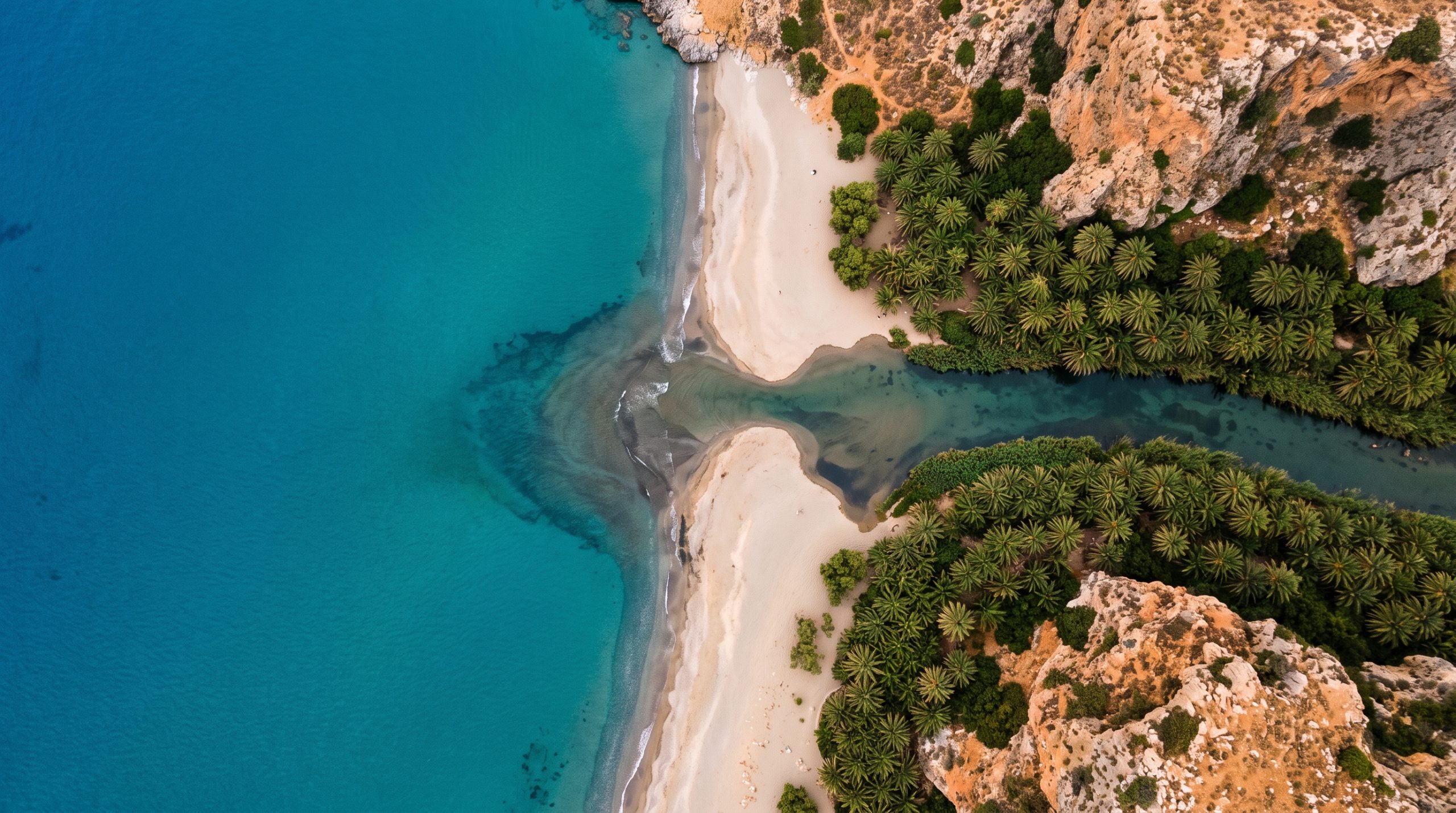
At Preveli the fresh water arrives before the sea does. The Megalos Potamos comes down out of the Kourtaliotiko gorge, runs its last stretch under a forest of rare Cretan date palms, and crosses the sand in a shallow channel on its way into the Libyan Sea. You can stand with one foot in each. That detail, and not the palms, is why couples write to us about this beach rather than the fifty other beaches on Crete’s south coast.
What the photographs rarely show is the vertical part. The road from the monastery ends at a car park on the clifftop, and the sand is roughly four hundred stone steps below it, on a path with no shade anywhere along it. There is also a second way in that takes about ten minutes on nearly level ground, and most couples planning a ceremony here have never heard of it.
Preveli lies around 35 km south of Rethymno and about 12 km east of Plakias, which makes it a drive rather than a detour. This is how a wedding morning actually behaves down there.
Where the ceremony happens at Preveli
The ceremony happens on the sand at the river mouth or a short way upstream among the palms. A small private ceremony with no furniture and no amplification needs no permit, because the shoreline is public land. The legal signing is separate, arranged in advance with a Greek municipality, and Greece sets no residency requirement for foreign couples.
Four hundred steps, or ten flat minutes
Almost everyone arrives the same way. You follow the road toward Preveli Monastery, take the turning that drops to the large guarded car park on the edge of the cliffs, pay a couple of euros for the day, and start down. The path is stone the whole way, mostly rough steps, and the descent takes twenty to thirty minutes at a walking pace. Coming back up takes longer, and the whole path sits in open sun.
In wedding clothes that route works in one direction far better than the other. Going down, a hem collects grit and finds every loose stone, so we plan the descent in trainers with the dress carried and shoes in a bag. Coming back up in the heat of a Cretan afternoon, in a dress, is the part nobody plans for. We either schedule the exit for after the sun has come off the path, or we bring you out through the next bay entirely.
That next bay is Drimiskiano Ammoudi, where a couple of tavernas sit above the water and parking is free. From there it is about ten mostly level minutes over a low rocky headland into the Preveli bay. It costs you the view from the stairway, which is the view everyone comes for, and it gives you back a lot of energy for the hour that matters. On many of our Preveli days we use both: down the steps in the morning for the wide frames from height, out through Ammoudi at the end.
| Route in | Parking | To the sand | Underfoot |
|---|---|---|---|
| Clifftop car park below the monastery | Paid, a couple of euros per day | 20 to 30 minutes down, longer back up | About 400 rough stone steps, no shade |
| Drimiskiano Ammoudi, the neighbouring bay | Free, beside the tavernas | About 10 minutes | Low rocky headland, close to level |
| Excursion boat from Plakias, calling at Damnoni | Leave the car in Plakias | Off the boat onto the beach | Nothing, if the sea is calm enough to land |
A seasonal bus runs down as far as the clifftop car park, which is useful for guests who would rather not drive the gorge road, though it does not solve the steps for anyone. If you are staying in Plakias, budget twenty-five minutes of driving; from Rethymno the road through the Kourtaliotiko gorge is beautiful, slow and worth allowing an hour for.
The bay is in shade until mid-morning
This is the part most planning pages get wrong, and it is worth understanding before you fix an hour. The river mouth opens due south, and the walls on either side of it are high. At sunrise, the first light of the day lands on the cliff face across the water from the stairway and works its way down; the sand, the channel and the palms upstream stay in shade for a good while after the sun is technically up. An early start at Preveli buys you an empty beach in flat, cool, blue light.
By the middle of the morning the whole bowl is lit. Through the hours either side of noon the light is hard and close to vertical, which is unflattering on faces and beautiful on water, and it is also exactly when the boats land. Late in the day the sequence reverses. The sun drops behind the headland to the west and the beach loses direct light well before the published sunset, while the cliff top and the upper part of the stairway hold warm light for a while longer.
So the honest windows for vows at the mouth are the second half of the morning and the middle of the afternoon, and the last golden half hour of the day belongs to the clifftop, not the sand. That is not a compromise, it is a route: vows below, then the climb, then the final frames from the rim with the whole delta in shadow underneath you.
The gap between the first boat and the last
Preveli has been busy since the 1960s and it is not a place where you will be alone at eleven in the morning in July. Excursion boats run from the jetty at Plakias, calling at Damnoni on the way, from early in the spring right through the season, and the first of them puts people on the beach in the second half of the morning. Private boats add to that all day. Even in low season, in November, there are people on the sand.
Two things genuinely help. The first is timing: arriving before the boats gives you an hour or two with the beach nearly to yourself, which is why our Preveli mornings tend to start in the dark at the top of the steps. The second is geography. Almost every visitor stays within a hundred metres of the canteen and the lagoon, so a ten minute walk upstream into the palms puts you somewhere that feels private even at midday. May and June, then September and October, are the months when the whole equation gets easier.
The river changes; the sea barely does
There is no tide table to build a Preveli day around. The Mediterranean moves a few centimetres and the sea level is effectively fixed, so the variable here is fresh water, not salt. In spring the outflow is wide and the crossing to the palm forest can be a proper wade; by late summer it narrows to something you step over. After rain upstream in the gorge, the crossing is the first thing we scout on the morning, because it decides whether the ceremony sits on the near bank or the far one.
Wind is the other mover. When the summer northerly is up it comes over the mountains and funnels down the gorge in gusts, which does nothing to the sea in front of you but a great deal to a veil and to recorded sound. A southerly swell is the reverse problem: the water at the mouth gets lively and boat landings stop being reliable, at which point the plan quietly becomes the car park and the steps.
Real alternatives sit close by, which is the reason we like this corner of Crete. Drimiskiano Ammoudi is ten minutes on foot. Damnoni is a short drive west. The old arched bridge the Preveli monks built over the Megalopotamos, on the road from Plakias, is five minutes off the route and gives you deep shade, running water and no steps at all, which has saved more than one hot afternoon. Our destination guides cover how these places link into a single day.
Who to ask: shoreline, monastery ground, airspace
The shoreline is public. A ceremony for two people, or for two people and a handful of guests, with nothing built, nothing amplified and nothing left behind, does not need anyone’s permission at Preveli. That is genuinely the answer, and it is worth stating plainly because most pages hedge it. The delta and the palm forest are protected ground, so fires and camping are out, and the small parking fee at the top exists to look after exactly that.
The legal marriage is a municipal matter rather than a national one. Preveli sits in the Municipality of Agios Vasileios, within the Rethymno regional unit, and the licence comes from a Greek municipality once your documents have been lodged, apostilled and translated ahead of time. The signing itself takes place in an approved municipal setting, not on the sand, so most couples treat it as a separate errand on a different day and keep the beach for the ceremony that matters to them. We map that sequence out for you, and our notes on how an elopement fits together cover the order of operations.
Above the bay, the monastery keeps its own hours and its own rules. The rear monastery, sixteenth century and dedicated to Saint John the Theologian, closes for part of the day in summer, so anything involving that ground gets asked about rather than assumed. Aerials run on registered operator status, on Greek civil aviation rules for a protected area, and on a time window we agree before the film depends on them. The permit fees themselves are yours to pay; the research, the asking and the paperwork trail are ours.
Two cameras at a narrow river mouth
Preveli photographs better than it films, unless you plan for it. The strand is narrow, the lagoon sits immediately behind it, and there is less standing room at the mouth than the aerial shots suggest. When a photographer and a filmmaker work here together, they split the space by lens: the filmmaker holds back along the water’s edge on a long lens while the photographer stays close in, then they swap ends of the beach rather than crossing each other’s frames. The wind down the gorge is the reason we mic vows on our Expedition days wherever conditions allow, because unprotected audio at a river mouth is mostly air. Working as one team, from one plan, is the difference between that choreography happening and two strangers negotiating it on the sand.
You can see how Cretan light and water actually resolve in our published galleries and films, including the hard midday water and the softer upstream shade. Preveli runs as a single full day either way, with one dedicated photographer or filmmaker in The Adventure from $4,900, or a photographer and filmmaker together in The Expedition from $7,900, and team travel to Crete is included in both, with the rest set out on our pricing page.
Common questions
Is there anywhere to change out of hiking shoes at Preveli?
No. There is a simple canteen selling drinks and snacks at one end of the beach and nothing else, no showers and no changing rooms. In practice couples change at their accommodation in Plakias, or at the car above the cliff, or in a room at one of the tavernas at Drimiskiano Ammoudi ten minutes along the coast. We build the timeline around wherever that happens.
Do we have to walk down the steps, or can we arrive by boat?
Excursion boats run from Plakias through the season and put you straight onto the sand, which is the gentlest arrival there is. They depend on the state of the sea, so we always hold the clifftop car park and the ten minute walk from Drimiskiano Ammoudi as the backup, and we confirm which one we are using the day before.
Can we cross the river to the palm forest in a dress?
Usually, barefoot, with the dress lifted. In spring, and after rain in the gorge, the channel is wider and deeper and we scout it before you come down the steps. By September it is often a single step across wet sand. If the crossing looks like work, the near bank has palms too.
Is Preveli quiet enough for a ceremony in October?
Yes, more than in high summer. The boats still run and there are still visitors, but October mornings on that beach are a different experience from July ones, the sea is still warm from the summer, and the light stays lower for longer through the middle of the day.
Do we need a permit for a ceremony on Preveli beach?
Not for a private ceremony with nothing built or amplified, since the beach is public. Permission questions here attach to other things: drone flying over a protected area, monastery ground above the bay, and any setup involving structures. We research all of it and tell you exactly which fees, if any, land on you.
Picking your hour at Preveli
Preveli suits couples who like the idea of earning the place a little, who do not mind a stone staircase and a river crossing before the vows, and who would rather have an hour of near solitude at seven in the morning than a convenient car park. If that is not the morning you want, tell us. There is a gentler version of this day that comes in through Ammoudi, sits in the shade by the old monks’ bridge and puts the wide gorge frames at the end instead of the beginning, and there are months when the whole thing is easier.
Tell us the date and the shape of the day you are picturing, and we will come back in writing with a plan for that specific hour of that specific week. The planning stays in writing from the first message onward, at whatever hour suits you. Dates are currently open across our 2027, 2028 and 2029 Crete seasons, we send highlights within five days and the full gallery or film within three weeks, and planning starts once the contract is signed and the thirty percent retainer is paid. Start Your Story.