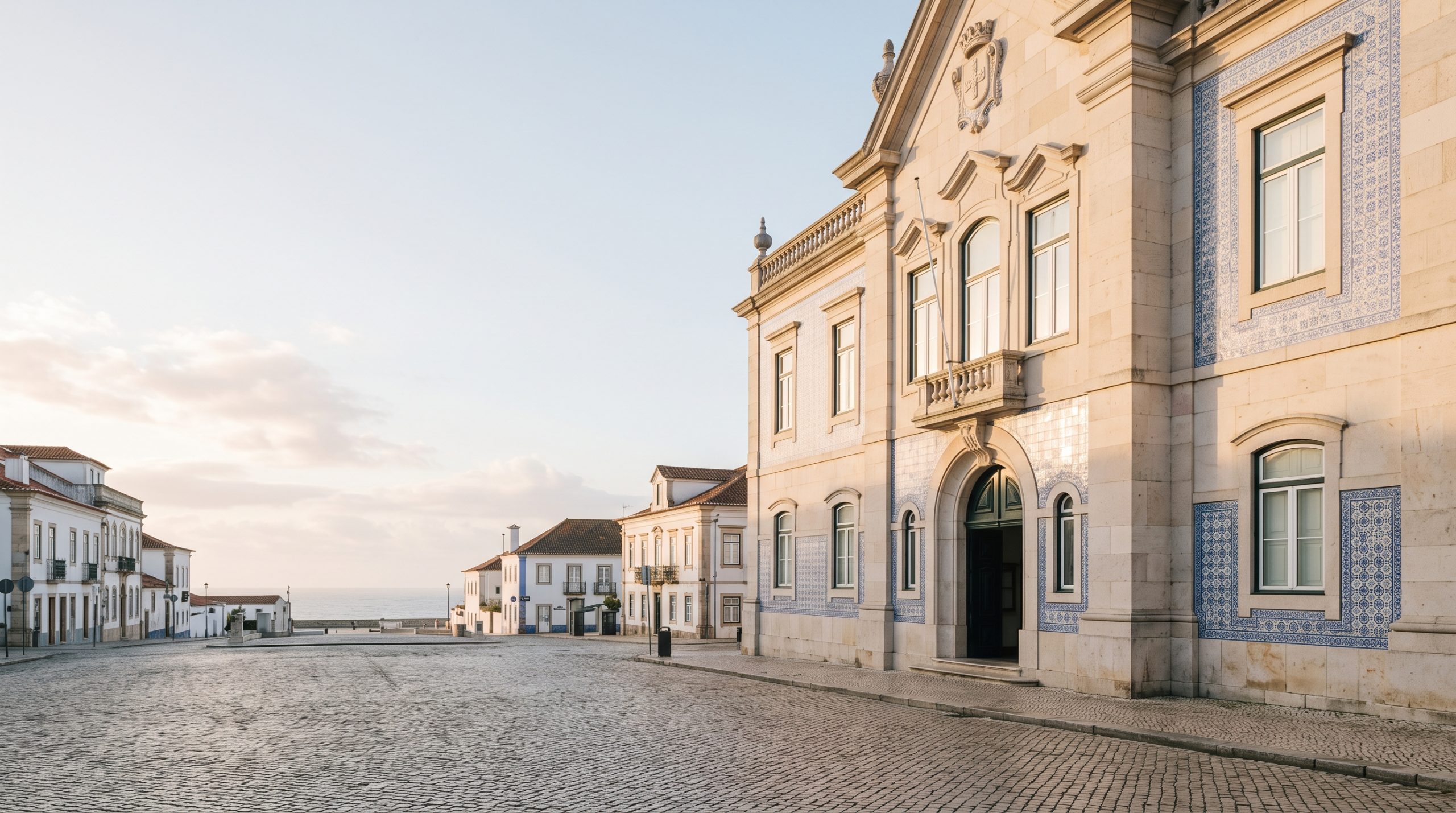
The fee table published by Portugal’s Instituto dos Registos e Notariado prices a civil marriage at 120 euros. Hold that same ceremony somewhere other than the registry office, or outside working hours, or on a Saturday, Sunday or public holiday, and it becomes 200 euros, with the registrar’s transport arranged by you. Two numbers, published, no negotiation.
Everything else is paper. The right documents, in the right order, in the right language, inside a window that is almost always six months long. That window is the part American couples underestimate, because it runs from the day a document is issued, not the day you hand it across a counter in Lagos or Ponta Delgada.
What follows is the chain as it actually plays out: what needs an apostille, who is allowed to certify a translation into Portuguese, how far back to count from your date, and the second route that a lot of couples end up preferring once someone describes it without condescension.
What the six-month clock actually covers
Foreign couples can marry in Portugal with no residency requirement and no waiting period spent in the country. Vital records generally need to have been issued within the previous six months, apostilled and translated into Portuguese, then filed at a Conservatória do Registo Civil. Once the registrar approves the file, you have six months to hold the ceremony.
Where Portuguese paperwork takes the most patience
Portugal is one of the more workable countries in Europe for a foreign couple who want the legal marriage to happen on the trip. Nobody has to move there. Nobody has to sit out a waiting period in a rented apartment. Same-sex marriage has been legal since June 2010, and the file a same-sex couple assembles is the same file as anyone else’s.
The difficulty is administrative rather than legal. Three offices in two countries have to hand paper to each other in the correct sequence, and two of them work at their own pace regardless of your flights. It is fiddly, heavily front-loaded, and entirely manageable with nine months of runway. Couples who start six weeks out are the ones who end up marrying at home and flying here anyway, which is a fine outcome but a better decision made deliberately.
Treat this as a planning map, not a legal opinion. The office issuing the documents remains the source of truth for your case.
The Portuguese document chain from home to conservatória
Collect these in sequence. Each step depends on the one above it, and the most common delay in the whole process is someone paying for a translation before the apostille exists.
- Passports. Valid, and that is the whole requirement. No apostille, no translation, no certified copy.
- Long-form birth certificates, issued within the previous six months. Not the wallet-sized abstract. The full version naming both parents, ordered as a certified copy from the vital records office of the state that issued it. The six-month clock starts on the issue date printed on that copy.
- An apostille on each birth certificate. A US birth certificate is a state document, so the apostille comes from the Secretary of State of the state that issued it. Not from Washington, and not from the embassy in Lisbon, which states plainly that it cannot certify state-issued documents. Processing runs from same-week to several weeks depending on the state, and this is the single step most worth starting early.
- Proof that you are free to marry. Portugal asks foreign nationals for a certificado de capacidade matrimonial, a certificate of no impediment. The United States has no office that issues one, and the US Embassy in Lisbon says so directly on its own marriage page. What it offers instead is a statement of eligibility to marry, executed in front of a consular officer at the embassy and presented to the registry office. The notarial fee is 50 dollars, or the euro equivalent, for each notarization, which means two of them for the two of you. If your own country does issue a capacity certificate, it joins the file with its own apostille and its own six-month window.
- Paperwork ending any earlier marriage. If either of you has been married before, the document that closed that marriage goes into the file, apostilled and translated on exactly the same terms as the birth certificate.
- Portuguese translations, produced after the apostilles are attached. An apostille is a certificate stapled to your document, and it is text on a page like everything else, so it forms part of what gets translated. Translate first and you will pay twice.
- An antenuptial convention, only if you want one. Portugal’s default property regime is comunhão de adquiridos, community of property acquired after the marriage. Choosing a different regime, such as separation of property, means an antenuptial convention drawn up before the ceremony, and it becomes part of the file rather than an afterthought.
- Names and identification details for your witnesses. The registry office wants these in advance rather than on the morning.
On who is allowed to translate: Portugal does not maintain a national roster of sworn translators the way France or Spain does. What the conservatória wants is a Portuguese translation whose accuracy has been attested by someone with certifying power, which in practice means a Portuguese notary, lawyer or solicitador, and many Portuguese consulates abroad certify translations too. Guidance published for consular files treats documents in Portuguese, Spanish, French or English as acceptable, but the conservatória holding your file is the office that decides what it will take, and a certified Portuguese translation is the version no office refuses.
Turn the ceremony date into a six-month document plan
Work from the date, never from today. The table below is the shape we build planning around, and it assumes a couple starting from scratch in the United States.
| Time before the ceremony | What is happening |
|---|---|
| 9 to 12 months | Date held with us. You confirm the current requirement list with the specific conservatória that will hold your file. |
| 5 to 6 months | Certified copies of birth certificates ordered. Apostille requests filed with the issuing states. |
| 4 months | Apostilles in hand. Portuguese translation arranged and certified. |
| 3 months | File opened at the conservatória, in person or through a representative holding a power of attorney with special powers. |
| 2 months | Favourable decision issued. The six-month window in which the marriage must take place starts here. |
| 4 to 6 weeks | Ceremony hour agreed with the office. Registrar’s transport arranged if the ceremony is off-site. |
| The week itself | Witness identification lodged. Timeline locked to sunrise, sunset and real driving times. |
The real minimum is shorter than that. A file that lands complete is commonly decided in around a month, so a couple who already hold apostilled and translated documents can be looking at six to eight weeks from filing to ceremony. The comfortable minimum is six months. The one we work to is nine to twelve, and that is rarely about the paperwork. It is about the date itself, because a Saturday in late May in the Algarve is spoken for long before the apostille is.
Note where the two six-month windows sit relative to each other. Documents must be recent when the file opens, and the marriage must happen within six months of approval. Ordering your birth certificate eleven months out is the one piece of diligence that backfires, because the copy will have gone stale before a registrar reads it.
Six details that keep the file moving
None of these are difficult. All of them cost a fortnight if you find out about them late.
The clock runs from issue, not from filing
Every validity window in this process is measured from the date printed on the document. A birth certificate ordered in January and filed in August is a document nobody will accept, no matter how correct it is. We build the ordering month into the planning timeline for exactly this reason.
Apostille first, translation second
The apostille is part of the document once it is attached, so it gets translated with everything else. Couples who translate in the United States before apostilling generally pay for the work twice, and the second one has to happen in Portugal anyway.
The online route is not open to Americans
Portugal runs a civil registry service online, and it is genuinely good, but the IRN restricts the online marriage process to Portuguese citizens and to Brazilian citizens holding equal-rights status, in both cases with an active cartão de cidadão. For everyone else the file is opened in person at a conservatória, or by a representative acting under a power of attorney with special powers. That power of attorney, if you sign it at home, is a foreign public document like any other and travels the same apostille and translation road.
Off-site means you move the registrar
The 200 euro tier in the national fee table covers a marriage held outside the conservatória, or inside it but outside working hours, on a Saturday, Sunday or public holiday, with transport for the officiant arranged by the couple. That last clause is a planning item, not a footnote. If your quinta is forty minutes up a dirt track from the nearest town, somebody has to drive an official there and back, and the office will want to know who and in what.
The ceremony is conducted in Portuguese
A civil marriage in Portugal is performed in Portuguese. Where neither of you speaks it, expect the office to want an interpreter present, and expect the legal part to be brisk and procedural rather than the emotional centre of your morning. Registrars typically work with two witnesses, and up to four may sign, all adults with valid photo identification.
The registrar’s hour is not the light’s hour
Office slots cluster in the middle of the working day, which in the Algarve in July is the flattest, hardest light there is. We treat the legal hour and the photographic hour as two separate entries in the timeline, and we say so early, because couples who assume the registrar will come at 6am are planning around a hope rather than a calendar.
Use the quoted fees and timings as planning guidance, then confirm the live figures with the issuing authority before submitting anything.
Marrying at home first, then eloping here properly
A large share of the couples we film in Portugal sign the legal paperwork at a courthouse at home, usually on a weekday morning with two friends and no fuss, and then hold the actual ceremony on a clifftop in the western Algarve or on a terrace above the Douro. This is not the consolation version. For a lot of people it is the better one, and it is worth understanding exactly what it changes.
What disappears: the six-month document chain, the apostilles, the certified translations, the conservatória’s calendar, the interpreter, the transport arrangements for an official, and the requirement that your vows happen in a language you do not speak. What arrives in its place is total control of the hour. You can stand on the boardwalk at Praia da Marinha at 6:40am in June with nobody else on it, or say your vows at the last light on a Sintra ridge in October, because the only people who need to be there are you, us and whoever is leading the ceremony.
What does not change at all is the day. The vows are the vows. A celebrant or a close friend can lead them, the reading you chose still happens, and the film and the gallery are identical in every respect to the ones we deliver for a legally binding ceremony. Our published elopement galleries and films are the clearest way to see that for yourself, because you cannot tell from the finished work which couples signed in Portugal and which signed at home three weeks earlier.
Our destination guides go into where the light lands in each region and when the coach traffic arrives, which matters far more to how the morning feels than which country stamped the certificate. If you are earlier in the process and still deciding on the shape of the day, the planning fundamentals are the place to start.
Tell us the date you are circling and the country you would rather sign in, and we will tell you honestly what each version does to your morning. Send Us a Message.
What we coordinate around the registry process
We handle destination and location design, the planning, the custom timeline built around light and real travel time, permit research and logistics guidance, and the weather alternatives that mean a wind shift at 5am changes the route rather than the day. Where a legal ceremony is part of it, we hold the date against the office’s availability and coordinate the ceremony hour with sunrise or sunset so the two do not compete. We are not lawyers, and we do not file your paperwork.
Coverage is one team rather than a photographer and a separately hired videographer who are introduced to each other on the morning. On the Expedition a dedicated photographer and a dedicated filmmaker work the same day together, which matters most at a signing: it happens once, it takes about ninety seconds, and one of us can hold the wide frame of the table and the landscape behind it while the other stays close on hands and faces. Full detail sits on our experiences and pricing page.
What stays with you: the documents themselves, government and venue permit fees, the celebrant, accommodation, and any unusual transport such as a boat along the Benagil coast or a 4×4 up into the Serra. Team travel is ours, in every destination, with no long-haul surcharge.
Common questions
Do we have to live in Portugal to get married there?
No. Portugal sets no residency requirement and no waiting period spent in the country for foreign couples, which is one of the main reasons it beats several of its neighbours for a destination elopement. You assemble the file, the conservatória approves it, and you can fly in days before the ceremony.
Can we start the Portuguese marriage process online from the United States?
Not as US citizens. The IRN limits the online marriage process to Portuguese citizens and to Brazilian citizens with equal-rights status, both holding an active cartão de cidadão. Everyone else opens the file in person at a conservatória or through a representative holding a power of attorney with special powers.
Does the US Embassy in Lisbon issue a certificate of no impediment?
It does not, because no US authority issues that document. The embassy instead lets you execute a statement of eligibility to marry in front of a consular officer, which you then present to the registry office. The notarial fee is 50 dollars or the euro equivalent for each notarization, so budget for two.
How much does a civil marriage cost at a Portuguese registry office?
The national fee table sets 120 euros for the marriage process and registration. A non-urgent marriage held outside the conservatória, or inside it but outside working hours or on a Saturday, Sunday or public holiday, with transport arranged by you, is 200 euros. Translations, apostilles and certified copies are separate and paid where they are produced.
Can we be legally married outdoors, on a clifftop or a beach?
The fee table explicitly prices a marriage celebrated away from the registry office, so the route exists and is used. Whether a particular conservatória can staff your date and hour, and whether the site itself permits a ceremony, are two separate questions and both are worth settling before anything else is booked.
Do we need witnesses if it is only the two of us?
Plan for two, with valid photo identification, and give the office their details ahead of the date. Up to four may sign. This is the single logistical item that catches genuinely solo elopements, and it is one of the first things we raise when a legal ceremony in Portugal is on the table.
Can same-sex couples marry in Portugal?
Yes. Same-sex marriage has been legal in Portugal since June 2010, and the process, the document list, the fees and the six-month windows are identical. Foreign same-sex marriages are recognised in Portugal as well.
Is a Portuguese marriage recognised back home in the United States?
A marriage validly performed under Portuguese law is generally recognised in the US, and there is no federal register to file it in. After registration the Portuguese civil registry issues a marriage certificate free of charge, and further copies can be requested at any time. If an institution at home wants it authenticated, it can be apostilled in Portugal.
Picking the date and the hour around it
Light is the reason to care about which month you choose. In the Algarve in late June the sun is up before 6:30am and still working after 9pm, which gives you two usable ceremony hours a long way apart. In December the light is gone before 5:30pm, the cliffs are empty, and the whole day compresses into something quieter and, some years, better. Both are good. They are not the same day.
We are booking 2027, 2028 and 2029, and everything between us happens in writing. Send the inquiry form, we reply with an initial brochure within 24 hours, and a tailored proposal follows. Tell us the date, the region and whether you want the signing to happen in Portugal or at home before you fly. Start Your Story.