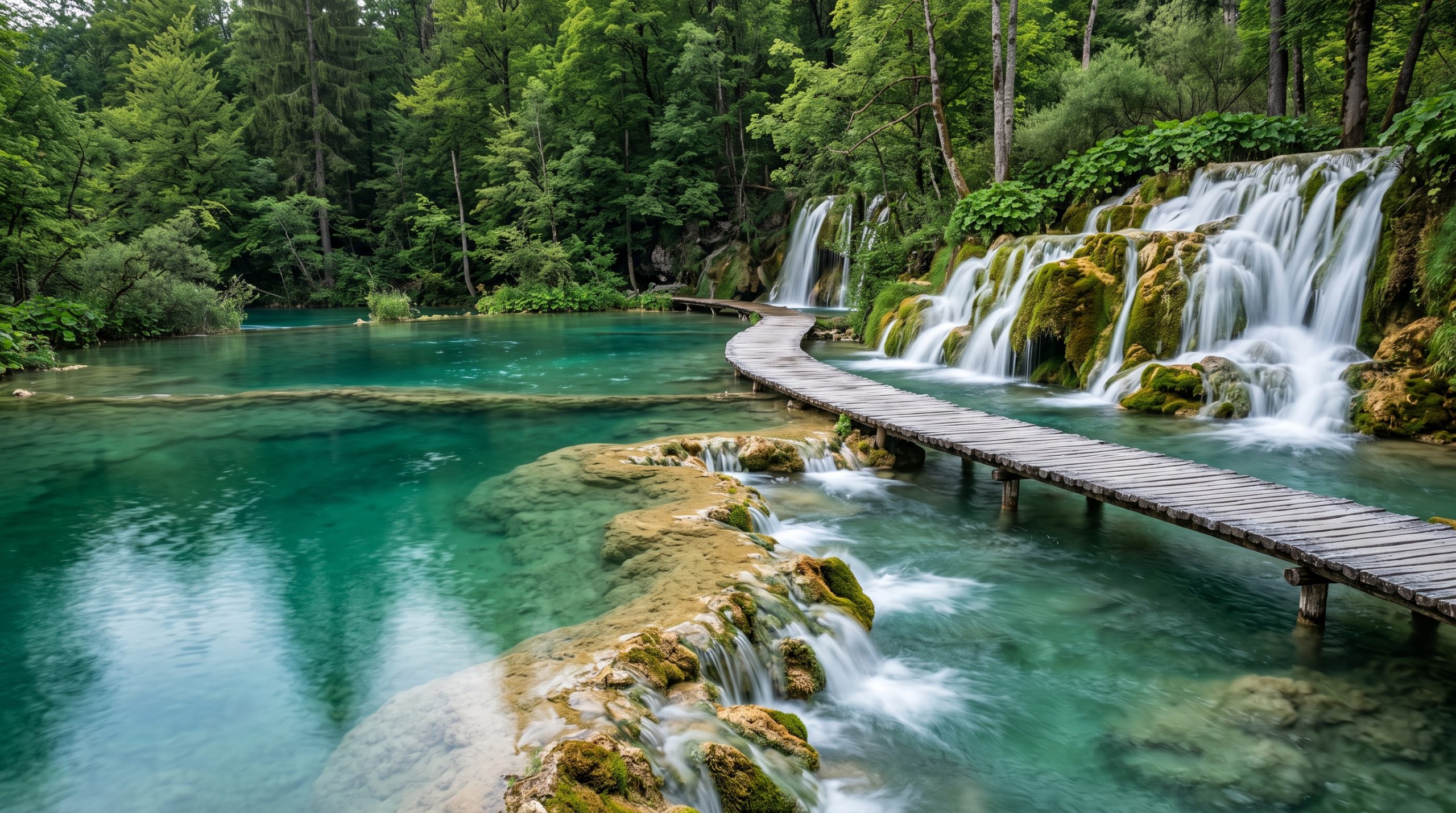
There is someone at a Croatian civil ceremony that almost nobody plans for, and it is not the registrar. If neither of you speaks Croatian, the U.S. Embassy in Croatia is direct about it: you will need a court-appointed translator present for the marriage itself. Couples find that out late, usually after the flights are booked and the boardwalk is chosen.
That is the shape of this whole subject. The two most photographed parks in Croatia are not the difficult part. Plitvice runs a published wedding service with its own inbox. Krka runs a transport timetable that decides, more than anything else, what hour your ceremony can happen. Neither park marries you. A registrar does that, in the district where you are standing, and the file that lets them has to be complete 30 days out.
So this page separates the two questions. What each park permits, in its own published words, and what the Croatian paperwork actually asks of two Americans who want to stand above a waterfall and mean something out loud.
Two parks, one registrar
Both parks are locations, not legal authorities. A marriage in Croatia is concluded before a registrar, and the Croatian Ministry of Foreign Affairs asks couples to contact the local registry office at least three months ahead and to file documents 30 days before the date. Plitvice publishes a wedding service. Krka publishes visiting rules.
The ceremony idea is simple; park permissions are the complicated part
Getting permission to stand somewhere in these two parks is the straightforward half. The documents that make the marriage legal are where the hours go, and almost all of that work happens in your own country, months before you fly.
Croatia’s foreign ministry asks couples to contact the registry office in the district where the marriage will take place at least three months before the date they want, and to have the full file submitted to that office 30 days before the wedding. Every foreign document has to be an original or a certified copy carrying an Apostille, and every one of them has to be translated into Croatian by an official court interpreter. The U.S. Embassy in Croatia adds the detail that catches people out: your birth certificate must be a new copy issued within the past 90 days, bearing the Apostille of the competent authority of the state that issued it.
So the honest rating is fiddly. Not difficult, not gatekept, not closed to visiting couples. Fiddly in the sense that four or five documents each have a clock running on them and the clocks do not all start on the same day. Couples who begin the ordering sequence around four months out tend to find the whole thing anticlimactic. Couples who begin at six weeks find it loud. The general rhythm of planning an elopement abroad applies here with one extra layer of stamps on top.
This guide is practical planning help, not legal advice. Confirm the final requirements with the registry office or your consulate before booking travel.
One park has a wedding inbox, the other has a timetable
These two answer the same question in completely different registers. One of them will talk to you about your wedding. The other will talk to you about April.
Plitvice: twenty days for a crew, one week for a reserved spot
The park’s own weddings page offers photography and video recording at its most attractive locations, with mandatory prior notice and a reservation at least one week before the planned arrival. It also offers rooms at Hotel Jezero, Hotel Plitvice, Hotel Grabovac and Hotel Bellevue, formal wedding dinners and receptions inside the park’s own hospitality buildings, an organised guided tour of the park, and one-to-one advice while you plan. Inquiries go to a dedicated address, vjencanje@np-plitvicka-jezera.hr.
That is the visitor-facing side. There is a second document that matters more to a working team: the protocol for taking photographs and filming in the park for commercial purposes. Requests go in at least 20 days before the first planned day, and they name every person on the crew with a passport number, the date and time of arrival, and the make and plate of any vehicle being taken into the park. Under Article 36 of the park’s protection and preservation policy, published in Official Gazette 80/21, filming is permitted on the condition that the original state of the place is not put at risk and no natural process is interfered with. Crews move through the park accompanied by a ranger and stay inside the marked pedestrian trails.
Two things follow from that. Remotely controlled aircraft for filming from the air are banned at Plitvice, so there is no aerial sequence in a Plitvice film and we design the day around that from the first sketch rather than discovering it on site. And because the trail edge is the boundary of where anyone may stand, the frames that work here are built with a long lens down the length of a boardwalk, or wide from a viewpoint the trail already hands you. That constraint is visible in the finished work, and you can watch how it reads in our published stories and films.
Guests can relax. Private individuals photographing for their own personal use need no permit at all.
Winter redraws the map. The Lower Lakes usually stay open through the cold months while the Upper Lakes close, and the Upper Lakes typically reopen in early April once conditions allow. A February ceremony at Plitvice is a Lower Lakes ceremony, and it is a good one, but it is not the route in the photographs taken in June.
There is precedent here, older than most couples expect. From 1968 to 1990 the park staged what it called the Plitvice Wedding: twenty events, 177 couples in total, most of them arriving from the Netherlands and Germany. The ceremony was held under Veliki slap, followed by a walk along the Lower Lakes, a boat ride on Kozjak and a tree planted in the Village of the Newly-weds on Medveđak. The programme finished decades ago. The instinct behind it is why the park still keeps a wedding address at all.
Krka: the boat season decides your ceremony window
Krka publishes no equivalent wedding page. What it publishes is a calendar, and at Krka the calendar shapes the day more than any other single factor.
| How you move around Krka | Available |
|---|---|
| Boat transport Skradin to Skradinski buk and back | 1 April to 31 October |
| Bus transport Lozovac to Skradinski buk and back | 1 April to 31 October |
| Visit to the island of Visovac | 1 April to 31 October |
| Visit to the Oziđana pećina cave | 1 April to 31 October |
| Bus transfer Laškovica to Roški slap and Bogatići | 1 June to 30 September |
Outside those dates Skradinski buk is still there, but the boat up from Skradin and the bus down from Lozovac are not running, and how you and anyone with you physically reach the falls becomes a different problem. It is a planning question rather than an obstacle. It is also the first thing we check the moment a couple names a date at Krka.
Tickets are seasonal in the same way. At current rates a full adult entrance ticket in the peak months runs €40, and in June, July, August and September the same ticket bought after 15:00 is reduced by a quarter, to €30. Groups sit in their own category: 20 people is the minimum that counts as a group, and the park requires written notice at least 24 hours before arrival, without which the group rate and the reservation do not stand. Keeping a vessel on Visovac Lake, or navigating it, needs authorisation from the Public Institute of Krka National Park.
Now the part a brochure will not tell you. Skradinski buk at midday in July is not the place in the pictures you have been saving. It is a wide, warm, generous set of boardwalks with a great many people on them, and the water noise competes with everything. The same boardwalks at eight in the morning in late September are quiet enough to hear the falls properly. At Krka the hour beats the month, every time.
Individual localities close for conservation work from time to time, so we confirm the exact spot is open and reachable before we build a timeline on top of it.
Build the park-permission file in this order
Order matters, because two of these have expiry dates and one of them cannot begin until the one before it has come back.
- Passports. Valid, and the names on them are the names that go on everything else. A U.S. citizen entering Croatia to marry and staying under 90 days needs no special visa for the trip.
- Birth certificates, both of you. Clock running. The U.S. Embassy in Croatia states the copy must be newly issued within the past 90 days. Croatia’s foreign ministry asks for an original no older than three months that names both parents. Order these late rather than early.
- Apostille on each birth certificate. From the competent authority of the state that issued it. The Apostille is physically attached and travels with the document from here on.
- Certificate of no impediment. Clock running. Original, verified with an Apostille, and no older than three months.
- Paperwork closing any previous marriage, if that applies to either of you. A divorce decree, apostilled the same way, together with the previous marriage certificate.
- Sworn translation of the whole file into Croatian. Not a translation by a fluent friend. An official court interpreter, either from the list the U.S. Embassy publishes or a certified court interpreter in Croatia once you land.
- Submission to the registry office, 30 days ahead. The office that governs is the one covering the district where the ceremony takes place, not the one nearest your hotel.
- A court-appointed translator for the ceremony itself, if neither of you speaks Croatian. This is the step couples discover last and the one that needs a name against it in the timeline.
None of those items is unusual on its own. The sequence is what people underestimate, and the sequence is the reason we ask for your date before we ask for anything else.
Work back from the ceremony slot
Two numbers govern everything: the file lands 30 days before the wedding, and the birth certificate has to be fresh when it does. Everything else is arranged to make those two true at the same time.
| Counting back | What has to be true |
|---|---|
| Six months | First contact with the registry office for the district, and with the park. This is where we like to start. |
| Three months | Croatia’s foreign ministry asks that contact with the registry office has happened by now at the latest. |
| Around 100 days | Order fresh birth certificates. Nothing issued more than 90 days before will serve. |
| Two months | Apostilles attached, sworn translations completed, certificate of no impediment in hand. |
| 30 days | Full file submitted to the registry office. This one does not move. |
| 20 days | Latest date for a commercial photography or filming request at Plitvice. |
| 7 days | Latest date to reserve a photography and video location under the Plitvice wedding service. |
| 24 hours | Written notice to Krka if 20 or more of you are arriving as a group. |
The real minimum, then, is short. If your certificates are ordered cleanly and the apostilles come back quickly, the chain can be run inside four months, and Croatia’s own guidance is built for three months of lead time.
The comfortable minimum is different, and it is the one we work to. Six to nine months, because two calendars have to agree with each other and neither is yours: the registrar’s availability for the date and hour you want, and the park’s own season. Fees and processing windows can move. Treat the figures here as a planning snapshot and reconfirm them with the issuing office before you file.
Where Plitvice and Krka plans usually snag
Ordering the birth certificate too early. This is the most common one by a distance. It feels responsible to request it a year ahead and file it in the folder with the passports. Then it is eleven months old at submission and the whole document has to be ordered again, apostilled again and translated again. Order it around the 100-day mark and it stays inside the 90-day window all the way to the registry office counter.
Assuming any translator will do. The requirement is an official court interpreter, and the U.S. Embassy in Croatia publishes a list. A translation by a bilingual relative, however good, is not the document Croatia is asking for.
Forgetting that the Apostille gets translated too. The stamp is part of the document once it is attached, so the interpreter handles the original and the Apostille as one packet. Budget the interpreter’s time accordingly.
Trying to file online. Croatia’s e-Citizens system carries an e-registration service for marriage, and it is built for adult Croatian citizens marrying in official premises. Foreign couples go to the office in person, in the district where the ceremony will happen.
Not asking about the outside-premises fee. A civil marriage can be performed in the registry office’s official premises or outside them, and marrying outside carries a separate fee charged against published criteria. It is a real line in your budget and the office will quote it. Ask early rather than on the day you sign.
Expecting a church to do the legal work by itself. A religious ceremony carries civil effect only if that religious community holds a contract with the Government of Croatia, and you still see the registrar to prepare the marriage legally either way.
Planning a drone shot over Plitvice. Remotely controlled aircraft for filming from the air are banned in the park. If the aerial matters to your film more than the specific waterfall does, tell us early and we will look at where in Croatia it is permitted and build the film there instead.
Booking a March date for the Upper Lakes. They usually reopen in early April, weather depending. A March elopement at Plitvice is a beautiful Lower Lakes day, and it is worth going in knowing that rather than finding out at Entrance 1.
If any of that has made you want a second opinion on a date you are holding, send it over and we will walk it back through this calendar with you. Check Your Date.
Two clean routes, and who carries which piece
Route one is the full Croatian marriage. Registrar, file at 30 days, apostilles, sworn translations, and a court-appointed translator standing with you if neither of you speaks Croatian. It ends with the legal marriage itself happening within sight of the water, which for some couples is the entire point and worth every stamp.
Route two is quieter. You sign at home, in a courthouse or a county office, usually in fifteen minutes with two friends. Then you fly, and the ceremony in the park is the ceremony, with no filing deadline, no interpreter and no registrar’s diary sitting on top of your morning. What changes is the paperwork. Nothing else does. The vows are still the ones you wrote, the hour is still the hour you chose for the light, the walk in is the same walk, and the photographs and the film are identical. A great many of the days we shoot are built exactly this way and none of them feel like a compromise from the inside.
Here is the division of labour. We handle destination and location design, the timeline built around light and genuine travel time, permit research and the logistics that hang off it, weather alternatives, and holding your date against the park’s season and the registrar’s availability at the same time. You handle the government, venue and landowner permit fees themselves, your celebrant, accommodation, and any unusual transport such as a private boat. We are not lawyers and we do not file your paperwork.
The reason we care so much about the ceremony hour is that on the Expedition we are covering it twice. A photographer and a filmmaker who planned the morning together work the same hour together, which means the still frame and the moving frame are not fighting over the same two metres of boardwalk at Skradinski buk. Highlights reach you five days later, the full gallery or film three weeks after that.
Both of our full-day experiences cover a park day of this shape, and what sits inside each of them is set out on our pricing page. Team travel to Croatia is included, in every destination we work, with no long-haul surcharge.
Common questions
Can we legally get married inside Plitvice Lakes National Park?
The park does not marry anyone. A registrar does, and the registry office covering the district decides whether it can hold a civil marriage outside its official premises for your date and hour. The park’s side is a separate permission, handled through its wedding address and, for a working crew, through its filming protocol.
How far in advance do we have to contact the Croatian registry office?
Croatia’s foreign ministry asks for contact at least three months before the date you want, and the complete file has to be submitted to that office 30 days before the wedding. We would rather start at six months, because the registrar’s diary and the park’s season both have to line up.
Does our U.S. birth certificate need an Apostille for a Croatian wedding?
Yes. The U.S. Embassy in Croatia states the birth certificate must bear the Apostille of the competent authority of the issuing state, must be a new copy issued within the past 90 days, and must be translated into Croatian by a sworn court interpreter.
Do we need a translator at the ceremony if we do not speak Croatian?
Yes. According to the U.S. Embassy in Croatia, a court-appointed translator is required for the marriage ceremony itself when you do not speak the language. Book that person into the timeline the same way you book everything else, because they have to be standing there.
Can we fly a drone at Plitvice for our elopement film?
No. Remotely controlled aircraft for filming from the air are banned in Plitvice Lakes National Park. We build a Plitvice film entirely from the ground, which the boardwalks and terraces suit better than people expect, and we will point you somewhere else in Croatia if the aerial is non-negotiable.
When can we reach Skradinski buk by boat from Skradin?
The boat transport between Skradin and Skradinski buk runs from 1 April to 31 October, as does the bus from Lozovac and the visit to the island of Visovac. Outside that window the falls are still open, but how everyone arrives has to be solved differently.
Is a late afternoon ceremony at Krka a good idea?
It can be excellent, and the entrance ticket is reduced by a quarter after 15:00 in June, July, August and September. The trade is light: by mid afternoon in high summer the boardwalks are at their busiest. Eight in the morning in September is the hour we would argue for.
Do we file our documents in the town where we are staying?
No. The registry office that matters is the one covering the district where the ceremony takes place, which for these two parks is unlikely to be the town you have booked a hotel in. We factor the drive between the two into the morning timeline.
Pick the month first, then the hour
Almost everything on this page falls out of the month you choose. Krka’s boat from Skradin runs 1 April to 31 October. Plitvice’s Upper Lakes usually reopen in early April. The registry office wants your file 30 days before whatever date you land on. Choose the month, and the rest of the sequence lays itself out in front of you.
Write to us with the date you keep circling and the park you keep going back to, and we will tell you what the light is doing at that hour, which of the two actually fits the day you are describing, and where the paperwork sits in your calendar. Everything between us happens in writing, so you can read it twice and think about it properly. You will have a reply and our brochure within 24 hours, a tailored proposal after that, and planning begins once the contract is signed and the 30 percent retainer is in. We are booking 2027, 2028 and 2029, and our destination elopement guides are a good place to wander while you decide. Start Your Story.